Showing posts with label wolfgang krauser. Show all posts

Tuesday, August 14, 2018

G, or the evolution of power-hungry characters in fighting games

Another year, another EVO and another few character reveals for some popular fighting games. I’m going to talk a little bit about G, the new character unveiled for Street Fighter V. We’re going to talk about the design roots of the character. If you want the punchline here it is: G is the self proclaimed “President of the World.” His design is rooted in American Imperialism. It’s as simple and as complex as that. Think about it for a moment. The absurd stovepipe hat and filigreed coat and tails hasn’t been en vogue in more than 150 years. G is a juiced up Abraham Lincoln and demanding of more patriotism than Uncle Sam.


G’s motives may be noble but there is a dark undercurrent carrying his inclusion in the series. Any man that forces himself as a leader on the global stage is a narcissist, a despot or a tyrant. G has delusions of grandeur and sadly, the physical properties to make him appear superior to normal people. G is a reflection of several world leaders that we are dealing with right now, especially in the USA. I’ll get to this comparison in a bit. Did you notice that G is covered in golden marks? They look like golden tattoos. In the original design notes these golden patches were shaped after the continents. Without his jacket you would be able to see that each golden patch outlines the nations of the world. The cover his arms, torso and neck. Visually it is an interesting look. There is a lot of contrast with gold, especially over bare skin. Gold has actually been used in cosmetics going back thousands of years. Some makeup artists actually apply gold leaf to to the skin for aesthetic reasons. I don't know if these markings on G are makeup, tattoos or even a skin condition.


Before G was introduced there was a lot of speculation to his design. He has a very unique look, however it is not completely original. Above I mentioned that he already takes cues from Lincoln and Sam, but in the fighting game world there have been others like him. Steven Chavez posted a theory that Du Nguyen and Xavier had circulated on Twitter. Namely that G was actually Greg, a character from Bloody Roar, a game by Hudson Soft released in 1997. Bloody Roar was a unique fighting game. There were masters of various arts in it, this was nothing new to the genre, however these characters also had the ability to transform into animal-like avatars. Audiences have seen werewolves and even werebears in popular culture but Bloody Roar also gave us weretigers, wererabbits and even weregorillas. Plus this game was another title built on 3D technology. Hudson Soft was not know for their fighting game library but they proved that the shift in fighting games from 2D to 3D was more than a fad. The similarities between G and Greg were eerie. Top hat, bodybuilder physique, large beard were all spot on. Plus there was an ape teased in Ed's ending in Street Fighter V. It stood to reason why some in the fighting game community saw this as the alternate form of G.


I've said it before and I'll continue saying it. No character design exists in a vacuum. Influences from pop culture help color each design. It doesn't matter if you're an artist in Japan, the US or anywhere else in the world. Whether consciously or subconsciously the artists creating these new fighters are all putting in their own insight and tastes. This can sometimes include elements seen in other fighting games, action movies, comics or cartoons. Changes in music, movies and even politics helped shift the public perception of fighting game characters. In the earliest days of the genre fighting games featured martial artists. They were easy to create and were universally recognized as being fighters. As the genre took off so too did the types of characters that could be considered fighters. The industry tried different things out and audiences responded accordingly. Robots, aliens, dinosaurs, demons and superheroes were all used to replace the tried and true kung-fu archetypes. G is the latest version of a more contemporary design. His look is rooted in ultra wealthy and ultra powerful villains.


Fatal Fury (1991) introduced the world to Geese Howard, a martial arts master that was also a crime lord that ran the fictional South Town. He was a break in tradition from the boss characters that were simply martial artists. Geese could have been a bad guy in a modern action movie. One which featured drugs, cops and murder instead of fantasy swordplay. Howard wasn't the first villain in a fighting game to be the kingpin type. Belger, from Capcom's Final Fight in 1989 and Mr. X from Sega's Streets of Rage were also mobster-type villains. Geese was unique in that he was in a fighting game and a powerful opponent. SNK pushed the concept of powerful leader even further in Fatal Fury 2 (1992). Wolfgang Krauser von Stronheim, the half-brother of Geese Howard, was the new sponsor of the King of Fighters tournament. SNK wanted Krauser to have the look of a European aristocrat. He was wearing a cape and sporting golden armor in his character intro. He did not have the same moves or techniques of Howard but he was still a powerful opponent. It was not the first or last time the aristocratic design would be featured in their extended universe.


King Leo, the main villain in SNK's Savage Reign (1995), also sported royal colors and golden armor. With his ornate mask and elaborate headdress he pushed the idea of eccentric villain even further. A somewhat subdued doppleganger named King Lion also appeared in the same game. Within two years SNK had established that rich, powerful, and corrupt men were the new boss templates. Sagat from the original Street Fighter (1987) was still an icon but he represented the first generation of villain. Someone with a limited role outside of fighting. Vega / the Dictator from Street Fighter II (1991) would become more influential to the story and boss designs for the universe. Vega, like Geese Howard, was not a traditional martial artist. Because of that he could be placed in much more interesting locations and force the playable characters to appear out of their element.


Without a doubt the biggest shift in villain designs happened in 1994 with the introduction of Rugal Bernstein. The newest benefactor of the King of Fighter's tournament was a groundbreaking opponent. SNK learned from all the design notes that went into Geese and Wolfgang and created a hybrid of the two. He had the size and power of Krauser, with the balanced techniques of Howard. Plus he was a very sharp dressed man. He didn't wear armor or any other martial arts costume but instead wore black and red tailored suits. Nobody looked half as fresh as Rugal when he debuted. SNK wanted him to stand out and they succeeded. Despite being a new to the universe audiences instantly gravitated towards his design. Nobody else in the genre looked or fought like him. His wide arcing kicks and powerful punches could take down the strongest opponents. SNK demonstrated in the game that Rugal could easily take on a team of three fighters, even if that group included Terry and Andy Bogard and Joe Higashi, the stars of the original Fatal Fury. To help frame how much influence this new boss had had the studio created one of the most memorable stages ever.


Rugal flew the best team in his tournament to his personal aircraft carrier, named the Black Noah. As a background detail this is important. An aircraft carrier of its size costs around $6 billion, when fully loaded with aircraft, supplies and a private soldiers that number rises to almost $30 billion. Now consider that we don't even see the extent of Rugal's personal wealth. We have no idea how big his private army is or what he actually controls. We do know that he has enough money and influence to buy a navy and even decorate the bridge with paintings, lavish rugs, a grand piano and keep a pet panther there. This level of opulence makes for fantastic storytelling. It helps frame Rugal's impact on the world. He is much more important to the SNK universe than just about any other villain. The King of Fighters '94 was a major milestone for the genre. It connected the timelines and characters from the Fatal Fury and Art of Fighting series. Also it connected the characters from arcade gems Athena (1986), and Ikari Warriors (1986). Other fighting games would be influenced by the direction of these new fighting games and especially from the new villain archetype. The introduction of Heihachi Mishima in Tekken (1994), and Gill in Street Fighter III (1997) solidified the shift in this design. Karate fighters and kung-fu masters were no longer doing battle against other martial artists, they were now literally saving the world from tyrants.


Capcom was actually close to creating their own version of Rugal. An ultra powerful, aristocratic, multinational, authoritarian villain. They were not the only studio that was on the same path. Dream Factory (developers behind Tobal No. 1) also happened to be headed in the direction of a blonde-haired, red suit wearing villain. Whether coincidence, zeitgeist or something else entirely the Antonov made his debut as the "first champion" of King of Fighter's tournament. He appeared as a cigar chomping mogul in the King of Fighters XIV (2016). His design is nothing new. Years ago I mentioned that he was pretty much based on a comic book character called Asimov.
   

Antonov is a master of the Siberian Gold Fist. An almost unparalleled form of boxing. He is the most recent retelling of the power hungry despot but his roots are a bit on the nose in this current political climate. It is well known that Russia has been dealing with oligarchs for some time. A few very wealthy and very influential people are consolidating power, killing their political enemies, dissenters, members of the press, and destabilizing rival nations. I wouldn't go so far as to say that Antonov is the Putin of fighting games, any more than G is the Trump of villain designs. Both however are instead a reflection of the changing global perceptions. Antonov and G are examples of how power corrupts. A decade ago the world still saw the USA, specifically the US leadership favorably. An example of this in fighting games was with the character Andrew.


Andrew debuted in Samurai Shodown 6 (2005). The series by SNK was based around the time where firearms were changing the world. Guns were replacing swords, the era of the samurai was coming to an end and cowboys and indians ran the wild west. Andrew was a new American character, he was actually a young president that enjoyed fighting. His design was a mix of fantasy and aristocracy. The Japanese artists took tremendous liberties with his look. Soldiers in the early 19th century didn't look anything like this anime character. Had SNK done a little homework they would have realized that the continental army didn't have long red coats. Those were the colors of the British uniforms during the American Revolution. Blue however was already assigned to the other American character, the blonde ninja Galford. SNK went heavy with the pandering. The inclusion of the White House as a stage and an epic electric rock guitar version of the Star Spangled Banner-meets-Stars and Stripes Forever for his stage music were as gung-ho USA as you could possibly get. Despite being presented in a patriotic light there was something authoritarian about the character.


Andrew confessed to Galford in the story mode that he didn't fight for freedom as much as he fought for domination. He was trying to create a literal "New World Order" a sort of United Nations where unfortunately votes were not exactly equal. It would be Andrew that ultimately called the shots. This character was inspired in part by Andrew Jackson, soldier and seventh president of the USA. He stood up to a British officer as a young man and carried the scar from his fight. Plus he participated in many duels. As inspiring as this sounded he was also responsible for one of the worst atrocities of any administration on US soil. Jackson pushed for the Indian Removal Act of 1830 which lead to the forced relocation and murder of thousands of Native Americans. This became known as the Trail of Tears. A version of that was retold in Samurai Shodown 6 with Andrew conquering South America and making sure that Europe and Asia all followed his lead. The developers at SNK knew that the US could be as imperialistic as the British and made sure to push the character in that direction. It was a light jab that predated the design of characters like G.


As for the gold over skin. Maybe it's a jab by Capcom at a certain president spending too much time with spray tans. Or maybe it's just a way to show off the neat effects that the Unreal engine can pull off. Sort of like the glowing tattoos of Necalli. I don't think it really makes or breaks the character. The solid black costume is a bit boring, despite the filigree and cut of the jacket. His top hat is painfully absurd, but no more than a red-skinned Turk or green-skinned Brazilian beast man. So is G a good design or a bad one? Me, I don't care much for his look. I do expect to see more villains with this shade of political coloring in fighting games as well as in other genres. Politics have always been a part of the genre. Whether it was saving President Ronnie in Bad Dudes vs. Dragon Ninja (Data East - 1988) or having Zangief dance with Mikhail Gorbachev at the end of Street Fighter II. The next generation will end up putting orange-skinned politicians in their stories. Mark my words. What do you think of this character? Does he work for you? Why or why not? If you would like to sponsor me please visit my Patreon page and consider donating each month, even as little as $1 would help make better blogs and even podcasts!
follow the Street Writer on Patreon!

Tuesday, May 17, 2016

The Street Writer Blogcast, Episode 2

Every time I release a new Podcast I will release the text version for my hearing-impaired friends. I don't want them to miss anything that I cover. Also you are welcome to leave comments and questions for this podcast as well as future podcasts on this blog.


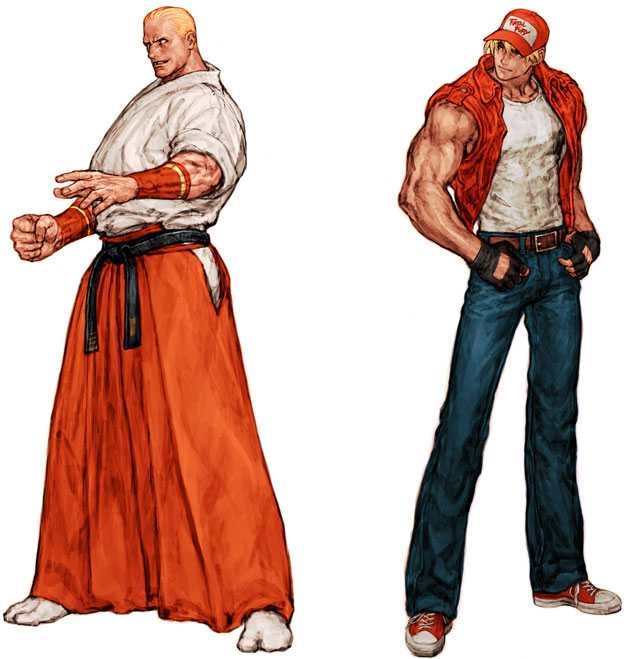
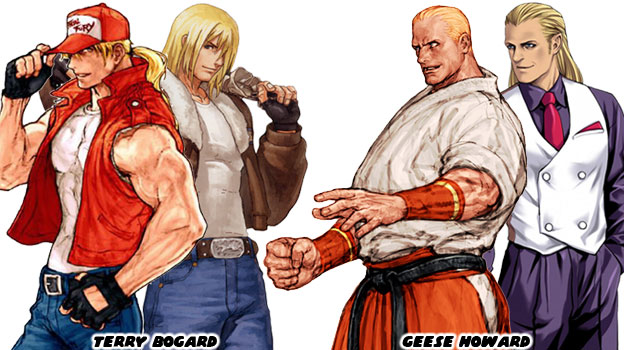
Takashi Nishiyama was the designer on the original Street Fighter and had left Capcom to work on a new fighting game for the crosstown rivals at SNK. His title was called Garō Densetsu Shukumei no Tatakai aka Legend of the Hungry Wolf: The Battle of Destiny, which was changed to Fatal Fury: King of Fighters in the west. The game from 1991 was the first entry in the King of Fighters franchise and appeared months after the release of Street Fighter II. In the Fatal Fury series there have been countless rivalries, the most outstanding of which was between Geese Howard and the Bogard family. Mr. Nishiyama had created a classic rivalry in Street Fighter by basing traditional martial arts masters against each other. For his follow-up game he wanted to modernize the concept. The ones that dressed like traditional practitioners became supporting characters. He wanted audiences to recognize that a person dressed in regular street clothes could be the modern martial arts master. The three main characters in his game knew each other, two were brothers Terry and Andy Bogard and their best friend Joe Higashi. Andy studied a form of ninjitsu and Joe was a muay thai champ. Their costumes were riffs on classic outfits. Terry stood out most of all, his blue jeans, white shirt and red leather jacket screamed Western hero. He was inferred to be the true star of the game. Geese on the other hand was dressed in a traditional costume, reminiscent of samurai clothing. It was actually an aikidogi and hakama or akido pants. Geese had studied many different martial arts, including secretive ones. He had walked away as a master of ancient techniques whether the teachers wanted to reveal these secrets to him or not was a moot point.


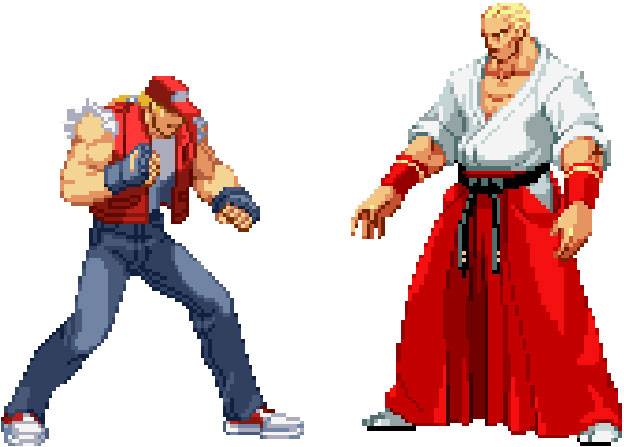
Geese and Terry, like many of the main characters in SNK fighting games had moves based on fictional styles and supernatural abilities. They could direct energy waves from their bodies to their hands and feet. They could even send energy waves through the ground and bowl over opponents. While Geese had studied traditionally under different masters Terry was more of a "Lone Wolf." He learned how to fight in the street and picked up various techniques along the way. His unorthodox style was very different from Geese's. Terry had moves that were more aggressive, the Burn Knuckle punch that allowed him to fly across the screen and the Crack Shoot kick that spun through the air and caught opponents off guard. He fought unlike anybody else out there including characters from other studios. He bobbed on the toes of his feet and kept his fists up like a boxer yet threw diving strikes like a football player going after a tackle. This loose style was a stark contrast to Geese's more reserved power attacks. Geese stood calm with his hands relaxed and open. He waited for the perfect moment to strike. Like a true samurai warrior he did not waste any effort and tried to make every move a lethal hit. The contrast of styles helped define the two. The rivalry between the two was much different than the one between Ryu and Sagat. Geese did not have any moves in common with Terry or Andy Bogard. Geese still had a tighter defense, a greater range, could stuff any physical attack and counter all the special attacks of the brothers. Yet he had not always been powerful.


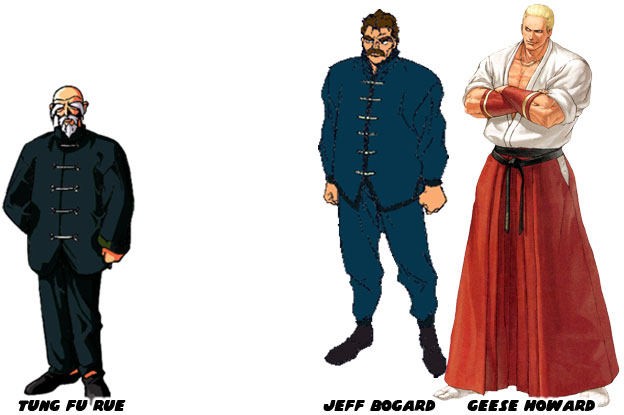
Geese grew up in Southtown, a fictional USA city connected via a few roads to the mainland. It was not unlike New Jersey sitting just outside of New York. But for a more accurate comparison Southtown was to the USA what Taiwan was to China. It was a powerful modern city that pretty much had its own economy, trade and industrial portions and didn't need to be a part of any other country in order to thrive. Geese was abandoned by his father leaving him and his mother poor while growing up. Geese struggled to provide for the household but his mother died poor and hungry. He wanted to track down his father and kill him for abandoning him. Along the way he ran into his half-brother Wolfgang Krauser. He learned his father was Rudolph Krauser Von Stronheim, a terrorist and a powerful man in his own right. If he wanted revenge he would have to become more powerful and more dangerous than his father ever was. Geese set out to do this by studying the most dangerous fighting arts. He picked techniques up from Toji Sakata, a character that later appeared in Fatal Fury: Wild Ambition, as well as the grandfather of Mary Ryan aka Blue Mary, a detective from Fatal Fury 3. Geese's most influential teacher was an elderly Chinese master named Tung Fu Rue. He was learning Hakkyokuseiken: the Eight Extremities Holy Fist technique alongside another gifted martial artist named Jeff Bogard.


Jeff had adopted two orphans from the streets of Southtown, young brothers Terry and Andy. He gave them a last name, cleaned them up, put them through school and took care of them the best he could. He even began teaching the two how to fight. Jeff did pretty much the opposite of what Geese's father had done. It was just one thorn in the side of Geese. The other was that the final techniques of Tung Fu Rue would only be taught to his best pupil. Rue could tell that Geese would only use the techniques to hurt people and attain power. When Tung Fu Rue named the senior Bogard the new master of the dojo it sent Geese into a frenzy. He killed Jeff in front of Terry. Terry was barely 10 at the time and could do nothing to stop the murder. From that point on the two brothers swore that they would become great fighters and take their revenge. Geese disappeared shortly after and set about completing his goal. He would take over Southtown from the inside, starting with the gangs and mobs and work his way up to taking control of the corporations.


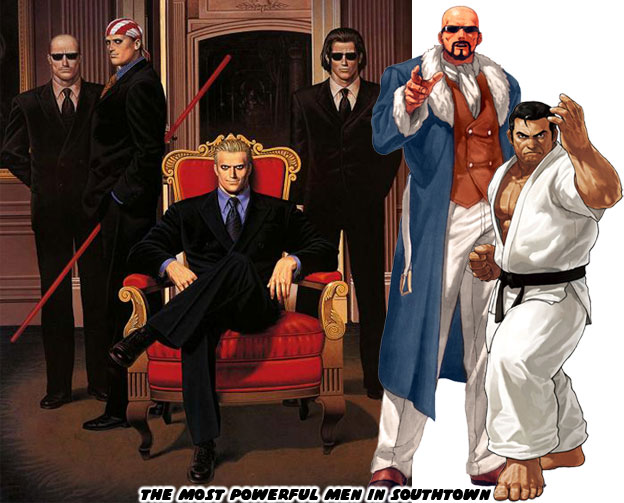
To outsiders Geese was a self-made tycoon, respected in business and political circles. To everyone on the street Geese was to be feared. Even before he murdered Bogard he had already started his own criminal empire. His first henchmen were Ripper and Hopper, two guys in suits and sunglasses, one bald and one with long black hair. They were often seen in stage backgrounds and official art. They were ruthless enforcers that helped infiltrate rival organizations. The previous crime lord of Southtown was a tall man named Mr. Big. Like all villains in video games he was also a martial arts master. Mr. Big wore fine suits, fur coats and fought with two sticks. He was eventually dethroned by Geese and rather than being executed he was turned into a right hand man. Geese believed in the old saying, keep your friends close and your enemies closer. Geese also recruited a master of stick fighting from Great Britain known as Billy Kane to act as a bodyguard. Those that Geese couldn't buyout or intimidate he often killed. Yet there were some people that he saw as threats but kept around to fulfill a purpose.

Takuma Sakazaki was possibly the most dangerous fighter in all of Southtown. He was the founder of Kyokugenryu Karate, the Extreme Utmost Limit Way of the open hand. Takuma was somebody that Geese could not beat in a fight. Mr. Big was aware of this and also respected and feared the fighter. When Mr. Big was trying to muscle out more territory in Southtown he decided to kidnap Takuma's daughter Yuri and blackmail him into becoming an enforcer. Takuma did as he was ordered but he wore an ancient tengu mask and called himself Mr. Karate. He wanted to hide his identity and distance himself from what he was being forced to do. The Mr. Karate personae of Sakazaki was completely ruthless. He wanted people to fear the character more than any crime boss. He was eventually stopped by his son Ryo Sakazaki and their family friend Robert Garcia.


Now the reason that I bring all of this backstory up is because Mr. Nishiyama and his team were creating a narrative that would bridge several games together. The story of Geese Howard and Terry Bogard would be explored in the Art of Fighting. The story between Mr. Big and Mr. Karate would be revealed in the Art of Fighting, an SNK game released in 1992. The events of both franchises laid the foundation for the King of Fighters series which debuted in 1994. Having an understanding of where the characters came from, where they were going and how they fit into the world took a tremendous amount of planning. The team at SNK didn't want to move from game to game and have nothing supporting the characters. They wanted every fighting game to be interconnected. They didn't want to have throw away characters or bosses that simply faded away either. By thinking three moves ahead the games were consistently good. Audiences were hooked with the series because of memorable good guys and bad guys. Mr. Nishiyama had done something similar, albeit to a lesser extent while with Capcom.

Many of the original Street Fighter characters were inspired by the martial arts but none had much depth to them, at least not much in the sense of a purpose. The more interesting ones would return and the studio began exploring their back story. Think about where Sagat came from, it wasn't really explained in the first game. He was simply the champion when Ryu met him. Later on the studio invented the character that took his eye, someone named Gou Hibiki that just so happened to like Mr. Karate. Capcom and SNK had been trading jabs with each other because they were early competitors in the market. It didn't hurt that the team members at the studios knew each other as well. Capcom began designing more fighting game characters with histories. If you look at Guile and Chun-Li they were much better developed than the original Street Fighter cast and became bigger hits with the community than the first characters. SNK demonstrated that fighting game characters with planning and a back story tended to be more memorable than those with just cool looks. This level of detail did not just apply to the characters but also to the world that they inhabited.


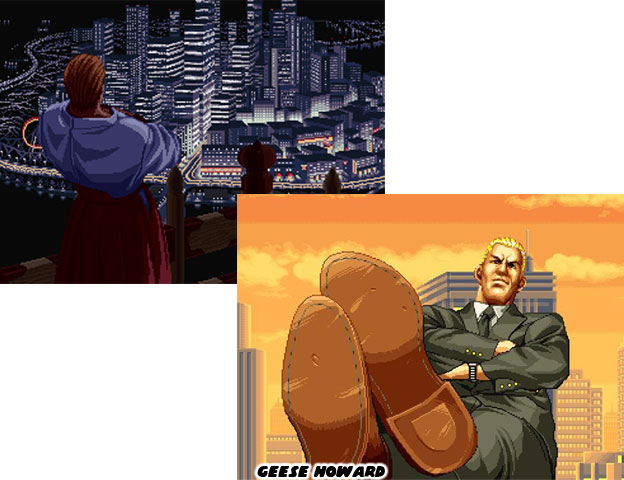
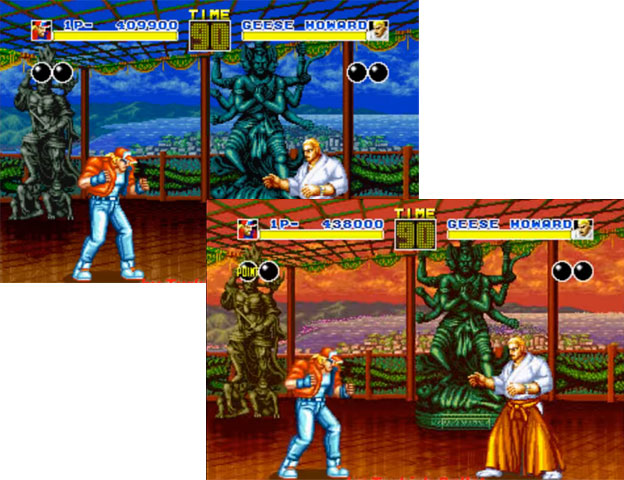
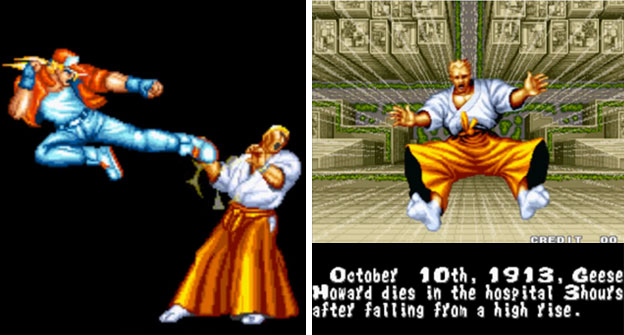
Geese was a very powerful man and a very arrogant man. He surrounded himself with treasures from Asia, various statues and temple guardians were on display. In his fancy robes Geese looked like the opposite of Terry, whose torn jeans and sneakers showed that he was poor. The penthouse on Geese Tower looked like a temple, this would be the setting of the final battle in Fatal Fury. It told a story and framed the battle between Terry and Geese. Players could see Southtown from high above the city. It was one of the most memorable stages in early fighting games. Not only that but from round to round the time of day changed. This was to illustrate that the fight had taken a long time to finish. Neither man could get the upper hand so the battle raged on. The team at SNK wanted to show that stages evolved in their fighting games. Perhaps it would rain between rounds, you would notice the audience clear out, or perhaps the stage would transition from day to night. They were doing things for the genre that other studios didn't even consider. Evolving levels were rarely done even in modern fighting games. The climax of the final battle came with Terry kicking Geese right off the rooftop. The setup and execution of the final stage meant a little bit more than the fight between Ryu and Sagat. Audiences could tell that the stakes were high. Every rival defeated in the original King of Fighters tournament had some sort of secret agenda but none was more important than the revenge of the Bogard brothers. Players felt a sense of relief that the evil villain fell to his death.


In the ending screen it said that Geese died October 10, 1913. This was mistranslated, the studio meant to say 19:13 hours, or 7:13 pm in the hospital. He fell from the building at dusk and died 3 hours later. So why was his death important? It helped give audiences a sense of closure. This fighting game came with a story, it had a beginning, middle and end. The King of Fighters tournament had nothing to do with winning a belt or trophy. Geese simply wanted to meet and beat the best, what he didn't expect to see where two brothers that wanted him dead. The game was a tale of revenge, like many of the great martial arts films. Stop and think about how important a story was to Street Fighter II. The tournament was a front for a much bigger plot involving Shadowlaw and a rogue Dictator. There was a connection between Ryu and Sagat that made that battle much more memorable. For the supporting cast there was a reason why they were fighting as well. For some it was fame, for others it was a national duty, still for others it was a shot at redemption.

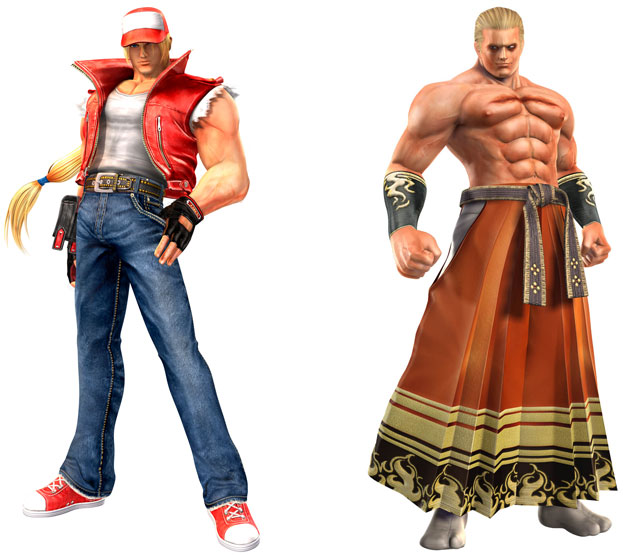
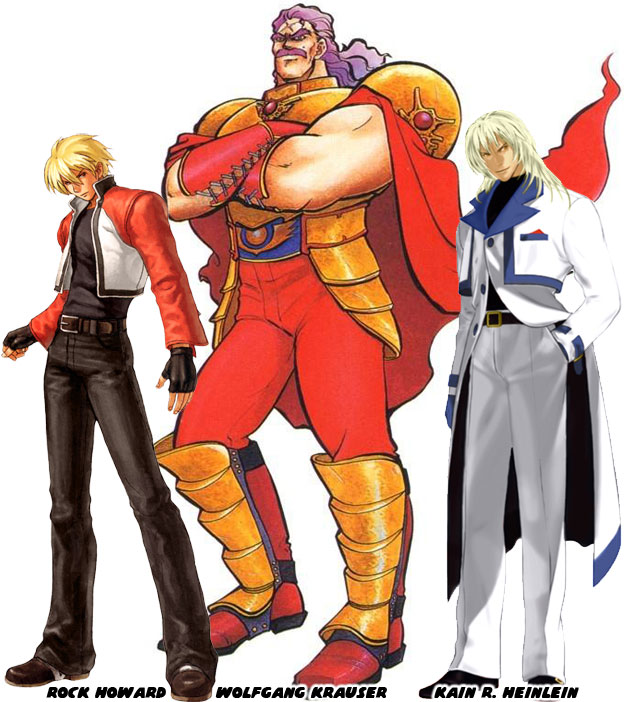
If Mr. Nishiyama was such a good director then why would he kill the main villain in his very first appearance? Why would he develop such a rich back story if the character was a throw away figure? Well it turned out to be a false death. Geese survived the fall thanks to an outside influence. He would actually continue pulling strings from the shadows while he recovered. Audiences didn't know this until years later. The series would continue and players would get to fight as the Bogard brothers, Joe Higashi as well as knew friends and enemies. These new faces would have to fight Geese's half-brother Wolfgang Krauser and his brother-in-law Kain R. Heinlein in the various sequels. The rivalry between Geese and Terry had just started. It would be a cornerstone of the franchise for almost a decade. Rather than focus only on the hero the two were featured in SNK promotional material. A hero was only as popular as his rival after all. The two were also used to highlight the changes in technology. When the studio looked at leaving sprite graphics behind and developing the next generation of fighting games in 3D they made sure to show off the new models for Geese and Terry right away.


Identity was very important to the characters in the King of Fighters (KOF) universe. Every figure was treated like a franchise fighter. Each character had the potential of being a breakout star. They could be featured in their own game if the fan reaction was strong enough. Some KOF fighters were already stars from a different genre. All of the heroes and all of the villains were building an identity and helping strengthen the SNK brand. The development teams wanted the audience to know that the universe of KOF was constantly changing. The main characters were not set in stone. Other studios, namely Capcom, tried to keep their fighting stars locked into one look or one style. Ryu could only wear the white gi for example and Chun-Li could only wear a blue dress. While this rule has been relaxed a little thanks to the costume pack updates from Capcom most fans still expect to see the iconic characters in familiar costumes. The studio assumed that anything else might be a disservice to the series and turn off fans. SNK on the other hand didn't have a problem revising their main characters between games. They wanted audiences to see that the world was constantly evolving. Not only that but they could create sequels and prequels to show how the characters appeared at any point in time. At a future point in the universe Terry had changed his look completely. His red, white and blue costume gave way to a brown bomber jacket and jeans. He ditched his cap and let his long hair fall loose. The design for Geese Howard was different when he first started taking over Southtown. In his younger days he wore a business suit and had long hair. This was an aesthetic decision from the team at SNK. It was okay to play with the costumes of the characters as long as they retained their moves, purpose and personality. The two were still as dangerous as they had ever been and audiences more or less accepted the change in their appearance.


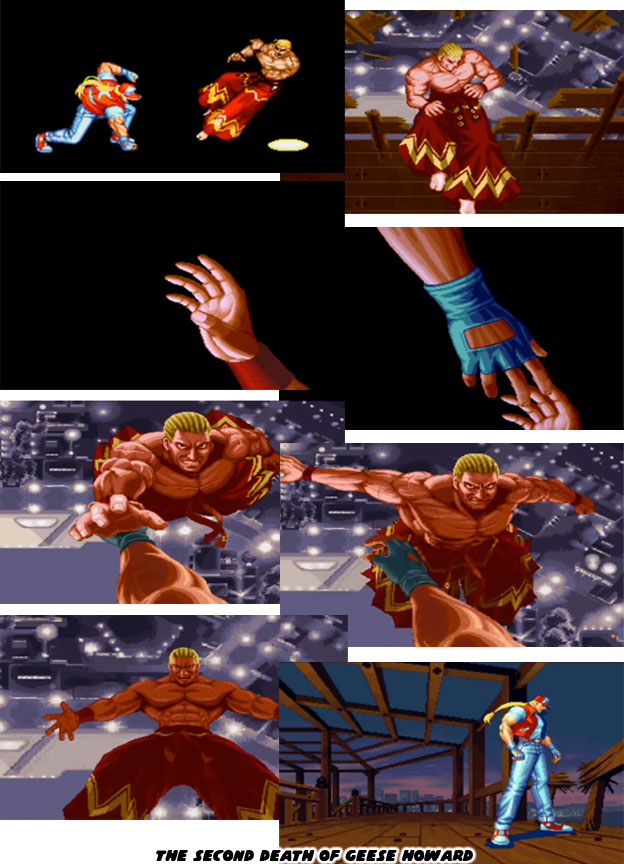
SNK did not want to have audiences think that Geese was indestructible. Players saw him get dropped from the top of a building in the first game. So how did he survive the fall? It turned out that all of the treasures he had been surrounding himself with had a purpose. In his travels he discovered a scroll of ancient techniques. It was called the Phoenix Scroll and allowed its owner to recover from mortal wounds. It took a long time but sure enough he came back with a renewed purpose. Geese learned that there were two more scrolls, known as the Jin Scrolls, these scrolls were part of the Qin Book of Secrets. Legend said that the person that had all three would obtain the secret to immortality. This became a plot point in the Fatal Fury sequels. The Bogard brothers had been robbed of their revenge. They tracked down Geese several years after the first encounter during the events of Fatal Fury Real Bout. Terry once again found himself at the top of Geese Tower. He knocked Geese through a railing but this time he did not mean to kill him. Terry reached out and grabbed Geese at the last moment. Refusing the gesture, or confident that he had indeed become immortal, Geese shrugged off the help and fell once more. He laughed the entire way down. It was a shocking ending. I don't remember the last time a villain had committed suicide on screen. Since Geese had been unable to secure all three Jin scrolls it was assumed that he died for real this time. Time would prove otherwise...


When Terry first knocked Geese from the tower he did so out of rage. As time went on he realized that he had made a mistake, of course not getting caught by the police for the murder of Southtown's biggest crime boss was a blessing in disguise. Killing Geese would not bring his father back. If anything Terry dishonored his own family name by fighting for the wrong reasons. Terry tried to make amends the next time they battled but Geese refused the gesture. The death weighed heavily on his conscience. It was not every day that you could say that a great rivalry ended with the hero feeling guilty. Just like you could say that it was not every day that a rivalry started with the hero killing the villain. This story did not end there however. Terry discovered that Geese had a son named Rock Howard. Geese had abandoned his son just as he himself had been abandoned. Terry became the surrogate father for Rock, guided him and taught him some of his own fighting techniques. What made Rock unique was that he had a mix of both Geese and Terry's moves but thankfully none of his biological father's evil tendencies. His uncle Kain R Heinlein did try to get Rock to side with him and throw Southtown into chaos and create what would be known as Second Southtown. Rock refused and battled his uncle during the events of the King of Fighters Maximum Mayhem tournament.


One of the great all-time fighting game rivalries was a clash of ideals. Terry Bogard and Geese Howard each came from broken homes, both had lost their parents at a young age. Each made it to adulthood and each became a powerful fighter in the process. The decisions they made along the way defined one as good and one as evil. The two were very similar otherwise, and I don't mean just on a physical level. At the core they had strong wills a were fiercely determined to overcome all obstacles and achieve their goal. This was something that Sagat and Ryu did not necessarily have in common. They were rivals but did not share many traits. Both fought to become the strongest Street Fighter and defend that title. SNK had a completely different approach to the genre and it was refreshing. The pre-planning by Mr. Nishiyama and his team paid off in Fatal Fury and the various sequels. Terry, Geese and the rest of the King of Fighters cast would enjoy an incredible fan following.

The success of the series demonstrated that there was more than one way to frame a rivalry. Planning had a lot to do with it. Think about successful books and movies, the creators had to know their world and how it worked backwards and forwards before sharing their story. J.K. Rowling had to know the history of her magical world, who came before and how everyone was related. She then sprinkled those details all throughout the Harry Potter books. George Lucas had to know how the Force worked and the history between the Sith and Jedi as he told the Star Wars trilogy. Mr. Nishiyama had a clear picture of Southtown and the origins of the King of Fighters tournament. He was very familiar with the most dangerous men in that universe before he told the story of Fatal Fury. These were important lessons for budding creators to remember. You must always know where your story comes from before you can tell people where it is going. Revenge was a powerful motivator but what about the other great rivalries in fighting games? What else caused a rivalry to start? We'll take a look at one of the most important ones in the next broadcast. As always if you would like to sponsor me please visit my Patreon page and consider donating each month, even as little as $1 is better than nothing..

 follow the Street Writer on Patreon!