Showing posts with label preston ajax. Show all posts

Sunday, July 19, 2015

The return of Charlie Nash, or how zombies make the best fighters...

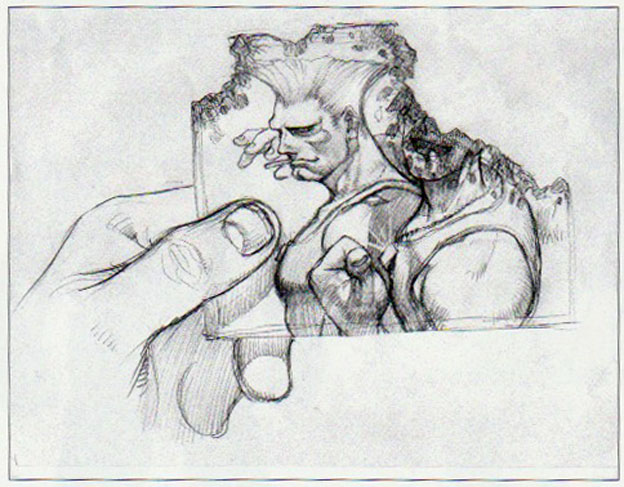
Of the characters announced so far for Street Fighter V I think the most interesting was the return of Charlie Nash. I thought he was a great character in the Street Fighter Zero / Alpha series. I liked him partially because he wore glasses. For those that didn't get a chance to play as the soldier he was essentially the American representative for the series. He was created the person whose death Guile was avenging during Street Fighter II. What was most interesting was that this character did not have a face, only a name when Street Fighter II came out. In fact even the developers at Capcom didn't know what Charlie looked like originally. In some unused art by Bengus the only picture that Guile had of his friend had the face burned out. Making him the original gaming unknown soldier.


Audiences didn't know if Charlie was a friend or family member killed in the line of duty. Guile would hoist his dog tags in the air in some victory animations. The myth behind Charlie grew as the endings in the Street Fighter II were changed and new details were added. At first Guile would threaten the Dictator and in other versions Guile would visit the grave of his friend. Guile was a visually unique character, with his military look and odd haircut, but he became interesting thanks to his ending. He attacked the Dictator after his defeat, grabbing him by the collar. It was a palpable rage when he brought up the names of Charlie and Cambodia. Audiences didn't know quite what happened but it sounded like something serious went down. When Charlie Nash was killed Guile was younger, considered a runt, Only Guile's wife and daughter were able to talk him out of killing the Dictator. Some of the endings in the game were silly but most were played out like a dramatic movie, Guile's ending was no exception. He had abandoned his family in the pursuit of revenge and was reunited once his vendetta was completed.
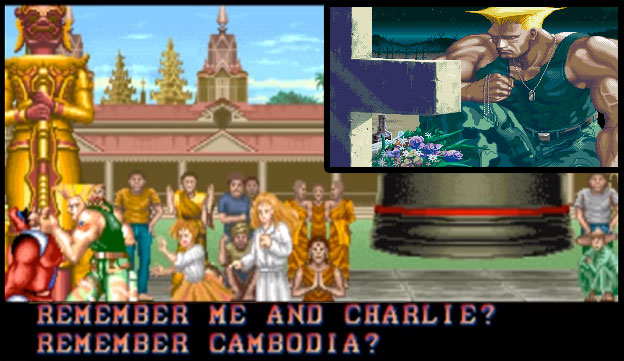
   

Charlie Nash died officially during the events of the Street Fighter Zero / Alpha series. What was unique was how differently he died during each release of the game. In one version he had found a hideout for Shadowlaw and was radioing home base for reinforcement. The Dictator snuck up behind him and attacked him. All that was left was a bloody dog tag. It didn't really look like Cambodia but more like the US Southwest.
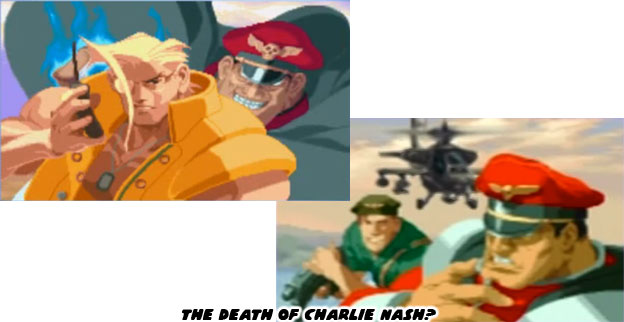
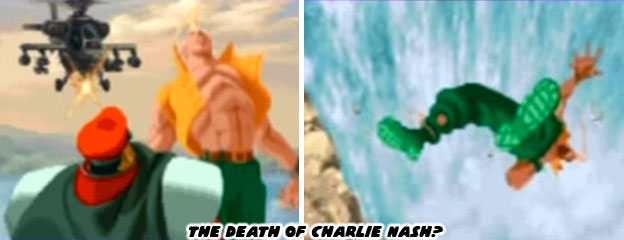
 

In the second release of the game Nash had the Dictator on the ropes, somewhere in Brazil, possibly the Iguazu Falls, when he was shot in the back by a Shadowlaw helicopter and fell to his presumed death. When the Shadowlaw soldier asked the Dictator if he wanted to confirm the kill the Dictator said that no one could have survived the fall. Again, all that was left of Nash were some dog tags. By the third release of the game Nash was flying a jet and had blown up the base of operations for Shadowlaw but was still on the hunt for the Dictator. So in one out of the three endings he did not die.


It was an interesting contrast from the previous game and this was something that the Street Fighter series had become known for. There were multiple endings in the games yet each ending did not necessarily work with every other one. There were even endings that contradicted the ending of a previous game. Sure the Dictator could have captured Nash and turned him into one of his brainwashed soldiers. He had done this before to soldiers and special agents the world over, including his prized subject the Delta Red agent known as Cammy. 
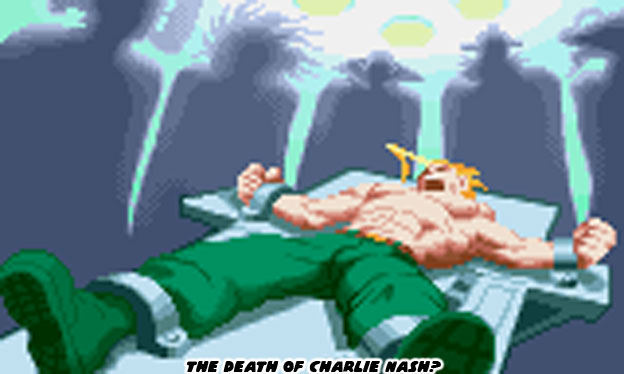


Then again Nash could have been captured and brainwashed by a different group. In Marvel Super Heroes vs Street Fighter the Shadow version of Nash made his debut. He even popped up in X-Men vs Street Fighter. During the crossover games it was hinted that some mysterious group was responsible for his new form. Were these mad scientists, or cultists of some sort? All gamers could do was speculate as to the "true" fate of Charlie.


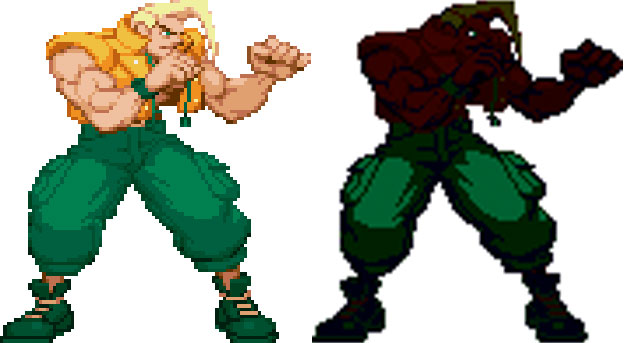
The dark Shadow version was literally a sprite of Charlie from the Zero series that had been discolored to make him look as if he were in a perpetual shadow. His eyes glowed and his attacks took on a blue hue. He had the same basic attacks and audiences began wondering if the character had returned from the dead. It did not become official until Udon began writing about the character and his history and of course when Street Fighter V was announced, almost 20 years since the character had debuted.
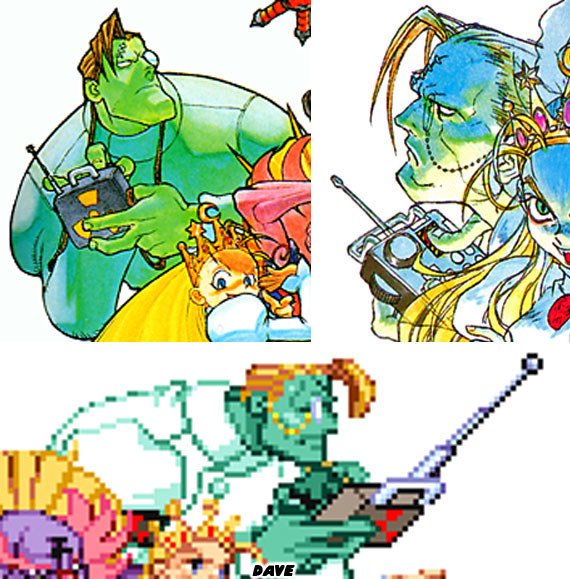
 

Of course many eagle-eyed Capcom fans said that the new Charlie Nash looked an awful lot like Dave. He was one of the alien henchmen characters from Cyberbots: Full Metal Madness. He served under Princess Devilotte de Deathsatan IX, an over-the-top lolita-dressed alien bent on universal domination. I could see where people would see the same hair and glasses on both characters. Dave debuted a few months before Charlie Nash, it's entirely possible that the artists liked the look of the character and incorporated some of his visual cues on Charlie as well.
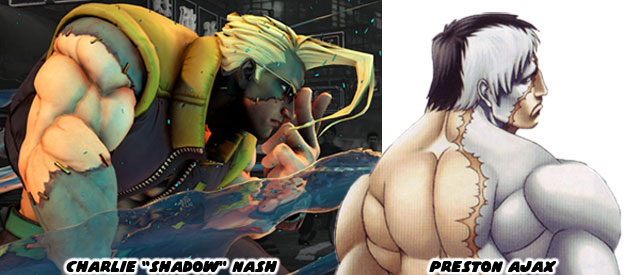
 

When I saw Charlie back from the dead, complete with stapled and stitched body parts, I was reminded of a different fighting game character. Preston Ajax was a sub-boss character from the game Fighting Layer. The character was a mercenary that had been mortally wounded in a bomb attack. He was pieced together with the remains of his brother, who was a fellow mercenary. The discolored portions of his skin were like dead tissue, very macabre. I got the same feeling while looking at Charlie. Ajax was actually inspired by the manga character Black Jack. He was injured when he stepped on a land mine as a young man. His only friend, a young black boy named Kuro, donated his skin for a transplant. This contrast made him one of the most memorable manga heroes ever created. Black Jack went on to inspire the creation of the Tekken series as well, but I digress...
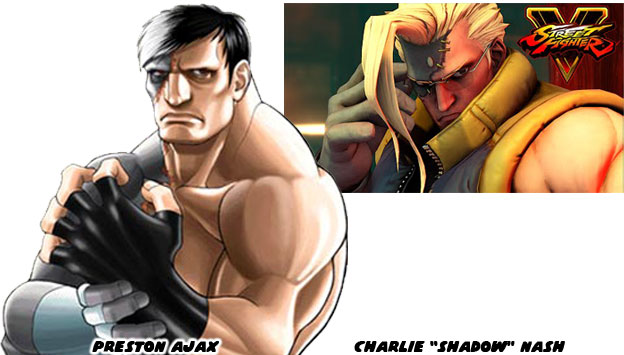
 

Preston was created by ARIKA, the studio that was founded by many Street Fighter II members. The game Fighting Layer that Ajax appeared in could be considered a revisit to the original plans for Street Fighter II. I wonder if it was a coincidence that two military characters with similar "back from the dead" origin stories ended up in fighting games or if it was an idea that the SF II team had kicked around before they split up. I guess the world may never know.

But there was more to the character than a cool background and a connection to one of the Street Fighter II characters. The series had always been about combining a great fighting game engine with characters that could perform amazing moves. Ken and Ryu had the Shoryuken or "Fireball" attack. In the original game only they and Sagat could perform the move. In the sequel it was the same thing but Guile was one of the new characters that could also perform a ranged attack. Guile's version was called a Sonic Boom. When Charlie appeared as a playable character a few years later he too was given the Sonic Boom attack. However there were nuances that separated Guile from Charlie.
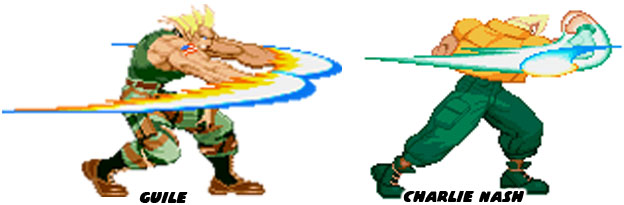
 

It was assumed that Nash had taught Guile the special attacks. As a master of these unknown fighting arts Nash was able to perform the same moves with a little more ease. For example he would perform his Sonic Boom attack with one hand while Guile used both. That was not the only special move that Guile possessed. He also had a Flash Kick, which was a backflip and kick combined into one. Nash also had a version of this move except he did it with his back turned to his opponent. Again the move looked a little bit easier for Nash to perform.
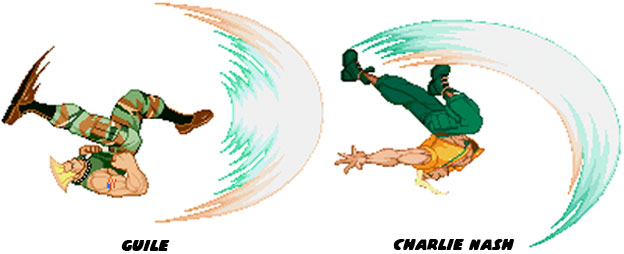
 

Both moves happened so fast that audiences didn't always catch the frames of animation that Capcom placed on them. There was a tremendous amount of forethought that went into how each fighter tumbled in the air. Each actually led with the opposite kicking leg in order to create the momentum for the attack. Since Charlie had his back to opponents he needed to be able to kick as well as twist in the air, this translated to him leaping cross legged. He would kick his back leg out and then tuck it in as his other leg created the arc for the Flash Kick. Then just before he landed he would complete the twist and land facing his opponent.
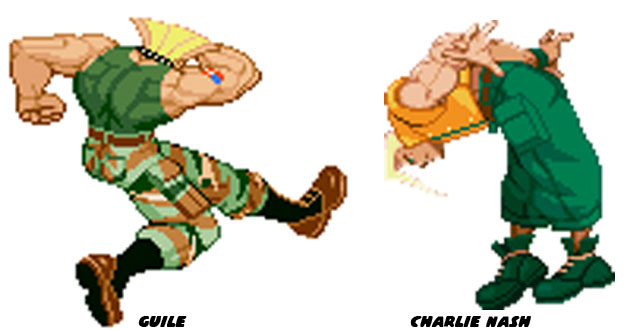
 

Both moves looked fantastic even if audiences didn't spend the time dissecting how each was performed. If assigning special attacks was all it took to make a character memorable in the genre then it would apply to any new character introduced. Right? Capcom pushed their luck in Street Fighter III 3rd Strike with a new character called Remy. This character had all of the moves of Guile and Nash and could perform them with even greater ease than the military fighters.
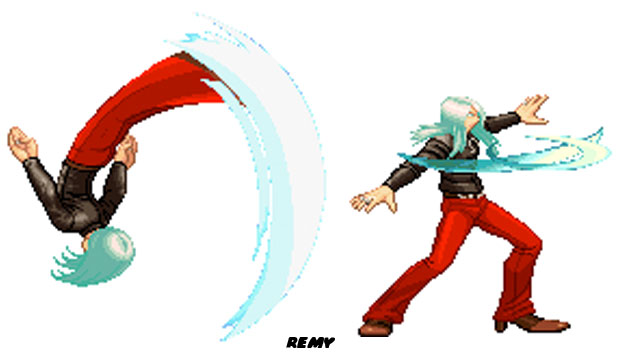


This character didn't have a fraction of the forethought that went into the design of Guile or Nash. It was a bit insulting to the legacy character that some skinny Frenchman with no build for fighting or no interesting origin would have the same techniques. Not only that he could also throw Sonic Boom attacks while crouching which was something that neither Charlie nor Guile could do. Audiences wondered why put in a character with all of Guile's attacks in Street Fighter III rather than just return Guile. After all the studio had brought back Chun-Li in the series as well. Remy was one of the more forgettable characters that the studio produced and had not been brought up since.
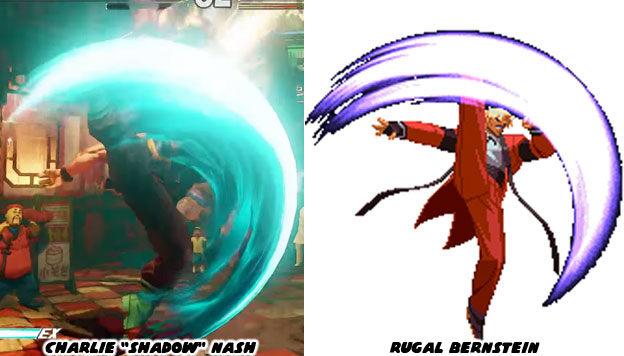


The physical appearance of Charlie was not the only thing that had changed with his return. The Flash Kick was gone, in it's place were two new special kicks, the Sonic Scythe and the Moonsault Slash. Nash now performed the trademark kick with one wide arcing leg movement. It was reminiscent of the special attacks of Rugal Bernstein, a boss character from the King of Fighters series. I kind of miss his original backwards flip.
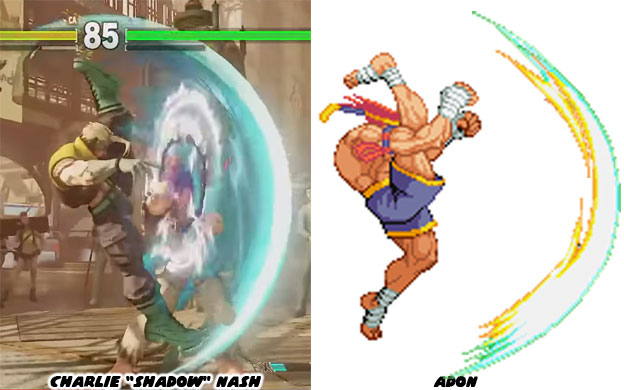


The other kick was a front tumbling heel strike. It was very similar to the Jaguar Kick pioneered by Adon. Charlie's super attacks had been changed as well. The character not only looked new but played new. What do you think about the return of Charlie? What do you think of the changes of his strikes and abilities? Are you a fan of the new look? Who do you want to see in the new lineup? As always if you enjoyed this blog and would like to sponsor me please visit my Patreon page and consider donating each month, even as little as $1 would help make better blogs and even podcasts!
Tuesday, May 13, 2014

Fighting Layer, return of the dragon, part 3...

The Fighting Layer tournament had pulled together many different styles of martial artists. Some of these archetypes reminded players of the Street Fighter II icons. Developer ARIKA had revisited some of the prototypical characters in the planning stages for Street Fighter II while building a cast for their new tournament. Two of the more lethal fighters had very contrasting styles yet both had a similar goal, to kill a target. The ninja Sessyu Tsukikage fought like a man possessed. He had an arsenal of quick attacks and traditional weapons. The man was extremely fast and could even disappear in a puff of smoke and drop down on opponents with his sword. The homicidal maniac Janice Luciani balanced out the ninja. She was a crazed killer that used knives and guns on opponents. It was suspected that both characters were trying to assassinate the sponsor of the tournament. Of the two Luciani seemed content with killing all her opponents on the way to the top.


All of the characters announced thus far fell in the realm of possibility. Most were rooted in real fighting systems. The artists and designers at ARIKA did not use exaggerated proportions to make characters giants like Zangief or Sagat. Yet part of the charm of Street Fighter II was the oddball characters that fought alongside the "regular" characters. The wild man Blanka and elastic yoga master Dhalsim had become icons to fighting game fans. Those characters looked and fought unlike any other character in history. ARIKA had previously introduced Skullomania in the Street Fighter EX series. The circus performer wore a skeleton costume and thought of himself as a super hero. His attacks in the game were very unconventional but memorable. Fighting Layer had its own oddball character that was leagues beyond Skullomania, Dhalsim or Blanka. In fact the new character so beyond what had ever seen before that few knew what to make of him at all.

Capriccio was a sort of mystical, tribal, animistic witch doctor. His costume and helmet made him appear like a cycloptic bee. The best way I could describe the costume and influences that the ARIKA designers put into the character were if the Alien, as designed by H.R. Geiger had a lovechild with Mudman, the character from World Heroes. Capriccio fought with an assortment of odd attacks. He would crawl along the ground like an insect and make poisonous mushrooms appear from thin air for his opponents to step on. He was without a doubt the strangest human(?) character ever to appear in a fighting game.


The sub-boss characters in the game were not as eccentric as Capriccio. They were in fact a retelling of the bosses from Street Fighter II. In Fighting Layer players chose which sub-boss they wanted to fight, or had to fight, depending on which paths they had played through. Players faced one animal-boss and one sub-boss before facing the final villain. In SFII players had to defeat three consecutive boss characters before facing the final battle. The ability to choose a sub-boss was unique to audiences. Each boss character offered a different challenge to gamers. The characters themselves however seemed eerily familiar to veterans.

There was a one-eyed former world champion that was in the twilight of his career… Sagat was the boss of the original Street Fighter and was relegated to second-in-command by Street Fighter II. The former champ was still a powerful opponent but challengers knew he was a stepping stone on the way to a more powerful opponent. Clemence Kleiber was a wrestler that stepped out of the limelight to find a new challenge. What he found instead was an empty existence. He lived in the lap of luxury. A private ring was built inside of a library of an ornate castle. Kleiber would spend his final days waiting for a worthy challenger that might never come.


Almost as tragic was the story of the boxing champion that had been banned from the sport he was born to dominate. In Street Fighter II this character was M. Bison, or Balrog depending on which country you lived in. The Mike Tyson clone was once idolized the world over. He spent and drank his fortune away and had to work as a Shadowlaw enforcer to recapture some of his former glory. In Fighting Layer the former champ Joe Fendi was turned down by all of the boxing promotions because it was rumored that he had gone blind in an eye. A disabled athlete would never be allowed to compete on the professional circuit. Fendi denied these claims but never allowed a doctor to confirm his condition. Both fighters were extremely dirty boxers. They were known for throwing head-butts and elbows at opponents. Fendi would pummel his opponents with brass knuckles and even gauntlets during the Fighting Layer tournament. His personal trainer backed him up at every chance, especially when he taunted opponents.


The last of the sub-bosses was a trained killer. This person was more dangerous than either Janice Luciani or Sessyu Tsukikage. The masked assassin in SFII was named Balrog or Vega depending on your country. He was called "Claw" by Capcom developers as to avoid confusion. He wore a mask, not to hide his identity but to protect his beautiful face. This assassin was a famed matador, a bull fighter by day and one of the Shadowlaw generals by night. He was proud, vain and responsible for killing government officials, soldiers and law enforcement officers, including Chun-Li's father. The assassin acting as a sub-boss in Fighting Layer was neither pretty nor stealthy. Preston Ajax had been featured in an earlier blog. The character was a patchwork of body parts, half his own and half of his brother following a failed bombing attempt. Of the sub-bosses he was the most tragic. A fighting Frankenstein's monster, Ajax was also inspired in part by the manga character Dr. Black Jack.


Before players could even face these dangerous sub-bosses they had to defeat the fiercest predators from nature. The selection of creatures were right out of martial arts myth. The next blog will look at these characters. If you would like to sponsor me please visit my Patreon page and consider donating each month, even as little as $1 would help make better blogs and even podcasts!
follow the Street Writer on Patreon!

Monday, May 5, 2014

The manga and fighting game connection, part 3...

ARIKA was founded by former Capcom employee Akira Nishitani and some of the other developers behind Street Fighter II. The studio was the first to push for the creation of a 3D version of Street Fighter with the series Street Fighter EX. ARIKA developed the 1996 game and Capcom published it. The two studios worked to create the arcade and Playstation releases of the various titles. Capcom began shuttering their arcade division and focusing exclusively on consoles by the end of the '90s. A rift developed between the two companies. Released in 2000 Street Fighter EX3 would be the last joint venture and first EX game that was console-exclusive. ARIKA knew that there was still an audience for arcade fighting games and was eager to create a successor to the EX series should Capcom completely shut down their arcade division. They found a new publisher with Namco, the long-time rival to Capcom. ARIKA did not want to create a new universe as many fans had enjoyed the world that they had presented in the EX series. The studio wanted to keep the new game out of Tekken canon in case they could sign a new deal with Capcom. At the same time ARIKA could not include all of the EX characters as they were mostly owned by Capcom. To make sure that they did not have a breach of contract in 1998 ARIKA pulled two characters from the EX series before the release of EX2. Blair Dame and Allen Snider were two popular characters from the original EX but were absent in EX2 and EX3. They were featured in Fighting Layer instead. This allowed arcade visitors to accept that any new characters introduced in the title might fall within SF continuity but not necessarily canon. I will talk at length about Fighting Layer in a future blog but for now I will focus on a sub-boss that was also featured in the game. This fighter was inspired by Osamu Tezuka's mysterious medical protagonist.


Black Jack, the title character from the medical drama series had a unique look. His face and body were laced in scars. These were the results of countless reconstructive surgeries during his rehabilitation from a mine explosion. His complexion had two different tones because the donor for his skin grafts was a Black-Japanese. The hair on half of his scalp had gone white from the shock of the explosion as well. The contrast between light and dark features made the character look macabre. When people described him as looking as Frankenstein's monster it was a valid comparison. In the manga he rarely had to rely on physical violence to solve a crisis. He knew how to throw a punch when challenged but was more dangerous when throwing a scalpel. Black Jack had a strong identity yet the adaptation to fighting game character was not a straight path.

ARIKA wanted to create a fighting game character that had the same presence as Black Jack but did not diminish his rivals. The studio managed to capture the aesthetics and even tragic origin that made Black Jack memorable. They did so first by giving the character a history that complimented the universe of Fighting Layer. Preston Ajax was a military specialist, a mercenary and a specialist in explosives. His combat training made him an excellent fighter and much more dangerous than the "regular" martial artists that were featured in the game. He was not initially a playable character in the Fighting Layer tournament but instead a sub-boss.


The first thing that players noticed about the character were the scars, discolored skin and hair. It was easy for audiences to see how similar Preston appeared to Black Jack. The origin of his scars were also familiar. He had been caught in an explosion but it was a bomb that he had set along with his brother, who was a fellow soldier. The two had set explosives the world over to create instability and fear in various nations. Their campaign of terror was not always against military installations but sometimes in public sectors were they could count on high amounts of collateral damage. When a bomb went off prematurely it killed his brother and left Preston with only half a body. He was rescued and the remains of his brother were used to piece him back together. His benefactor and biggest contractor was an eccentric dictator named Vold Ignitio. The disfigured Ajax was obliged to continue following orders from Vold and keep planting bombs. Preston was close to his brother and the loss coupled with what had been done with his remains began to warp his mind. Ajax began hearing the voice of his brother. Asking him to bide his time and complete one final mission.

The template for a psychotic mercenary fighter had actually been done previously by ARIKA. The character Doctrine Dark, featured in Street Fighter EX, had also suffered from the horrors of war. Colonel Guile, one of the star characters from Street Fighter II, had mistakenly lead his unit into an ambush. The resulting firefight decimated his soldiers. When the fighting was over there were only two survivors, Guile and Doctrine. The two were separated in the melee. Guile returned home and became a decorated hero. Doctrine was left behind and assumed as a casualty of war. Doctrine felt betrayed by his commanding officer and abandoned by his country. His psyche had completely snapped after that day. He became a mercenary and learned to trap and kill his opponents without the aid of the army. He was adept at using knives, explosives and a wire garrote in hand-to-hand combat. He swore revenge on Guile and spent several years tracking his prey and finally caught up with him during the EX tournament. The back story made the character interesting but it was the diversity of attacks that made him a great fighting game character.


Preston and Doctrine shared similar fighting techniques. Both had solid strikes and combos but relied on the garrote for ranged attacks. Both could also plant explosives on their opponents for tremendous damage. This was a way to balance out the characters that had fireball-type projectiles. Doctrine made good use of the knives hidden in his sleeves for close-up strikes. ARIKA focused less on weapons and more on punches and grappling attacks for Preston. He was certainly the more powerful striker of the two. Dark was playable right at the start of EX however gamers had to wait to try out Ajax. Fighting Layer actually had a time-release feature and each of the sub-bosses were unlocked over the weeks that the game was featured in the arcade. Preston eventually became a playable character and like the other bosses he also had his own unique story.

Ajax played the role of a sub-boss very well. He was a good all-around fighter with a unique complement of special attacks. His level was based inside of a military complex to help reinforce his theme. Preston was also a melancholy character. His origin was certainly very tragic and the character knew that he should have perished in the explosion years ago. He was like the monster created by Dr. Frankenstein, an abomination that the natural world would reject. But like the creature from the classic Mary Shelly story he was also waiting to meet his maker alone and hopefully destroy him. Every character in the Fighting Layer tournaments had a unique ending after they faced Vold, the boss of the game. The majority wanted to get out of his castle and off of his cursed island as it was collapsing around them. Preston was the only character that did not try to leave the island as it was breaking apart.


Preston made his final mission to destroy Vold and himself in the process. Vold was a monster that hid his cruelty behind the guise of royalty. In reality he was even more twisted than Ajax and needed to be stopped. Who better for the job than the trained killer that Ignitio had pieced together? Only then would Ajax atone for the horrors of war and let his brother rest in piece. Once Ignitio was defeated Ajax stood his ground as the castle that hosted the final stages crumbled around him. A giant stone fell on him and players assumed that he had been killed in the process. The other sub bosses died in the collapse but by accident or mistake, not by choice. The other characters in the game could be seen making a daring escape from the Zausu Island during the ending credits. They would run through a stone corridor as bricks fell from the walls and ceiling. If a player got the "best" ending they would see their character floating away from the island on a small raft. For the ending of Preston the final shot was simply the island burning in the distance. The character did not make it out after all. It was a tragic ending for a tragic character. ARIKA made the brief appearance of a fighter inspired by Black Jack a memorable one.


The studio never followed up with a sequel for Fighting Layer or even Street Fighter EX4 despite pleas from the community. It is unknown what plans the studio had after Fighting Layer was published. Thankfully the game was well done and stood on its own merit. ARIKA worked on different genres over the years and tended to steer clear of fighters. Although they did develop Tekken 3D Prime for the Nintendo 3DS in 2012. Perhaps some day Akira Nishitani might reconsider his stance on the genre and Capcom might once again be willing to partner with the studio. Like the work produced by Osamu Tezuka, the characters, stories and worlds developed by both studios deserve to be revisited again and again by generations yet to be born. If you would like to sponsor me please visit my Patreon page and consider donating each month, even as little as $1 would help make better blogs and even podcasts!
follow the Street Writer on Patreon!