Midway returned to the giant monster series in 1997. It had been a pretty quiet time for the genre, more than a few years after the last
King of the Monsters by SNK in fact. In a previous blog I talked about how
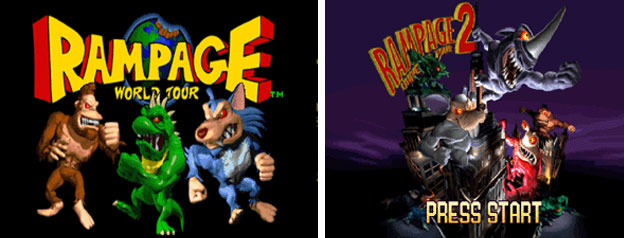
Rampage World Tour was a reboot of the franchise. It brought back Lizzie, Ralph and George and had updated the graphics, level designs, opponents and game play elements. The title did okay in the arcade but really found its stride on the home consoles. Midway realized that the era of the arcade was coming to an end and began developing the next title with the new consoles in mind, the Nintendo 64 and Playstation to be precise. In 1999 the studio came out with
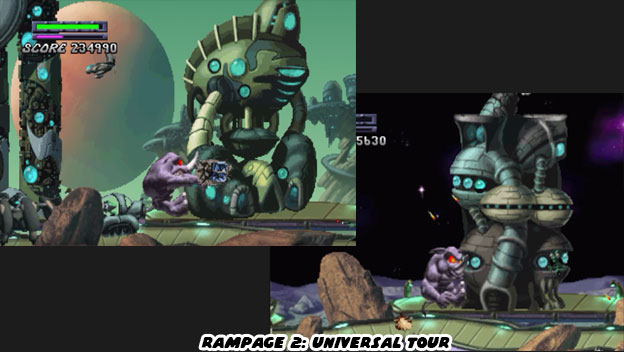
Rampage 2 Universal Tour.
Avalanche Software developed the title for Midway. The game had a slight visual upgrade over
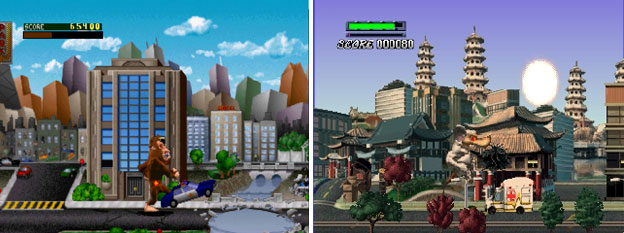
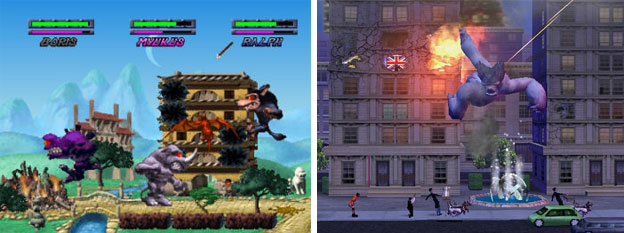
World Tour. The studio used the same rendering techniques of the arcade game. They created models for the characters on CGI workstations and then converted that data into sprites for the consoles to use. The consoles at the time were still not powerful enough to render, light and texture complex 3D objects, that's why sprite workarounds were used. Even with that shortcut to the visuals it was apparent that the backgrounds in
Universal Tour were modeled from 3D data as well. Avalanche also added a foreground layer at the bottom of the screen to add an additional sense of depth to the stages. In the original Rampage the background was either a black outline of a city or mountain. In
World Tour the background was made of flat shapes with gradients applied to them. By
Universal Tour they were actually buildings and scenery as far as the eye could see.
Midway decided that the game needed a plot and a reason for players to become invested in the series once more. The original trio had been captured by SCUM Labs and were locked up in different cities. It was up to three new giant mutations to free them. The gigantic Ruby, Boris and Curtis; respectively a lobster, rhinoceros and mouse. The new monsters searched the world for the original trio and once they were freed they became playable characters as well. The game then switched over to the second act, involving the group of monsters fending off an alien invasion. Two more monsters ended up joining the fray; Myukus and Noobus the cyclopses. The giant monsters ended up following the aliens from planet to planet
until they ended up on their home world.
This was not the first time that giant monsters had thwarted an alien invasion. Godzilla had been deterring would be conquering aliens going as far back as 1964 when he took on King Ghidorah, the challenger from Mars. The daijaiku series had become very popular among young kids, boys especially, and Godzilla changed roles. When he originally appeared he was the symbol of the atomic menace, the cautionary tale of Hiroshima. By the end of the 60's he had become a sort of super-powered hero. Other giant characters came out of the woodwork to help fill the demand for daikaiju heroes.
Gamera made his appearance in 1965 on the big screen and
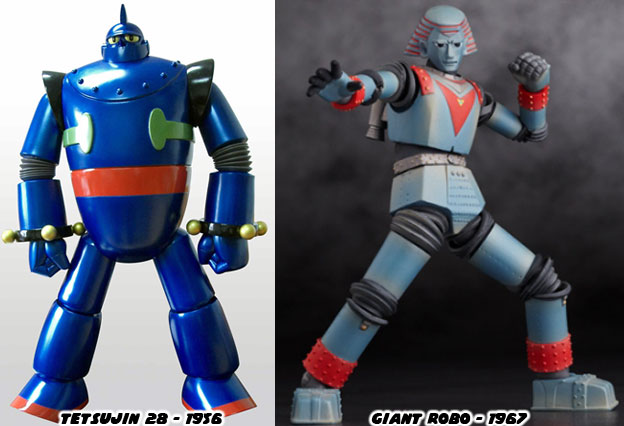
Ultraman in 1966 as a television star. These creatures were very much like the giant robots that were also popular in Japan. Mitsutero Yokoyama had created both
Tetsujin 28 and
Giant Robo. Tetsujin-28 was actually as old as Godzilla. The giant robot was more like a protective big brother in the stories than a weapon of mass destruction. They were created to fight other giant robots or even daikaiju in their own shows.
The giant monsters-as-heroes switch had happened in
Rampage 2, technically the third game in the series. Midway and Avalance Studios were keenly aware that the series had to offer a bit more than the same mechanics and jokes that had sustained the first two titles. As such
Universal Tour had to become more appealing to younger players, especially those that weren't even born when the first game was released. The studio dropped Dr. Betty and toned down the violence and gore slightly. The game became a little more campy. The humor was a bit forced. The better monster games used a slight amount of camp but felt more sincere about the genre.
Midway kept the tone of the series light and developed another sequel for the consoles in 2000.
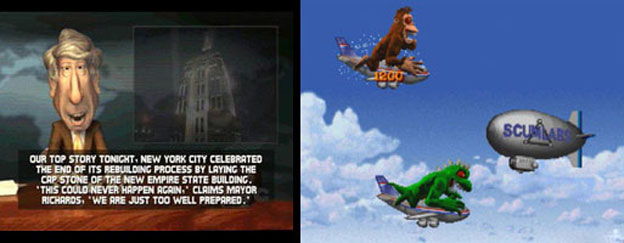
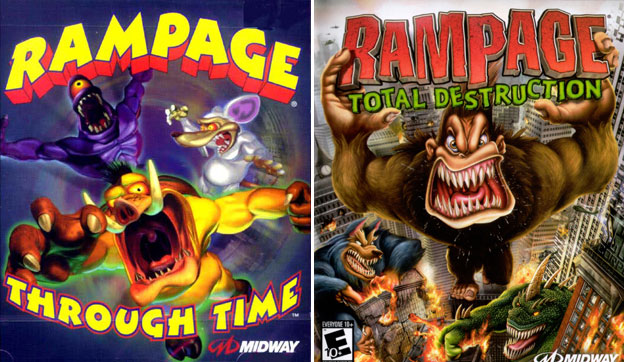
Rampage Through Time introduced yet more new characters and locations for the monsters to visit. Unlike the serious announcer that instantly hooked players in the original
King of the Monsters the
news reporter in Rampage Through Time was very silly. Despite making a game about mass destruction the titles had become very kid-friendly, perhaps to the point of losing their own identity. From a technical standpoint the games kept improving. The graphics remained sprite based on
Rampage Through Time but they didn't just reuse old assets. The character models, buildings, levels and enemies were completely redone. The characters kept their cartoonish styling but had greater fidelity. All of the classic monsters and
Universal Tour monsters returned as well.
Rampage Through Time was notable for the diversity of locations and opponents. Since players were going backward and forward through time the buildings they destroyed and enemies they fought were period appropriate. Chicago in the 1920's had gangsters shooting at the monsters with tommy guns, whereas Sapporo in the far future had flying robots defending the town. The game also introduced mini-games for the players which were very much like the arcade classics
Asteroids, Snake and
Dog Fight. Of all the versions
Rampage Through Time was possibly the best multiplayer experience. Unfortunately
the review scores had been anything but kind as the titles had progressed. It was not hard to imagine that the franchise had become overexposed.
There was an 11 year gap between the original and the reboot. That was plenty of time for new gamers to jump on board and veterans to be reintroduced to the title. Unfortunately the massive collection of similar levels with repetitive game play wore out their welcome. Then two more sequels just two years apart with minor bumps in the graphics department were not enough to keep players interested. In fact, the destruction game play that first drew people to the title had become very redundant by
Rampage Through Time. Players climbed buildings, ate people and kneecapped teammates to get ahead in the rankings. Although there weren't as many levels as
World Tour the franchise was beginning to burn out.
Midway took a six year break from the game. Pipeworks took over development duties from Avalanche. The next console exclusive title
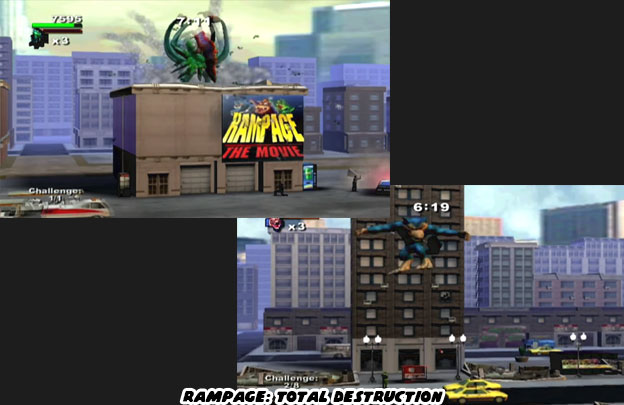
Rampage: Total Destruction was the first to be entirely rendered in 3D by the console itself. The format hadn't changed much in the time off. The
opening scene was very cartoonish and felt more like a CGI film than a game. It had the comedic timing of a DreamWorks picture as it recreated
Rampage canon. It turned out that SCUM Soda was causing genetic mutations in people all around the world and the CEO was trying to keep things under wraps. The writing was targeted at younger audiences as was the game play itself. The levels were still presented in a two-dimensional format although the monsters could now punch the fronts of the buildings as well as the sides. This pseudo 3D gameplay made the title slightly more interesting but for veteran players the game held little interest.
The ad campaign for
Total Destruction fell as flat as the comedy bits in Rampage Through Time. This was despite the best efforts of an artistic team that included 1UP community member Ryan Braman. The game seemed to have a very specific demographic, young boys that enjoyed smashing things and collecting monsters. I know that if I were 10-years-old when the game came out then I would probably be vehemently defending it right now instead of deconstructing it. The handful of monsters added in
Universal Tour were well done but by
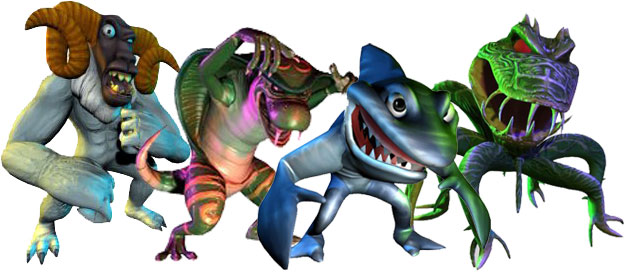
Total Destruction the series had added over 60 monsters with only the slightest difference in control and ability between them. These new creatures included a plant, french poodle, chicken, ram, tarantula and porcupine. The series had figuratively and literally "jumped the shark" when they added Marco the giant shark.
Despite the declining review scores the game still managed to sell very well, over a million units in fact. The focus on the younger gamer seemed to have paid off for Midway, at least for the short run. It turned out that
Total Destruction was the swan song from the original publisher. The company filed for bankruptcy in 2009 and sold off the rights to the games soon after. Warner Bros. picked up most of the games but the fate of Rampage was unknown. It was a sad end to a once popular and well regarded series. Of course no giant monster ever stays dead for long. Like the creatures that inspired the series expect Rampage to return from the depths of our subconscious when we least expect it. Possibly in a summer or two when the kids are out of school and looking for something to entertain them. In the next blog we shall explore the original king of the box office and find out more on Godzilla's contribution to gaming.