Showing posts with label world tour. Show all posts

Friday, March 2, 2018

The Giant Monster Series, part 12...


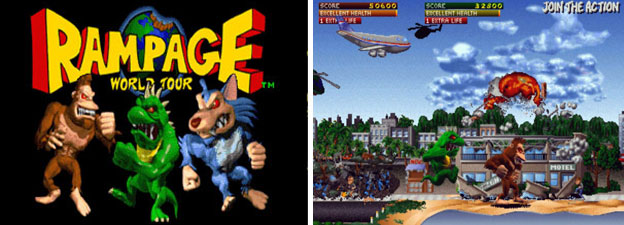
Midway returned to the giant monster series in 1997. It had been a pretty quiet time for the genre, more than a few years after the last King of the Monsters by SNK in fact. In a previous blog I talked about how Rampage World Tour was a reboot of the franchise. It brought back Lizzie, Ralph and George and had updated the graphics, level designs, opponents and game play elements. The title did okay in the arcade but really found its stride on the home consoles. Midway realized that the era of the arcade was coming to an end and began developing the next title with the new consoles in mind, the Nintendo 64 and Playstation to be precise. In 1999 the studio came out with Rampage 2 Universal Tour.
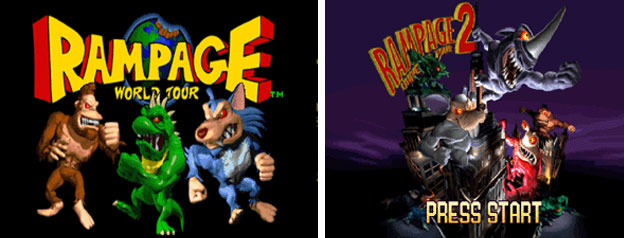

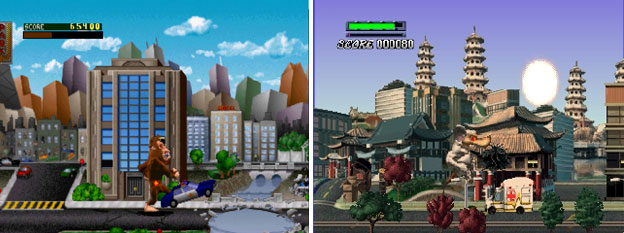
Avalanche Software developed the title for Midway. The game had a slight visual upgrade over World Tour. The studio used the same rendering techniques of the arcade game. They created models for the characters on CGI workstations and then converted that data into sprites for the consoles to use. The consoles at the time were still not powerful enough to render, light and texture complex 3D objects, that's why sprite workarounds were used. Even with that shortcut to the visuals it was apparent that the backgrounds in Universal Tour were modeled from 3D data as well. Avalanche also added a foreground layer at the bottom of the screen to add an additional sense of depth to the stages. In the original Rampage the background was either a black outline of a city or mountain. In World Tour the background was made of flat shapes with gradients applied to them. By Universal Tour they were actually buildings and scenery as far as the eye could see.

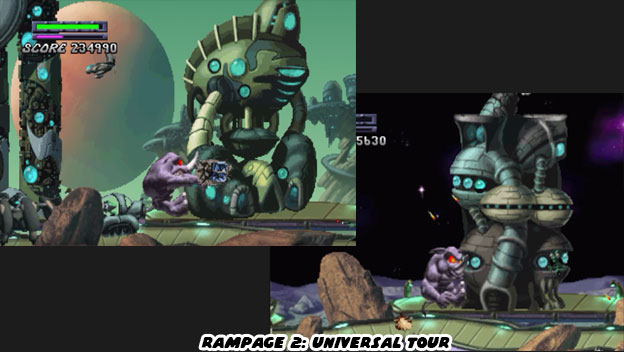
Midway decided that the game needed a plot and a reason for players to become invested in the series once more. The original trio had been captured by SCUM Labs and were locked up in different cities. It was up to three new giant mutations to free them. The gigantic Ruby, Boris and Curtis; respectively a lobster, rhinoceros and mouse. The new monsters searched the world for the original trio and once they were freed they became playable characters as well. The game then switched over to the second act, involving the group of monsters fending off an alien invasion. Two more monsters ended up joining the fray; Myukus and Noobus the cyclopses. The giant monsters ended up following the aliens from planet to planet until they ended up on their home world.

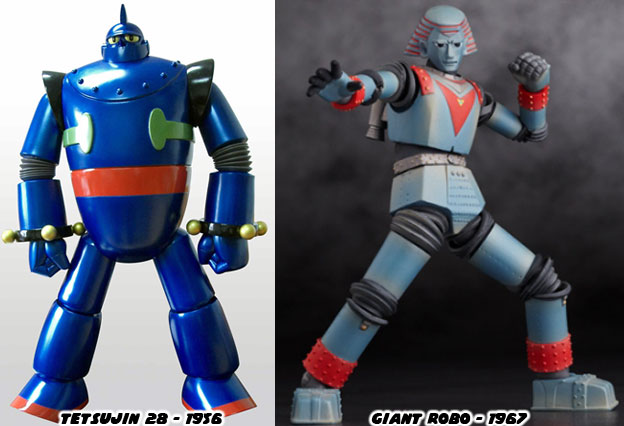
This was not the first time that giant monsters had thwarted an alien invasion. Godzilla had been deterring would be conquering aliens going as far back as 1964 when he took on King Ghidorah, the challenger from Mars. The daijaiku series had become very popular among young kids, boys especially, and Godzilla changed roles. When he originally appeared he was the symbol of the atomic menace, the cautionary tale of Hiroshima. By the end of the 60's he had become a sort of super-powered hero. Other giant characters came out of the woodwork to help fill the demand for daikaiju heroes. Gamera made his appearance in 1965 on the big screen and Ultraman in 1966 as a television star. These creatures were very much like the giant robots that were also popular in Japan. Mitsutero Yokoyama had created both Tetsujin 28 and Giant Robo. Tetsujin-28 was actually as old as Godzilla. The giant robot was more like a protective big brother in the stories than a weapon of mass destruction. They were created to fight other giant robots or even daikaiju in their own shows.

The giant monsters-as-heroes switch had happened in Rampage 2, technically the third game in the series. Midway and Avalance Studios were keenly aware that the series had to offer a bit more than the same mechanics and jokes that had sustained the first two titles. As such Universal Tour had to become more appealing to younger players, especially those that weren't even born when the first game was released. The studio dropped Dr. Betty and toned down the violence and gore slightly. The game became a little more campy. The humor was a bit forced. The better monster games used a slight amount of camp but felt more sincere about the genre.
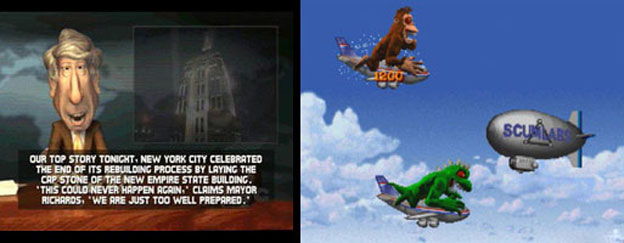

Midway kept the tone of the series light and developed another sequel for the consoles in 2000. Rampage Through Time introduced yet more new characters and locations for the monsters to visit. Unlike the serious announcer that instantly hooked players in the original King of the Monsters the news reporter in Rampage Through Time was very silly. Despite making a game about mass destruction the titles had become very kid-friendly, perhaps to the point of losing their own identity. From a technical standpoint the games kept improving. The graphics remained sprite based on Rampage Through Time but they didn't just reuse old assets. The character models, buildings, levels and enemies were completely redone. The characters kept their cartoonish styling but had greater fidelity. All of the classic monsters and Universal Tour monsters returned as well.
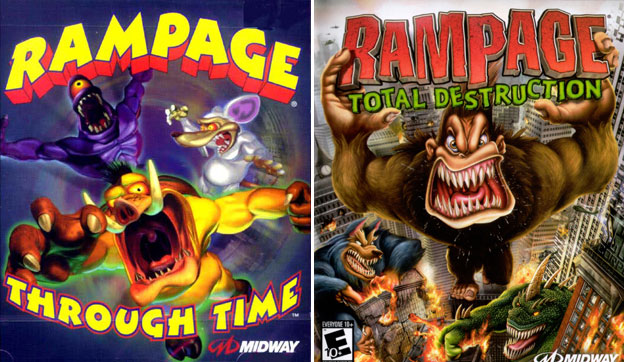

Rampage Through Time was notable for the diversity of locations and opponents. Since players were going backward and forward through time the buildings they destroyed and enemies they fought were period appropriate. Chicago in the 1920's had gangsters shooting at the monsters with tommy guns, whereas Sapporo in the far future had flying robots defending the town. The game also introduced mini-games for the players which were very much like the arcade classics Asteroids, Snake and Dog Fight. Of all the versions Rampage Through Time was possibly the best multiplayer experience. Unfortunately the review scores had been anything but kind as the titles had progressed. It was not hard to imagine that the franchise had become overexposed.

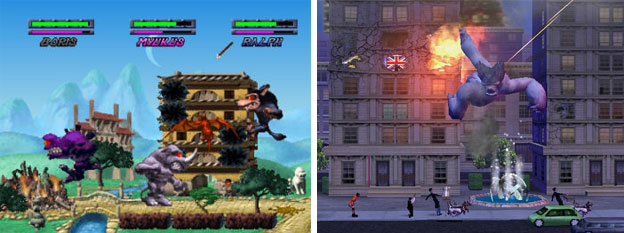
There was an 11 year gap between the original and the reboot. That was plenty of time for new gamers to jump on board and veterans to be reintroduced to the title. Unfortunately the massive collection of similar levels with repetitive game play wore out their welcome. Then two more sequels just two years apart with minor bumps in the graphics department were not enough to keep players interested. In fact, the destruction game play that first drew people to the title had become very redundant by Rampage Through Time. Players climbed buildings, ate people and kneecapped teammates to get ahead in the rankings. Although there weren't as many levels as World Tour the franchise was beginning to burn out.

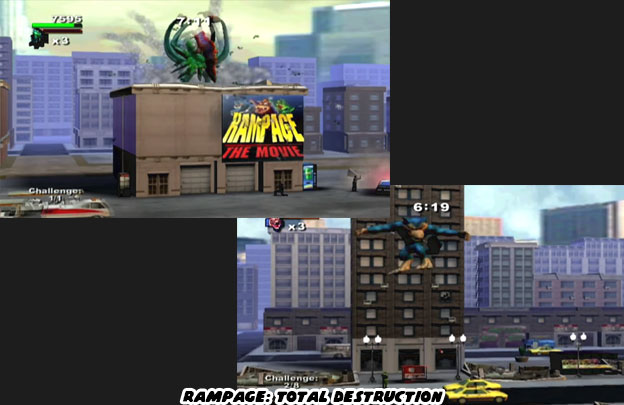
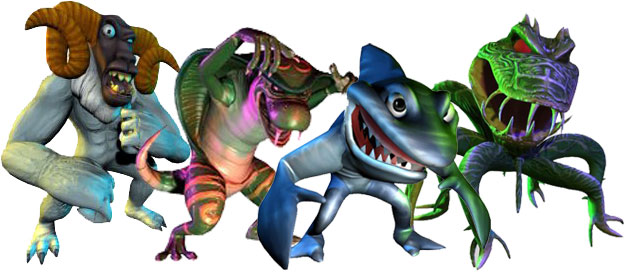
Midway took a six year break from the game. Pipeworks took over development duties from Avalanche. The next console exclusive title Rampage: Total Destruction was the first to be entirely rendered in 3D by the console itself. The format hadn't changed much in the time off. The opening scene was very cartoonish and felt more like a CGI film than a game. It had the comedic timing of a DreamWorks picture as it recreated Rampage canon. It turned out that SCUM Soda was causing genetic mutations in people all around the world and the CEO was trying to keep things under wraps. The writing was targeted at younger audiences as was the game play itself. The levels were still presented in a two-dimensional format although the monsters could now punch the fronts of the buildings as well as the sides. This pseudo 3D gameplay made the title slightly more interesting but for veteran players the game held little interest.

The ad campaign for Total Destruction fell as flat as the comedy bits in Rampage Through Time. This was despite the best efforts of an artistic team that included 1UP community member Ryan Braman. The game seemed to have a very specific demographic, young boys that enjoyed smashing things and collecting monsters. I know that if I were 10-years-old when the game came out then I would probably be vehemently defending it right now instead of deconstructing it. The handful of monsters added in Universal Tour were well done but by Total Destruction the series had added over 60 monsters with only the slightest difference in control and ability between them. These new creatures included a plant, french poodle, chicken, ram, tarantula and porcupine. The series had figuratively and literally "jumped the shark" when they added Marco the giant shark.

Despite the declining review scores the game still managed to sell very well, over a million units in fact. The focus on the younger gamer seemed to have paid off for Midway, at least for the short run. It turned out that Total Destruction was the swan song from the original publisher. The company filed for bankruptcy in 2009 and sold off the rights to the games soon after. Warner Bros. picked up most of the games but the fate of Rampage was unknown. It was a sad end to a once popular and well regarded series. Of course no giant monster ever stays dead for long. Like the creatures that inspired the series expect Rampage to return from the depths of our subconscious when we least expect it. Possibly in a summer or two when the kids are out of school and looking for something to entertain them. In the next blog we shall explore the original king of the box office and find out more on Godzilla's contribution to gaming.

Friday, February 23, 2018

The Giant Monster Series, part 9...


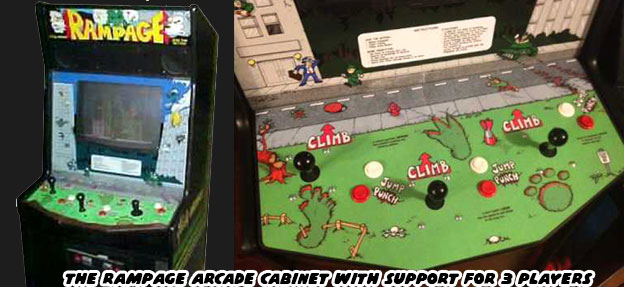
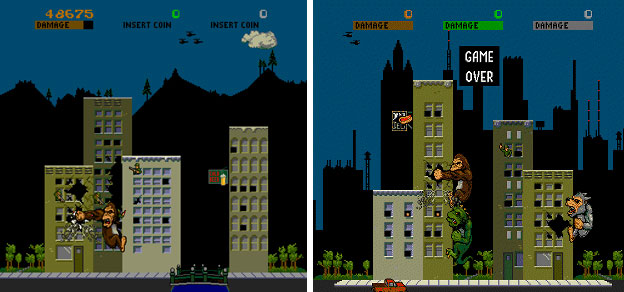
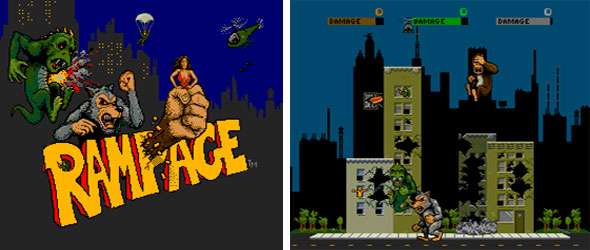
Rampage by Bally Midway was the other giant monster game from 1986. Most long-time gamers would tell you it was the ONLY giant monster game that year. It set the standard by which all other giant monster games would be measured and rightfully so. The arcade hit introduced three monsters into game canon. Lizzie, George and Ralph, a giant lizard, ape and werewolf respectively. The creatures were barely three stories tall, ranking them among the "shortest" giant monsters ever created. Bally Midway still managed to create a movie spectacle atmosphere with the trio. The gameplay lived up to the title, the monsters were rampaging through the continental US. Going from city to city and leveling all of the buildings was the objective. Never before had arcade visitors been offered this type of wanton destruction. They ate it up in droves, pumping quarter after quarter into a game that never seemed to end. Bally Midway managed to find the sweet spot for arcade manufacturers because audiences could never get enough of it.


Each level consisted of a single-screen "city." It was up to the players to climb onto buildings and then punch out the windows and foundations. When the monster had inflicted enough damage onto the structure it would collapse and reward them with a bonus. Destroying a city was only part of the charm to the game. Players were assaulted from all sides by the military. They could take damage from the tiny pixelated bullets and explosives. In order to recover their health the monsters could eat the humans they came across. Whether they were scooping soldiers off the street or snatching people from their apartment windows there was a satisfying crunch that the monsters made when they chewed on them. The game offered tremendous layers of detail. No two cities were exactly alike, neon signs, shops and the silhouette in the background would change in each town. Some cities had rivers for players to jump over or subway cars to knock around, Players could even jump from rooftop to rooftop and swat helicopters from the sky. The sense of scale and devastation was well presented but the game was best experienced when multiple players were going head-to-head.


By offering three sets of joysticks and attack buttons on a single cabinet Bally Midway was able to triple the potential for revenue. Many arcade visitors enjoyed competing against each other for a top score. Instead of playing one at a time for the score they could now compete in a three-way battle. This was not only a perfect set up for the arcade but also wherever friends would hang out, like at the local 7-11 or even bar. The dark humor of eating people and smashing buildings was perfect fit for the teen crowd. The players could punch each other and knock their opponents off of buildings. Some players waited until a building was almost ready to collapse before knocking their opponent off and taking down the last of the foundation. It was a dirty tactic but everything was fair while terrorizing the major cities.


Rampage was a certifiable hit. It was released on multiple platforms not long after it debuted. Bally Midway did not follow up with a sequel right away. They were trying to keep up with changes in taste and technology. That meant that the studio was constantly developing different types of experiences. Rampage was just one of the memorable titles they released. Other classic arcade hits included Defender, Joust, Robotron 2084, Tapper, Spy Hunter and Tron. In later years they developed NBA Jam, Mortal Kombat, Hydro Thunder, Cruis'n USA and Smash TV. There was little reason for the developer to focus much on Rampage when they seemed to be cranking out hit after hit.

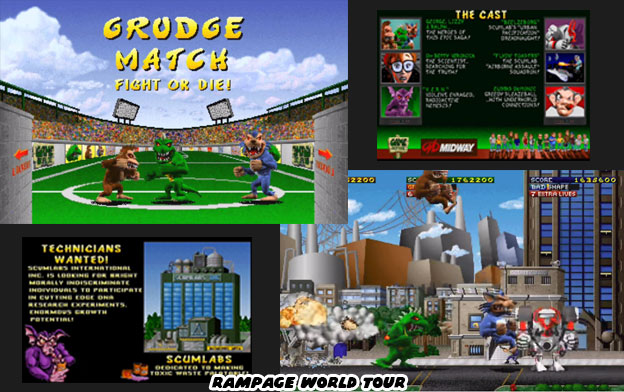
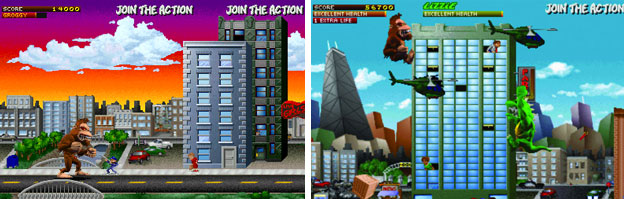
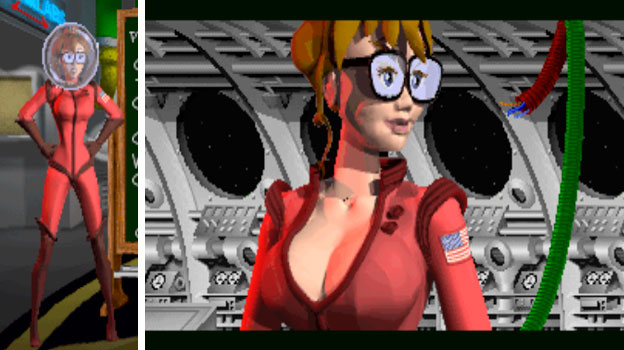
The trio of monsters got a chance to shine once more. Rampage World Tour debuted from Midway in 1997, 11 years after the original debuted. The new game fleshed out the universe of Rampage, tried to add a plot and introduced some new faces including the leggy Dr. Elizabeth "Betty" Veronica. The graphics were completely redone for this game. The characters and backgrounds were still composed from sprites however the sprite data was rendered from CGI workstations. The new sprites had far more color, depth and resolution. The buildings, traffic and scenery all preserved this new level of detail.


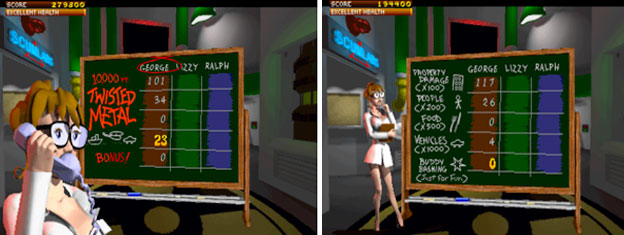
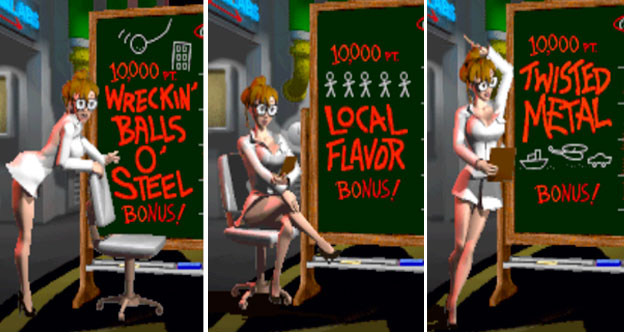
This time George, Lizzy and Ralph were the results of the toxic radiation from SCUM Labs. The monsters had a vendetta against the lab and set out on a global tour of destruction. They visited every major city in the US as several major cities around the world that hosted a SCUM Lab. This type of game completely opened up the genre that Bally Midway had established. Instead of one-screen levels the monsters could now walk left or right and access several screens worth of buildings to destroy. The sheer volume of new enemies, vehicles and civilians to interact with was mind boggling. Hundreds of animations were created for all of the new characters on screen. Kids could be seen skateboarding on the street, old ladies hobbling along on their walkers and even hot dog vendors pushing their carts. Soldiers advanced on the monsters, civilians ran, screaming for their lives. Jets, helicopters, robots, ufos and even jet-pack wearing heroes all took shots at the monsters. Dr. Betty was introduced early on. She was in contact with Eustas DeMonic the CEO of SCUM Labs and giving him an update on all the destruction that the monsters were causing.


Dr. Betty did more for players than simply act as a scorekeeper. I was a little kid when the first game came out. I was drawn to the monsters and chaos at that age. I was now a teenager giving the franchise a second look. I needed something more than the monsters to hold my attention. I was keenly aware of why Midway put Dr. Betty in the game. I would consider her the first pin-up girl of gaming. A less famous Jessica Rabbit for arcade visitors. She certainly offered plenty of eye candy in between the levels and helped keep me interested as the levels became more redundant.


The game was very much like the original. It was a chance for Midway to take as many quarters from arcade visitors as they could. The monsters seemed to take damage more easily than in the original game. Enemies would attack from both sides and sometimes pin the players down so they would lose all their health. Many encounters in the game felt cheap, It was as if Midway was going to make it painfully obvious what the purpose of the company was. The publisher did find ways to keep gamers from rioting. Some levels offered ways for players to recover health quickly and sometimes more than what they started with. The sheer volume of cities that players could visit was staggering, it was well over 100 and there certainly was no way for any arcade visitor to see all of those locations on just one quarter, one dollar or even 10 dollars. It didn't stop Midway from trying to keep the attention of players.


Midway introduced a few new mechanics for players to enjoy. Instead of having to scale up and down the sides of buildings, punching out one floor at a time, a player could stand on top of the building and jump on it and punch it until the entire unit collapsed. Players that fell from high floors took damage however players that pressed the jump button repeatedly could float down. It was a hilarious animation as the three monsters flapped their arms like cartoon characters in order to stay airborne. What the monsters ate not only gave them health but also introduced hidden animations. If a character ate an explosive they might burp up flame and smoke, if they ate a poison then they might vomit. Players that ate certain radioactive containers could build up for a transformation. Any character in the game could mutate into a winged purple monster nicknamed V.E.R.N. the violently enraged radioactive nemesis. In this form players could fly all over the screen and rack up tons of points. V.E.R.N. took damage at a slower pace and could hold his own against the giant robots that turned up in latter levels.


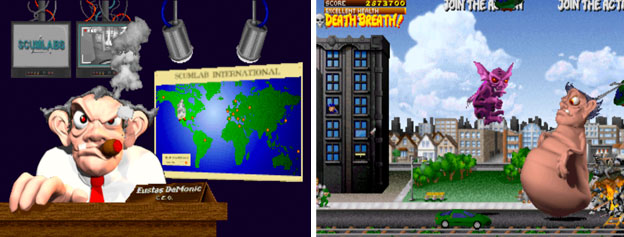
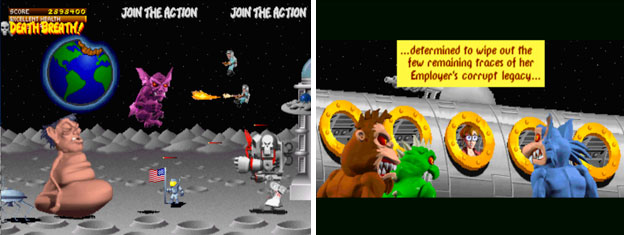
The main villain would be seen on some cut scenes. The CEO of SCUM Labs was a cigar chomping corporate-tycoon named Eustas DeMonic. Near the end of the game he got fed up with the monsters and mutated himself in order to take them on. The swollen bouncing Eustace was easily three times the size of the original creatures. He could flatten them simply by jumping on them. Thankfully the monsters could all gang up on him and take him down or wait to turn into V.E.R.N. to have a better 1-on-1 battle.


Once the player had destroyed every city on the map they were moved on to the final stages. Toxic Hollow in the USA and Luna Tech on the Moon. Toxic Hollow offered players a chance to battle Eustace one more time on Earth before facing him on the moon. Of course I didn't mind the trip to the Moon because it gave players a chance to see Dr. Betty in her skin tight space uniform.


On the moon players could see the damage they had done to Earth. A large bite shaped chunk was missing from the planet. Eustace, the military and even Dr. Betty were all determined to make a final stand. The buildings and scenery on Luna Tech were right out of classic science fiction storytelling. Buildings had habitable gardens and parks encased under domes on the roofs of the space towers. There were UFOs and other armed astronauts patrolling the level. The classic Lunar Lander and Alan Shepard holding the US flag from Apollo 14 could be seen in the background. These details were great, especially since the monsters could eat Alan and the Lander if they wanted.


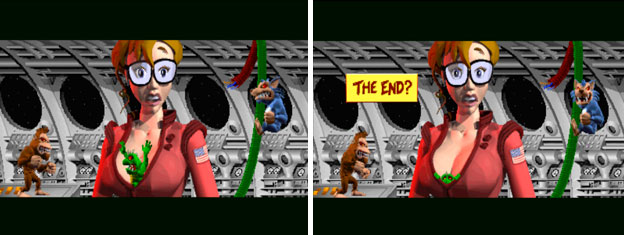
After players had destroyed everything that they could on the moon then the final cinema played out. Dr. Betty landed on her rocket ship and blasted the trio with a shrinking ray. When the monsters had disappeared from sight the ship took off once more to Earth. It turned out that the sole survivor from SCUM Labs was not alone on the ship. Very few people saw the ending of Rampage World Tour. Midway left the ending open for repeat visits from the monsters. There were three other games published after World Tour but sadly any trace of Dr. Betty and Eustas were stripped from sequels. The giant monster genre had its first certifiable arcade hit. George, Ralph and Lizzie could even be considered the first recognizable mascots for the genre. I was bummed out that Dr. Betty would be nothing more than a footnote in history, she could have been a contender, especially a 50-foot version of her in a sequel.


Between the work of PC publisher Epyx and Bally Midway the monster template had been set. Gamers enjoyed the destruction with none of the pretense. If the action alone was enough to hold the attention of some gamers for over a hundred levels then perhaps other studios could find ways of making their own titles more memorable. The Japanese would answer the challenge in the early 1990s. The next blog will look at the giant monster game that I consider one of the most difficult but rewarding experiences ever. Please return for that entry.