Privateer Press did the same thing for giant monsters and tabletop games in 2009 that Incog Inc. had a few years earlier for video games. Both studios started a game project as a love letter to the genre but then it evolved into a great contribution to the genre in its own right. The studios had created their own legacy, they introduced players to enormous creatures layered in personality while battling for supremacy in fun locations the world over. The only difference was that Privateer was working on a tabletop system instead of a video game. I had talked about the little American company that could back in 2007 when they were offering tabletop game players a fresh perspective. They were challenging the status quo of the big overseas studios that seemed to dominate the market.
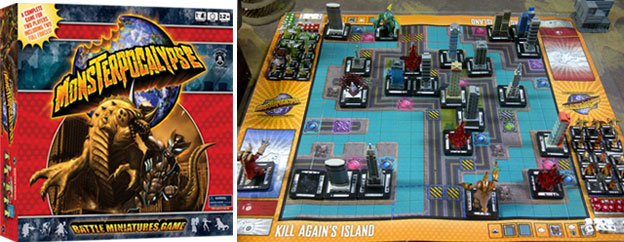
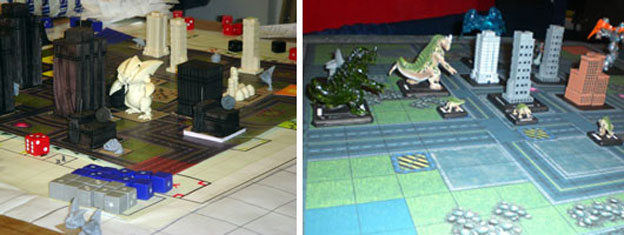
Game designers Matt Wilson and Erik Yaple wanted to create a miniatures based game system that could rekindle the memories of the classic monster films. They started off by making a list of all the things that they enjoyed about the genre. Big monsters fighting, cool military weapons, detailed buildings and plenty of destruction were at the forefront. The system they put together was lovingly called
Monsterpocalypse. It had a straightforward play mechanic which allowed for plenty of back and forth action between the gamers. The best portions actually predated some of the design elements that Richard Garfield incorporated into his King of Tokyo game. The creatures in
Monsterpocalypse could evolve, grow powers and abilities but they did so by controlling buildings and areas in the game instead of through randomly played cards. I had been keeping tabs on
Monsterpocalypse back when they were play testing it at various gaming conventions.
In the early days Privateer took their paper templates, unfinished resin models and rough plastic buildings to local game stores in the Pacific Northwest as well as the larger conventions. At the time Privateer had earned a dedicated following through their grassroots campaign. The
Warmachine and
Hordes systems quickly grew and the company expanded to create their own line of paints and even magazine to support the community. Players were eager to see what new projects they were working on, especially since the company had a reputation for being fairly open and transparent. As
Monsterpocalypse evolved the maps went from graph paper to colored pencil illustrations and eventually laser printed pages. The studio was running on a very tight margin and deadline. As the miniature sculpts were being finished the company was using all the feedback they received to clarify the rules and balance the game. Like many of their systems the goal was to keep players engaged at every level of the development.
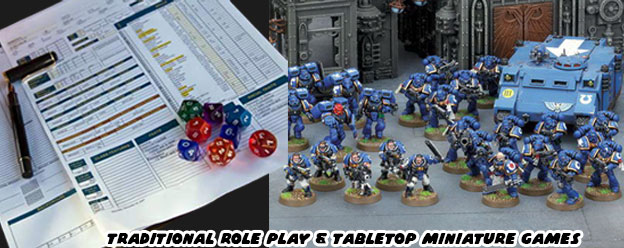
Privateer was going to release this system as their first pre-painted miniatures game, this decision raised the ire of many traditionalists. Fans of classic tabletop systems believed that all great systems required a hobby element on top of a solid play element. Role-playing audiences were supposed to keep track of character stats and unit special abilities with character sheets that they created and updated by hand with every game. Participants of tabletop systems were supposed to assemble and paint their own miniatures and models, anything less than that was considered a product for the toy store. To further set things apart Privateer would also be using counters and ability markers on the miniatures themselves.
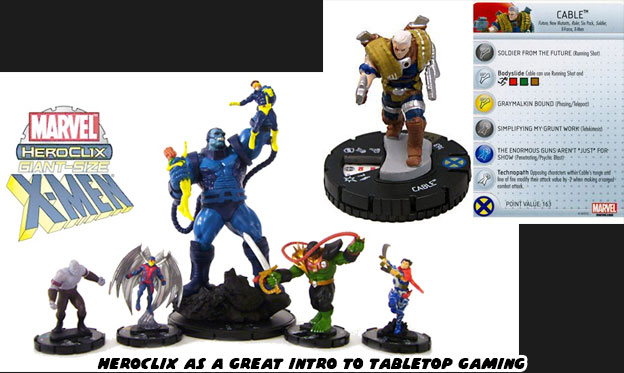
This approach to tabletop gaming was made popular by
Wizkids Heroclix series, which licensed characters from Marvel, DC and other properties into an easy-to-play tabletop system. The
Clix games were a great way to introduce younger gamers to the genre. The built in counters on the bases of the figures were cleverly designed to keep tabs of important things for the characters. Strength, stamina, movement, powers and agility could be found right on or under the models. As players battled they could wind down the stats on the miniatures until an opponent was defeated. No more keeping track of stats on a separate sheet! Hobbyists were worried that Privateer might "dumb down" all of their systems and switch to pre-painted plastic models. Privateer assuaged their fears by reminding them that
Monsterpocalypse was a unique stand alone game and that the other systems would not be affected by the new manufacturing techniques.
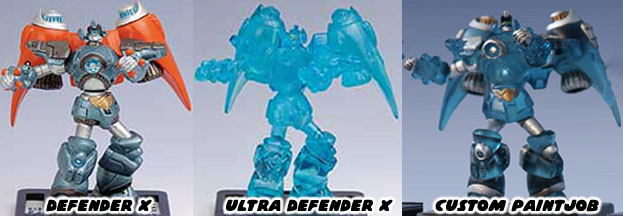
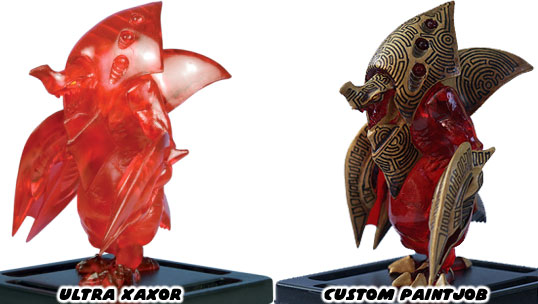
The hobby aspect itself was not affected by the use of pre-painted miniatures. Thanks to new production methods the largest and smallest figures all received great paint jobs. Those that were not experienced painters did not feel put out when starting a collection. However those with some skills and a great imagination were more than welcome to recolor and repaint entire armies. For example, the largest monsters in the game can undergo a transformation in their power level, these "Ultra" forms of the character were represented by by clear or sometimes opaque plastic models. Many in the gaming community thought that the Ultra figures were lackluster. By going with a completely transparent color all of the great details from the sculpt were lost. That was until artists began coloring portions of these Ultra forms. The
custom Monsterpocalypse paintjobs by Martin Whitmore were a prime example of what could be done to make the miniatures more interesting.
The default paint job for
Defender X was great out of the box. The character was inspired by classic Japanese mech designs including
Mazinger-Z who was a member of
the Shogun Warrior robots. The blue tint Ultra version lost a lot of the detail, especially as light passed through the surface. Mr. Whitmore picked out some details in gold and silver with a paintbrush to make his figure stand out. He did the same for several clear and pre-painted figures as well. He demonstrated to the community that even by using one or two extra colors a model could be made to stand out. His gold and black highlights to
Ultra Xaxor inspired many players, especially newcomers, not to be afraid to customize their own figures.
The success of Monsterpocalypse was certainly due more to just the great miniatures that Privateer was putting out.
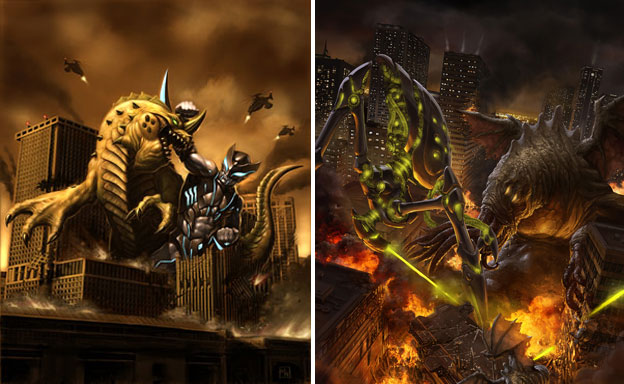
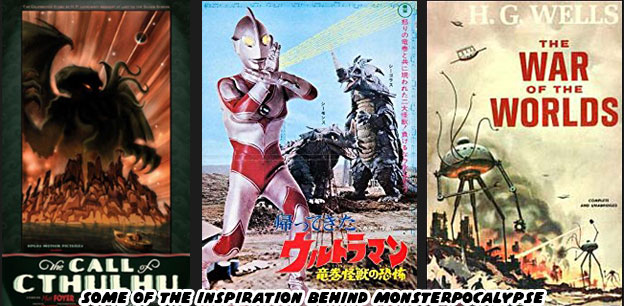
The system may have begun trying to recreate the battles from classic cinema but it grew to include influences from the science fiction and horror genres.
Godzilla-like creatures could do battle with giant humanoid or
Ultraman-like robots. It was daikaiju nirvana but the universe turned out to be far more expansive and violent than that! There were at least two alien species had decided to invade the Earth at the same time. One group was comprised of the classic UFO ships and
War of the Worlds machinations. The other group were more like the daikaiju villains, giant sentient beings bent on total destruction. These aliens were met by another inter-dimensional being, an ancient creature that was a reminder of the monster from classic HP Lovecraft mythology. The creatures and robots were given purpose which helped shape the factions of the universe. Some monsters could partner up while others were strictly enemies. Players learned to field the armies that appealed the most to them. The first wave of factions were released over three expansion sets. The original release of
Monsterpocalypse was titled
Rise! The following was
I Chomp NY and third was
All Your Base. Readers could probably guess what the focus was on each release.
The first six factions were introduced in
Block 1. These teams included
GUARD, whose scientific consortium had built a giant robot that acted like a UN peacekeeper.
The Lords of Cthul, the ancient creatures focused on enslaving the planet. The
Martian Menace and
Planet Eaters who needed no further explanation.
The Shadow Sun Syndicate was a powerful organization founded by the Yakuza. They had created the ninja-like titans. Finally there were the
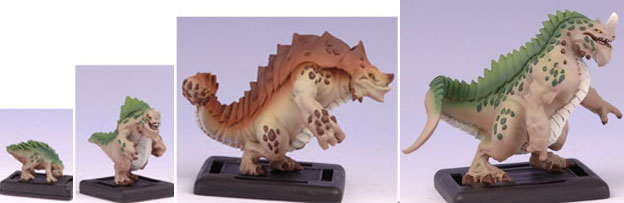
Terrasaurs, the dinosaur-like creatures that wanted to restore nature by reclaiming civilization. Each of these factions were supported by different sized units. It was actually the smaller troops that made
Monsterpocalypse unique, especially when compared to the other games I had been writing about.
Giant monsters were supported either by organic or inorganic creatures. The smallest creature would be the size of a military transport truck while the largest would be as big as a skyscraper. The giant robots had traditional military weapons backing them up. Some were supplemented by incredible science fiction technology, think of the
Maser Cannon and
Super X from the Godzilla films, variations of these fantastic weapons were in the game. The diversity in scale for the creatures, robots and weapons made this universe among the most robust ever created. Imagine a videogame where characters from
Rampage, War of the Monsters, Earth Defense Force and
King of the Monsters were all playable. Now imagine if that system had miniatures produced for everything, including the levels and landmarks. It was the ultimate celebration of the genre in tabletop format.
The popularity of the game took off as the studio released wave after wave of scenarios and supplemental miniatures. They continued to push the system at gaming conventions, as well as PAX and the San Diego Comic Con. The word of mouth was tremendous for the game. Privateer continued on expanding the universe to include a second set of factions. Fans of the genre were surprised with how many obvious choices comprised
Block 2 and the expansions
Big In Japan and
Monsterpocalypse Now! These new units could help make a great game even better. There was the
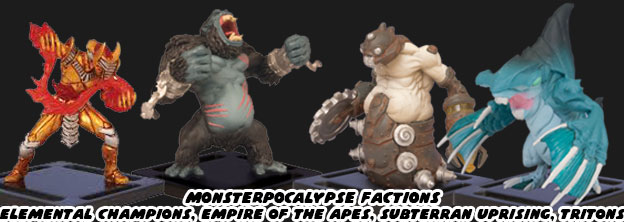
Empire of the Apes, consisting of gigantic intelligent apes and the Savage Swarm, made up of enormous insects. Those two were pulled from some of the oldest film influences. Then there were the giant mole creatures that made up the
Subterran Uprising and the
Elemental Champions which were monks that created weapons out of the elements. Think of the monks as each having the powers of Ang from
Avatar: the Last Airbender. When they combined their forces they could create giants made up of fire, water, earth, air and metal. Creatures from the deep ocean were even turned into giant monsters through the
Tritons.
It was very clever how Privateer explained some of the new factions while appealing to the classic kaiju formula. For example,
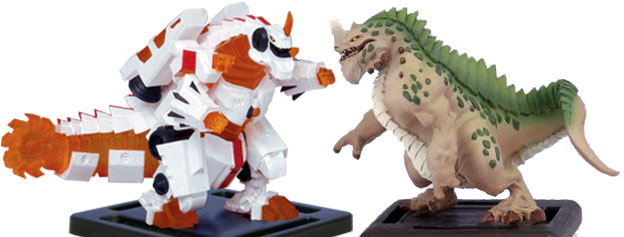
UberCorp International were comprised of multinational military contractors, they were selling defensive units modeled after the monsters and aliens themselves. Only the richest nations could afford to purchase the massive weapons of destruction. This jab at profiteering was not too subtle but appropriate considering that the other corporate faction in the game was founded by the Japanese mafia. UberCorp was a way to get "mecha" versions of the most popular creatures in the game. The miniatures that Privateer created for them were very unique, they did not simply look like silver versions of the existing characters but were instead built of translucent material and white armor. These giant machines mirrored the
Planet Eaters, Lords of Cthul and Terrasaurs.
As the system expanded players learned that games did not have to be limited to 1-on-1 battles. The maps, buildings and rules could be scaled to include 2 vs 2, 4 vs 4 or even all 12 factions at once. The game play usually revolved around the monsters controlling or destroying buildings on specific maps, when these maps were laid side by side they could create gargantuan layouts encompassing several tables. The battles that gamers had during tournaments was bigger and badder than what any other system promised. Those new to tabletop gaming were blown away by what was possible on certain systems. The best part was that players did not have to build scenery or carry around delicate models in order to enjoy the game. Each map was double sided and could be folded and stacked. The miniatures were already painted, light but very sturdy. The time and cost of getting into the system was less expensive than any of the more popular games. Players could still invest their time and money and continue to build and collect the various factions. The best part was that players could set up a game anywhere there was a little bit of space available.
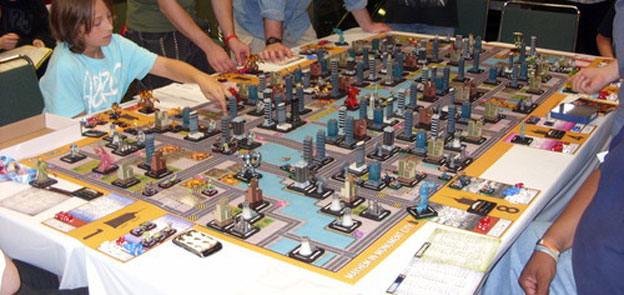
The little game about big monsters had quickly built a dedicated following. It was a unique convergence of giant monster fans and tabletop gaming fans that helped build a reputation in the community. Yet it seemed to disappear almost as quickly as it popped up on the convention circuit. Find out how internal decisions and outside interests killed the momentum for
Monsterpocalypse in the next blog.