Showing posts with label dlc. Show all posts

Wednesday, April 18, 2018

The rise of Falke, or how military design works in fighting games...

The newest Street Fighter V character has just been announced. A former Shadowlaw / Shadaloo super soldier that goes by the name of Falke. She debuts on April 24, 2018 as part of Season 3. In this blog we're going to break down the character, her powers, inspiration and the military motif being used in the genre.
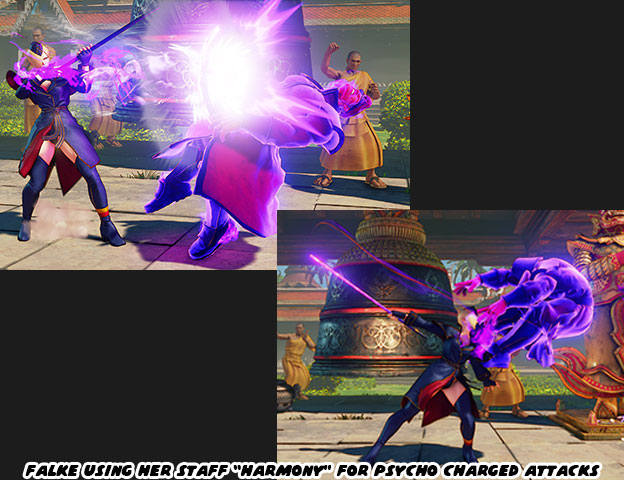

Falke has some very unique powers. As a former Shadowlaw soldier she was subject to experimentation and fight training. This gave her the ability to use "Psycho Power" the psychic energy that allows organization leader Vega / M. Bison / The Dictator to fly, teleport, and even shoot fireballs. Ed was also experimented on and uses his psycho energy to generate awesome punches and even psychic webs. Every major Shadowlaw character in the series uses psycho power a little bit differently. Falke actually channels her energy through a fighting staff which she nicknames Harmony. She can send projectiles of psycho energy through the air, as if they were bullets. She can also fill the staff with psycho energy and use it as a sword. This makes her game play style very unique in Street Fighter V. Her effective distance for strikes is increased over regular hand-to-hand fighters thanks to the staff and because of her psycho power she has the ability to shoot psychic projectiles at range.
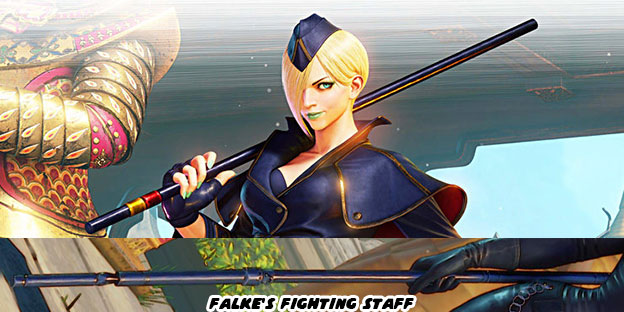

Falke's fighting staff seems to be made in sections and out of a unique composite material. It seems to be metal and not really flexible. If you look at it closely you can see where the staff is screwed together. Also when an alternate costume is selected the staff changes shape slightly as well. It looks collapsible now, almost like a walking stick. Also this variation of the staff has a muzzle diffuser,  these are the small holes that would normally be seen on the tip of a rifle. Perhaps this acts as a blast diffuser, a feature on some firearms that helps focus the energy of a bullet forward instead of out to the sides. In the case of Harmony the diffuser could focus psycho energy in a specific direction. Little details like this help reinforce the overall military look that the designers at Capcom were going for.  
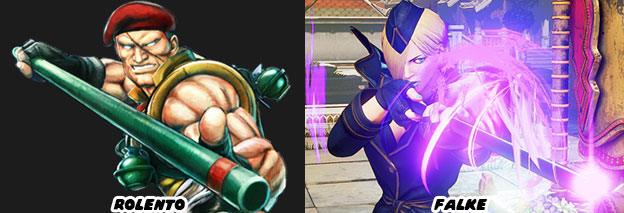

Of course the first thing that many people commented on when Falke was announced was how because she fought with a staff she seemed to be the new Rolento. Well let's talk a little bit about this. Using a staff or any other weapon in Street Fighter is not a new idea. In the original Street Fighter (1987) the ninja Geki had a claw and threw shuriken aka ninja stars. In England the fighter named Eagle used two fighting sticks. The name Falke is actually German for Falcon. I doubt she is related to Eagle because his name was a golf pun. The other fighter from the UK was named Birdie. But I digress... Maki from Final Fight 2, Street Figher Zero 3 fought with a tonfa. Ibuki from Street Fighter 3 (1997) also threw shuriken. Rolento returned in Street Fighter Zero 2 (1996) but he originally debuted in Final Fight (1989) as a boss for Mad Gear. He appeared a few more time in the series, always fighting with his staff and throwing grenades at opponents. These moves were adapted into Street Fighter. The first female to actually use a staff in the series was Nanase in Street Fighter EX 2 (1999). 
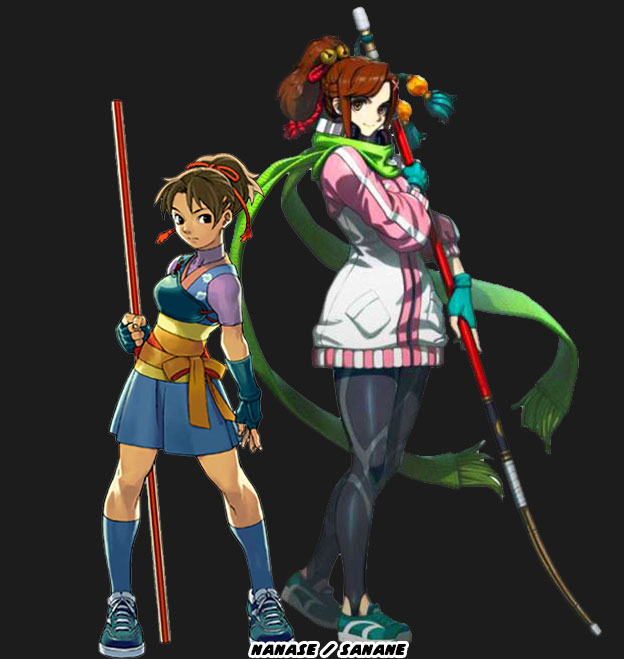

Nanase was the younger sister of Kairi and Hokuto, the two main characters in the story arc of the EX series. Nanase was being groomed to lead the Mizugami clan in the event that anything happened to her elder siblings. Of course in storytelling fashion they both disappeared and she was thrust into the spotlight. She had to track them down and prove her worth in the EX tournament. Because she was a kid it wouldn't have made sense for her to compete hand-to-hand against adults no matter how talented she was. This was why she was designed with a weapon in hand, a bo to be exact. It was a regular wooden bo, nothing special like Falke's staff. Nanase might have been half as big as Ryu but with the staff she had more range than he did and the ability to hit almost as hard. In the updated version of the EX story she is a little older, her memory of Hokuto is wiped but she remembers her fight training. Now going by the name Sanane, an anagram of Nanase. Falke did not move or fight like Nanase, or for that matter any other weapons-based character from the Street Fighter universe. 
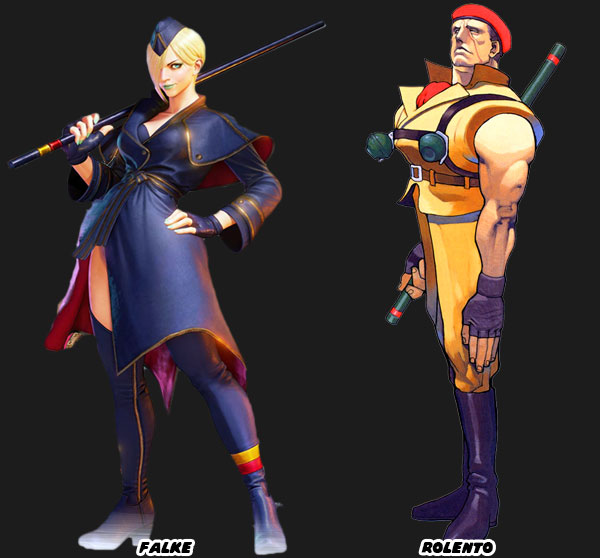

Falke focused her psycho energy through Harmony. She didn't really thrust with it like Nanase, or spin it quickly as with Rolento. It was an extension of herself rather than a weapon. The precision with which she used it was done in a very militaristic fashion. She squared Harmony with her shoulder as if it were a rifle when firing bolts of psycho energy. Without it I don't know how effective of a fighter she would be or if she could even control her psycho power. Ed on the other hand knew how to box, trained by former champ M. Bison / Boxer. He could also use his psycho energy in hand-to-hand combat. In canon fighters like Rolento and Nanase would not be at a loss without their staff. They still had training to fall back on. I wouldn't guess the same thing could be said of Falke. Like Rolento however her design worked in the series because it kept up the military aesthetic. Shadowlaw was made up of mostly soldiers. Looking at the cut of Ed and Falke's uniform you could tell they were not soldiers but officers. Shadowlaw, or Ex-Shadowlaw operatives wore armor and what appeared to be leather. They were fit for operations in the northern hemisphere, especially Eurasia. Rolento was not a member of Shadowlaw but instead a contractor. As a mercenary he did a lot of travelling. He wore khaki's and no armor, his uniform was suited for the tropic or desert climates. The color, cut and fabric of a costume did a lot of storytelling. It was something that every studio could take advantage of.
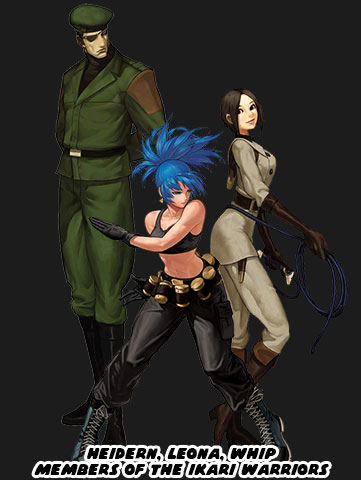

If you are working on a fighting game and want audiences to recognize a character as a serious fighter what do you do? Do you give them a facial scar and tattoos? Do you give them a flat nose and huge muscles? Or do you begin with the most obvious clue to audiences? The easiest thing you can do is put them in a costume. Look at some of the game characters through history and see which were the easiest to identify as a fighter. Those in military, or military-inspired costumes stood out. The best part for designers was that a military uniform could be given to a man or woman. Thanks to history we associated military training with martial ability. This was why characters like Heidern, Leona and Whip stood out in the King of Fighters series. We didn't need to know if they studied a particular form of fighting we just knew that they could fight. If they were members of a special forces team, which they were, then they weren't just good they were lethal. The Ikari Warriors were notorious in game canon as being the most skilled mercenaries operating abroad. They were able to topple regimes, steal secrets or just lay waste to an entire battalion. The two most famous Ikari Warriors, Ralf and Clark, made their debut in 1986. This was a year before the original Street Fighter was released.
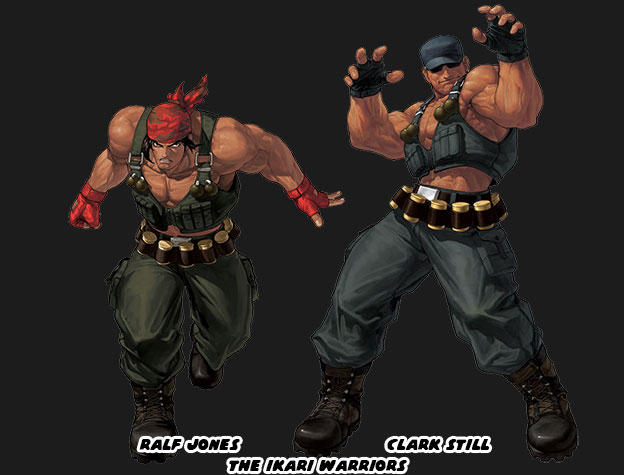

Some costumes, even military ones, can still be ambiguous. A person wearing a karate uniform might be a karateka, but they can also be a judo or jujitsu practitioner. That is why designers give them supporting details. Ken and Ryu for example had striking gloves so you could tell they were more likely karate fighters than judo grapplers. Ralf and Clark are obviously military fighters but what type? They don't wear stripes on their sleeves, or sleeves for that matter. We can tell that Rolento or Heidern are officers because of their full uniforms. Ralf and Clark are different, just look at their supporting details. They carry ammunition and explosives on their vest and belt. They look more like jungle mercenaries than servicemen. Based on their size we can tell that they are immensely strong. Since neither carries a weapon we can tell they are going to be strikers or grapplers in the King of Fighters. 
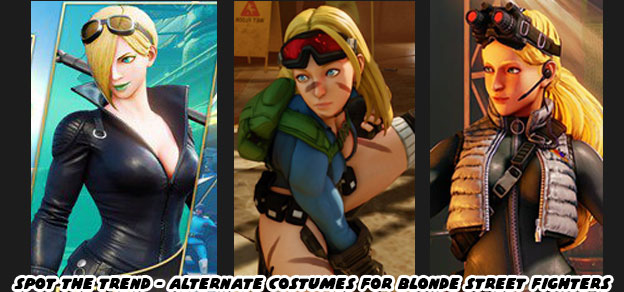

Something that was pointed out on Twitter this week was how somebody at Capcom has a certain fallback when designing alternate costumes. Specifically for blonde female characters. See if you can spot the costume detail they like to add. Aside from that Falke is an interesting addition to the Street Fighter lineup. She seems to be on par with Ed as far as introducing new game play mechanics and shifting the focus to a new generation of characters. Capcom has done a decent job of focusing on new female characters through Street Fighter IV and V. The focus on the story is particularly unique. Ed is the founder of Neo Shadowlaw, a group assembled of former or discarded Shadowlaw experiments. With Falke revealed as a new recruit audiences are eager to find out who the other characters shown in the story mode are. Also if this organization had anything to do with the Illuminati featured in Street Fighter III.
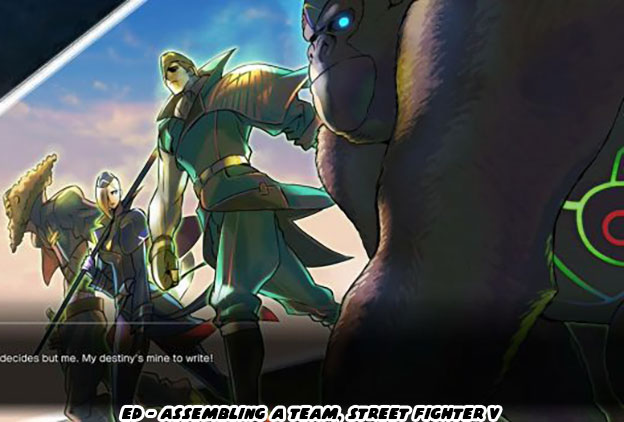

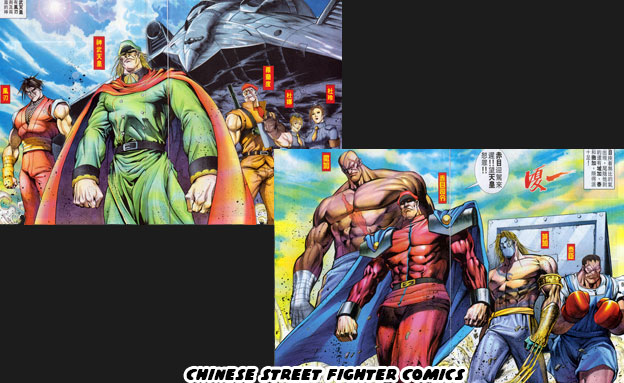
It seemed that Ed and Neo Shadowlaw would soon be confronting The Dictator and his Shadowlaw generals. This was a solid story push and something not entirely new to Street Fighter mythology. Many years ago in the manhua, or Chinese comics, of Street Fighter Zero there was a showdown between two factions fighting for control of Shadowlaw. We'll see how Falke and Ed figure into all of this. Of course the ramifications of any betrayals or sacrifices will ripple down to the rest of the universe.

So what do you think about Falke? Do you like her design? What do you think about her powers? Will you be playing as the character when she is released? Are you siding with Shadowlaw or Neo Shadowlaw in this update? I'd like to hear your take in the comments section. As always if you enjoyed this blog and would like to sponsor me please visit my Patreon page and consider donating each month, even as little as $1 would help make better blogs and even podcasts!
 follow the Street Writer on Patreon!

Thursday, August 14, 2014

The Ridge Racer Legacy, part 29...

Ridge Racer, like other long running Namco titles had been steadily improving over the years. The developers were keenly aware that the canon of the series was sacred to the company. Every location, every manufacturer and every track had to be better than the last. Ridge City and the other sites were constantly growing and changing. They were very much like real world cities in that regard. The studio wanted audiences to recognize that the virtual world was living and breathing and would look slightly bigger and better each time they visited it. What audiences never expected to see was how well those locations would translate onto the handheld consoles.


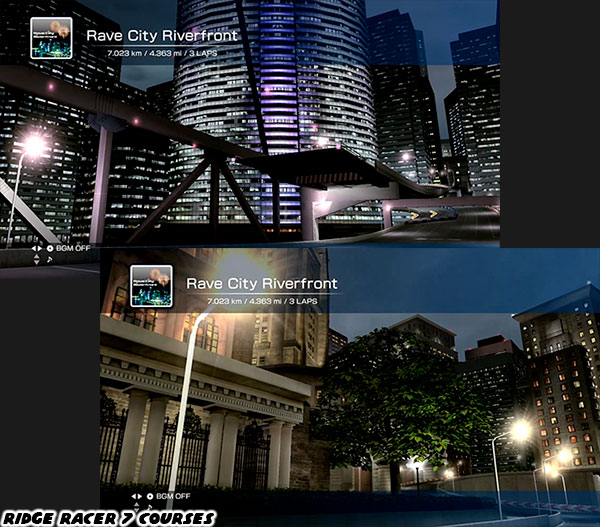
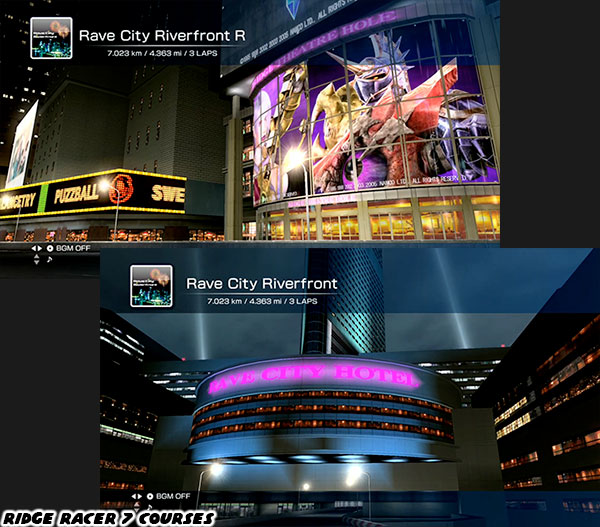
The publisher kept true to canon and made sure that the sights and sounds continued to improve in every release. Even with the limited processing power and storage capacity of the handhelds Namco was still able to deliver some memorable experiences. Ports that had a container ship, a crane and a few warehouses in Ridge Racer Type 4 had become much busier and far more packed with details when it was visited on the Playstation Vita. Of course the Vita was also a much more powerful system than either the Playstation or Playstation 2. It's high definition display was capable of presenting graphics which were light years ahead of where they were in 1999. It had grown out of the lessons learned from those consoles, the Playstation 3 as well as the PSP and PSP Go.

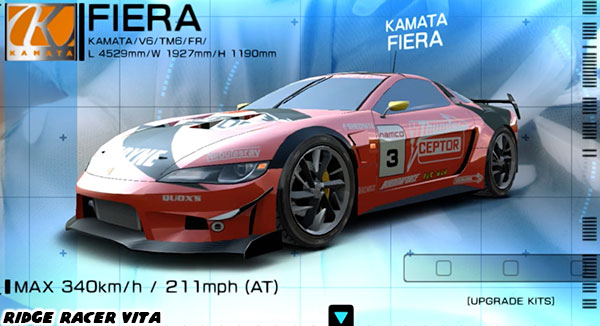
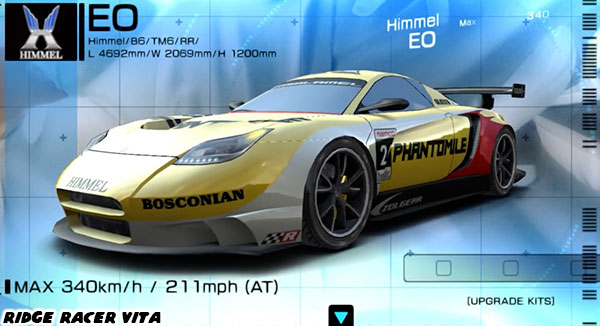
The most important lesson that Namco would learn from the title was how quickly the company could anger their fan base. Ridge Racer for the Vita was released in 2012 with three tracks and five cars. Additional cars and tracks were available by purchasing downloadable content packs (DLC). The company had charged full price for a game that was essentially an empty shell. A year later the company released Ridge Racer Unbounded and further distanced themselves from the things that made the original series so much fun. Visually the Vita game was a stunner. The tracks and cars had never looked better and the control was quite good but the lack of content severely hurt the review scores from critics and word of mouth from fans. It was considered one of the worst games of 2012, not for how it controlled or how it looked graphically but for how lacking the content was. Needless to say the Metacritic reviews were not kind.

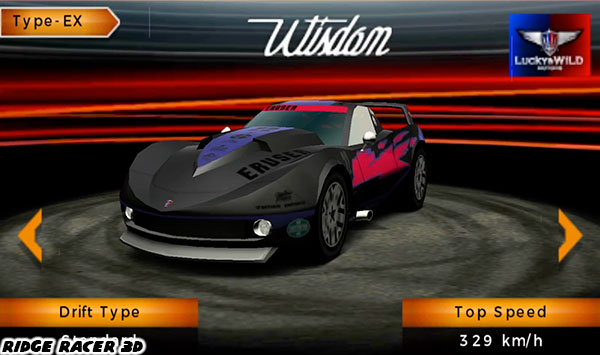
The game was a slap in the face to those that enjoyed the Ridge Racer 6 and 7 experience from six years prior. Fans were shocked that during those six years did not see a quantum leap in the progression of the handheld games. Before that the portable games were very well done. Ridge Racer Accelerated HD, a 2011 release for the iOS was a decent attempt at making a racing game for the iPhone. Ridge Racer 3D for the Nintendo 3DS came out in 2011 as well. It predicted the use of DLC micro-transactions from Namco. Audiences overlooked that because the game had included plenty of tracks and cars for players to unlock without having to pay for them. The 3D effects on the Nintendo handheld took some getting used to but were well done otherwise. The game was actually picking up on the desert environments that were featured in Ridge Racer 64 from the Nintendo 64 from a decade earlier. At least some of the developers working at Namco still cared about the legacy they had created.


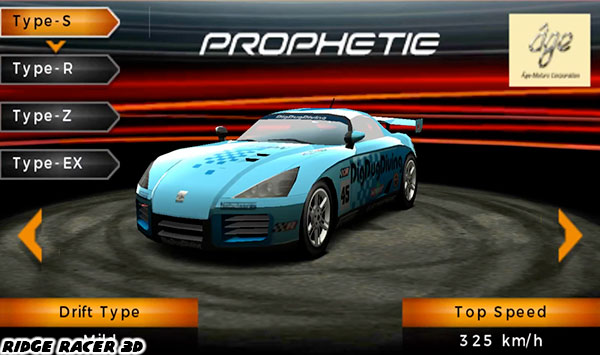
The other games in the handheld library were well done experiences but they were few and far between. Ridge Racer 2 for the PSP was released in 2006, it was the one that Sony President Ken Kutaragi got overly excited about during the E3 press conference. The original Ridge Racer for the PSP debuted in 2004, that was the same year that Gina Cavalli took over cover girl duties on Ridge Racer DS for the Nintendo DS. Not every handheld game ported over the cars or tracks featured on the consoles. Several new courses including Redstone Thunder Road and radical cars like the Lucky & Wild Evolver were first introduced on portable screens. Not every outside developer working with the franchise had turned their back on the classic elements, as Bugbear Entertainment had. There was actually a fantastic blend of the mobile experience and the best portions of Ridge Racer 7 for an inexpensive price.

Ridge Racer Slipstream debuted in 2013 for the iOS platform. The developers at Invictus had released a portable version of the franchise that was worth more than the $4.99 they were asking for. Namco was hoping to earn a little bit of revenue from micro-transactions. Audiences could spend anywhere from 99 cents all the way up to $49.99 to purchase credits that they could use to unlock additional tracks and cars. Unlike Ridge Racer Vita however Slipstream allowed players to "grind" through the races and earn the credits to unlock everything. It took a lot of patience and determination to unlock all of the content but the game was actually highly enjoyable and worth the number of replays that it took to get those credits. To keep things interesting the developer would send three daily tasks to complete where they would earn additional experience points or credits. For a mobile game the graphics on Slipstream were well done. It looked just a hair toned down from the Ridge Racer 6 and 7 experience from the pinnacle of the series. The game even included multiple music tracks from the previous games so that not only did it look and play like a classic Ridge Racer game, it also sounded like one.


Alex Adjaj, the Director of global strategy for mobile at Namco was a huge fan of the Ridge Racer series. He had been playing the game since it was on the Playstation and was not a fan of what the company had done with the Vita debut. He called the lack of content on the Vita and the charges that the company wanted to get out of players ridiculous. In an interview with Digital Spy he sided with fans. "If you look at all the Ridge Racer games that have been brought to portable consoles, in particular in the past few years PS Vita and PSP, and you look at the Metacritic score, you see that people complain a lot about the value they got when they spent £40 for the game/ And it's Ridge Racer - it's not like Ridge Racer Driftopia. We're not breaking cars. It's the real Ridge Racer with drifting and everything." He then added "Here we're bringing a game with 12 different cars, over 300 different modifications, 12 tracks - and if you reverse, 24 - 100 races in the career mode, then there'll be multiplayer in January [2014]."

I didn't download Slipstream when it came out last holiday season. I understand that the first few months were filled with random crashes and numerous bugs. I started playing it in February 2014. It was patched a few times since then, adding much more reliability to the experience. It was definitely the game that helped me get through jury duty! I have to admit that it was head and shoulders above the competition on the iOS arena and better than most handheld racing games out today. People reading this most definitely should check out the title for the iPhone, iPod Touch and iPad.

After reading the interview with Mr. Adjaj it was hard for this arcade veteran to accept that Namco might never return the series back to their roots. The division inside the company had stifled creativity. It was a trend over the past decade that had seen the best talent come and go in Sega, Capcom, Square-Enix and numerous other Japanese studios. The long-term fans would never forget the golden era and would long for a return to a classic arcade experiences. What the studios had failed to realize was that the experience could be captured on the home consoles and even portable systems. When I say arcade experience I did not mean having to pay 25¢ for every play through. That would now be considered a micro-transaction these days. Audiences wanted the robust AAA experience that Namco used to give them on the Playstation consoles. With cars worth racing, a team worth racing for and a resolution that would be etched in their memory. No strings attached, no additional content to download.


Today however was a different world. Arcade players had to come to terms with how much had changed in 20 years. Sega had once dominated Namco at every turn. The Hornet, car 41 from Daytona USA was featured DLC for Ridge Racer - Vita in Japan. The most iconic car from Sega, that wasn't a red Ferrari Testarossa, was a welcome addition to the Ridge Racer family. It was only a matter of time really. Sega had introduced the exaggerated drifting physics in Daytona USA that made Ridge Racer so popular in later years. The senior developers at Namco believed in their racing series enough to keep it going. There may have been some internal conflicts as to the direction of the series and how to handle future updates and content but the core the series remained the same. Sega had lost their way and had turned their back on their biggest racing and adventure titles. They then relied on outside developers to keep their most popular IP going.

Players that had grown up during the most formative years of the arcade racing movement could still rely on Namco, now Bandai Namco, to enjoy the best of both worlds. The over-the-top racing from the arcade but on lightweight portable devices. It was not known when the next full-fledged Ridge Racer would hit the consoles. The Playstation 4 and XboxOne had debuted at the end of 2013 and a new Ridge Racer game had yet to be announced for either system. The success of Ridge Racer Slipstream and the PC title Ridge Racer Driftopia helped keep the title on the public consciousness. Most recently the publisher wised up and began offering audiences in the west something that had been missing for more than a decade. The next blog will highlight the best part of the experience that had nothing to do with racing. If you would like to sponsor me please visit my Patreon page and consider donating each month, even as little as $1 would help make better blogs and even podcasts!
follow the Street Writer on Patreon!