A blog about my interests, mainly the history of fighting games. I also talk about animation, comic books, car culture, and art. Co-host of the Pink Monorail Podcast. Contributor to MiceChat, and Jim Hill Media. Former blogger on the old 1UP community site, and Capcom-Unity as well.
Showing posts with label akira nishitani. Show all posts
Wednesday, April 29, 2026
Bookmark This Page; how ARIKA turned an April Fools joke into a great fighting game
Many of the people that created Street Fighter II left Capcom, and founded ARIKA. If you want to find out about how they teased a successor to Street Fighter EX then Bookmark This Page.
Sunday, July 30, 2017
A look at the big man, where did the Capcom giants come from? Part 1...
It is a great time to be a fighting game fan. That's a sentence I never thought I would be writing at my age. After fighting games fell by the wayside at the end of the '90s I didn't think they would come roaring back. Thanks to Capcom, Namco, SNK, Arc System Works, NetherRealm Studios and Double Helix Games for keeping the genre alive. An extra special thanks to the community for supporting the wide spectrum of titles. I never thought that Street Fighter would live to see 30, or that King of Fighters, Tekken, Mortal Kombat and Killer Instinct would still be going strong as well. Sega might never release another Virtua Fighter but considering that even ARIKA is getting back into the mix gives me hope for the future. Nostalgia is a good reason why many of the titles are still being developed. The games are improving as a whole but fans also want to see familiar characters return. At the 2017 EVO Championships in Las Vegas we were reminded of this. Several major studios held back some details from the E3 in Los Angeles. They waited until they had a dedicated gathering at EVO to announce these major reveals. The biggest announcements were actually for some very old characters.
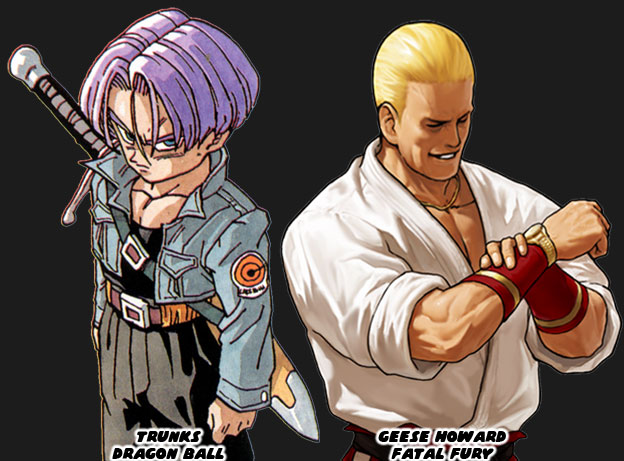
Trunks, a warrior from the future, was announced for Dragon Ball FighterZ. The character first appeared in the Dragon Ball manga in 1991. Geese Howard was the surprise guest announced for Tekken 7. He also debuted in 1991 for the SNK hit Fatal Fury: King of Fighters. Both of these character reveals sent shock-waves through the fighting game community. It was Capcom's announcement that was met with mixed emotions. The studio dug up a character that debuted in the 1989 cult hit Final Fight. Abigail was gigantic in proportion, had a few silly mannerisms and some awe-inspiring attacks. Long time fans of Capcom noticed that he had changed a bit from his original appearance. Some online commentators said that his design was too swollen and disproportionate when compared to his original look. Others thought that he fit right in with the already super-buff Street Fighter lineup. Who was this character? Where did he come from and did he really fit into the Street Fighter universe? In order to understand the significance of Abigail we have to travel back in time.
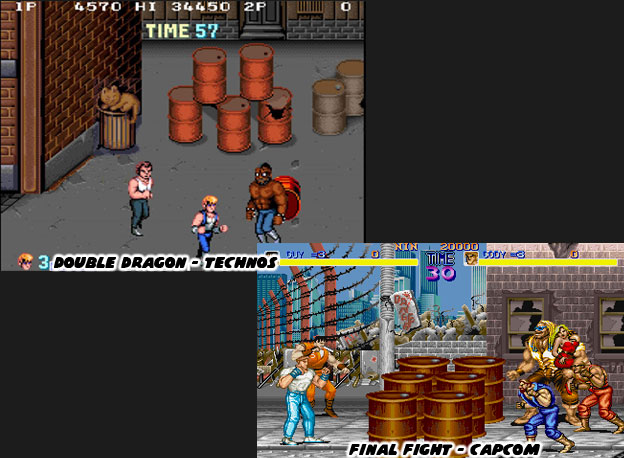
Capcom had marginal success when Street Fighter (SF) debuted in 1987. You might already know that Final Fight was designed to be the sequel to the original Street Fighter. It was originally called Street Fighter '89. In 1987 Technos had a smash hit arcade game called Double Dragon. I chronicled the importance of this game in my Brawling series. Double Dragon was essentially a more polished version of Renegade, a title the same publisher released in 1986. Instead of fighting on a fixed two-dimensional plane characters were free to move around the foreground and background and fight wave after wave of different opponents. This game was far more popular than the original SF and had been ported over to multiple systems. Capcom knew that they could probably make a superior version of the game with their own hardware. Producer Yoshiki Okamoto worked closely with designer Akira Nishitani (founder of ARIKA) and Akira Yasuda (designer better known as AKIMAN) to improve on everything in Double Dragon. They had bigger sprites, better graphics, more stages, more opponents and far more moves. They even created a story for audiences to follow. Among these were some enormous villains, one which was called Abigail.
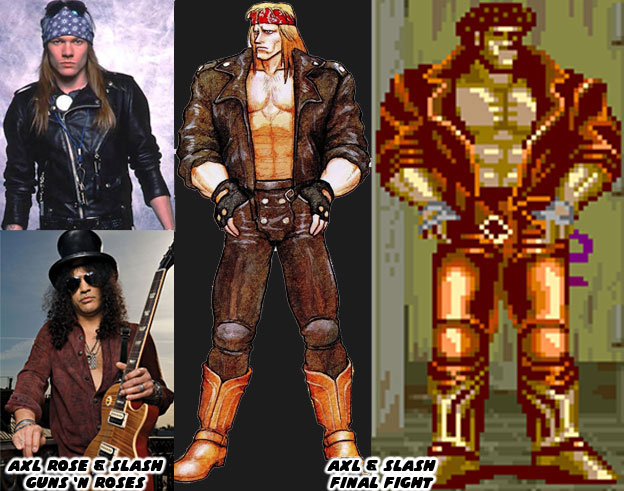
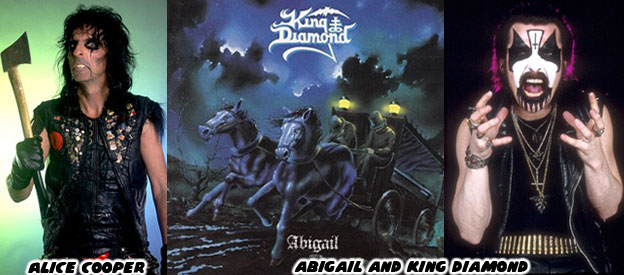
The story of Abigail and the designs behind the villains was very unique. The Mad Gear gang was inspired by Western pop culture, and in particular heavy metal music. A number of the characters were modeled after popular acts of the '70s and '80s. These included Billy Idol, Sid Vicious and Guns 'N Roses. The character of Abigail was considered a boss. He was very high up in the chain of command. Second only to Rolento, the military leader and right hand man of Belger, the organizer behind Mad Gear. Because of his status Abigail had to visually be different from his contemporaries. His uniform was white, which made him stand out from the darker colors assigned to the other Mad Gear characters. He was also the largest of the gang members, at 8 feet tall and over 580 lbs. he was the biggest character ever in the Street Fighter universe. Hugo Andore was no slouch though, at 7' 10" and 440 lbs. he was the second-largest Street Fighter character ever. Abigail sported some unique face paint. This makeup hearkened to an earlier era in metal music. Alice Cooper was a shock rocker that started the trend in the mid-1960s. He employed magic tricks in his performances, with some of his best illusions created by the Amazing Randi. Cooper's work set the foundation for the makeup and character-driven acts like KISS and King Diamond from the mid-1970s. Abigail in fact was the name of King Diamond’s second album from 1987. Abigail represented the foundation of hard rock while the rest of the Mad Gear members reflected the newer generation of metal stars.
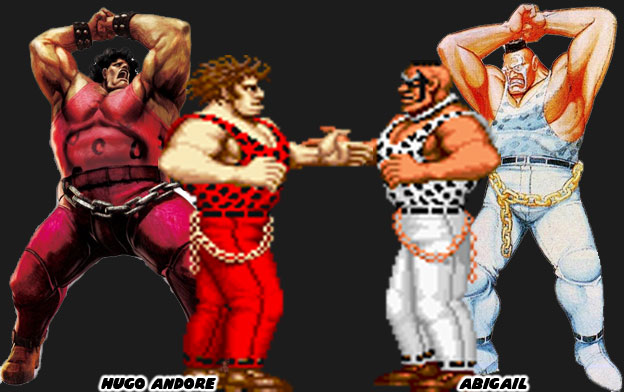
From a design standpoint Abigail was somewhat unique but not wholly original. The character in the game was a different colored version of the Andore sprite, with a slightly different head. The Andore family; (Hugo) Andore, G. Andore, U. Andore, F. Andore and Andore Jr., were inspired by Andre the Giant. The Andore family hearkened back to actual wrestling dynasties like the Von Erichs, the Harts and the Guerreros. They were unfortunately large oafish wrestlers who relied on sheer force rather than technique to win fights. The family was among the middle ranks of the Mad Gear organization. In canon wrestling was a way to recruit Mad Gear members and the format that they used in underground tournaments. Sodom for example was another famous Mad Gear wrestler and a boss in the organization. Abigail was designed to be much different than the Andore's in fighting ability as well as in temper. His white uniform, buzz cut and makeup stood out compared to the shaggy-haired Andore's.
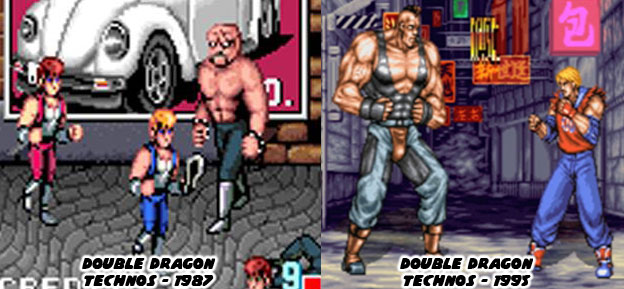
In the game Abigail was prone to fits of rage and would actually turn red and charge the heroes with his tree trunk-sized arms. Some of these details made it into Street Fighter V while others did not. As unique as he looked Abigail was far from an original idea. One of the major villains in the Double Dragon series was a giant bodybuilder named Abobo. If you go back through the early arcade hits you can draw a number of parallels between the story and characters in Double Dragon and Final Fight. Abigail was the Final Fight equivalent to Abobo. When Abobo first appeared he had the familiar face paint and spiked wrist guards. His size wasn't officially given by Technos in the original game. All players knew was that he was much taller than Billy and Jimmy Lee and about twice as wide. When Technos made a Double Dragon fighting game in 1995 and revisited the character he was described as being 7' 2" tall and weighing some 336 lbs. He was simply massive and at the time was among the largest sprite ever created for a fighting game. More surprising was that he could actually get more muscular with the use of his special move. How Capcom adapted his look and the theme for Final Fight was an important part in the history of the genre.
There was a game that predated Double Dragon that was designed by Takashi Nishiyama. When it came to fighting games very few people could be considered the godfather of the genre. My. Nishiyama was definitely one of them. His tenure at Irem was important to the industry. He worked on Moon Patrol, the 1982 science fiction game that introduced parallax scrolling to the arcade. This graphic technique allowed layers to move at different speeds on screen, creating the illusion of depth in 2-dimensions. Double Dragon and Final Fight used parallax scrolling to good effect. Take a close look at the floors in most brawlers and fighting games and see how bricks, tiles and even wood seem to stay in perspective as the characters advance. Then look in the distance, especially if the stage has water or an ocean in the background. You'll notice that the layered effect gives a good sense of depth to a 2D world. As fun as Moon Patrol was, it was Mr. Nishiyama's following game that was even more important. The 1984 game Kung-Fu Master was revolutionary. It was one of the first fighting games and also set the standard for brawling games as well.
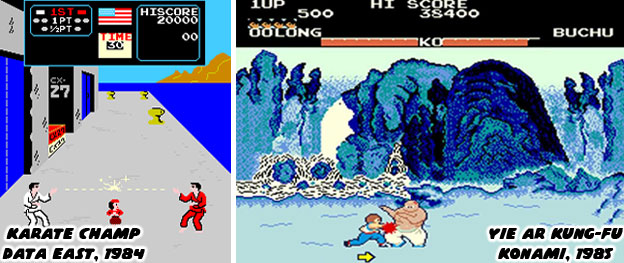
There was another game from 1984 that could be considered the father of the modern fighting game. Karate Champ developed by Technos was the first player-versus-player, side-profile martial arts game. Kung-Fu Master expanded on that idea and introduced many new elements to the genre. It had a narrative, the hero Thomas fought wave after wave of bad guys in order to save his girlfriend. Predating the same plot used in both Double Dragon and Final Fight. The enemies came in different shapes and sizes and there was even a final boss. The only other influential fighter from this period that I should name was Konami's Yie Ar Kung Fu from 1985. Yie Ar Kung Fu also featured characters of different sizes and abilities. Mr. Nishiyama left Irem to go work for Capcom in the mid '80s. He took his ideas about featuring characters with unique martial arts, adding a narrative and different boss characters when he directed the original Street Fighter.
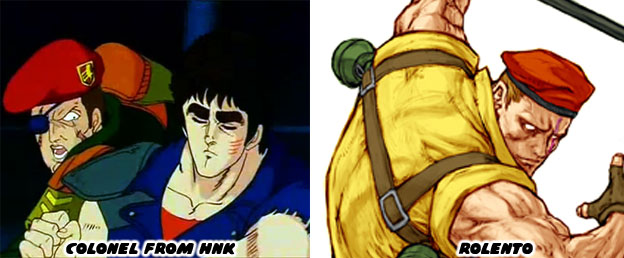
Mr. Nishiyama and the team at Capcom were heavily influenced by Japanese pop culture. The developers grew up on a steady diet of comics and cartoons and they reflected these things with every game they released. At that time most Japanese audiences would have gotten their points of reference. The fireball thrown by Ryu for example was inspired by the energy attack from the Space Battleship Yamato, a popular animé show from the mid '70s. The story of Ryu travelling around the world fighting masters of different styles was inspired by the '70s manga series Karate Backa Ichidai. The visual language, heroes and villains in western-style costumes in both Final Fight and Street Fighter were based on the '80s manga Hokuto No Ken / Fist of the North Star (HNK) series. The post-apocalyptic setting featured in the HNK stories by Buronson and Tetsuo Hara colored a lot of the work coming out of Capcom in the '80s and '90s.
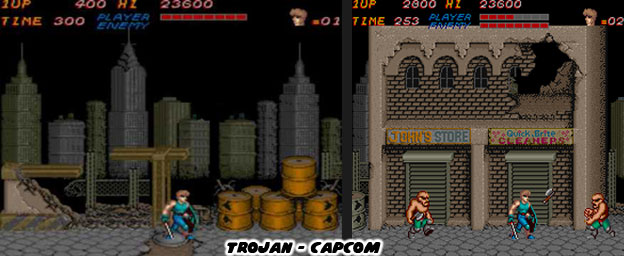
One of the earliest games to reflect a warrior fighting through a dystopian world was called Trojan. The arcade and NES console title was a sleeper from 1986 but it featured some very unique character designs. The villains, Armadillon, Mamushi and Iron Arm were a mix of mutants and soldiers wearing piecemeal armor. They looked like the roving gang members that inhabited the HNK wastelands. The dark future timeline was used again and again in both console and arcade releases. Bionic Commando (1987), Strider (1989), and Street Fighter 2010: The Final Fight (1990) each had their own take on a future corrupted by villainy and greed. The HNK manga shaped the world of Double Dragon as well, especially when it came to character design. The manga had many memorable villains. Some were covered in tattoos and face paint. Some wore armor, others were simply giants that couldn't be hurt by conventional weapons. These were all perfect for gaming.
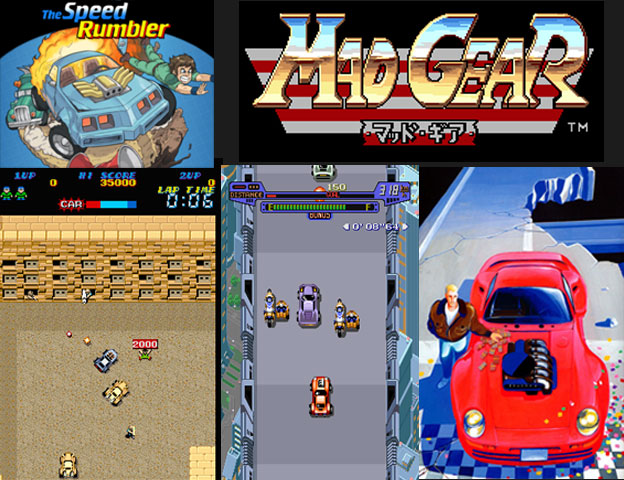
It wasn't just Japanese pop culture that shaped the look and feel of the early Capcom hits. Western pop culture was just as influential. Hokuto No Ken was itself inspired by the films of Bruce Lee, but also by movies like the Terminator (1984), Cobra (1986) and the Mad Max series. The gangs in Mad Max (1979) and the Road Warrior (1981) were poached by Tetsuo Hara for HNK. Characters had very radical designs in these films. They wore armor that was made up of leather, football pads, hockey gear and car tires. Some gang members wore face paint with Mohawks, others were deformed by radiation and hid behind masks. Director George Miller had a very strong visual style. He often worked directly from storyboards that he created while he was finalizing a script. His approach ended up influencing games, comics and other films for over 30 years. One of the lesser known Capcom arcade games themed after Mad Max was called Speed Rumbler, in which the hero drove an armed car and shot up bad guys. Some were in trucks, others in buggies or tanks. Mr. Nishiyama worked on a different type of vehicle combat game after Street Fighter. This new game was set in a science fiction road race. The future looked much more promising than it did in the Speed Rumbler. The new game was called Mad Gear in Japan and Led Storm in the rest of the world. In the planning stages for a Street Fighter sequel Mr. Nishiyama left Capcom to work at rival studio SNK.
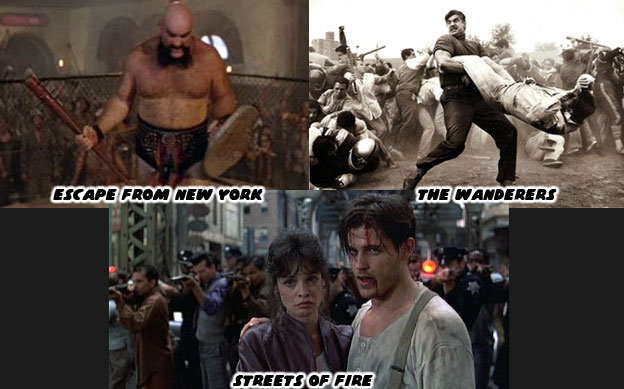
Arcade operators had their pulse on the trends and would push developers into certain formats. Many of them were interested in a new fighting game following the success of Double Dragon and they let Capcom know. That was when Mr. Okamoto, Nishitani and Yasuda decided to create their take on the brawler. To do this they needed to create an enormous western metropolis that felt more realistic than the world that Technos had established. They needed reference material for everything audiences might see. How were the buildings laid out, what architecture was used, how did alleys and street corners look? They needed to present convincing subway systems, neighborhoods and boroughs that had a distinct "USA" feel to them. Even things like police uniforms, gang colors and street fashion needed to be recreated. These things were all very different than how cities, advertising, pedestrians and gangs looked in Japan or Europe after all. The designers at Capcom studied a number of cult films while trying to create the fictional Metro City. Among these films were the Wanderers, Escape from New York, and Streets of Fire. The films from 1979, 1981 and 1984 respectively had over-the-top characters and settings. Watching the three films you could easily to spot where Mike Haggar, Cody, Jessica and the various Mad Gear gang members came from.
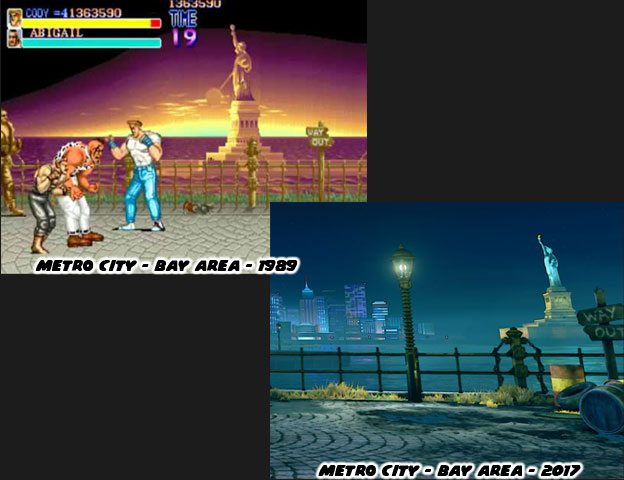
Metro City needed to have all of the elements that might be found in New York but without being bound by an actual site. In this way Capcom could take players to the most interesting landmarks within the span of a day, or rather a single play-through. Each location could tell a story, and every stage could be more unique than the last. The new virtual city was created on an island on the North Eastern Seaboard of the USA, right on the Atlantic Ocean. One of the most memorable stages was near the end of the game. Players had fought their way from the slums, through the subway and all the way to the Bay Side. At this point it was dusk and off in the distance players could see the Statue of Liberty. It was the perfect "American" point of reference and one that international audiences could recognize. When Capcom designed a stage for Abigail in Street Fighter V they made sure to recreate that slice of Metro City.
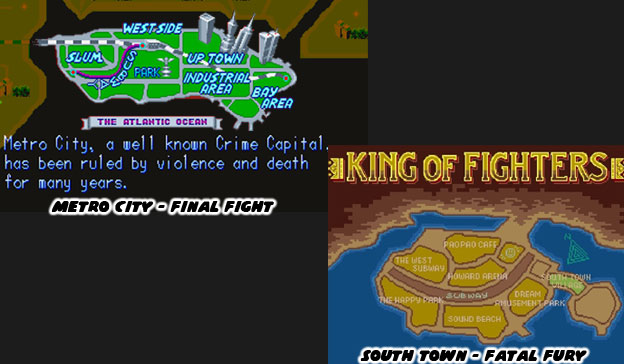
The interesting thing about Metro City was how the layout and planning were very similar to the design of South Town. This other virtual city would appear in the SNK fighting game Fatal Fury, almost two years after Final Fight debuted and just as Street Fighter II came out. South Town was set in the southern coast of the USA, closer to Florida but it retained many of the same big city themes as Metro City. I believe that Mr. Nishiyama was putting out ideas for his next fighting game while still with at Capcom. He would have been discussing these ideas with Mr. Okamoto and Nishitani. If you look at the stage progression in both Final Fight and Fatal Fury they were very similar. The final battle in both games took place on the penthouse of the crime boss' skyscraper, and both games ending with the villain getting knocked from the top.
Mr. Nishiyama was thinking about creating three main heroes for the series. They may have been Ken, Ryu and a third fighter, or they may have been three completely new characters. The trio eventually became Andy Bogard, Terry Bogard and Joe Higashi. Mr. Nishiyama also recognized that audiences wanted to see some visual depth to the game. Fatal Fury introduced a system where players could jump to the foreground or background and launch an attack. It wasn't the free-roaming environment of Double Dragon or Final Fight but it was something that had not been tried before in a fighting game. I believe that Mr. Okamoto and Nishitani ran with some of these ideas when they created Final Fight. In honor of their old colleague they named the bad guys Mad Gear gang members. With the return of Abigail we should explore the limits on character scale in a fighting game. How big is too big? What did Capcom get right or wrong with him? We'll look at these things in the next blog. As always if you enjoyed this blog and would like to sponsor me please visit my Patreon page and consider donating each month, even as little as $1 would help make better blogs and even podcasts!
Trunks, a warrior from the future, was announced for Dragon Ball FighterZ. The character first appeared in the Dragon Ball manga in 1991. Geese Howard was the surprise guest announced for Tekken 7. He also debuted in 1991 for the SNK hit Fatal Fury: King of Fighters. Both of these character reveals sent shock-waves through the fighting game community. It was Capcom's announcement that was met with mixed emotions. The studio dug up a character that debuted in the 1989 cult hit Final Fight. Abigail was gigantic in proportion, had a few silly mannerisms and some awe-inspiring attacks. Long time fans of Capcom noticed that he had changed a bit from his original appearance. Some online commentators said that his design was too swollen and disproportionate when compared to his original look. Others thought that he fit right in with the already super-buff Street Fighter lineup. Who was this character? Where did he come from and did he really fit into the Street Fighter universe? In order to understand the significance of Abigail we have to travel back in time.
Capcom had marginal success when Street Fighter (SF) debuted in 1987. You might already know that Final Fight was designed to be the sequel to the original Street Fighter. It was originally called Street Fighter '89. In 1987 Technos had a smash hit arcade game called Double Dragon. I chronicled the importance of this game in my Brawling series. Double Dragon was essentially a more polished version of Renegade, a title the same publisher released in 1986. Instead of fighting on a fixed two-dimensional plane characters were free to move around the foreground and background and fight wave after wave of different opponents. This game was far more popular than the original SF and had been ported over to multiple systems. Capcom knew that they could probably make a superior version of the game with their own hardware. Producer Yoshiki Okamoto worked closely with designer Akira Nishitani (founder of ARIKA) and Akira Yasuda (designer better known as AKIMAN) to improve on everything in Double Dragon. They had bigger sprites, better graphics, more stages, more opponents and far more moves. They even created a story for audiences to follow. Among these were some enormous villains, one which was called Abigail.
The story of Abigail and the designs behind the villains was very unique. The Mad Gear gang was inspired by Western pop culture, and in particular heavy metal music. A number of the characters were modeled after popular acts of the '70s and '80s. These included Billy Idol, Sid Vicious and Guns 'N Roses. The character of Abigail was considered a boss. He was very high up in the chain of command. Second only to Rolento, the military leader and right hand man of Belger, the organizer behind Mad Gear. Because of his status Abigail had to visually be different from his contemporaries. His uniform was white, which made him stand out from the darker colors assigned to the other Mad Gear characters. He was also the largest of the gang members, at 8 feet tall and over 580 lbs. he was the biggest character ever in the Street Fighter universe. Hugo Andore was no slouch though, at 7' 10" and 440 lbs. he was the second-largest Street Fighter character ever. Abigail sported some unique face paint. This makeup hearkened to an earlier era in metal music. Alice Cooper was a shock rocker that started the trend in the mid-1960s. He employed magic tricks in his performances, with some of his best illusions created by the Amazing Randi. Cooper's work set the foundation for the makeup and character-driven acts like KISS and King Diamond from the mid-1970s. Abigail in fact was the name of King Diamond’s second album from 1987. Abigail represented the foundation of hard rock while the rest of the Mad Gear members reflected the newer generation of metal stars.
From a design standpoint Abigail was somewhat unique but not wholly original. The character in the game was a different colored version of the Andore sprite, with a slightly different head. The Andore family; (Hugo) Andore, G. Andore, U. Andore, F. Andore and Andore Jr., were inspired by Andre the Giant. The Andore family hearkened back to actual wrestling dynasties like the Von Erichs, the Harts and the Guerreros. They were unfortunately large oafish wrestlers who relied on sheer force rather than technique to win fights. The family was among the middle ranks of the Mad Gear organization. In canon wrestling was a way to recruit Mad Gear members and the format that they used in underground tournaments. Sodom for example was another famous Mad Gear wrestler and a boss in the organization. Abigail was designed to be much different than the Andore's in fighting ability as well as in temper. His white uniform, buzz cut and makeup stood out compared to the shaggy-haired Andore's.
In the game Abigail was prone to fits of rage and would actually turn red and charge the heroes with his tree trunk-sized arms. Some of these details made it into Street Fighter V while others did not. As unique as he looked Abigail was far from an original idea. One of the major villains in the Double Dragon series was a giant bodybuilder named Abobo. If you go back through the early arcade hits you can draw a number of parallels between the story and characters in Double Dragon and Final Fight. Abigail was the Final Fight equivalent to Abobo. When Abobo first appeared he had the familiar face paint and spiked wrist guards. His size wasn't officially given by Technos in the original game. All players knew was that he was much taller than Billy and Jimmy Lee and about twice as wide. When Technos made a Double Dragon fighting game in 1995 and revisited the character he was described as being 7' 2" tall and weighing some 336 lbs. He was simply massive and at the time was among the largest sprite ever created for a fighting game. More surprising was that he could actually get more muscular with the use of his special move. How Capcom adapted his look and the theme for Final Fight was an important part in the history of the genre.
There was a game that predated Double Dragon that was designed by Takashi Nishiyama. When it came to fighting games very few people could be considered the godfather of the genre. My. Nishiyama was definitely one of them. His tenure at Irem was important to the industry. He worked on Moon Patrol, the 1982 science fiction game that introduced parallax scrolling to the arcade. This graphic technique allowed layers to move at different speeds on screen, creating the illusion of depth in 2-dimensions. Double Dragon and Final Fight used parallax scrolling to good effect. Take a close look at the floors in most brawlers and fighting games and see how bricks, tiles and even wood seem to stay in perspective as the characters advance. Then look in the distance, especially if the stage has water or an ocean in the background. You'll notice that the layered effect gives a good sense of depth to a 2D world. As fun as Moon Patrol was, it was Mr. Nishiyama's following game that was even more important. The 1984 game Kung-Fu Master was revolutionary. It was one of the first fighting games and also set the standard for brawling games as well.

There was another game from 1984 that could be considered the father of the modern fighting game. Karate Champ developed by Technos was the first player-versus-player, side-profile martial arts game. Kung-Fu Master expanded on that idea and introduced many new elements to the genre. It had a narrative, the hero Thomas fought wave after wave of bad guys in order to save his girlfriend. Predating the same plot used in both Double Dragon and Final Fight. The enemies came in different shapes and sizes and there was even a final boss. The only other influential fighter from this period that I should name was Konami's Yie Ar Kung Fu from 1985. Yie Ar Kung Fu also featured characters of different sizes and abilities. Mr. Nishiyama left Irem to go work for Capcom in the mid '80s. He took his ideas about featuring characters with unique martial arts, adding a narrative and different boss characters when he directed the original Street Fighter.

Mr. Nishiyama and the team at Capcom were heavily influenced by Japanese pop culture. The developers grew up on a steady diet of comics and cartoons and they reflected these things with every game they released. At that time most Japanese audiences would have gotten their points of reference. The fireball thrown by Ryu for example was inspired by the energy attack from the Space Battleship Yamato, a popular animé show from the mid '70s. The story of Ryu travelling around the world fighting masters of different styles was inspired by the '70s manga series Karate Backa Ichidai. The visual language, heroes and villains in western-style costumes in both Final Fight and Street Fighter were based on the '80s manga Hokuto No Ken / Fist of the North Star (HNK) series. The post-apocalyptic setting featured in the HNK stories by Buronson and Tetsuo Hara colored a lot of the work coming out of Capcom in the '80s and '90s.

One of the earliest games to reflect a warrior fighting through a dystopian world was called Trojan. The arcade and NES console title was a sleeper from 1986 but it featured some very unique character designs. The villains, Armadillon, Mamushi and Iron Arm were a mix of mutants and soldiers wearing piecemeal armor. They looked like the roving gang members that inhabited the HNK wastelands. The dark future timeline was used again and again in both console and arcade releases. Bionic Commando (1987), Strider (1989), and Street Fighter 2010: The Final Fight (1990) each had their own take on a future corrupted by villainy and greed. The HNK manga shaped the world of Double Dragon as well, especially when it came to character design. The manga had many memorable villains. Some were covered in tattoos and face paint. Some wore armor, others were simply giants that couldn't be hurt by conventional weapons. These were all perfect for gaming.
It wasn't just Japanese pop culture that shaped the look and feel of the early Capcom hits. Western pop culture was just as influential. Hokuto No Ken was itself inspired by the films of Bruce Lee, but also by movies like the Terminator (1984), Cobra (1986) and the Mad Max series. The gangs in Mad Max (1979) and the Road Warrior (1981) were poached by Tetsuo Hara for HNK. Characters had very radical designs in these films. They wore armor that was made up of leather, football pads, hockey gear and car tires. Some gang members wore face paint with Mohawks, others were deformed by radiation and hid behind masks. Director George Miller had a very strong visual style. He often worked directly from storyboards that he created while he was finalizing a script. His approach ended up influencing games, comics and other films for over 30 years. One of the lesser known Capcom arcade games themed after Mad Max was called Speed Rumbler, in which the hero drove an armed car and shot up bad guys. Some were in trucks, others in buggies or tanks. Mr. Nishiyama worked on a different type of vehicle combat game after Street Fighter. This new game was set in a science fiction road race. The future looked much more promising than it did in the Speed Rumbler. The new game was called Mad Gear in Japan and Led Storm in the rest of the world. In the planning stages for a Street Fighter sequel Mr. Nishiyama left Capcom to work at rival studio SNK.
Arcade operators had their pulse on the trends and would push developers into certain formats. Many of them were interested in a new fighting game following the success of Double Dragon and they let Capcom know. That was when Mr. Okamoto, Nishitani and Yasuda decided to create their take on the brawler. To do this they needed to create an enormous western metropolis that felt more realistic than the world that Technos had established. They needed reference material for everything audiences might see. How were the buildings laid out, what architecture was used, how did alleys and street corners look? They needed to present convincing subway systems, neighborhoods and boroughs that had a distinct "USA" feel to them. Even things like police uniforms, gang colors and street fashion needed to be recreated. These things were all very different than how cities, advertising, pedestrians and gangs looked in Japan or Europe after all. The designers at Capcom studied a number of cult films while trying to create the fictional Metro City. Among these films were the Wanderers, Escape from New York, and Streets of Fire. The films from 1979, 1981 and 1984 respectively had over-the-top characters and settings. Watching the three films you could easily to spot where Mike Haggar, Cody, Jessica and the various Mad Gear gang members came from.

Metro City needed to have all of the elements that might be found in New York but without being bound by an actual site. In this way Capcom could take players to the most interesting landmarks within the span of a day, or rather a single play-through. Each location could tell a story, and every stage could be more unique than the last. The new virtual city was created on an island on the North Eastern Seaboard of the USA, right on the Atlantic Ocean. One of the most memorable stages was near the end of the game. Players had fought their way from the slums, through the subway and all the way to the Bay Side. At this point it was dusk and off in the distance players could see the Statue of Liberty. It was the perfect "American" point of reference and one that international audiences could recognize. When Capcom designed a stage for Abigail in Street Fighter V they made sure to recreate that slice of Metro City.
The interesting thing about Metro City was how the layout and planning were very similar to the design of South Town. This other virtual city would appear in the SNK fighting game Fatal Fury, almost two years after Final Fight debuted and just as Street Fighter II came out. South Town was set in the southern coast of the USA, closer to Florida but it retained many of the same big city themes as Metro City. I believe that Mr. Nishiyama was putting out ideas for his next fighting game while still with at Capcom. He would have been discussing these ideas with Mr. Okamoto and Nishitani. If you look at the stage progression in both Final Fight and Fatal Fury they were very similar. The final battle in both games took place on the penthouse of the crime boss' skyscraper, and both games ending with the villain getting knocked from the top.
Mr. Nishiyama was thinking about creating three main heroes for the series. They may have been Ken, Ryu and a third fighter, or they may have been three completely new characters. The trio eventually became Andy Bogard, Terry Bogard and Joe Higashi. Mr. Nishiyama also recognized that audiences wanted to see some visual depth to the game. Fatal Fury introduced a system where players could jump to the foreground or background and launch an attack. It wasn't the free-roaming environment of Double Dragon or Final Fight but it was something that had not been tried before in a fighting game. I believe that Mr. Okamoto and Nishitani ran with some of these ideas when they created Final Fight. In honor of their old colleague they named the bad guys Mad Gear gang members. With the return of Abigail we should explore the limits on character scale in a fighting game. How big is too big? What did Capcom get right or wrong with him? We'll look at these things in the next blog. As always if you enjoyed this blog and would like to sponsor me please visit my Patreon page and consider donating each month, even as little as $1 would help make better blogs and even podcasts!
Labels:
abigail,
akiman,
akira nishitani,
akira yasuda,
alice cooper,
andore,
axl,
capcom,
cody,
fatal fury,
final fight,
haggar,
king diamond,
mad gear,
slash,
snk,
speed rumbler,
Takashi Nishiyama,
Yoshiki Okamoto
Friday, May 9, 2014
Fighting Layer, return of the dragon, part 1...
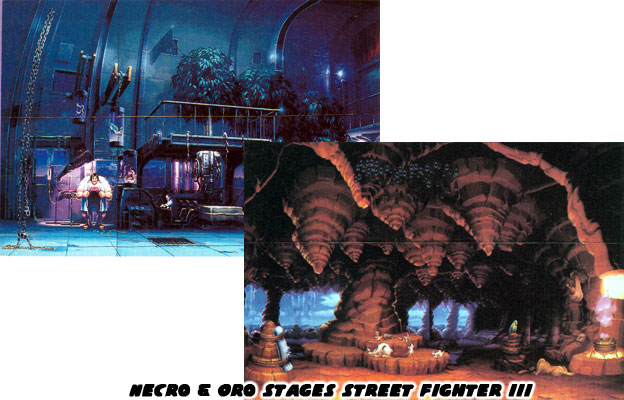
The previous blog mentioned that the unused concept art for Street Fighter II would return in future sequels. Street Fighter Alpha / Zero, Street Fighter III and IV all had at least one level that was inspired by earlier concept art. In the early days Capcom was looking at having the entire game take place on one island. Unique areas on that island were highlighted as stages. Even the transportation around the island was considered as the basis for a stage. A cave was envisioned for a bearded hermit-like character in the earliest concept art. The character and his cave was scrapped but returned a few years later with some new refinements. An ancient Brazilian named Oro lived in seclusion. He made an outcropping on the side of a mountain his home and training ground. The previous cave was barren but the new one included animal guests, a cooking pot and punching bag. One of the levels that was also dropped was set on top of a speeding train. Other fighting games that followed Street Fighter II in 1991 did create stages on top of a train. Some were set on top of a moving bus or cable car. Some were featured in titles for the consoles rather than arcade. Capcom did not revisit the idea until 1997 with the release of Street Fighter III. However instead of setting a level on top of a speeding train it was instead set inside of a speeding train. The level was as exotic as the cave in Brazil. The train was actually a two story science lab that the character Necro called home. The mad scientists that had created him were conducting experiments in the background as the European countryside passed in the distance. This was a unique spin on an already unique level design.

The team that worked on Street Fighter III had very few members that had worked on Street Fighter II. Most of the senior members went to work at a new company called ARIKA. It was founded by Akira Nishitani, the programmer credited as "NIN" in many Capcom classics. His team was responsible for the first adaptation of Street Fighter into 3D with the series Street Fighter EX. Many of the same designers that created the original World Warriors went to work creating the EX cast. Many of the new characters served as counterparts if not outright rivals to the original cast. I had talked about many of these characters in my Based on a True Story series on 1UP. Bruce Lee and several real martial arts masters had inspired the development of the series. Akira and his co-workers then infused more mythology into the series than prior directors. Although the game had amazing fighters that were capable of awe-inspiring attacks, they were grounded in some sense of reality. Anything that couldn't be explained through science was skirted over. ARIKA went in with a slightly different perspective. Although they did not get as far to the magical / demonic extreme as the Mortal Kombat cast they certainly came close through the characters Kairi and Garuda. Those characters had spirit-based special attacks and broke the consistency of the universe to some fans.
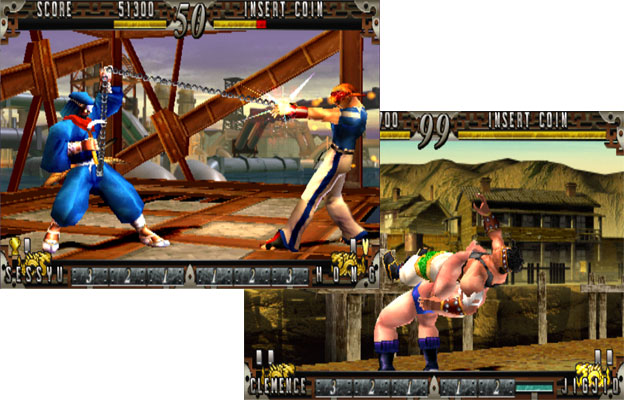
ARIKA was having legal challenges with Capcom regarding the use of Street Fighter characters in the EX series. The studio wanted to expand the franchise but found that the publishing arrangement that they had with Capcom was limited. They created a new partnership with Namco, the long-time rival of Capcom. A new fighting game was being developed that would expand on the world that they had created without infringing on any of Capcom's IP. ARIKA did not forget the legacy and designs that inspired Street Fighter II. The movies, locations and characters that inspired the World Warriors remained influential to the designers years later. The original plans for Street Fighter II, especially the ideas that were left on the cutting room floor were revisited. Although their new game was non-canonical it nonetheless paralleled the original vision for SFII. It also introduced many new gamplay elements to audiences. The studio titled this game Fighting Layer.

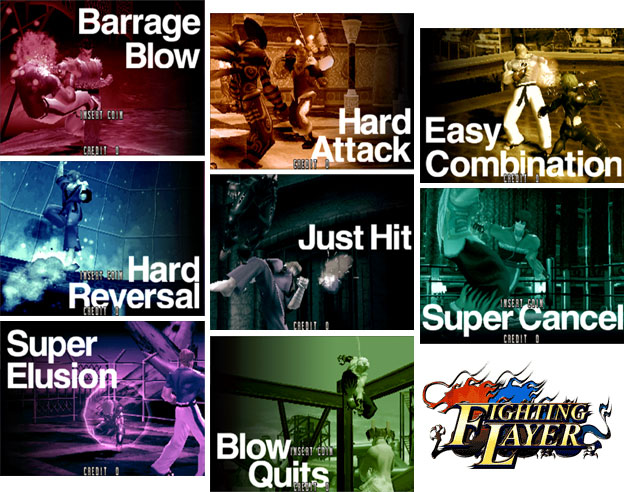
The graphics engine was in 3D but the majority of the gameplay was in 2D, in keeping with the traditions of the company. Even Street Fighter EX had featured traditional 2D mechanics. Other 3D fighting games like Tekken and Virtua Fighter made limited use of three-dimensional space. The pacing and gameplay for those titles was completely different to 2D fighters like SF, Mortal Kombat or Killer Instinct. Fighting Layer kept the super attacks and special attacks that made Super Street Fighter II popular. The studio also included hidden attacks and combos for players to figure out. The game engine also allowed for ways for players to break out of combos on the ground or in the air. This was a way to help balance the engine against players that were good at performing long combo strings. Players could quit out of their own combos and super attacks and switch them up to keep opponents guessing. This was a mechanic that the studio had employed in the EX series with some success. For beginning players there were simple attacks and combos that could be triggered by pressing one punch or one kick button multiple times. It took several revisions for most fighting titles to get all of these features included in the game engine. Most studios went through a learning curve where they balanced and rebalanced character attacks and abilities. Upgrade kits for Street Fighter II labeled Hyper, Turbo, Championship and Super added many new elements to the game. Arcade owners could purchase these upgrade kits to keep the gameplay fresh. ARIKA tried to roll out a game that had all of the modern mechanics expected in a fighting game. It was an ambitious task. To keep gamers coming back they had hidden content that would be released by an internal clock.


Fighting Layer was not the first 3D fighting game, it did not have the most powerful graphics engine and it was not the first to feature time release characters. It was released in 1998, at a time when fighting games had become passé and the arcade industry was dying off in the US. Most fighting games, including the 3D ones would transition to the consoles thanks in part to the success of the Sony Playstation. When 2000 saw the release of the Playstation 2 there was little reason for long-time gamers to visit the arcade. Fighting Layer was also rarely seen outside of Japan. As such not many players saw or played the title. Those fortunate enough to live near an arcade that imported titles could be considered lucky. Fighting Layer (FL) was not the second coming of Street Fighter II as ARIKA had hoped. It was nonetheless a very solid fighting game.

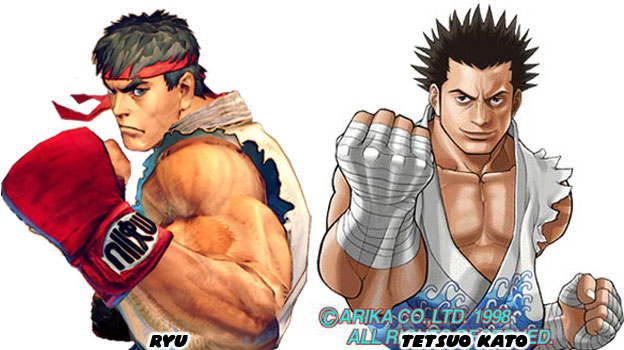
What fighting game from former Capcom employees would be complete if it did not start with a powerful Japanese protagonist? Many gamers expected the return of Kairi from Street Fighter EX. ARIKA designed him to be a rival to Ryu and eventually replace Gouki in canon. Not many behind the scenes or in the fighting game community thought that was a good idea. Regardless Kairi had been elevated to boss-tier character by Street Fighter EX 3 and would not appear in Fighting Layer. The new protagonist was young and heroic. Tetsuo Kato appeared brash and unconventional. With torn sleeves and taped up hands he did seem partially inspired by Kairi but seemed even less refined than Ryu. He was a very powerful karateka that was constantly testing himself against the greatest fighters around the world. Although not a dead-ringer for Ryu he certainly shared his fighting spirit.

Audiences could guess where the influences behind the character were pulled from. The wild spiky hair made him look like Tetsuo, a main character from the manga and animé film Akira. The surname is common in Japan but could also be based on a character that Bruce Lee played in the TV series the Green Hornet. ARIKA followed a tradition that they started with Street Fighter EX. Almost every character that they added to canon had a last name. The designers never included last names for most of the World Warriors and boss characters in the original Street Fighter, SF II or III. However the ones in the planning stages for Street Fighter III that were shoehorned into SF II as the "Super" upgrade did get last names. Cammy White, Dee Jay, T. Hawk and Fei Long all had surnames. It makes you wonder if they were not created from the future ARIKA designers. Tetsuo Kato needed other heroic fighters to accompany him in the newly created Fighting Layer tournament. The core of the group had to be equally passionate as Kato and equally gifted in combat. Although none of the characters knew each other there was something eerily familiar about them. We will go down the rabbit hole in the next blog and take a closer look at the roots of the Fighting Layer designs.
If you would like to sponsor me please visit my Patreon page and consider donating each month, even as little as $1 would help make better blogs and even podcasts!

Subscribe to:
Posts (Atom)