Showing posts with label ridge racer unbounded. Show all posts

Wednesday, August 6, 2014

The Ridge Racer Legacy, part 23...

The steady decline of arcade gaming in the US over the late '90s meant that more and more developers began to take their franchises to home consoles. Ridge Racer V, released in 2000 was an extremely rare game that saw success on both the Playstation 2 as well as the arcade. Namco knew that the US would not support the arcade market as they once had through the late '70s and '80s. Console, PC and mobile gaming had completely eclipsed the out-of-home experience.
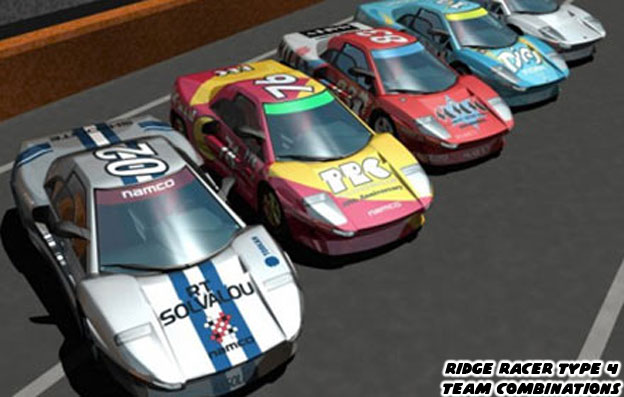
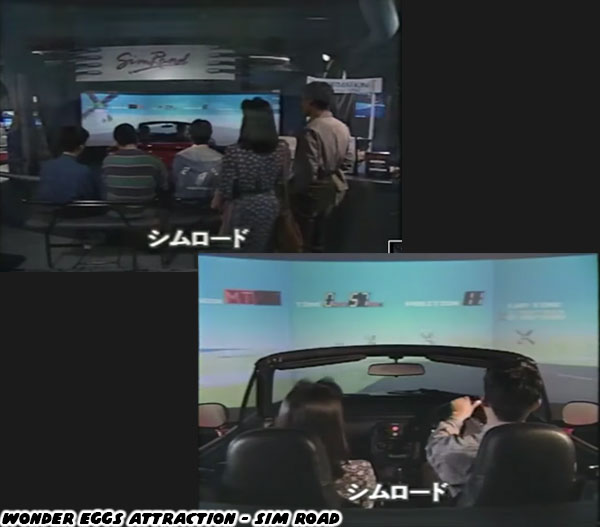
Namco made a solid effort to ensure that every iteration of Ridge Racer offered experiences that could not be matched in the arcade. The most important of these game design elements being time. An arcade game is meant to be enjoyed in a few short bursts. Longer, more drawn out stories and adventures were rarely presented. If the arcade title was meant to last 5 or 10 minutes then it was usually very difficult, and required players to continuously add credits to the machine. Console players never had to worry about running out of money or time. They expected to get the greatest possible experience for their dollar as they could. Namco did everything in their power to make arcade visitors feel like they were having the superior experience. This was partly the reason why the company created the Wonder Eggs theme park. It featured many attractions based on Namco titles.
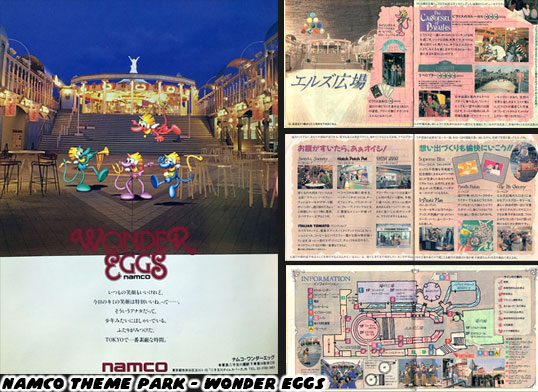
Ridge Racer Type 4 set the bar impossibly high. No arcade to console series would ever match the numbers in that game. There were four manufacturers, four teams and eight tracks for players to choose from. That doesn't sound very impressive but the 321 cars that could also be unlocked certainly was. Namco gave racing fans a reason to go through multiple replays. When technology improved so did the franchise. Ridge Racer V gave audiences a taste of the classic arcade experience but with enhanced graphics and many more secrets to unlock. In 2003 Namco tried their boldest experiment yet. R: Racing Evolution (RRE) was an attempt at redefining the franchise. It was not a radical shift as in Ridge Racer Unbounded. The game still had the classic racing experience but featured actual manufacturers instead of fictional ones. The story elements from Ridge Racer Type 4 were fleshed out with a defined hero named Rena Hayami and a villain with the corporate sponsors G.V.I. Console players however were hoping that Namco would return to their roots.
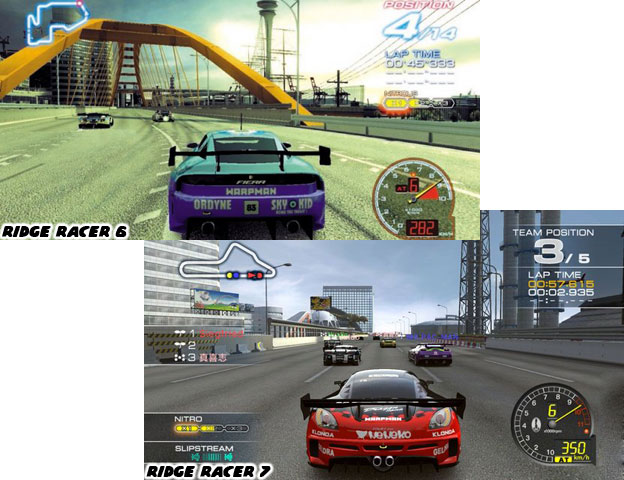
In 2005 Namco released Ridge Racer 6. It was an Xbox 360 exclusive much to the surprise of Sony fans. The visuals had jumped exponentially over the previous game. The new hardware was capable of creating cars and tracks which were amazing. For the first time the studio could claim to have photorealistic visuals for their long-running franchise. Ridge City and the surrounding communities looked as vivid as any real world location that had been featured in a rival AAA title. Reiko Nagase had even returned in the opening animation and all seemed right with the world. What audiences did not know was what the studio was secretly working on. The developers were refining the cars, locations, tracks and animations over the course of that calendar year. In 2006 the Playstation 3 received a superior version of the game labeled Ridge Racer 7. Again the bar had been raised, this time in full HD and with online gameplay that would have been a dream a decade earlier.
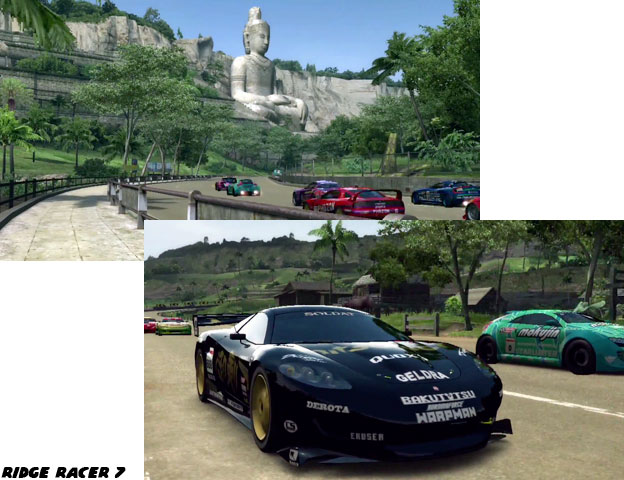
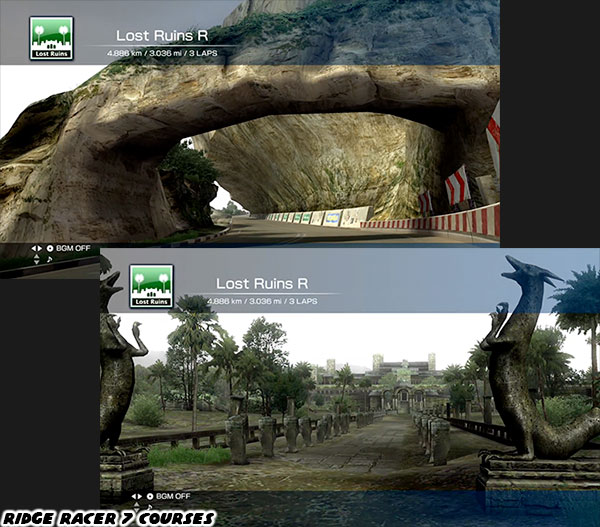
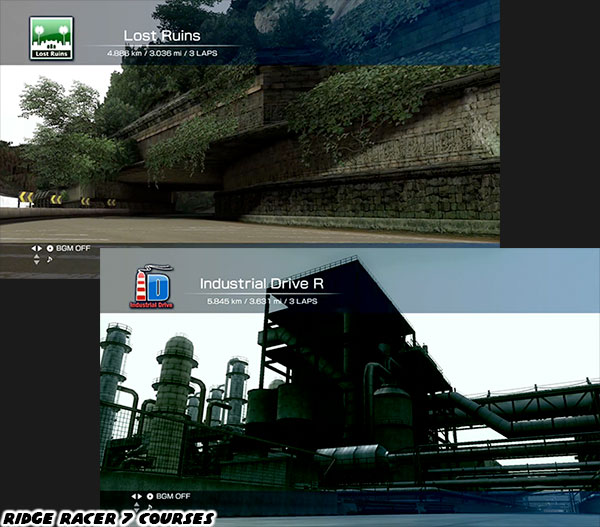
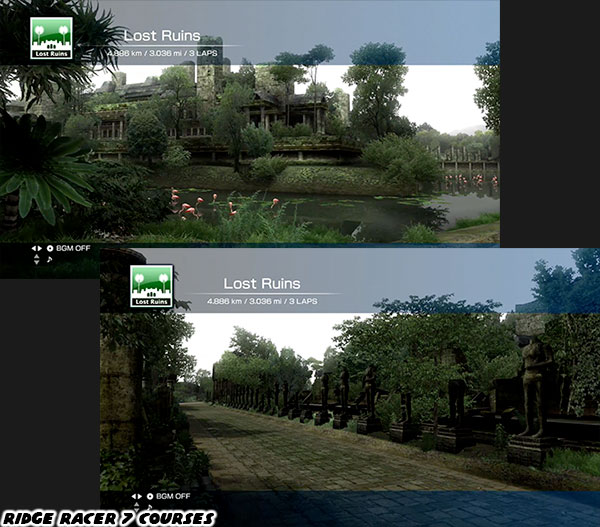
The new Ridge Racer experience had improved in several ways, not the least of which were track designs. Namco actually came close to topping Sega's best work in several courses. The studio had a record of using storytelling elements in several of their games, including the Ace Driver, Cyber Cycles and Final Lap. The elements featured in those tracks never pushed the envelope as far as Sega did. Namco made up for the lack of spectacle with realism. Certainly a track could exist near some ancient ruins but it would never desecrate the history of that region by putting a winding course through a temple. In the Mist Falls and Lost Ruins courses Namco developers connected portions of an ancient road with a modern expressway. Cars would drift between several different eras in the Southeast Asian-themed tracks during each lap. Part of the course would run through caves and rice patties and part or the road was tethered to pylons and floating above the tide on pontoon bridges. Visually it was another stunner but every element incorporated into the track was inspired by actual locations and even road technology. My Cambodian and Vietnamese friends would comment on how familiar the sights looked, including the foliage and rural villages as I raced around the courses.
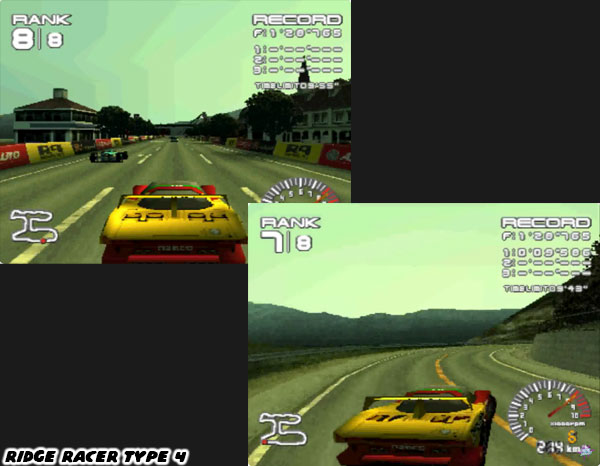
It was often the little details that were overlooked in other racing games that Namco capitalized on It was like a trade secret for the studio. In many of their locations players could actually see a walkway that followed the edge of the track. The majority of the locations featured in the Ridge Racer series were supposed to be used as public roads when cars were not racing on them. Because of that many of the tracks in the series actually had temporary barriers and cones cutting off side streets. Players could still make out sidewalks, driveways and exits on the side of the road. Even the tiniest of details, like stairs, bridges and doorways meant for pedestrians were easy to make out in the edges of each course. It was an absurd amount of work that went into each and every course but the end result was worth it to gamers.
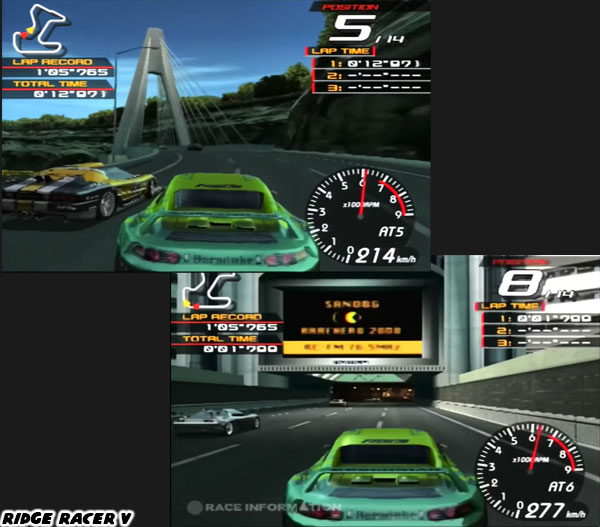
No other fictional place looked as inviting in any other racing series. Namco never lost focus on the big picture. The courses had to be visually appealing even while traveling well over 200MPH. Many of the smaller details that I had described were nothing more than a blur at high speed. The larger set pieces that the developers had created as scenery certainly stood out. The enormous sitting Buddha in the Thai-inspired tracks was one example. The studio had been creating enormous scenery features since the very first game. The multitude of bridges that were featured across several sequels were always memorable. In fact it would be hard to imagine a Ridge Racer track that did not have at least one unique bridge incorporated into the layout. Enormous suspension, truss and cantilever bridges were impossible to ignore from a distance, even while traveling at a very high speed.
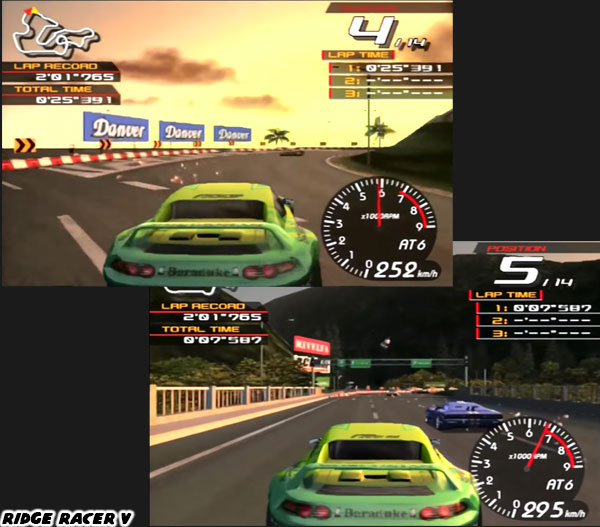
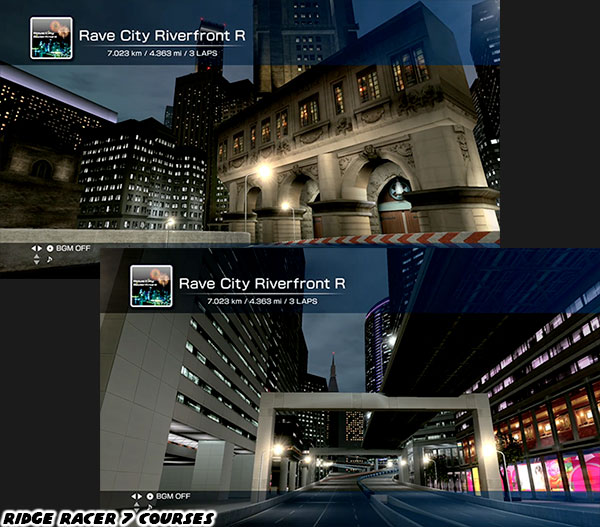
Every track in the Ridge Racer series had been set at a particular time of day, most often with the lighting and weather that best highlighted the location. The majority of the tracks featured perfect weather, some with a hint of sun gleaming off the screen. Other tracks were set at dusk when the color of the sky was a blend of bright colors. Some of the greatest tracks however were presented at night. No other city created by Namco, or many other developers for that matter, looked better than Rave City at night. Not Ridge City, Bayshore or even the Bugbear developed Shatterbay. Rave City had come a long way since it debuted in 1995.
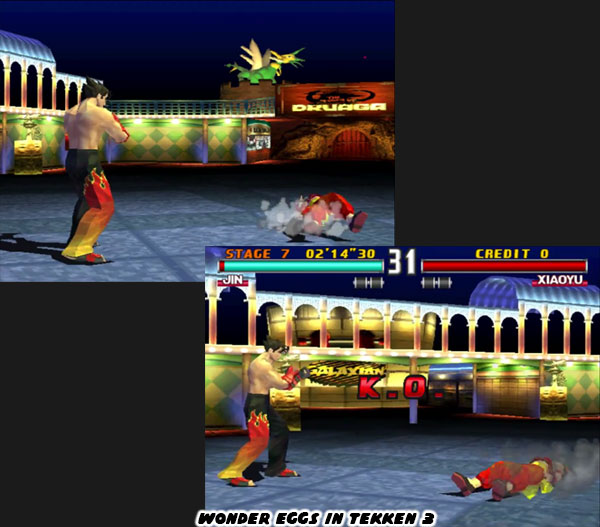
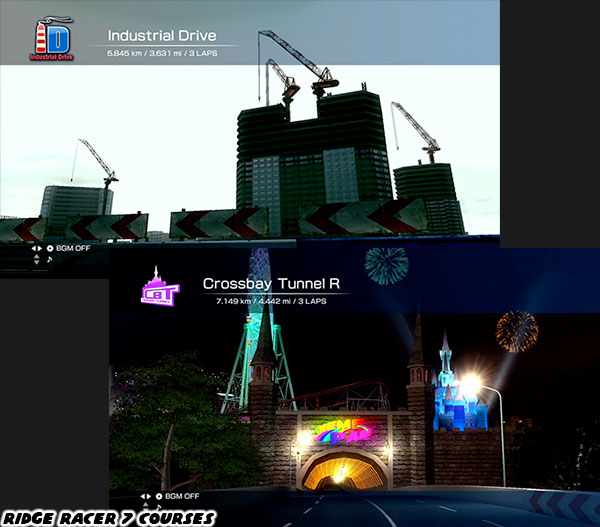
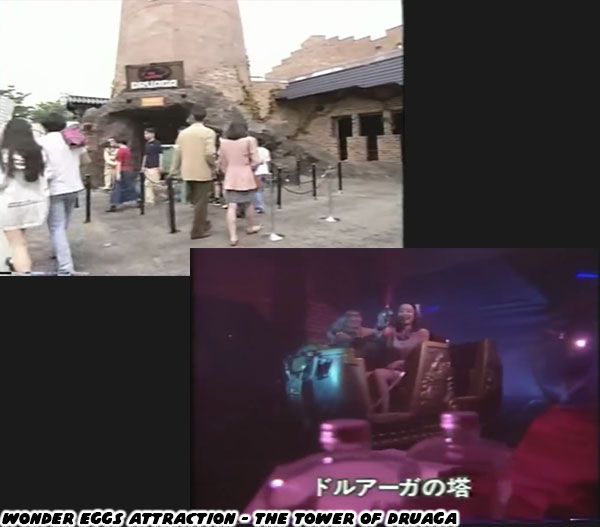
Gone were the billboards advertising arcade games from the '80s and '90s. Gone were the see-saw screen tilts, chunky car textures and annoying voice-overs. The new Rave City and its multitude of courses were cast in perpetual midnight. The enormous skyscrapers that lined the roads were illuminated with millions of lights. Drivers could make their way across the bay by taking a series of massive bridges or by using a series of underground tunnels colored by neon lights. To add Sega-style spectacle to the location there was even a theme park, casino, shopping complex and stadium located through, next to and under the courses. It was essentially the great timeline version of the Wonder Eggs theme park that Namco hoped to have built. Sharp-eyed arcade fans could spot a rollercoaster modeled after the classic fantasy title The Tower of Druaga. Even in this world every Namco shout-out had to be acceptable in canon.
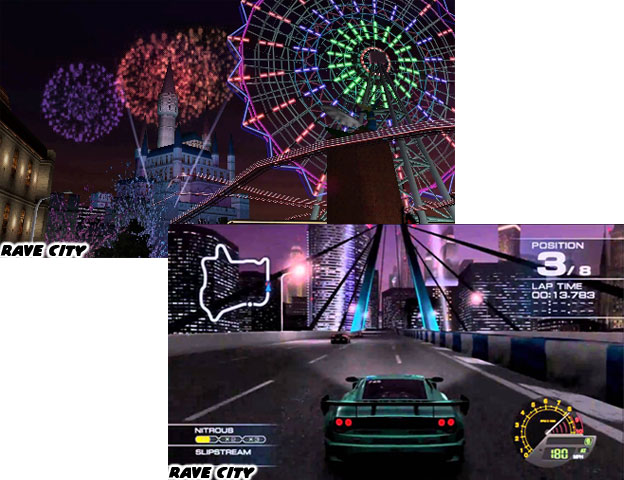
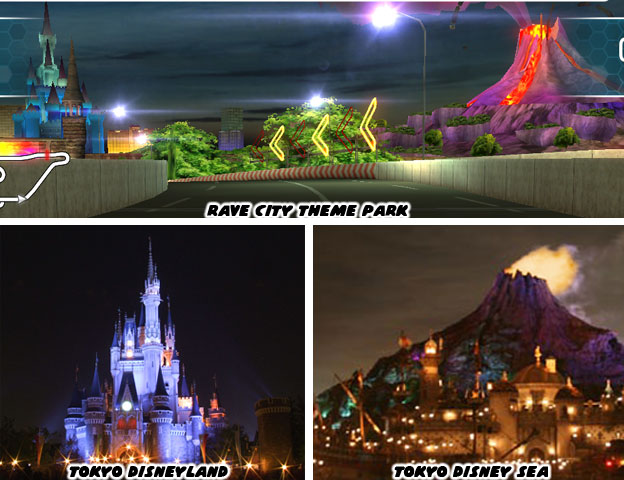
Fireworks could be seen lighting up the sky over the The Rave City theme park. The gigantic ferris wheel sparkled with thousands of multicolored LED lights and part of the Druaga coaster track was suspended over the street course. There was even a huge man made volcano that would spit out smoke and fire on regular intervals. The enormous castle was undoubtedly modeled after Tokyo Disneyland and the volcano after the one in the neighboring Tokyo Disney Sea park.
A portion of the backlot could be raced through, making the Downtown Rave City and Crossbay Tunnel courses almost as memorable as Sega's legendary Joypolis 2020 course from Daytona USA 2. The Namco response was essentially Wonder Eggs World 3030. This was the Ridge Racer experience that long-time fans were hoping to see on newer consoles. It was the evolutionary step from Ridge Racer Type 4 that wasn't reached in Ridge Racer V. The experience was far more fantastic than any previous title yet maintained a certain sense of realism, rather than reality.
The sense of the impossibly fast races and futuristic landscapes was absent when Bugbear Entertainment developed Unbounded. Everything suddenly became dark and gritty. The streets were dirty and cracked, the world was covered with a layer of grime. Cinematic reality was the goal that the developers had achieved. It was visually amazing but somewhat depressing at the same time. The atmosphere in Unbounded was nihilistic, the studio wanted drivers not to feel bad about destroying the city of Shatterbay with unstoppable muscle cars.
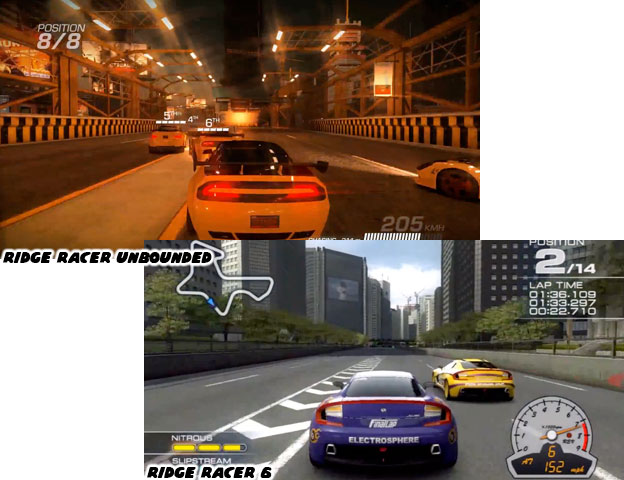
Bugbear Entertainment had changed the world of Ridge Racer to suit their vision. I don't hold it against them. Unbounded was a great game, but it was not a Ridge Racer experience. Namco had made the mistake of following a trend rather than charting out its own destiny. Destruction racing, action racing, whatever the gaming media dubbed it was almost a decade old before the Japanese publisher decided to cash in on it. The worst thing was that Namco had turned its back on the promise of tomorrow.
The future was the strongest selling point that the series had going for it. Every version of the game was meant to push the boundaries of racing. It dared to ask the question of what would happen if there was an era without conflict and without strife. What sorts of entertainment achievements could be achieved in that time? How much more amazing of a spectacle would racing become if the biggest industries were invested in it rather than in the instruments of war? The next blog will answer that question. As always if you would like to sponsor me please visit my Patreon page and consider donating each month, even as little as $1 would help make better blogs and even podcasts!
follow the Street Writer on Patreon!

Monday, August 4, 2014

The Ridge Racer Legacy, part 21...

Bugbear Entertainment had a very specific vision for Ridge Racer Unbounded. They created a game with a certain tone and atmosphere. It was much darker than fans of the series were used to seeing. In order to get audiences to accept why the racers were willing to destroy their own city they had to give them a reason to. The city of Shatterbay had a very strong contrast between the political and business elite. Those that ran the city did so from the comfort of glass and steel skyscrapers. Everything away from the heart of downtown, pretty much the rest of the city was a slum. The actual working masses lived in poorly maintained, poorly run boroughs. The city looked worn and beat down from years of neglect. Buildings were all in muted colors, it had obviously been years since they had seen a fresh coat of paint. Trash and graffiti littered the streets and roads were in sorry condition. It didn't take much for the "Unbounded" to take the system apart one wall at a time.


The game was very much calling out to the frustration that the Occupy movement had been trying express. The inequity was what the 99% felt towards a system that was rigged against them. Social commentary had been very lightly sprinkled over video games for the past four decades. As storage, graphics and animation increased so could the ability to tell more complex stories. Strong political statements began to creep in over the past few console generations. Since some racing games were taking on the qualities of action titles then it was only a matter of time before some of the political themes would get carried over as well.

Unbounded was an extremely rare example of that type of game design and storytelling. The ability to race and destroy had always had a cathartic effect on gamers. It was not only crucial for the Unbounded story but actually made for a fun experience. Since the game did not actually have pedestrians to run over or carnage, as in Carmageddon, then the destruction was more acceptable for younger audiences. Sometimes it was okay to cut loose and just smash into things in a racing game. The release was similar to what violent fighting games did to get aggression out of fans.

Namco knew a thing about fighting games as well. They were well versed in creating worlds where heroes and villains were in constant battle. Their worlds were believable but presented much differently than those from the west. Bayshore, the location for several Tekken games, was as big if not bigger than Shatterbay. Yet there was a stark contrast between the way that metropolis was presented. The Japanese designers wanted to show a realistic world that also had a hint of futurism rather than nihilism. The logistical problems of a major city such as traffic, roads, and mass transit were always in the minds of the developers. These things were always present in the Tekken games. The cities were always alive and breathing, with traffic flowing back and forth and monorails carrying passengers to work. Even if these details could only be seen from a distance they were nonetheless there. Bayshore never looked old and neglected as did Shatterbay. The masses did live in gigantic apartment buildings and condos, but those buildings were as spotless as the skyscrapers that the powerful ruled from. There was no graffiti, no litter and nothing that would give audiences an unfavorable impression of the location.


Namco was not ignorant to the trends of the world. The studio knew that they could not present a completely utopian view of the civilization, especially within the Tekken series. War and strife were still very much relevant in canon, however that reality did not trickle down to the masses. The citizens of Bayshore and other Namco cities did not live in constant fear, nor were they protesting the establishment. The Mishima Zaibatsu and the G Corporation had done an impeccable job convincing the masses that they were working for the public good. They showed this by creating enormous public works projects, hosting the King of the Iron Fist tournaments and running cities which were seemingly free of any crime.

Of course the public works projects were usually building enormous underground bunkers for military units or research facilities for mad scientists. The Iron Fist tournament was a cover for paramilitary soldiers to try and out each other in front of the sponsors. Criminals were rounded up by the zero tolerance private police force or recruited by the Zaibatsu and other organizations. There was much more happening behind the scenes than gamers or even reviewers had realized. Namco created cities that would shine like a beacon to the rest of the world and at the same time hide a dark secret. By comparison Bugbear Entertainment thought that western audiences would not "get" that Shatterbay was corrupt unless it looked like an enormous slum.

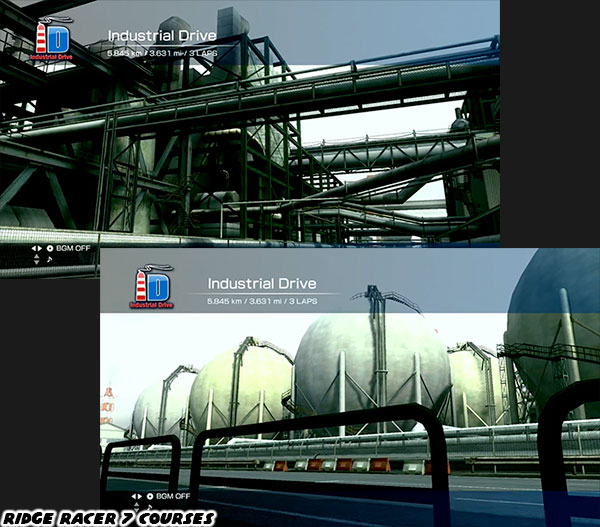
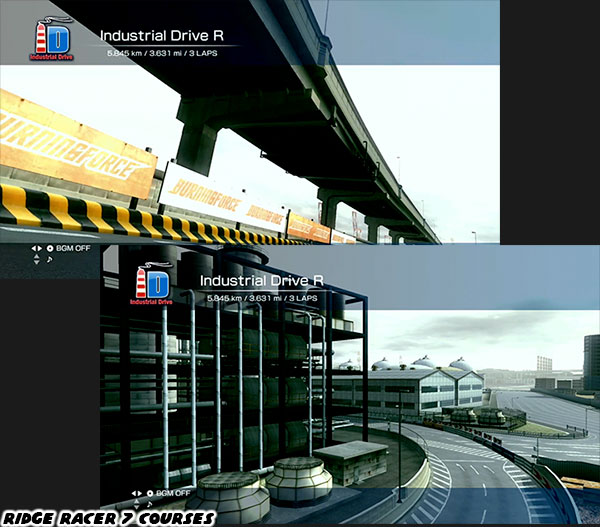
Namco designers knew that the levels featured in their franchise titles had to look believable. Bayshore and Ridge City needed to have bustling ports, refineries, airports and freeways. These cities could not simply exist for the sake of fighting or racing tournaments. Although to be fair they were certainly laid out to cater to them. Namco had demonstrated that levels could have a tremendous amount of atmosphere without it being all dark and gloomy. Dusk could look amazing instead of ominous in an industrial area. Even an overcast day in downtown could look like paradise because of how the city was framed. Ridge City was even more utopian than Bayshore in this regard. It was hard to get an unfavorable take on the city because Namco was willing to let audiences enjoy the atmosphere.


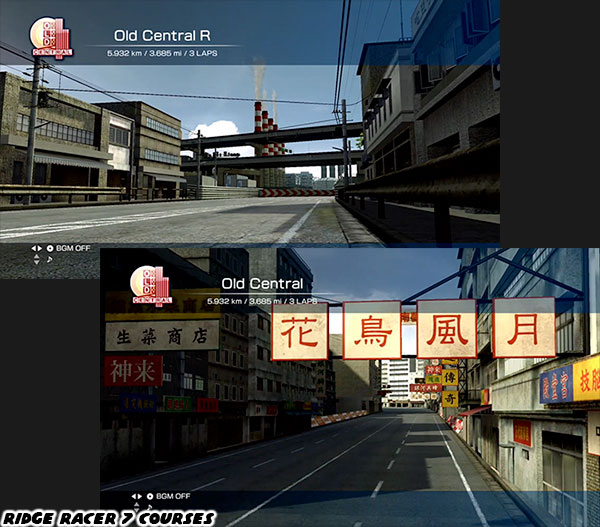
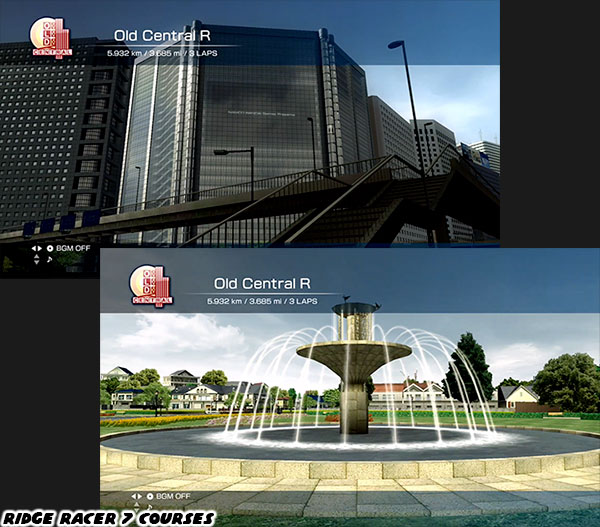
There were layers and layers of details that went into the creation of each stage in the previous Ridge Racer games. Unbounded seemed hollow by comparison. The manicured lawns, enormous fountain, European clock tower and craftsman-style mansions that lined the Old Central course. The neon splendor of the Crossbay Tunnel which ran under Rave City River. The span bridge that crossed Ridge Bay and had been a staple since the very first game. It was better known as the Harbor Line 765 circuit. It had been featured in many sequels and became symbolic for the series. Yet there was a small town in the shadows of that bridge. It was the original settlement that Ridge City had grown out of. The remains of a Spanish fort and an old pueblo had remained untouched for several centuries. The humble origins of the greatest Namco metropolis made up the Island Circle level. The juxtaposition of the old and the new was something very subtle. It was something that gamers might have overlooked. It was something that the gaming media may have even ignored. Yet it was also something that not every studio was capable of doing.

Bugbear had not paid close attention to the classic Namco levels. They missed the nuances that made up many memorable stages. Several of the locations featured in the series were as iconic as the race cars in the game. I would go as far as to say that they were as memorable as the fighters in the Tekken series. A great race course, both the real and fictional kind, could have a personality after all. The scenery that surrounded the locations, the personalities in attendance and sponsors that were cutting deals from private suites high above the courses. Every track told a story. Every city host had a history and roots as rich as Ridge City. Some of the best could be considered almost SEGA good in fact.


The best tracks in Ridge Racer had a timeless quality to them. Whether they were set in a bustling metropolis or in a jungle outcropping they did not instantly date themselves. By using a backdrop that looked a lot like current New York City Ridge Racer Unbounded locked itself into one era. In a few years the railcars would look even more dated than they already were. The muscle cars and exotics would be further our of place and the architecture, even for downtown, become antiquated. The dilapidated city of Shatterbay would no longer remain worth revisiting. Ridge City on the other hand would always be a welcome sight to fans of the franchise.

Bugbear did offer racers something that very few titles could. Ridge Racer Unbounded allowed them to create their own race courses and share them online with the community. Players earned the pieces for the basic and advanced editors by completing races and earning achievements. In the basic mode players could lay out a course by rotating and dropping curves and straightaways over a blank borough. Some sections of each track piece were designed with objects and obstacles that could be destroyed by the race cars. In the advanced mode players could add in additional details to each course including ramps, parked cars, walls and loops. These details could even be stacked and placed mid-air for the most creative editors.


The editor was not as easy to use as gamers had expected. In the PC release of the game it was broken from the onset. Players had to wait for Bugbear to release a patch to solve many problems with the editor. There was a surplus of courses online for players to try and review. It was as if for every one player a dozen variations was waiting for them. The drawbacks to Ridge Racer Unbounded, the lack of originality, began to show thanks to the editors. The same assets that the Bugbear had used to create the game were available to players. This was not bad in and of itself, however while racing through the game it was apparent that the developers had released a title that consisted of mostly edited set pieces. When those levels were combined with bland cars the experience felt cheap. It was not the Ridge Racer that I was a fan of.

Sandbox editors were nothing new to the genre. Trackmania by Nadeo lived up to its name. As one of the longest running PC titles with an editing program it had earned its name by allowing level authors to go completely crazy. Gamers could create courses that were as technically challenging as real Formula-1 stages, or they could create outlandish courses that would have been the envy of a Hot Wheels stunt track. The best part for audiences was that they didn't even have to be any good at driving to enjoy the racing experience. Some editors created tracks that were a series of twists, loops and free falls that would have been impossible to navigate. All the players had to do on these courses was Just Press Forward, or rather hold down the accelerator. The track would guide the car from beginning to end and allow gamers to enjoy the sights of the course. It was a lot like creating a dizzying ride in Roller Coaster Tycoon.


The editor in Ridge Racer Unbounded was not in the same league as Trackmania. Even with dozens and dozens of potential pieces to unlock and thousands of level combinations that they could come up with it was a drop in the bucket compared to what a more robust editor like Trackmania offered. The stages in Unbounded lacked the charm of the classic Ridge Racer tracks as well. The earlier Ridge Racer courses told a story. It was a story that would remain more promising than the future of Shatterbay. Namco tried to extend the life of the game by announcing Ridge Racer Driftopia in 2013. Essentially it was a free-to-play MMO racing game using the Unbounded engine. The spectacle of the action racing games was not enough to keep players engaged. It happened to Burnout and Need for Speed and would happen to Unbounded. Ridge Racer was a series that worked best when audiences lost themselves in the world that Namco had created. The next blog will take a closer look at what Namco lost when they went with the vision laid out by Bugbear Entertainment. If you would like to sponsor me please visit my Patreon page and consider donating each month, even as little as $1 would help make better blogs and even podcasts!
follow the Street Writer on Patreon!

Friday, August 1, 2014

The Ridge Racer Legacy, part 20...

Ridge Racer without a doubt has had the greatest library of fictional racing cars ever conceived. If I were to choose which were the best cars from any series I wouldn't even think twice about it. I fully admit that Sega made superior tracks and better overall racing experiences. I will also admit that Sega created the environments that I wish I could actually drive through and live within. The flipside of the statement is that I wish I could drive through those levels in a Ridge Racer car. The cars featured in Ridge Racer Unbounded however were completely forgettable.


Gone were the sponsor logos, gone were the nods to Namco's legacy games. All of the cars in Unbounded were designs poached from contemporary muscle cars. Even the exotics and super cars introduced in the title did not go very far to find inspiration. These were cars that you could find on the street and on the freeway. When Sega created a library of fictional motors in OutRunners they were cartoonish homages to the popular cars from around the world. Sega was one of the first studios to appreciate the aesthetics of a legendary car and create their own interpretations of them. They would not have been as well remembered if they had ripped them off wholesale. Other studios had also created a library of generic cars for their own titles. The designers working on Grand Theft Auto and Saints Row were notorious for creating cars that were eerily similar to production automobiles. These studios changed a few details and names so that they couldn't be sued for copyright infringement. The cars in Unbounded were as generic as those from the popular sandbox games. There was simply nothing memorable about them.

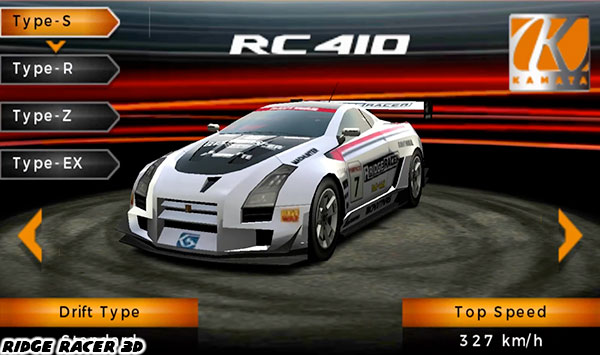
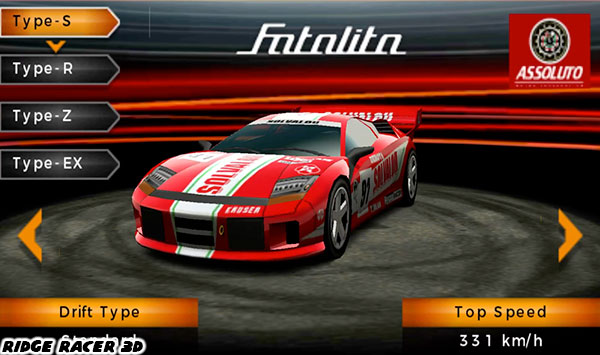
By comparison the cars in previous Ridge Racer games could never be forgotten. These cars ran from racing versions of everyday drivers to one-off prototypes. Yet each of the fictional cars also retained a sense of realism. It was not hard to imagine that many of the cars in Ridge Racer could have been spotted on the road. In some cases the cars were reminiscent of autos from the past and in many other cases they were predictive of the trends that would shape the industry 5, 10 or even 20 years down the road. The range of diverse driving experiences could be found in many Ridge Racer sequels. The manufactures from previous games would return along with some familiar rides as well as new models in each revision of Ridge Racer with the exception of Unbounded.


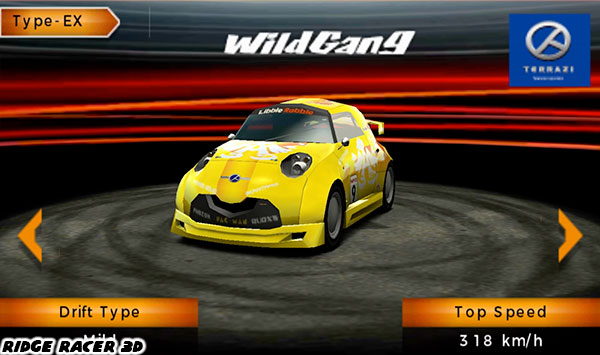
The most elite of the cars in Ridge Racer also looked very unique. The final cars that players could unlock, the ones with the impossibly fast acceleration and insanely high top speed, were the most desirable rides ever invented in a racing series. The Angel 0 and Devil 13 were at the top of the list but they were joined by some equally memorable cars as well. Some of the cars were based on designs for prototype racing classes that never got picked up by the major racing circuits. The designers at Namco breathed new life into these cars and gave them a purpose. They invented manufacturers that would become responsible for these prototypical machines through the life of the series. The manufacturer Terrazi for example was based in Japan. The company seemed focused on technology in everything they made. Some of their fastest race cars took on some bold designs. Such was the case for the Terrazi Terrific.


The Terrific was nothing short of an exposed engine with a wedge-shaped wing. It was a radical concept that still managed to find some sense of believability. Audiences could have imagined that the Terrific would have appeared in the 24 Hours of LeMans as a prototype entry. All of the information gathered from the car would be filtered down to every other car Terrazi manufactured. It was the same thing that actual manufacturers did with their most radical designs.

The special cars in Ridge Racer Unbounded lacked the standout features of the Terrific and other Namco designs. They were nice to look at but again, there was nothing memorable about them. The regular cars looked like current muscle cars while the special class was made up of classic muscle cars and hot rods. These were not the typical hot rods either but instead the fabricated, chromed-out cars that would appear in custom car shows. All of the designs were rooted in American culture and didn't quite reflect the global racing community.


It was quite an insult to the Japanese, German and Italian manufacturers when the majority of special cars in Unbouded were US bruisers. Diversity helped sell the experience to the original generation of Ridge Racer fans. Every particular taste was well represented in the library of cars that Namco had introduced. The design of the Unbounded cars was nothing more than heavy handed pandering to the west. The gameplay itself could also be called pandering as well.

When I saw the special class in Unbounded I imagined that the developers at Bugbear Entertainment jumped online and did a Google search for hot rods. What they turned up were the award-winning designs of artists like Thom Taylor, Boyd Coddington and Chip Foose. Again all they had to do was change some details and colors so that they couldn't be called out for poaching their designs. Any car fan worth their salt should be disappointed at the lack of originality that the studio employed while creating their lineup. It was an insult to the work that all the previous Ridge Racer teams had put into the series. Even the ones that left for Sega would have been ashamed at the lack of originality.


Perhaps the biggest insult to the legacy of Ridge Racer were the locations, level designs and overall theme featured in Unbounded. The graphics did look amazing, they were some of the best racing graphics in a long while. With that said there was nothing memorable about the setting. The next blog will explore what Namco had established and what Bugbear had done to the world of Ridge Racer. I hope to see you back for that. If you would like to sponsor me please visit my Patreon page and consider donating each month, even as little as $1 would help make better blogs and even podcasts!
follow the Street Writer on Patreon!

Thursday, July 31, 2014

The Ridge Racer Legacy, part 19...

When it came to indestructible muscle cars smashing through traffic there were several other games that Ridge Racer Unbounded could have been the sequel to. Need for Speed and Burnout were the two most obvious choices. Fans wondered aloud why Ridge Racer? Never in a million years would fans have expected to see that happen to the franchise. Fans after all complained about how unrealistic it was that the cars in Japanese racing games never could get dented and yet the entire premise for Unbounded was that these cars were powerful enough to tear through concrete and steel rebar pylons without so much as a scratch. In addition to the name there was a certain amount of suspension of disbelief that Namco could not acheive.


The studio had given players a franchise that was the definition of street drifting super cars. The focus was on the cars and the races, not about destruction and dirty driving. All of a sudden the laws of physics had changed. Instead of being lightweight and nimble the race cars carried the mass of a runaway freight train and were made out of indestructible material.That type of sudden change with the IP was absurd. It was as if someone that had never played the original Ridge Racer was trying to convince audiences that these were the best parts of the series. Even the official art for the game showed a strong contrast from the previous entries. Earlier campaigns featured Reiko and some futuristic performance cars racing around her. The new campaign featured gang leader Kara Shindo with cars smashing through a wall behind her. Racing wasn't even implied, but destruction certainly was!

Mind you that Bugbear created a very fun game. I would be a liar if I said that Unbounded was not a very memorable experience. In fact had the game been released without the Ridge Racer label I probably would have promoted it heavily to my friends. It was in the vein of the previously mentioned action racers and could be considered one of the better takes on the genre. Visually the game was stunning. The car models and level details appeared completely destructible. Paint chipped, panels shattered and glass sprayed in all directions as racers tore through the streets of Shatterbay city. The cars weren't the only things that broke apart. Walls, windows, pylons, fences and just about anything that a driver slammed into would break apart. It was on par if not superior to the visuals featured in other AAA action racing games including the Criterion remake of Need for Speed: Hot Pursuit.


Bugbear had developed an advanced 3D engine that they had originally created for the game FlatOut. All it took was the addition for a drifting mechanic and some actual race modes and Namco seemed willing to sign off on the Ridge Racer name. It's tough to knock Bugbear for the quality action racer that they released. There were tons of cars to unlock, race types to master and content to discover. Long-time arcade fans had to relearn the racing experience and it was okay. Instead of avoiding obstacles and opponents the best lines were found by breaking through buildings and creating shortcuts. If opponents were being particularly stubborn then there was nothing more rewarding than sending them flipping end over end with a perfectly executed Takedown, or rather "Frag." Even Burnout and Need for Speed had gone through periods where they seemed completely tapped for ideas. Unbouded slid right into their spot and gave audiences something new.

The visuals in Unbounded were very well done. The game made good use of lighting filters, for example it cast strong shadows across the metropolis as the sun set. Blending lights into long streaks that curved and followed the players as they activated their nitro boost was another unique visual treat. The environments had a sense of realism to them. The signage, architecture, layout, rail cars and supporting details all screamed New York City and the surrounding boroughs. A race played out very much like the best parts of car chases in the movies. Newsstands could be smashed to splinters, sending newspapers and magazines all over the road. Planters and tables would be scattered off the street corners like rubbish in a strong wind. Trees could be bowled over and leaves would come cascading down onto opponents. If a light post were upended then the remaining crater would be left shooting sparks. The flimsy gates in parking garages could be driven through with reckless abandon. Gas pumps could even be toppled, causing an entire gas station to explode in the wake of the racer.

Like Burnout and Carmageddon it was basically a way for gamers to get out their aggression and drive in a way that they always wanted to without fear of injury or death. It was the sense of permanence that helped make each lap memorable. In other games the debris and after effects of a wreck would be cleared off the road. Not in this game. Fires would remain burning, craters smoldering and broken fences would remain clipped lap after lap. Players would not only be rewarded for taking down opponents but also targeting buildings controlled by crooked city officials. Creating collateral damage was as important as finishing each race in first place.


Unbounded made good use of cinematic touches to break up the extended periods of destruction. Cuts to slow motion and lap timers that would appear as giant floating letters helped "reset" the attention of the player. After several races the player learned that the game surmounted to destruction pornography. It was most decidedly targeted to young men that enjoyed fast cars and lots of explosions. It was the type of racing game that Michael Bay or Jerry Bruckheimer would have created if they knew a thing about making games. In fact the entire experience of Unbounded quickly became more about the spectacle than the substance. It was something that had caused the Need for Speed and Burnout series to suffer as well.

There was a game that could be considered a predecessor to Unbounded I have not yet mentioned in this series. Blackrock Studio had released a game called Split/Second for the Xbox 360 and Playstation 3 in 2010. That game was as well rated as Unbounded and the better Burnout and Need for Speed titles. It also featured fictional race cars tearing up fictional courses. The premise was simple, the drivers were competing on a television show that revolved around racing and explosions. Players could trigger level-changing events called "Power Plays." Freeways and bridges would collapse, rockslides would come crashing down and construction equipment would go haywire. All of these things were designed to help wipe rivals off the courses and open up new areas to race through. The game was sheer spectacle and fans couldn't get enough of it.


Arcade fans would remember that the tilt of the screen from side to side when players drifted around corners in both Split/Second and Unbounded was poached from Rave Racer. The control in Split/Second was pretty good for a first-time action racer. Although to be fair Blackrock studio had plenty of experience working in the racing format with titles like ATV Offroad Fury, MotoGP, Hot Wheels: Stunt Track Challenge and Pure. The hardest part for the studio would have been figuring out how to incorporate Power Plays without breaking the playability of the game. It must have taken a lot of work to keep the pace of the game fluid. If the location of event triggers were too close then players might end up wiping themselves out along with opponents. If they were too far apart then rivals would be able to react and get out of the way. Blackrock Studio found the sweet spot and made it so that racers had enough time to enjoy the scale of entire buildings collapsing all around them while finding the right line to make it out alive.

The car designs in Split/Second were a mix of muscle and futurism. There were trucks, and sports cars with Japanese and European influences as well. They were quite unlike those in Need for Speed or any of the other western produced racing games. It made me wish that the title would have had a sequel as was promised in the end credits. The cars in Unbounded did not have the staying power of Split/Second or any of the other western developed games. It was yet another reason why fans of the series could not bring themselves to accept that Unbounded fell within Ridge Racer canon. The next blog will look specifically at the Ridge Racer cars that weren't. If you would like to sponsor me please visit my Patreon page and consider donating each month, even as little as $1 would help make better blogs and even podcasts!
follow the Street Writer on Patreon!

Wednesday, July 30, 2014

The Ridge Racer Legacy, part 18...

Namco (now Namco Bandai) published a game called Ridge Racer Unbounded in 2012. The game was developed by the Finnish studio Bugbear Entertainment. To say that it was a change of pace would be a severe understatement. The debut trailer for Unbounded was very dark and brooding. It had none of the atmosphere of the classic arcade series or even the more recent console updates.


In the intro players could see a pristine white race car driving down the streets of the gritty Shatterbay City. It turned down an alleyway that was littered and covered in graffiti. Clearly this town had seen better days. There were a few sponsor logos on the white car, leading audiences to believe that it was a traditional Ridge Racer car. The unseen driver pulled up to a dark corner of the alley and got out. The steam rising from the sewers obscured the character somewhat.

Audiences didn't get a good look at this character but based on her body shape and haircut they could assume that it was Reiko Nagase or a Reiko clone. This driver found a black muscle car in the shadows and got in it. Apparently the racing scene in Shatterbay City featured sinister-looking unmarked muscle cars instead of the sponsored racers from Ridge City. It was a sort of yin and yang for car fans. If this was Reiko then she became an illegal street racer at night when she was not an idol for the residents of Ridge City.


The new "edgy" Ridge Racer Unbounded intro talked about the "outcasts." Apparently Reiko, or someone assuming her role had become one of the marginalized masses. Speaking for them she declared that "we are the unbounded, we are the lawless." What that meant was sort of nebulous. Yes they could have been illegal street racers, like those in the Need for Speed series but as the intro played out it became something much darker. As the intro continued the character fixed the rear view mirror in this new car and winked at the player. It certainly did look like Reiko was driving, only she had slightly longer hair. The license plate on the back of the car read RIDGE. Bugbear was clearly calling out to fans of the franchise in the new opening. What happened next would leave those fans speechless.


Instead of taking her ride onto the streets the character hit the accelerator and came barreling out of the alleyway. She blindsided a taxi cab, sending it flying into other cars and buildings. She plowed through traffic seemingly without remorse or regret. The character went from a friendly face to a crazed psychopath in a matter of seconds. At least in Carmageddon audiences were "in" on the joke that it was a dystopian future and all of the participants in the macabre race were out of their minds. Why the character would do this in the very beginning of Unbounded was not known.


It made little to no sense that Namco would agree to sign off the franchise name on a title this violent . The studio couldn't even commit to naming R: Racing Evolution a sequel to Ridge Racer. That game featured actual cars and no violence whatsoever. The Ridge Racer legacy seemed precious to the company a decade earlier. What the game had become was unrecognizable from its roots. The next blog will begin to peel apart Unbounded layer by layer and try to understand it. If you would like to sponsor me please visit my Patreon page and consider donating each month, even as little as $1 would help make better blogs and even podcasts!
follow the Street Writer on Patreon!