Showing posts with label rad mobile. Show all posts

Monday, August 26, 2024

Rad Mobile vs Race Drivin', Japanese design vs American hardware - A 1UP classic from April 28, 2009

A few years after Power Drift Sega released another scaling sprites-as-3D racer called Rad Mobile. It was called Gale Racer to my friends overseas. The 1991 title was a coast-to-coast race set in-cockpit. At the core it was AM2's updated take on OutRun. Entire states could be cleared in seconds, there were hidden paths, multiple endings and cops to avoid! The graphics were very nice for the time but the details were what sold this game.

The arcade cabinet was an updated version of the Power Drift deluxe one. It rode on hydraulics to immerse the player further into the experience of racing. Hanging from the rearview mirror was a Sonic the Hedgehog. It was his first arcade cameo, a nod from Yu Suzuki to Yuji Naka for making Sega's console a real contender. The steering wheel provided force-feedback and on the dashboard were buttons to start the engine, turn on the headlights and windshield wipers. All of these things were used as the game progressed. It was nice seeing weather and time elements happen on the course. To help move the day and night along faster Yu logically had the race start on the west coast and had the cars run east. The tracks were all fantastic, some freeways suspended miles over the city or cutting a path through a valley. The most memorable level in any arcade racer is easily the Springfield portion of Rad Mobile.

It was the 12th stage in the game. Off to the side of the road was an open gate. The open track was welcoming as the rest of the racers had to contend with oncoming traffic. There was a rainstorm happening so they had to turn on their windshield wipers. It was right about then that racers realized they were on train tracks. Suddenly the cabinet would blair out a train horn and the player could see a locomotive bearing down on them in the rearview mirror. The fence on the side of the road would open up for a section of the track so the player could choose to jump into the streets and contend with oncoming traffic or take their chances and stay on the tracks. Of course most arcade gamers would stay on the tracks and take their chances with the train. It was a white-knuckle ride that has yet to be reproduced in any arcade racer. Best of all if you were a good enough driver you could beat the game on one credit, a rarity for most racing games.

The supercar that powered through this race was allegedly the Porsche 959 racing car. However most of my friends agreed that it looked a lot more like the Mclaren F1, although that supercar wouldn't debut until a year after Rad Mobile. Was this a case of design following culture or an odd coincidence?

A year before Rad Mobile the US was giving the arcade crowd an equally fantastic racer. 1990's Race Drivin' was the sequel to the groundbreaking polygon racer Hard Drivin'. Billed as the world's first authentic driving simulation game. It was a bit ugly and slow in the graphics department but more than made up for it with advances in the technology. Atari had closed the legacy on their arcade racing scene by leaving the free-wheeling Sprint games behind. They knew players wanted realism especially now that Badlands had shown that the Sprint formula was dead. Race Drivin' was as close as players would get to the feel and physics of driving without actually taking the family car out for a spin.

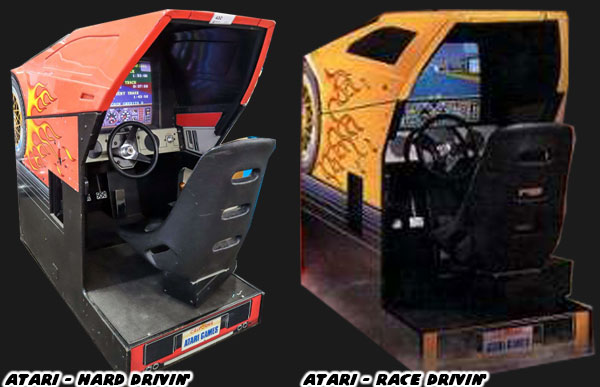
The Hard Drivin' and Race Drivin' cabinets were memorable for their attention to detail. These cabinets and controls were nothing at all like the freewheeling steering from the Sprint games. The steering wheels had rock-solid force feedback. Actually fighting the players for control if they were careening off course! The game also featured accurate gas, brake and even clutch pedals along with a five-speed shifter. On top of everything was a metal key that was built into the cabinet that players had to turn in order to start their cars. This game was the antithesis of every arcade racer ever. It rivaled the logic of Japanese design and trumped the details from any other western developer. However the tracks were anything but daily driving courses. They were designed to test your driving skill and patience. The game was very unforgiving. You would be penalized for driving off the course and every little bump seemed to cause your car to blow up. Every jump and landing had to be perfect or you'd be shelling out another quarter. The stunt and latter super-stunt tracks were the reasons why people really played the games. What good was realistic physics and force feedback steering if you weren't willing to drive the car like a mad stuntman? The wild jump and loop from the first title were blown out in the sequel. Players had to contend with a loop with the top portion cut out as well as a corkscrew loop as well. It was an amazing experience for a racing game.

Between Rad Mobile and Race Driving players could see how differently each country approached the racer. Sega would learn from Atari (then owned by Namco) and top Race Drivin'. They combined the US polygons with the memorable Japanese track designs and gave us Virtua Racing. Later on they would also give us Daytona. Atari would eventually catch up to the trends and release a series that many here hold in very high regards. Come back tomorrow to revisit Atari's last great arcade racing hurrah.
Do you enjoy realistic, or arcade style racing games? Let me know in the comments section please. As always if you would like to sponsor me please visit my Patreon page and consider donating each month, even as little as $1 would help make better blogs and even podcasts!
follow the Street Writer on Patreon!

Monday, June 16, 2014

The Sega / Namco Rivalry, part 2...

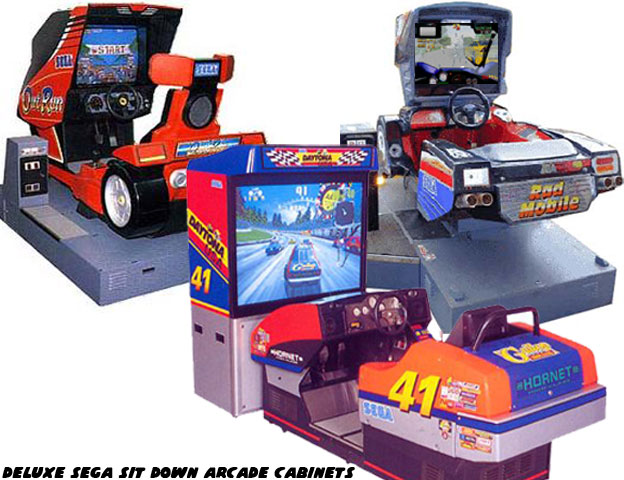
Sega and Namco were unparalleled in the arcade racing field. Sega was the older and larger of the two companies. It had several R&D groups running all of the time testing out new ideas and technology. The first three; AM1, AM2 and AM3 were working on games while AM4 was developing cabinets for the three. The stand up cabinets from Sega were always well done but the sit down deluxe cabinets were in a class all their own. In the previous blog I mentioned that the early sit down racing cabinets enclosed the player to give them more of a simulation experience. Some games had gas, brake and sometimes even a clutch and shifter. Those cabinets featured vinyl graphics that recreated dashboards, complete with a speedometer and tachometer. While these were static images stuck on pressed board to young patrons they were as good as the real thing. With some tape, markers and scissors a child with a vivid imagination could turn a large cardboard box into a rocket ship, submarine or fighter jet. Now think about the reaction that a deluxe cabinet would have given these same kids.

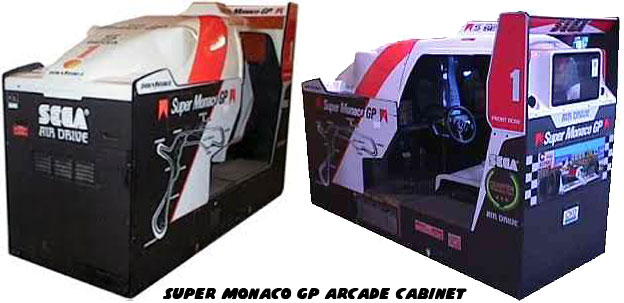
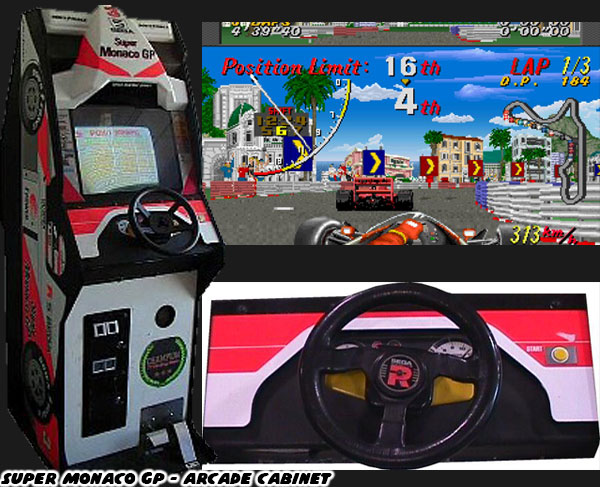
Sega did not have to shape the body of the Super Monaco GP cabinet like a Formula-1 racer. They did not have to paint up the fiberglass body and cover it with sponsor stickers either. They did not have to put a magnifying window behind the cabinet so that patrons could watch the race without interfering with the driver. They did not have to map out and recreate the most accurate (for the time) map of the actual Monaco Circuit. Arcade fans were grateful that they did all of those things. The game was also innovative for its use of paddle shifters rather than the traditional stick shift. Up until that point most games had a stick shift that went from low to high gear, sometimes with a turbo button on the thumb rest. Many racing games from the west actually had 4-gear shifters going all the way back to the late '70s. The paddle shifter, located behind the steering wheel, was cutting-edge technology that was pioneered in Formula-1 at the start of the '90s. The technology would not find its way into production cars for several years but Sega had a working version in their games right away. Young racing fans felt privy to the inside world of an F1 driver whenever they played the game. The extra touches that Sega put into the cabinet, including realistically moulded plastic racing seats, won them many accolades. The game found its way to the consoles and PC but with additional tracks and teams added as well.

Teens and adults would get the most out of a deluxe cabinet like Super Monaco GP but some fans were to small to reach the pedals and too weak to fight the force-feedback steering. For every big title that the publishers released they were always mindful of their youngest fans. Sega and Namco would sometimes create a kiddie-size version of some of their cabinets. Perhaps a very simple driving game on a cabinet that rocked back and forth. In this way little brothers and sisters would not feel left out from the experience. 

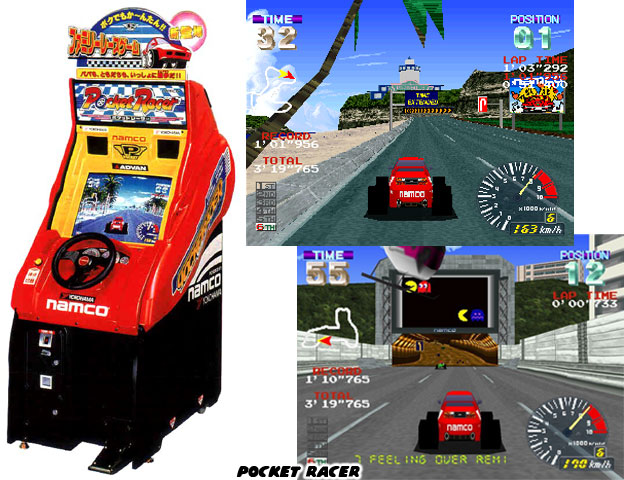
Namco had found considerable success when they released the 3D title Ridge Racer in 1993. I will go much more in depth on that title in future entries to this series. Ridge Racer had gotten sequels and console releases over the years and had become very familiar to young fans.The problem that kids had with Ridge Racer were its challenging controls and steep learning curve. They wanted to participate in the game, especially its over-the-top spectacle where news helicopters would fly right over the cars and fans would cheer from the edge of the track. Namco made a simpler version of the game with Choro-Q style versions of the iconic cars and tracks. It also included songs from the original game. Namco designed a smaller cabinet with a smaller steering wheel, no brake or gear shifter and only a gas pedal that the smallest patrons could use. The game was called Pocket Racer and it was released in 1996.

Pocket Racer was much more forgiving to players that made mistakes such as running into walls or even opponents. The cars would simply bounce and keep going. Namco knew that the best way to build a fan base was by offering as broad a spectrum of experiences as they could to players of every age and ability. They then had to continuously challenge these players at every stage. Toddlers that wanted to drive cars like the big boys no longer felt left out. Of course older kids and teens would become more critical about their own experiences as well. The deluxe sit down cabinets from the early '80s were nice but had become antiquated. The seats and back were rigid and in a fixed position. Players that were too short or too tall found it difficult to enjoy the experience. I remember that in the early 'late '70ss I couldn't reach the pedals on some games but by the end of the '80s I could barely fit into the cabinets. Namco, Sega, Atari and a few other developers began experimenting with adjustable seats. Atari's deluxe cabinets for Hard Drivin' and Race Drivin' were exceptional. By the '90s sliding seats were an innovation that many would take for granted. Not me of course, I would always be thankful to any developer that realized that one size did not fit all.

Through the '80s and '90s Sega would continue to push the definition of deluxe sit down cabinet and eventually did away with the enclosed cockpit for many of their racing games. Instead AM4 opted for outlandish body molds and non-functional but very stylish accents. These included wheels, fenders, taillights and exhaust pipes in some cases. If arcade games were about grabbing the attention of players then it would stand to reason that a shapely 3D cabinet attracted more people than even the flashiest 2D vinyl sticker. In several deluxe cabinets Sega integrated hydraulics to lift, tilt and shake the player and give them an even more immersive experience. It was a sight to behold when an arcade had four or more Daytona USA cabinets lined up side by side. The cabinets were actually designed to fit flush against each other and even be networked. A row of Daytona machines could easily take up over 20 feet and line an entire wall of an arcade. Watching the displays in perfect unison showing the entire width of a virtual racetrack was mesmerizing.

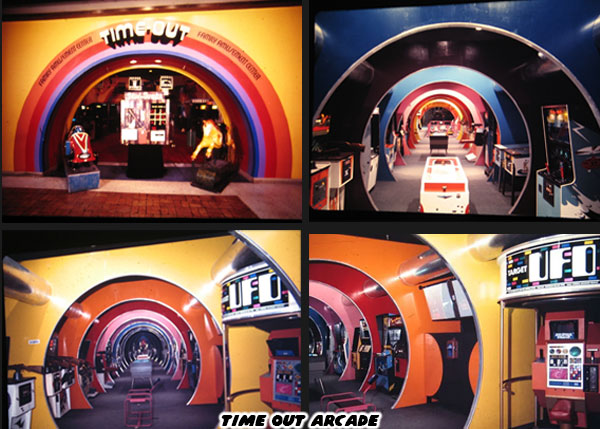
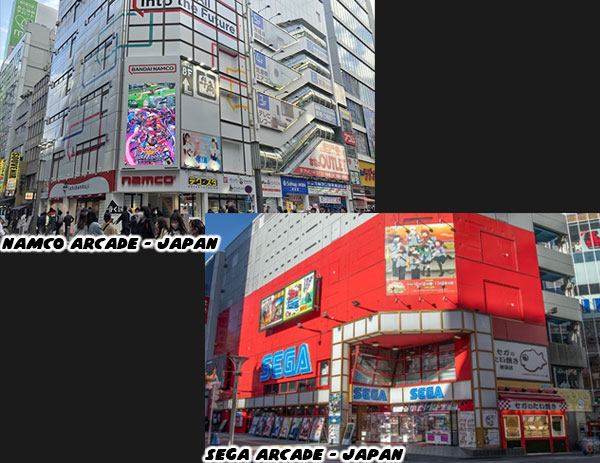
Not every arcade could afford the spectacle of multiple deluxe cabinets, often times one was more than enough for patrons. The arcades that could afford the biggest and best machines were always in the largest cities and sometimes even had an influx of tourists during peak seasons. Sega and Namco had built relationships with distributors and began opening up their own arcades in Japan. The best ones were usually closest to the corporate headquarters. In the US Sega had even opened up a chain of arcades in shopping malls called which were in turn bought out by a company known as Time-Out. Interestingly enough when the mall bubble burst and arcades fell out of favor to consoles the arcades were sold to Namco. There is a great web page dedicated to the history of the Time-Out arcade by Peter Hirschberg.

The boom and bust of the shopping mall in the US destroyed many stores and arcades. In Japan that was not the case. Arcades could stand apart from malls and cater to their own clientele. If older gamers and adults were the most frequent visitors then some arcades might even feature drink holders and ashtrays mounted on the cabinets. Smoking was banned in most US arcades for fire safety reasons but also because people assumed the majority of gamers were little kids. In Japan the stigma that gaming was only for children was not as prevalent. Like manga and animé there were titles for every age and interest, including adults only. This cultural acceptance of gaming as an entertainment pastime meant that arcades could advertise to every demographic. From a salaryman passing by to teens going on a first date, to an entire family. Arcades were an inclusive entertainment center.

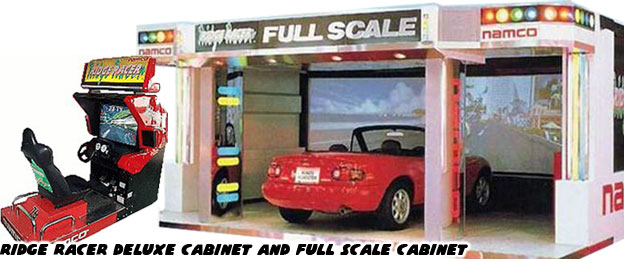
In the biggest locations Namco and Sega would test brand new hardware first and even design deluxe cabinets that wouldn't appear anywhere else. Some of these cabinets were fully functional but also served for spectacle and publicity. Take for example the Ridge Racer Full Scale machine. A regular deluxe cabinet was usually more than adequate for any arcade. Ridge Racer looked as good as most Sega racers for the time, but to stand apart Namco also created a cabinet that fit a full size car, a red Mazda MX-5 Miata / Enunos Roadster and projection screen. The enormous cabinet that Namco used was actually a platform for a light gun game that they were developing. It could be converted to run one of a few other games meant for multiple players. In this way they could collect money from up to six players at a time rather than one rich gamer.

With solid games and innovative cabinets Sega and Namco were slugging it out for arcade supremacy. The next blog will highlight were Namco tried to pull ahead of the competition by going to an old standby. As always if you would like to sponsor me please visit my Patreon page and consider donating each month, even as little as $1 would help make better blogs and even podcasts!
follow the Street Writer on Patreon!