Showing posts with label martial masters. Show all posts

Wednesday, April 15, 2026

Bookmark This Page; The best games from IGS and their PGM arcade machine

I sometimes wrote about indy developers, or indy publishers that made fun but rare games. In this series I talked about a Taiwanese company that made arcade games to rival the best from Capcom, and SNK. If you’ve never heard of IGS then Bookmark This Page.

A look at IGS, Demon Front - A 1UP classic from December 27, 2011

A look at IGS, the Gladiator; Road of Sword. A 1UP classic...

A look at IGS, the Martial Masters. A 1UP classic... 

Did you ever hear about IGS or their Poly Games Master arcade rig? Let me know about it in the comments section. As always if you enjoyed this blog, and would like to sponsor me please visit my Patreon page and consider donating each month, even as little as $1 would help make better blogs and even podcasts!

follow the Street Writer on Patreon!

Wednesday, April 14, 2021

A look at IGS, the Martial Masters. A 1UP classic...

The second studio that I would like to mention in this post brawler series is IGS from Taiwan. This independent developer and publisher has been releasing titles for almost 20 years, the majority of which players in the US have never tried or seen. The company does not go out of its way to promote a strong presence in English-speaking countries and only partially updates their web presence in Asian countries outside of Taiwan and China. Their focus has always seemed to have been based on following trends and becoming very good at imitating styles from developers in Japan. Currently they seem to be testing the waters of iPhone and other smart phone game projects as well as partnering up with MMO developers. They first entered the arcade consciousness in 1994 with Alien Challenge. The fighting game was subpar and even nonsensical when compared to other titles on the market. Their follow up fighter Gouken Kyoutou aka the Killing Blade, released in 1997, was a sort of Chinese take on the sword fighting game Samurai Spirits. Again, it was nothing special considering the number of great fighting games that had been in circulation at that time. However each successive arcade title was better than the previous, they were evolving at a rapid pace and would release a title that would be discovered in latter years through the MUGEN PC fighting engine. Those that managed to see Martial Masters in their local arcade certainly did a double-take.

Martial Masters was released in 1999, after Street Fighter III: Third Strike yet bore an uncanny resemblance to the Capcom fighter. At that point every major publisher and developer of fighting games had shut down their 2D game development teams. The sprite they assumed was a dead format and players would be likely to ignore new fighters using traditional methods. As the success of Sammy, DIMPS and SNK showed through the new millennia the other publishers were wrong IGS bet that their fighting game would grab long time fans of the Street Fighter series and give them a new experience to sink their quarters into. They started with their own PGM system, an arcade console more powerful than the Neo Geo and thus capable of rendering large sprites with dozens of animations per character. These sprites looked closer to those presented on the more powerful Capcom CPS-III system. What IGS did was nothing short of genius or a blatant rip-off, depending on whom you asked.

In order to make a fighter that had the elements of Street Fighter without outright copying the cast. Data East had copied Street Fighter II with Fighters History in 1993 and got slapped with a lawsuit by Capcom a year later. The courts ruled in favor of Data East and the results of which were other studios were able to develop fighting games with eerily similar characters and control schemes. IGS did not outright copy the cast as controls through Martial Masters, they did however poach the Capcom artistic style. Of course copying an artistic style was only part of the challenge. The other would be to fill a roster of fighting archetypes that were unique and memorable. By '99 there had been dozens of fighting games at home and the arcade, just about every possible character combination and fighting style had been explored. The brilliance of IGS was in filling out the roster with characters that were inspired by, and almost direct copies of, the fighters featured in the Once upon a time in China movie series The strict IP laws that curb comics, movies and games in the US seem to be more lax overseas. This loose interpretation of copyright allows for a thriving fan-based comic industry in Asia, as well as hobbyists creating models of popular characters in limited edition runs. Martial Masters was an example of that type of mentality influencing character designs in a game.

The sprites featured in Martial Masters (MM) were large and colorful. The male and female archetypes were all there, including a strong Chinese female lead, just as in the SF series. However the differences between SF design and designs featured in other fighting games were subtle yet more complex than most realized. The SF series succeeded in part because the masters of their respective art were inspired by actual and mythological heroes. They were an amalgamation of the inspirations but done in such a way as that the characters could never be pinned onto one person. Ryu in SF for example was based in part on karate masters Mas Oyama and Yoshiji Soeno with a look from Ken from Fist of the North Star. For MM and some of the other games, the designs were blatantly based on the mannerisms and gestures of popular actors, including Jet Li, Bruce Lee and Donny Yen.

More than that, some of the characters and moves in MM appeared to have multiple sources of inspiration. The Tiger character for example had the size and proportions from SF III's Alex but with some of the slashing moves from Wolverine of the X-Men.

Speaking of Tiger, he was a good example of the proportions that IGS had used to create sprites similar to Capcom's. The design of the characters was set somewhere in between the sprites used for SFIII and SF Zero / Alpha. Tiger appeared very much like a playable version of Chun-Li's partner from the ending of the game.

The other characters used the general proportions and scale made popular by Bengus. The Monk character for example had roughly the same size and proportions of the Hulk from the Marvel fighting game. If not Zangief from Street Fighter Alpha.

Of course not all of the characters were inspired by Capcom characters. Others were inspired by archetypes featured in other games but presented in the Capcom style. The Drunk Master for example appeared like the hybrid of Chin Gentsai from the King of Fighters and Gen from SF Zero. Not to take anything away from IGS because the character was fun to play as and had many original moves and animations. He, and several other characters should have returned for a sequel.

The subtle elements that IGS designers missed when imitating the SF character designs became obvious for the more esoteric fighting styles. The characters Scorpion and Ghost Kick highlighted the lack of understanding of how certain fighting styles appeared in the SF universe. The characters in Street Fighter were all representatives a particular style, like karate, kung-fu and wrestling. These characters had moves were not grounded in any particular school however. What the team at Capcom did was apply a stance and set of moves that mirrored the popular concepts but were optimized for use in a game engine. Ken and Ryu had moves that looked like karate strikes, Chun-Li had moves that looked like kung-fu strikes. Most of these moves looked fantastic, even if they were impractical, the purpose was that they could be animated and balanced within the fighting engine. Martial Masters took some of the styles too literally and presented the masters with exaggerated arts and stances. These forms may have appeared in a SF game, however the designs and stances for Scorpion and Ghost Kick were too unbalanced and exaggerated. The characters created a visual distraction that upset the symmetry of the rest of the cast. Moreover they would be difficult to animate moving and fighting convincingly with the rest of the cast.

As well made as the sprites were, the game was lacking substance. This would prove to be the biggest trend for almost all the IGS games. The studio was capable of following trends and even imitating the best developers in the industry, however the games were always lacking something. In the case of Martial Masters the game had decent controls and move sets for each character but it lacked balance. Every great fighting game strives for balance. Balance in the amount of damage that moves take, balance in how quickly characters attack, how slowly they recover and what strikes take precedence. A game that allows for players to constantly juggle opponents with a barrage of strikes and gives them no chance to recover or counter is clearly unbalanced. Almost all of the characters in Martial Masters were able to perform an endless loop of attacks that could completely drain the energy of an opponent. These things would have never appeared in a numbered SF title because of the extensive balancing process.

The flaw for IGS was clearly the lack of experience behind their developers. They could imitate Capcom and even create characters that were animated on par with the best efforts from the Japanese studio but they did not understand how all of the elements worked together in order to build a Capcom caliber fighting game. The levels were nice but lacked the vitality of the SF levels, the controls were good but not precise, the characters were diverse but almost all rooted in Asia rather than the global community that made up the SF cast. If I could describe an IGS game it would be anemic. It lacked the size and energy to have run with the major publishers. Players could see what the studio and designers wanted to do and appreciated the effort they made in bringing a game to market, especially after Capcom had closed its 2D wing. What killed the gamers though was that the games always seemed to be lacking something. Martial Masters looked and played like a SF game that was 80% maybe even 85% finished. At that stage it was good enough to demo at a trade show and get buyers interested in ordering arcade cabinets. For gamers it was not enough, that 85% was still more than a half a year's worth of hard work to make up for. It lacked the polish and level of detail that made the Capcom fighters great. Had IGS only had more time or team members then perhaps Martial Masters could have made an even bigger impact with the community. That, or the very least they could have had larger publishers looking to bring their fighting game to home consoles.

Thankfully, the PC emulation program MUGEN had brought these sprites to a whole new generation. Players could see how the Martial Masters would have stacked up against the Street Fighters. IGS did not create another game that was in the traditional SF vein. However a few years ago they did release a title in the arcades and the Playstation 2 that was similar to Guilty Gear. Spectral VS Generation came out in 2006 featuring developer Idea Factory’s Spectral Force vs Generation of Chaos. The game was fun but lacking. It was similar to Martial Masters in that it felt anemic. The levels were sparse, animations fun but not extraordinary, the character designs familiar but not revolutionary. IGS had fallen into a trap of a "good" game being "good enough" for the publisher.

The publisher would actually release two titles that were better gaming experiences. One of which fell into the trappings of Martial Masters, but in a different genre, and one title which could honestly stand on its own merits among the best arcade games ever produced. If you would like to sponsor me please visit my Patreon page and consider donating each month, even as little as $1 would help make better blogs and even podcasts!

follow the Street Writer on Patreon!

Wednesday, December 23, 2015

The Middle Eastern fighter, building a legacy, part 2...

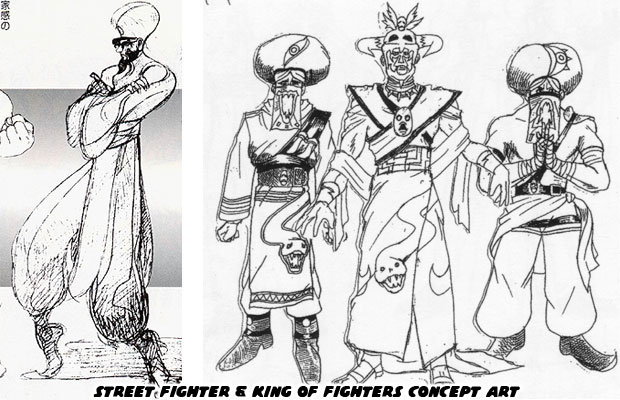
Capcom and SNK have been thinking about incorporating Middle Eastern and Indian fighters for some time. The concept art in their design books could point to the number of times they had tried to diversify the lineup in Street Fighter or the King of Fighters series. Yet if you were to look at some of these concept characters you might find them lacking. It was painfully obvious that the artists didn't really know how to represent characters from the Middle East or South Asia without relying on trope. The characters wore baggy pants, sashes and large turbans. It was as if people from this part of the world were still dressing up in ancient costumes. The SNK artists even went so far as to poach the look of Mola Ram, the villain from Indiana Jones and the Temple of Doom, at the leader of a South Asian team. To be fair the formal and ceremonial wear in some parts of the world did stick to classic fashion and had not changed much in centuries. Yet from day-to-day the same people could also be seen in western attire, especially the younger cultures.


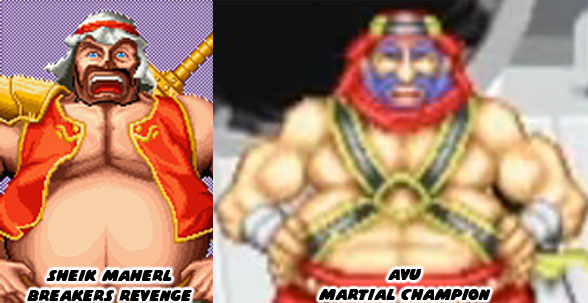
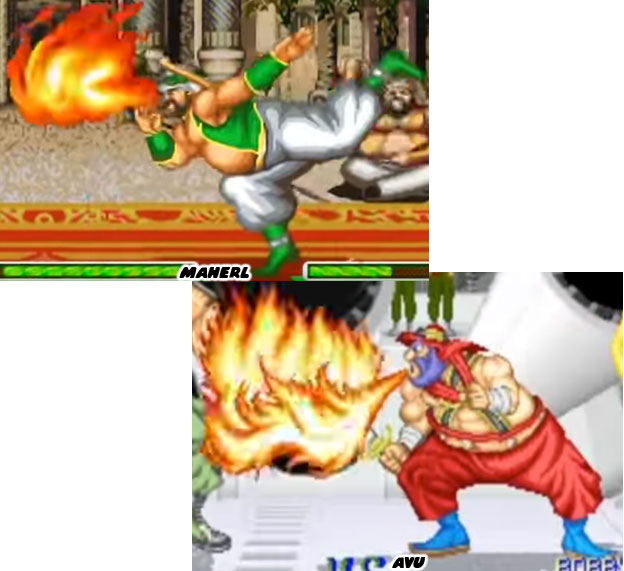
There were some Arab characters that did make it past the planning stages and were put into fighting games. The sad part was how stereotypical they were. Avu was one of the first, introduced in Martial Champion. The game featured brawlers from around the world, each representing their particular nation. The title was released in 1993 and poached a lot of ideas from Street Fighter II. Avu was a very typical Arabian hero. He wore the baggy pants, boots and carried a scimitar. It was as if he was one of the characters from the Arabian Nights stories brought to life. The sad part was that he was supposed to represent the modern Middle East. The same exact details were used with the character Sheik Maherl from Visco's 1996 sleeper Breakers. Surprisingly the Breakers title did well enough in the arcade to garner a sequel, Breakers Revenge. I would not have had an issue with either Avu and Maherl if they had been featured in Arabian Fight or Arabian Magic, the games mentioned in the previous blog. Their look and move selection was definitely pulled from a different era.


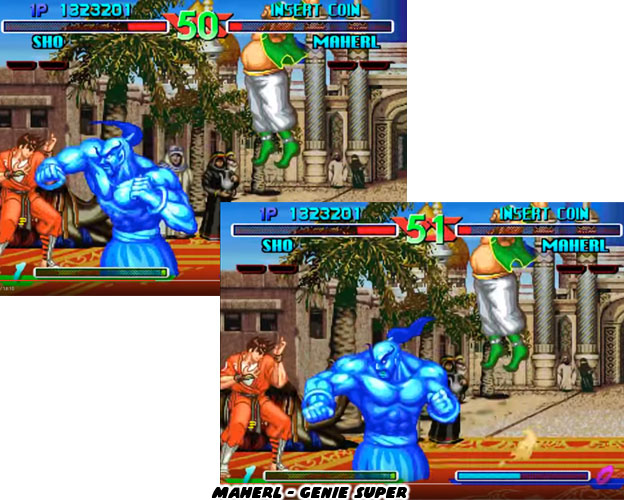
So what was so offensive about the characters aside from the clothes they wore? Well for starters lets take a look at their moves and special abilities. Maherl, like all token Arabian characters, was a master of the mystic arts. Not only could he use his sword in a fight but he could also summon magical creatures. He could call on a djinn that appeared from a puff of smoke to punch at opponents. It was the equivalent of a super fireball attack. Again, context was everything. If this was a move in the games set in mythological Arabia then it would have made sense. But this was a character set in modern times, fighting against martial arts masters and soldiers from the current era. Avu didn't fare much better when it came to stereotypes.


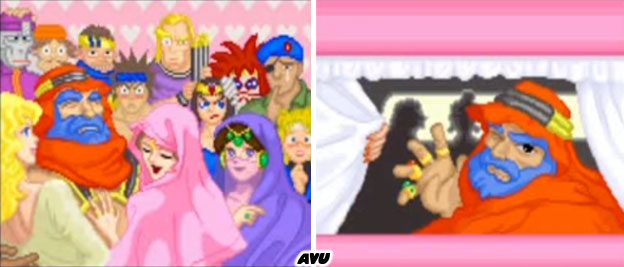
Both fighters were presented as wealthy figures, of course we were to assume they were oil barons. Konami made sure to bring in another cultural touchstone from Arab tradition that wouldn't necessarily win Avu any fans in western culture. In the ending of the game Avu was greeted by his beautiful wives. His harem gushed over him and made the other fighters in the game insanely jealous. They escorted Avu to his limousine and rode off. The translation in the English release of the game mentions a singular wife however in the design and Japanese version the three women were each wives. Avu was a Sheik from Saudia Arabia, and that nation actually recognizes polygamy via Sharia law. A man may take up to four wives provided that he treats each of them equally. If Konami was going to take a jab at a culture at least they managed to get this detail right.


What was odd from a design standpoint was how much of a trope the characters had become. Surely the Middle East was not trapped in some sort of time machine. Surely the people and traditions of the Arabian Peninsula were not still locked in the era of Scheherazade. What the Japanese developers were doing was creating a caricature of the region. They had done this before to great success in other fighting games and would continue to do so. It wasn't as if the Japanese were pulling these ideas out of thin air either. The media they consumed continued to feed them images of how men and women of the region dressed. How their politics were organized, what religions they followed, how their families were structured, how their armies were built and how their societies ran had been seen in the news and was especially dramatized in film.


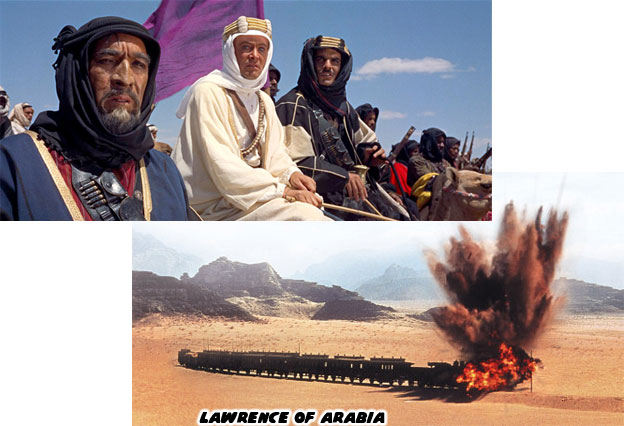
When it came to Saudi Arabia the sharp contrast between the modern world and ancient world was best demonstrated in the film Lawrence of Arabia. The movie was based on the military exploits of Thomas Edward Lawrence. It was set in World War I and depicted the events that would ultimately shape the region. There was a great contrast in the violent conflicts depicted in the movie. On one side there were soldiers with tanks and artillery and they would continuously get swept aside by rebels with swords and rifles riding horses and camels. The nomadic tribal system worked well, was still very much alive in the 20th century and would continue to be honored in the 21st century. These were the things that Avu and Maherl were representing.


The modern nations of the Middle East were still very culturally isolated. Since they were rich in resources, especially in oil, they held tremendous global influence. If the nations did not want to advance culturally, religiously or socially then they were under no obligation to do so. If they wanted to adhere to traditions that had not changed in a thousand years then they had the liberty to do so. This was cultural relevance, we could judge them and say they were refusing to get with the times. Or they would say that they were defending their culture and traditions from outside influences. Either point of view could be true depending on what you believed in. For example, they stuck with classic fashion and it was accepted as a cultural norm. The thawb for example was a long white garment, it looks like a robe, that had been worn for centuries. It hadn't changed in its design and was still worn by most men when they traveled to a mosque. By contrast fashion in the west changed from moment to moment. A character designer that had to create a modern fighter would have a harder time trying to make a passable western fighter than they would a traditional Asian, South Asian or Arabian fighter. I would like to believe that Avu and Maherl were exaggerations of the region, something more in tune with fantasy characters.


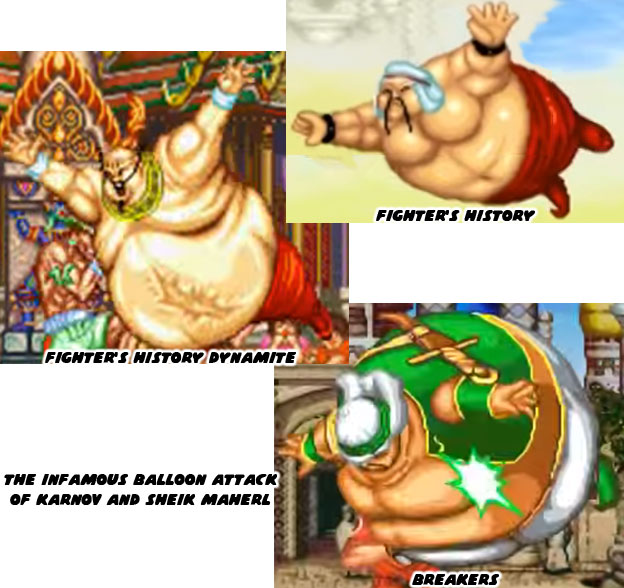
Sometimes it was hard to separate fact from fiction when it came to an "exotic" region. The attacks given to the Arabian characters were definitely given to them from myth. Summoning a genie was just one thing they could do. The other was breathing fire. In the previous blog I had mentioned that the fire breather was based on a classic tradition. Yet how many fighters from the Middle East or South Asia could there be that all shared this same gimmick? Four if you count Karnov and Dhalsim as well. Seeing Avu perform an "Arabian Burner" was nothing compared to the more outlandish moves given these fighters. One of the most absurd moves in any fighting game (I mean just as absurd as the worst Street Fighter IV super attacks!) was used by Karnov and Maherl. The two figures could inhale and expand into enormous balloons. Yet since they were filled with air they were almost weightless and would float to the ground. These things again made sense in a different context. If the games were based in ancient Arabia and the fighters were battling mythical creatures then having some magical attacks absolutely worked. But this wasn't a fantasy game, this was set in the here and now. How did the Japanese designers expect audiences to react to these characters? More important what were they doing to the public perception of the Arabian as a fighter? Were they reinforcing a stereotype or was this harmless funny design work? This was also cultural relevance, it depended on your point of view and whether you were Arab or not.


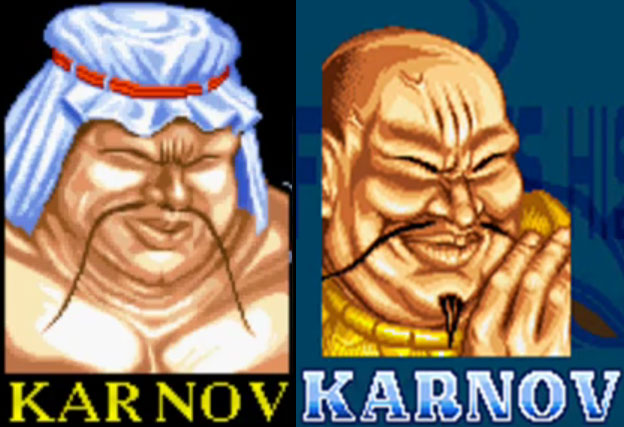
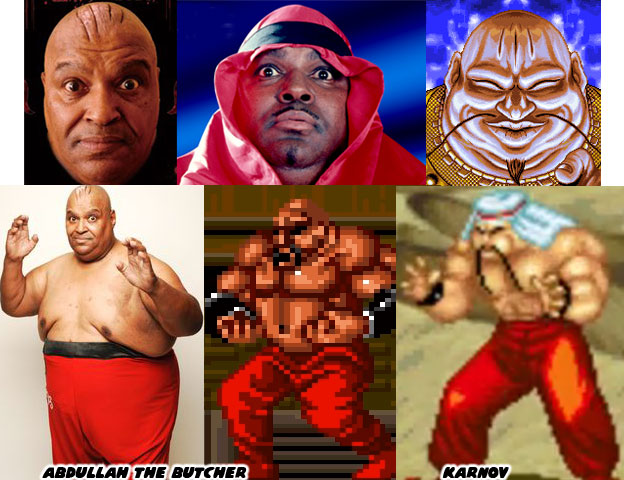
If you were a hero pulled from Arabian tradition then you must be big, fat and rich. The trope was not necessarily sugar coated. Karnov for example was an awe-inspiring character, one of the most important designs in the history of gaming. Yet at the same time he was an ugly caricature of a people. His facial features were an amalgamation of Asian, Arabian and Eurasian characteristics. Yet these weren't necessarily meant to be flattering to the character either. He had rolls on his neck, multiple chins, fat lips and a bulbous nose. His eyebrows were absent and his eyes were drawn incredibly tight. To add a bit of grotesque to an already ugly face he had deep scars on his forehead that told a story about his life as a fighter. Between Fighters History and Fighter's History Dynamite, just a couple of years really, Karnov actually became uglier than the artists at Data East had started with.


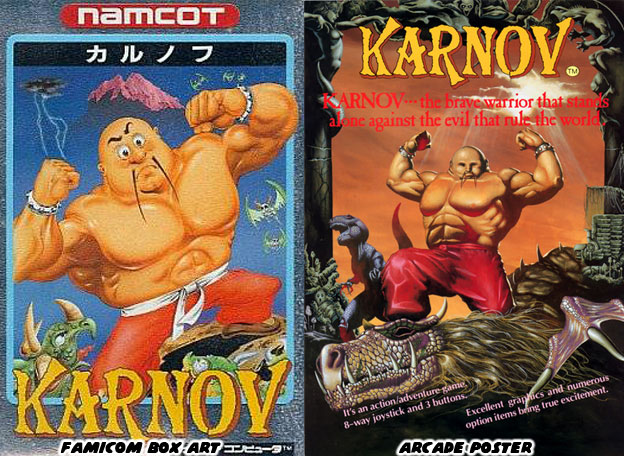
In his final appearance Karnov was larger, fatter and more scarred up than he had ever been. I'm not sure what caused the developers to push the character in this direction. When he debuted he was not exactly a handsome person. He was bald and he was fat but he was also insanely strong and heroic. In some versions of his story he was called a circus strongman rather than Arabian adventurer. His nationality was never quite defined, in one game he spelled  his name out of fire in Cyrillic rather than Abjad or Arabic. Perhaps he was Russian or Eurasian instead. On the official box art and arcade posters he was presented as having enormous muscles rather than a gut. He was the antithesis of the typical hero. He was not the dashing Prince of Persia or the devilish Sinbad. He was nonetheless a great character and one of the few body positive role models in gaming.


What Data East had changed the most for this character was not his appearance as much as his context. Karnov was a perfect fit for the mythical worlds of ancient Arabia. In his original arcade and console game he traveled through many exotic lands and fought all sorts of mythical monsters. At no point was it ever assumed that he was going through the modern era. He was pulled from his original title because Data East was desperate for a hit game. Capcom had become very successful thanks to the release of Street Fighter II. The other publishers could tell as arcade operators ordered more and more Street Fighter II cabinets and less of anything else. Capcom did not create the fighting game genre but they certainly perfected it. Data East, Konami, Sega, SNK and the other publishers began developing fighting games of their own.


Many studios copied the formula, controls and characters featured in Street Fighter II. Data East had copied them so closely that Capcom had to take them to court. Capcom lost the case because Fighters History and Street Fighter II were different enough that plagiarism could not be proven. This meant that other studios could also develop fighting games using similar characters and control schemes. Data East needed something to set their game apart. They had a well regarded console and arcade figure in Karnov. Data East had already brought him into modern times as a cameo boss in Bad Dudes. What the designers did next was actually tone down some of his special abilities so that he wouldn't be too overpowered. At the least they had him keep his fire techniques. In this way he could be accepted as a fighter and a boss character for the franchise.


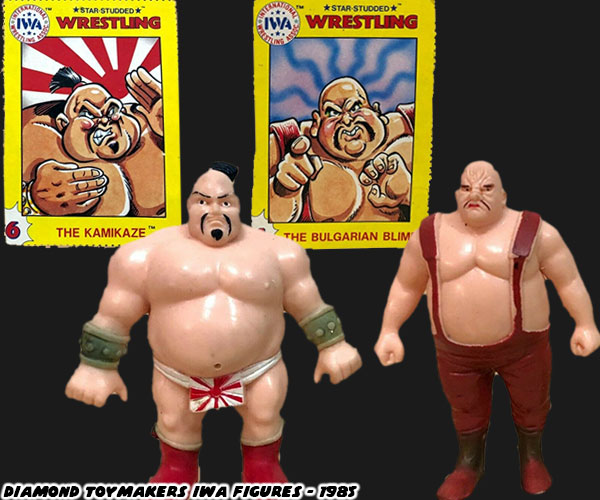
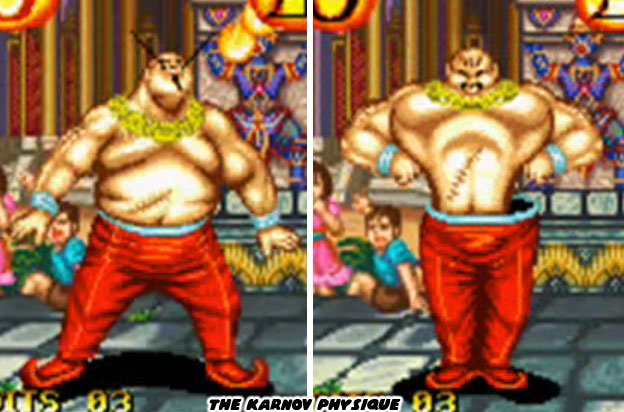
The other thing the studio did was change his appearance slightly. Let's face it, the character was always fat and should remain the same. However the final version of Karnov had scars crossing his body, from a life of battles no doubt. He still retained his muscles underneath his fat. The changes to Karnov were influenced not by legend but by professional wrestling. Professional wrestlers had inspired many characters in Capcom fighting games, this went well beyond Zangief and Darun Mister. It made sense too why the Japanese studios relied so heavily on pro wrestlers as a template. If you think about it. Pro wrestlers often had great physiques, they were photogenic and sold themselves well on television. Some were brilliant talkers and really made you believe they were the real deal whenever they cut a promo on TV. Some wrestlers were legit grapplers, boxers, jujitsu or karate experts. They could seriously hurt or kill a person if they wanted. Some of the most memorable wrestlers had a gimmick. Perhaps they were bad guys descended from German royalty, or perhaps they were savage men that came from parts unknown, in many instances those with gimmicks were considered heels or villains. Such was the case for Lawrence Robert Shreve. Or as he was known to his fans, Abdullah the Butcher.


Abdullah was actually Canadian but his character was sold as hailing from Sudan. It was a nation in North Africa that was right on the coast opposite the Arabian Peninsula. His costume consisted of the familiar baggy pants, sash and curled-toed boots that accompanied fighters from the Middle East. He also showed up wearing a keffiyeh, the traditional Arab headdress which people sometimes mistakenly call a turban. People would often notice the deep grooves in his forehead. They were the residuals of a life of "blading" or cutting himself open so that he would bleed during a match. He would take chair shots to the head and get busted open so many times that all that was left was scar tissue on most of his forehead. He would sometimes entertain guests by sticking poker chips in his forehead, they wouldn't fall out when he leaned forward. Abdullah lived up to his "butcher" moniker and didn't wrestle as much as he would gouge at his opponents with a fork, nail or sword. The matches he took part in were guaranteed to be a gore-fest.


Not every wrestling match was a test of athletic prowess, or a chance to see holds traded between two genuine "shooters." Some of the matches were just ugly brawls featuring foreign objects, barbed wire, thumbtacks and broken glass. These bloody "death matches" helped build the reputation of an opponent and made them all the more fearsome. This was especially true if they could beat Abdullah. I talked about him, Arabian and fat characters on an earlier series about representation. He was just one of the actual people that influenced the development of fighting game and manga characters. The Middle Eastern fighter would evolve as technology did. When fighting games went to 3D some things changed and some things stayed the same. The Street Fighter series seemed to regress in this regard. Some returning characters stayed the same while some characters got a makeover and it was not always pretty.


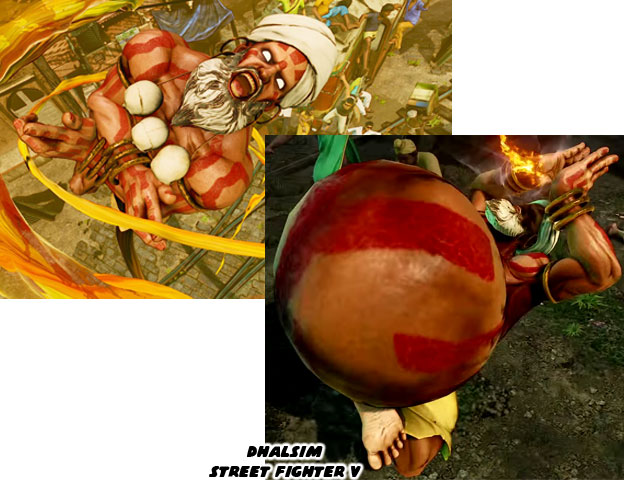
Dhalsim changed greatly between titles. Gone was his bald head and shaven face. Now he sported a turban and beard. He retained his stretchy limbs and fire-based attacks yet now the studio made all of his animations greatly exaggerated. For his new super strike his belly would blow up to grotesque proportions before he spat out an enormous fireball. It was ugly and a return to the balloon attacks of Karnov and Maherl. These strange inflation gimmicks were never done in any 2D version of Street Fighter. The new development team thought it would be a good idea to go overboard with the animations now that they were in 3D. Not only did they redo his moves they also redid his look for the series. Dhalsim regressed to a design that was much older and more stereotypical of Indians.


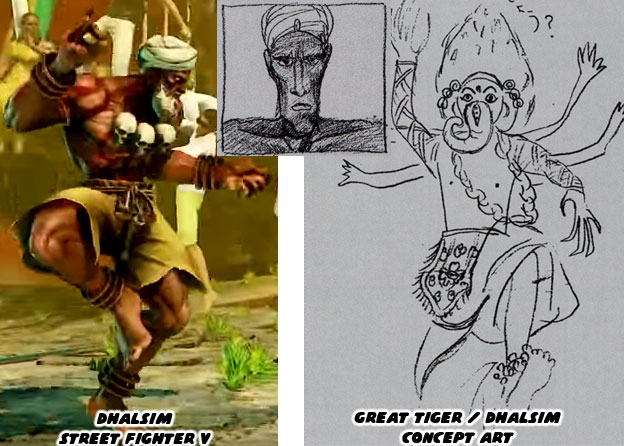
The original concept art of the Indian fighter in Street Fighter II was known as the Great Tiger. He wore a turban and had mystical attacks. In an alternate version of the concept art he wore an elephant "Ganesha" mask and fought while standing on one foot. They were some demeaning designs. The creators working on Great Tiger went away from trope and ended up creating a fantastic character. The Sikh's were the religious group that believed hair was sacred. This was why they kept their beards and wrapped their long hair in turbans to begin with. Dhalsim humbled himself and shaved off his hair and wore rags. Most any other game studio would have made an Indian with a beard and a turban but Capcom in the late '80s and early '90s was a different studio. They knew how to challenge public perceptions and create an Indian that defied convention. He stood out among the cast and this was before players could even see his stretchy limbs or fire attacks.


Sadly the developers working on Street Fighter V chose to ignore the established look. They thought they could improve on the character. By going back to the old stereotypes they ended up weakening his look. Again, this decision was made on Yoshinori Ono's watch and he should ultimately be held accountable for the direction the series went in. Dhalsim was not the most recent South Asian character added to the lineup. Nor was he the first 3D fighter to represent the region. We will look at these pioneers in the next blog. As always if you enjoyed this blog and would like to sponsor me please visit my Patreon page and consider donating each month, even as little as $1 would help make better blogs and even podcasts!