Showing posts with label hecatonchires. Show all posts

Friday, March 3, 2023

God of War Ascension, a female lead, and the two-player experience that never was

When I began the portion on God of War Ascension I mentioned that Sony Santa Monica had three goals for the game. They wanted to create a single player adventure, in the vein of the classic GoW titles. They also wanted to create an Online Multiplayer mode. They delivered on both counts, but the third goal for the game was dropped due to time, and budget constraints. The studio wanted to create a co-op adventure as well. I don’t know if the co-op mode was going to share the story, and locations of the main game. Perhaps it would have visited some of the multiplayer sites. I have a feeling this might have been the case when we look at some of the characters that were planned to have much bigger roles in Ascension, including dialogue. The first of these was Archimedes.

Archimedes was born in Syracuse, Italy in 287 B.C. He was a world renown philosopher, engineer, inventor, physicist, and mathematician. He mastered the lever, and perfected compound pulleys for moving heavy objects. He created new ways to pump water, and grain uphill. He discovered formulas for geometry that were still taught to this day. His type of genius wouldn’t be seen for another 1700 years when Leonardo DaVinci was born in another small town in Italy. We had actually seen the work of Archimedes previously in the Ghost of Sparta. He had engineered the mechanisms that kept the Methana Volcano from erupting, as well as the pumps that made Atlantis the masters of water. Before he was turned into a mummified corpse the team at Sony Santa Monica had plans for giving him a cut scene in GoW Ascension.

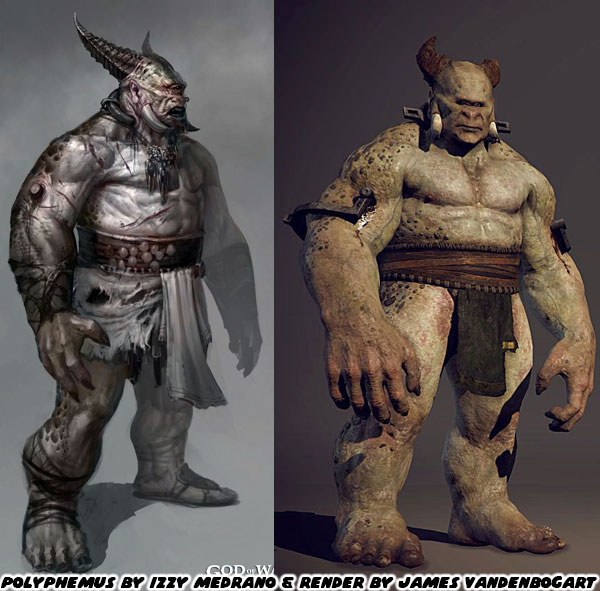
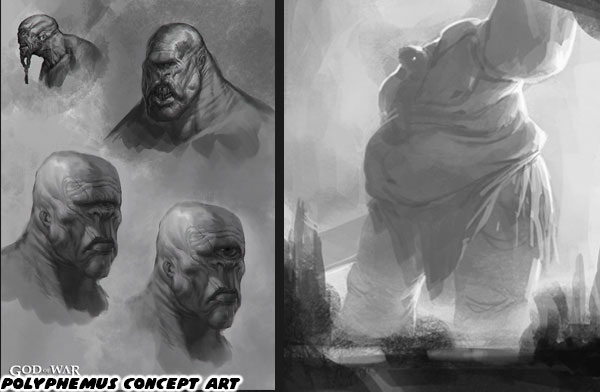
The engineer wasn’t the only person that was left on the cutting room floor. Another character from history would have also had a bigger role. The Cyclops had been a part of the GoW series since the very first game. They were the heavy-hitters in the franchise. Bigger, and stronger than the minotaur, juggernaut, or Talos. They weren’t often presented as very bright. Their job was pure destruction. Ascension would have had the biggest, and most famous of all the one-eyed creatures. Polyphemus was a one-eyed giant. He was the son of Poseidon, and the sea nymph Thoosa. He was blinded by Odysseus in the story of the Odyssey. Polyphemus was fueled with rage, and cursed the explorer. He prayed that his father would help him get revenge. Poseidon, and the other gods obliged. They kept Odysseus from reaching his home for two decades.

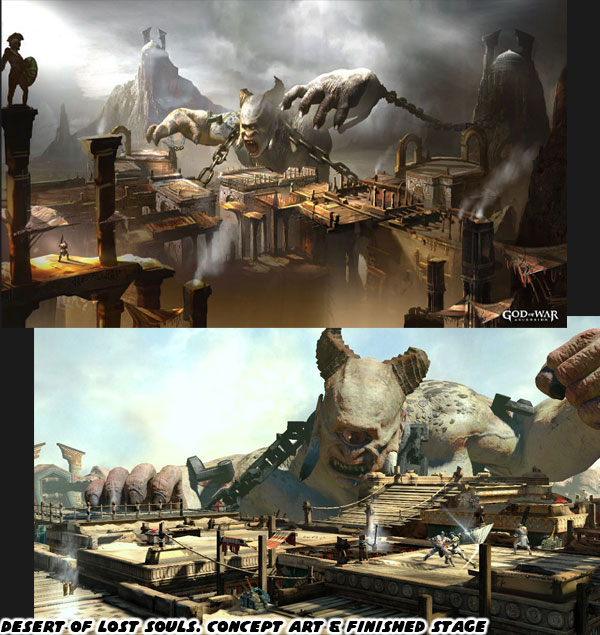
Polyphemus was supposed to have several speaking lines in Ascension. Having the massive character talk to, or challenge Kratos didn’t seem to be an impossible task. The developers had already created stages around the titans Atlas, Gaia, and Cronos. Plus the Hecatonchires stage was as massive as any other battle Kratos had to go through. I wonder though if Polyphemus would have chased Kratos, thrown a building at him, or interacted in some other way. Sadly as the studio was short on time, and money. They made the cyclops an interactive background character, and target for the multiplayer stage in the Desert of Lost Souls. Now I want you to imagine a series of encounters for Kratos, and a second playable character as they met Archimedes, Polyphemus, and perhaps other characters from Ascension. How would this have worked?

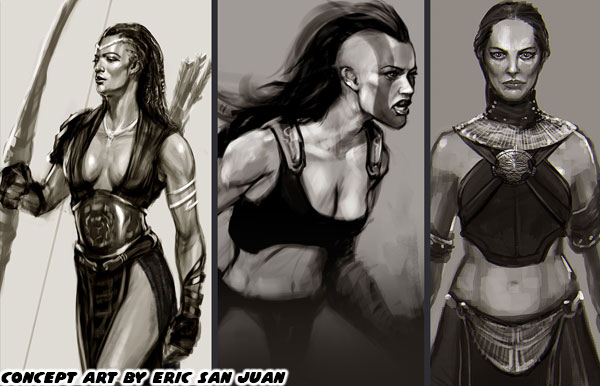
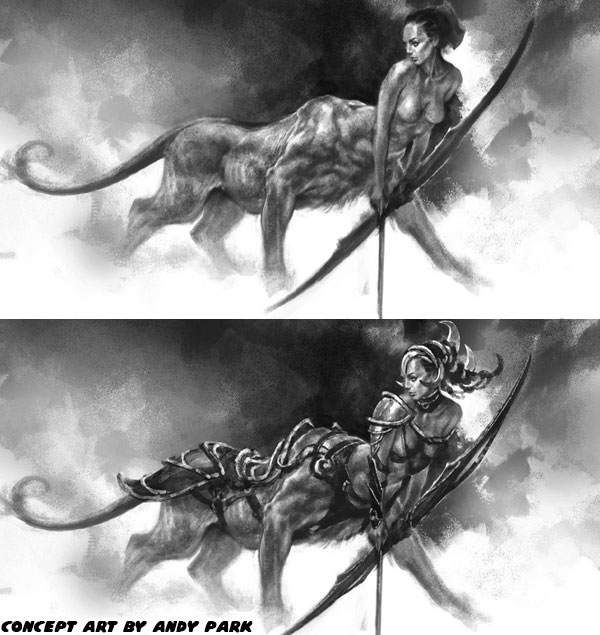
The studio wanted to create a complimentary figure to travel with Kratos. This person would have to be able to fight just as good, if not better than the god of war. They would also have to have their own library of weapons, and special attacks. The designers at Sony Santa Monica put together dozens, and dozens of proposed characters. There were men, women, monsters, gods, and Demi-gods all designed to help carry the adventure. The studio had so many choices to pull from that picking just one was all but impossible. That was until one of the senior artists proposed a few characters before he left the studio. Andy Park’s artistic fingerprints were all over GoW II, GoW III, and a little bit in Ascension. Andy helped come up with the look of many of the minor, and major villains in the series, including Persephone, and Cronos. He also helped set the tone for locations like the Temple of The Fates, and Kratos’ throne room on Olympus. One of the creatures he designed was similar in build to a centaur, but instead of the torso of a man, and a body of a horse, this one was a woman with the body of a lion. That design really stuck out to Izzy Medrano who was working on a lot of the characters in GoW Ascension.

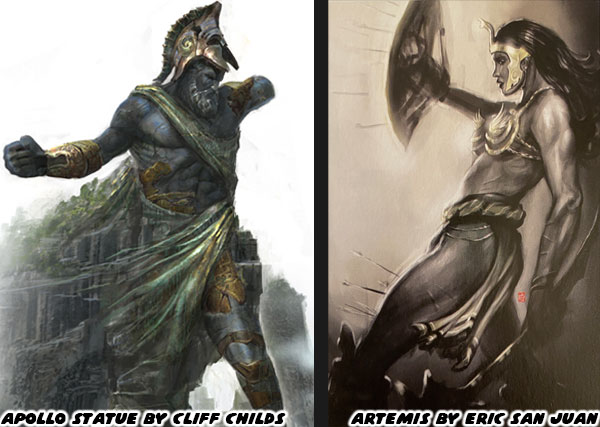
The question was who this character would become in the canon of the series. Was she a queen of some sort? A Demi-god, or god reinterpreted? There were a lot of characters in Ascension, would she be related to them? In a way the answer was yes. The studio decided that she would be Artemis the twin sister of Apollo. If you remember the previous blog there was a statue of Apollo on the isle of Delos. This was central to the story, and historically accurate as both of the gods were said to have been born on that island. Apollo, and Artemis were twins born from Leto, and Zeus. Leto was a goddess, born from the titans Coeus, and Phoebe. When Hera, the queen of the gods, and wife of Zeus had found out about about yet another extramarital affair she cursed Leto. She conspired with the other gods as to not allow Leto to find shelter on any land. Plus she sent the Python to constantly pursue her. In ancient times the Python was a child of Gaia. It was a giant serpent that lived in the center of the Earth. It could be summoned to destroy the enemies of the gods. All of this would ensure Leto, and her twins would die during childbirth.

Poseidon took pity on Leto, as she was denied safe passage at every port she traveled to in the Mediterranean. Plus he must have felt some responsibility since his own brother had gotten her into this situation. So he lifted a rock from the ocean floor where she could give birth. This island would become Delos, and since it was not attached to any land mass, nor was it attached to the bottom of the sea, then he was not bound to Hera’s curse. The twins were born like most gods, pretty much fully formed perfect adults. Apollo would kill the Python for hunting his mother. He would also become the patron for, and claim the oracle’s temple at Pytho, which would later be renamed Delphi. These bits of history helped shape the mechanized snake encounters, and murals within the temple in GoW Ascension.

Both Apollo, and Artemis loved archery, and hunting. Both were also very competitive, but never hateful of each other. Artemis was the goddess of the Hunt, the Night, and Chastity. She was associated with silvery moonlight, as Apollo was associated with golden sunlight. She mostly hunted at night, and only with other women so she could keep her vow of chastity. Only one man ever hunted alongside her, that was the giant Orion. He was an exceptional hunter in his own right, using a bronze club as his primary weapon. He wasn’t always a pleasant character. He got drunk in Chios, and sexually assaulted the princess Merope. He was blinded by her father Oenopion in retaliation. Orion would regain his site in Lemnos, the place where Kratos was born. Orion once threatened to kill every beast on the planet. Apollo didn’t like him, or his antics, and summoned one of Gaia’s children to sting him. It was the enormous Skorpius. He succumbed to the poison. Artemis, and Zeus turned Orion, and the Scorpion into a constellation in atonement. Skorpius was an enormous monster that showed up to fight Kratos in the Labyrinth of Daedalus in GoW III. It was also seen in the multiplayer mode in Ascension as well.

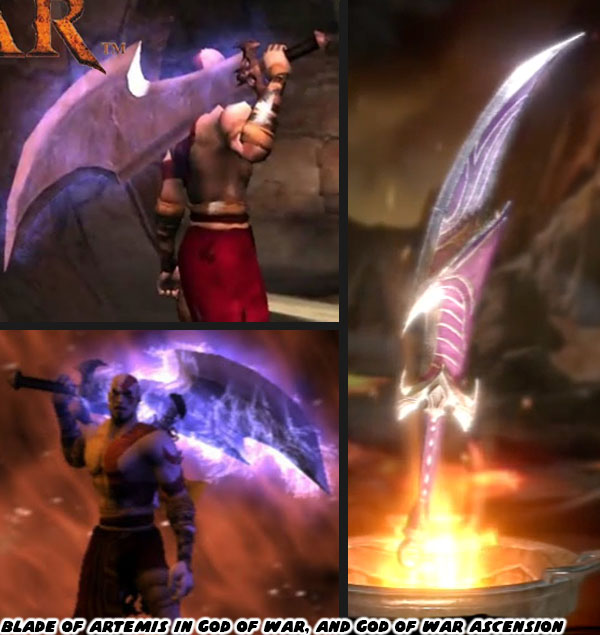
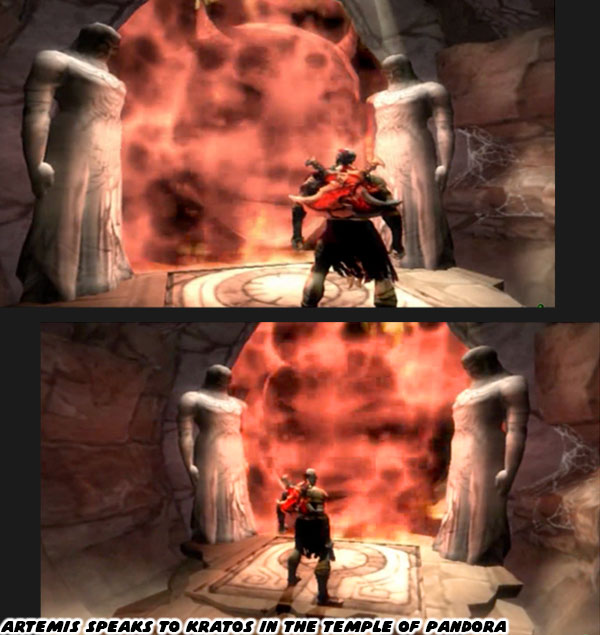
Although we never saw Artemis in full body perspective, she has been part of GoW canon since the very first title. When Kratos is exploring the Temple of Pandora he comes across a portal to the gods. Artemis appears to him, she seems to have a shaved haircut, and small horns on her temples. Artemis says “Kratos, the gods demand more of you. You have learned to use the Blades of Chaos well, but they alone will not carry you to the end of your task. I offer you the very blade I used to slay a Titan. Take this gift and use it to complete your quest. Take this weapon, take this power, and use it to defeat your enemies.” The sword is very large, you could imagine that it could pierce the thick skin of the titans. It also leads us to believe that Artemis is much larger than Kratos. A more proportional version of the weapon also appears in GoW Ascension.

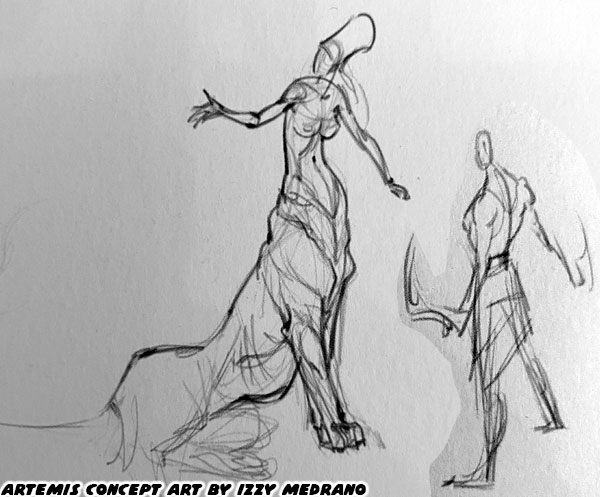
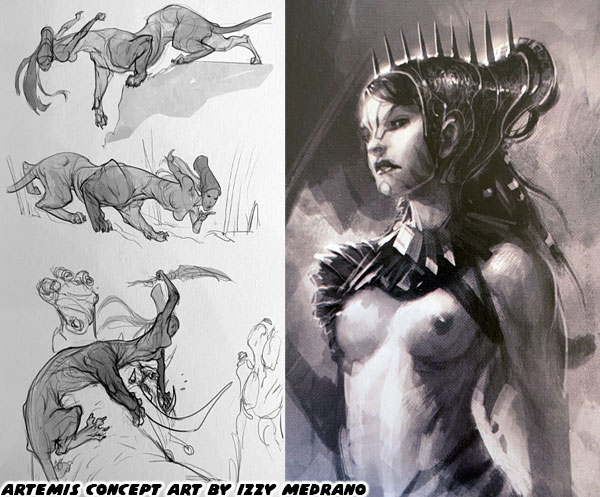
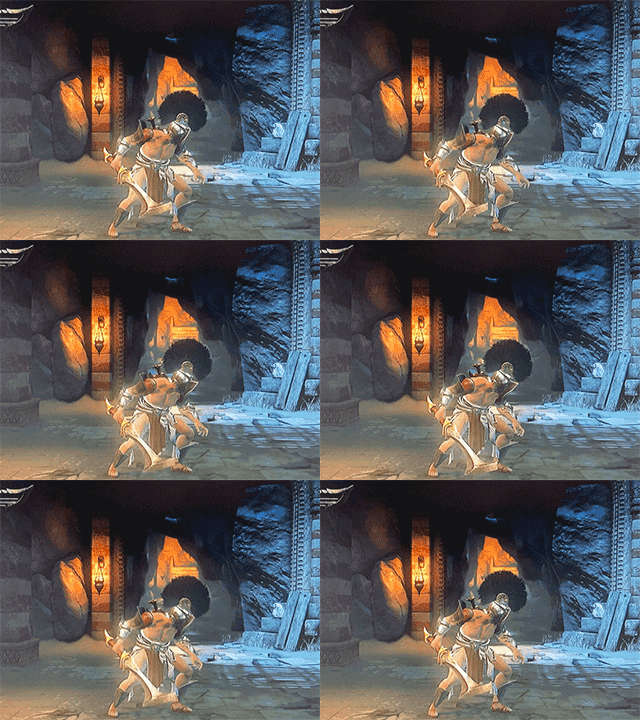
Izzy Medrano decided to adapt Andy Park’s female character, and turn her into Artemis. Her human torso was roughly in scale to Kratos, but when it was attached to her big cat body she was much longer, and taller than the Ghost of Sparta. We can see this in the earliest sketches of the goddess.

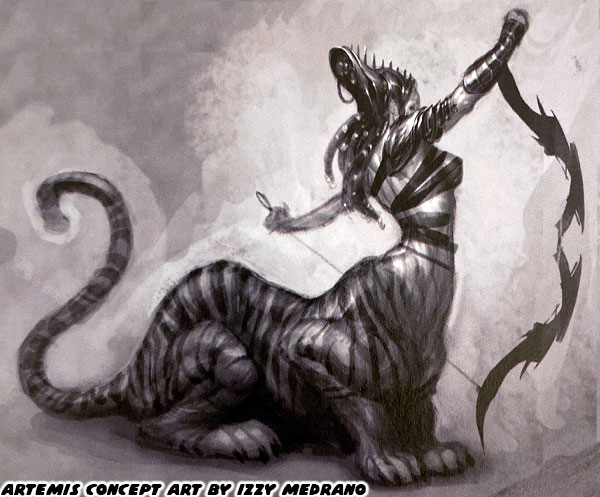
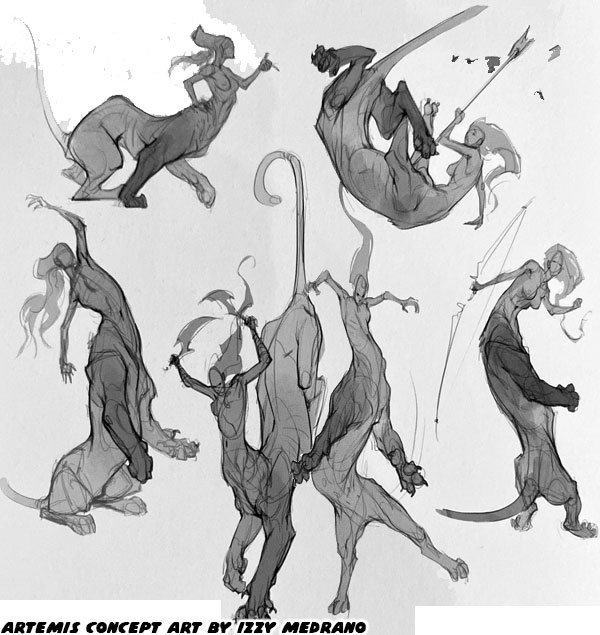
Izzy made a number of changes to the figure in his own iconic style. The lower half lion body was changed to a tiger body. She wore a shoulder pauldron, and helmet. But she did not have any armor on her animal half. As Izzy was making adjustments to the character he featured her in very dynamic poses. We could see that she fought amazingly well.

She did wield her namesake sword it one sketch, but she was better known as an archer. Izzy came up with a wicked bow design. You could imagine that she could shoot ranged targets, but also swing the angular bow in close combat. By now fans of the two newest GoW titles are guessing that a lot of this planning, and pre-production talk was eventually revisited for the character of Atreus. His library of archery attacks, and melee bow strikes in GoW Ragnarok may have come from the plans for Artemis. Of course by looking at the variety of action poses that Izzy created she was going to be a superior warrior.

Artemis would probably be able to hold her own in hand-to-hand combat against Kratos. The fact that she had two arms, and four massive paws meant she probably could probably even defeat him in unarmed combat. Her sword was equal in strength, if not more so than the Blades of Chaos, and she also had a bow, so her range of attacks was even greater. I can only imagine that the character would have been amazing to see in a co-op mode.

Sadly there wasn’t a model, or render of the character that I know of. We don’t have any test footage to look at. So we’ll just have to use our imagination and wonder how the game would have played. I’m sure there are lots of fans out there plotting out the adventures of Kratos, and Artemis. Part of me hopes that one of those fans works at Sony Santa Monica, and pitches the studio to revisit some of their earlier ideas. Anyhow, that wraps up my look at GoW Ascension. Did you enjoy the game? What do you think of the co-op idea? Would you have wanted to play as Artemis? Let me know in the comments section please. As always if you would like to sponsor me please visit my Patreon page and consider donating each month, even as little as $1 would help make better blogs and even podcasts!
follow the Street Writer on Patreon!

Wednesday, March 1, 2023

God of War Ascension, the multiplayer experience

God of War Ascension offers a grand adventure, comparable to the early GoW titles. However it has another major selling point, it is also the first time that Sony Santa Monica created a multiplayer combat title using the GoW engine. The studio wanted to see if it was possible to assign Kratos-like combat to an online game. Would it still be engaging to audiences? Would the type of combat work well when scaled up from 2 vs 2, 3 vs 3, or 4 vs 4? How large, and interactive would the maps have to be so the stages wouldn’t feel limited? The only way to find out was to build the game, and see. Not many people know that for GoW III the studio was starting to build an entirely new combat engine from scratch. One that would control, animate, and feel like the previous GoW titles. Except that the new engine would actually work in 3D environments when fighting opponents with similar powers, and abilities. The transition to the new fighting engine was so seamless that most people didn’t even notice.

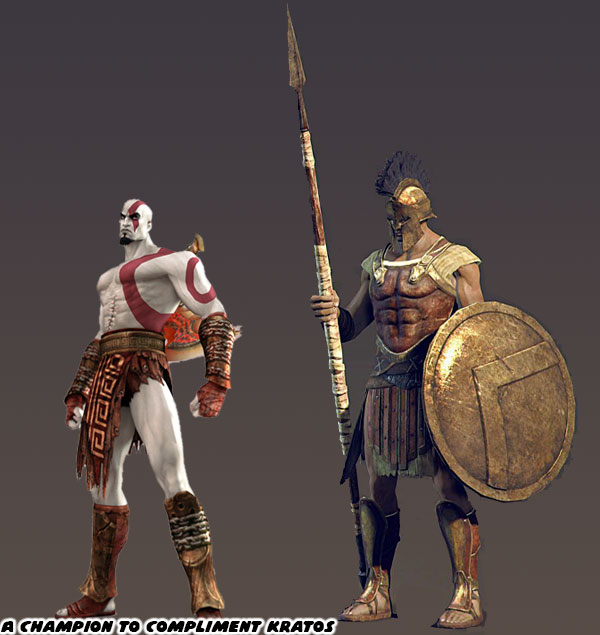
One of the first steps in designing a multiplayer game would be coming up with a leading character, somebody that worked in the GoW universe. This person had to have roughly the same size, and build as Kratos. By doing this the developers could work with roughly the same camera angles, and stage layouts that they had been used to. They wouldn’t have to completely change the assets used in the game for Kratos. The other advantage was for audiences. They would already be familiar with the attack range, and defense of the character if he was the same size as the ghost of Sparta. There were a few Kratos-sized figures in Ascension that could have fit the bill. In one cut scene we visited the streets of Sparta, and saw his soldiers becoming him to return. One of those faceless Spartans could have been a good fighter to start with. Instead Sony Santa Monica wanted a blank slate for players to identify with, and play through. It was decided to create a bald (or shaved head) muscular figure, almost exactly the same build, if not slightly more muscular than Kratos.

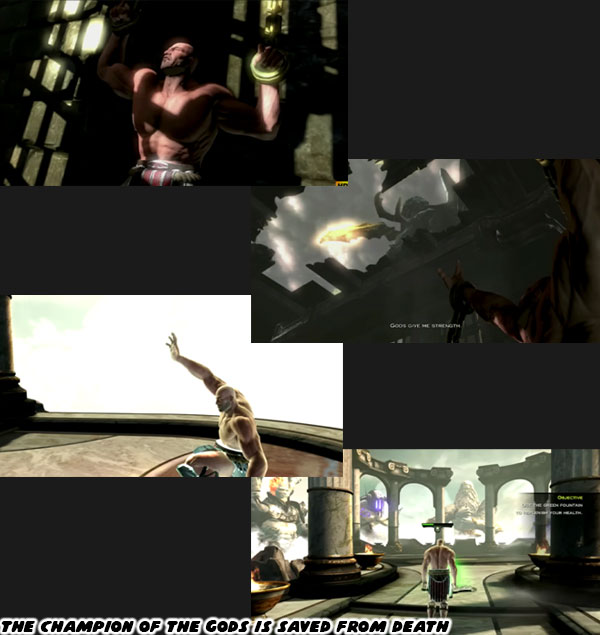
The studio referred to this nameless person as the Redeemed Warrior, he would eventually earn the title as Champion of the Gods. We first saw him in the early stages of Ascension. Kratos is chasing after Megaera while in the prison of the Hecatonchires. The warrior praises the gods because he thinks Kratos is there to liberate him. Instead an infected arm of the Hecatonchires breaks the roof of the cell, and it appears that the monster kills the warrior, but instead he actually disappears in a flash of light. When the multiplayer game begins we are returned to that cut scene, but see the warrior reappear in the Rotunda of Olympus. It is a circular arena surrounded by the statues of several gods. Here we are prompted to represent one of the patrons; Zeus, Ares, Hades, or Poseidon in their tournaments. Each god has specific blessings that they grant the warrior. These are advantages in attacks, or defense with magic, and physical strikes. The diversity of different strengths, and weaknesses helps make each selection unique.

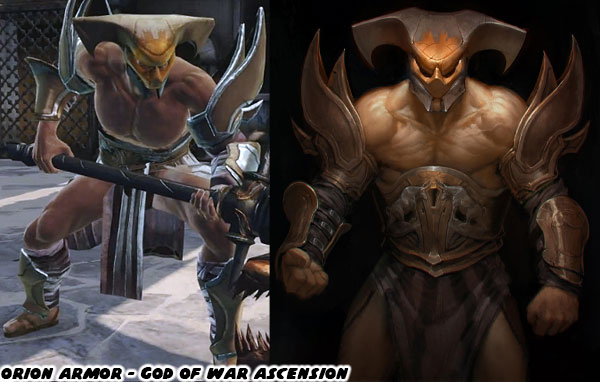
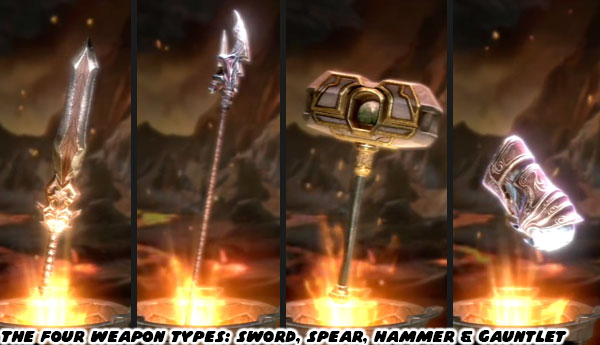
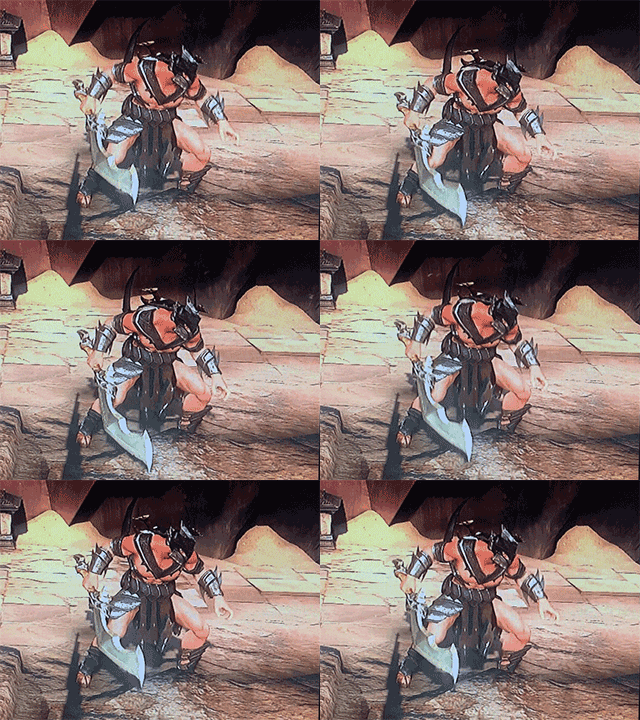
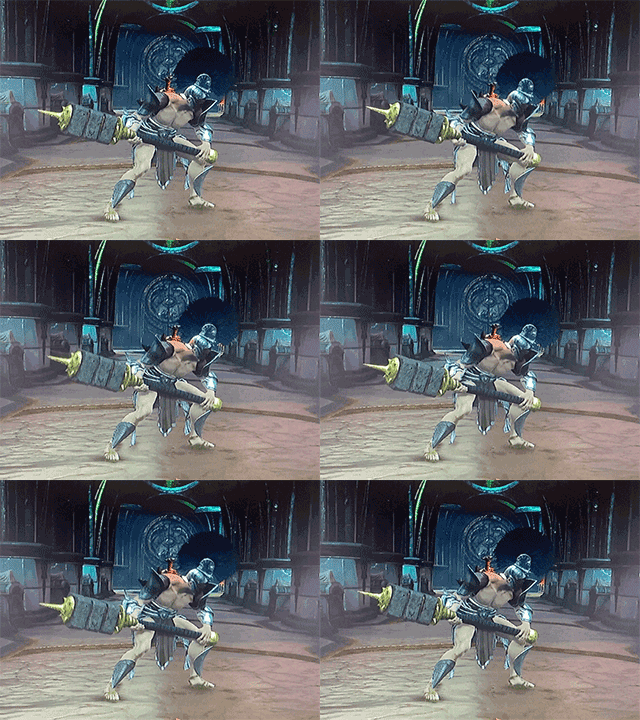
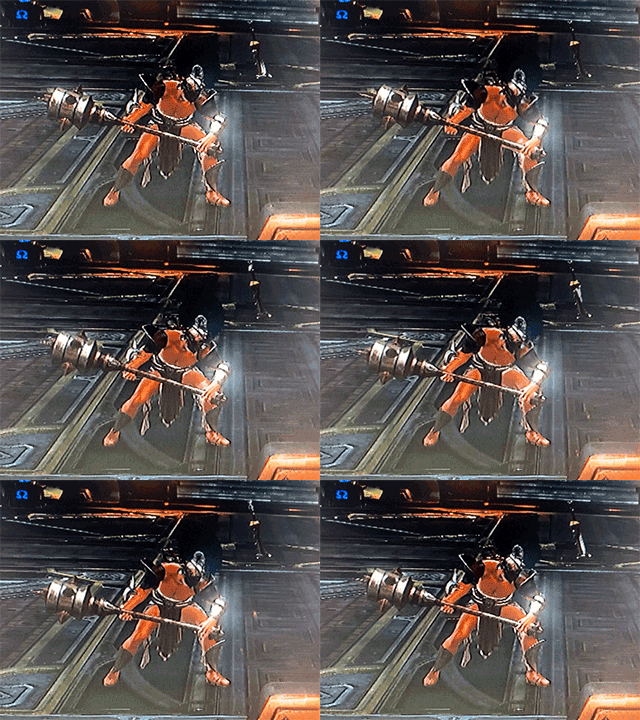
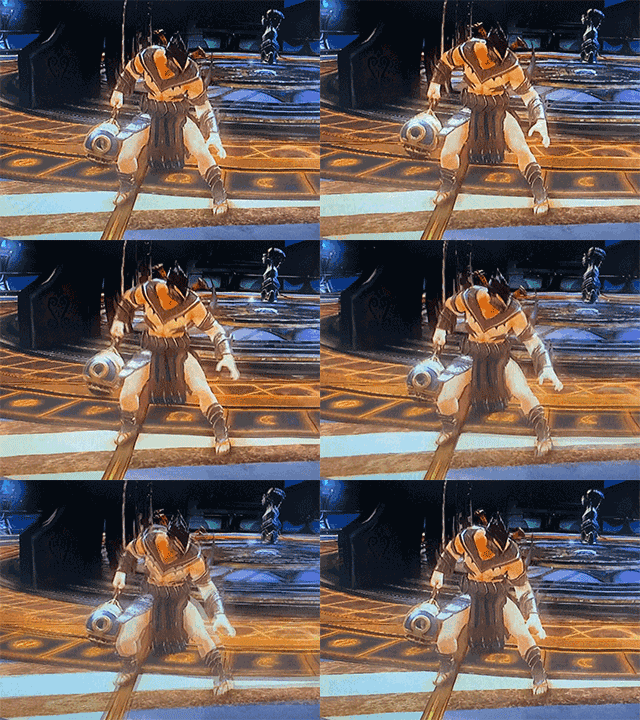
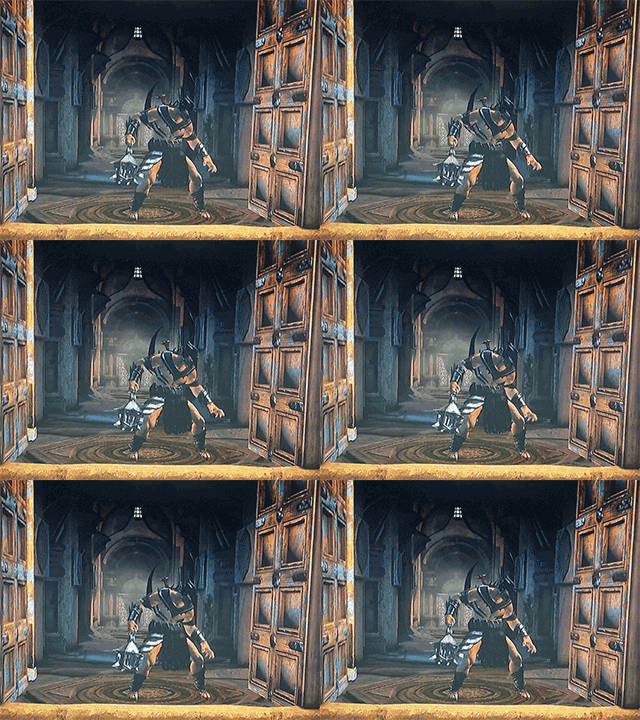
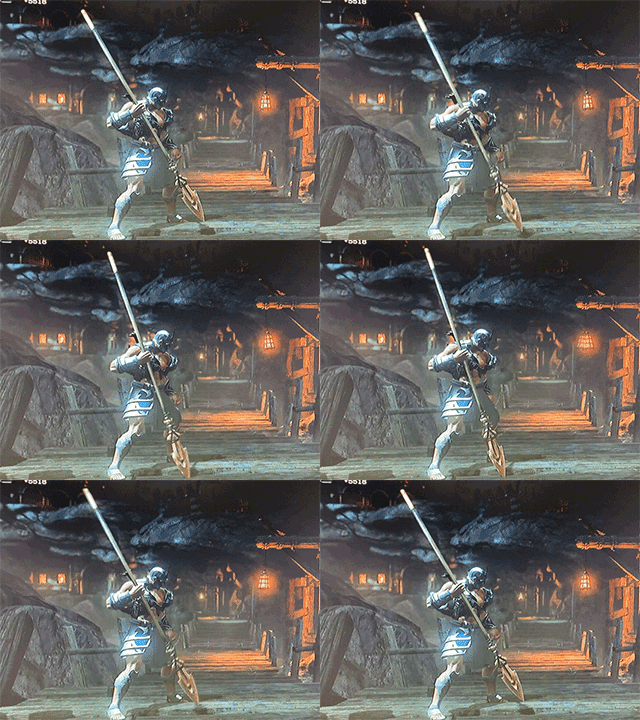
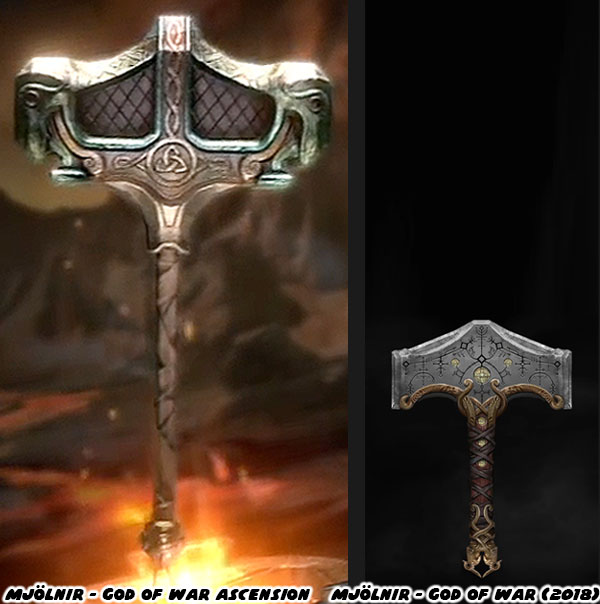
The Redeemed Warrior may have been as big as Kratos, but he wasn’t his equal in combat. He was just a hair slower, he moved, dodged, climbed, and recovered just a fraction slower than the god of war. The idea for the champion was that he was superior to a regular warrior, but not the equal to the ghost of Sparta. WIth that said he was someone that could have served as a Lieutenant in the Spartan army under Kratos. Sony Santa Monica did not want to create the Blades of Chaos for the champions to use, but they did introduce different armaments that were just as memorable. Once a player had selected which god to represent then they were prompted to use one of four main types of weapons. These were sword, spear, hammer, and gauntlet. Those that were familiar with the previous three numbered GoW titles had experience with each weapon. They would remember that some had greater range than the Blades of Chaos, or did more damage in close combat. Not only that, some of the named weapons such as the Blade of Artemis (GoW), the Barbarian Hammer (GoW II), the Nemean Cestus (GoW III), and the Spear of Destiny (GoW II) could be earned by winning multiple tournaments.

Not only could audiences fight with a main weapon type, they would also be able to pick up secondary weapons that spawned around the various stages. These second weapons were not as powerful as the main ones, not only that, but they would eventually break if overused.

The nice thing was that they were still useful to set up combos, and even be thrown at opponents to break their defenses. The five secondary weapons were actually featured during the Kratos story in Ascension. The first of these was the Sword. The developers at Sony Santa Monica created more than just one look for the secondary weapons. We could pick up alternate versions of the sword.

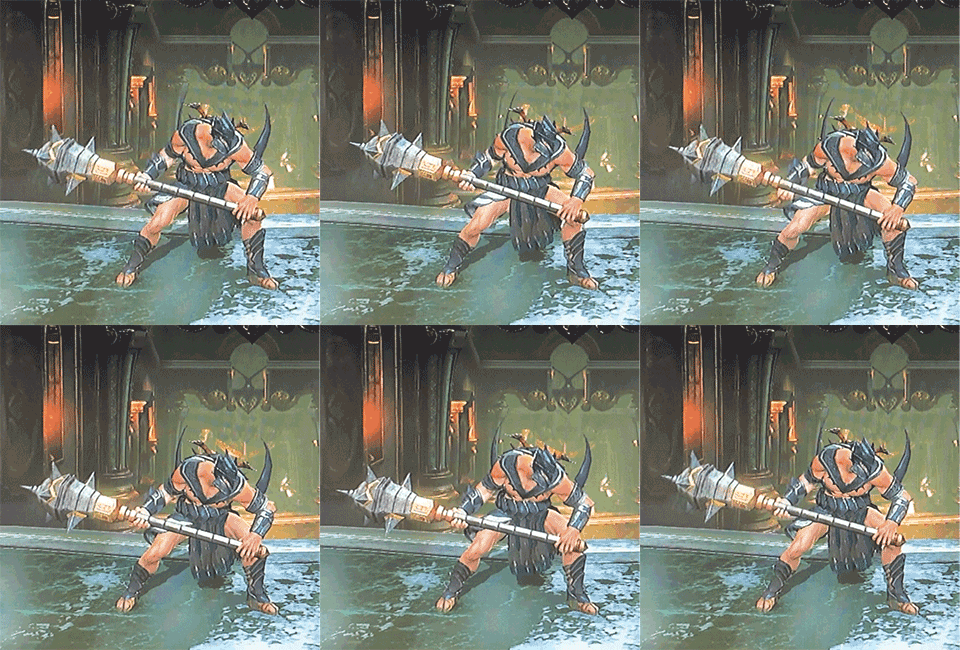
There was also a Shield, but that wasn’t half as interesting as the Club.

You might find a club had a stone build. Or the club was forged of iron. Or the club was polished metal with spikes.

There was also a ranged weapon known as the Sling.

You could hurtle fireballs at opponents, but also swing it up close like a mace.

The other ranged weapon was the Javelin.

The secondary weapons actually played differently than the main ones. The majority of secondary weapons were one-handed. This meant that they were mostly smaller, and lighter than the main weapons. Even the two-handed ones like the Club, did not play at all like the Hammer. They were faster to use than main weapons, so a combo could be started with a secondary weapon, but the majority of the damage would come from primary weapons. Sony was aware that some players didn’t want to grind to earn main weapons. They could purchase DLC as well. Some of these weapons I think gave us a hint as to where the franchise would be headed next.

Previously in the blog I talked about how the series had introduced multiple weapons for Kratos to earn, and upgrade. Unfortunately I thought that they were too similar to the Blade of Chaos, or didn’t change the game play enough to warrant wasting experience points on them. Sony Santa Monica found the best way to expand the game play was by adding these disposable secondary weapons. They were fun to use, and could be traded out when a different one was found.

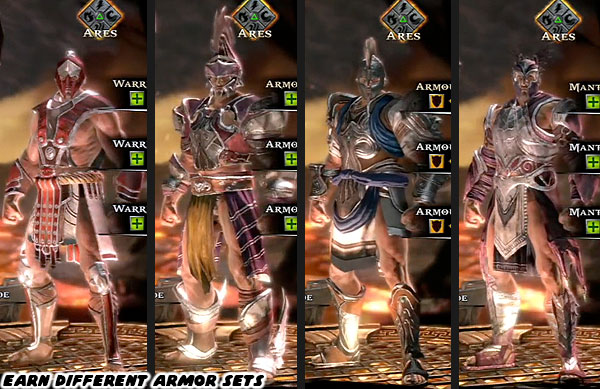
The multiplayer experience not only allowed gamers to collect different weapons, but also entirely different armor sets as well. They weren’t just aesthetic differences between the armors, but gave buffs to defense, attacks, and even resistance to magic as well. Some of these outfits were limited DLC, and some were rewards by being in a test group. Several alternate costumes were even available to replace Kratos during the story mode in Ascension. Of course having a unique library of weapons, and armor wouldn’t mean anything if the combat, and the environments were fun to play.

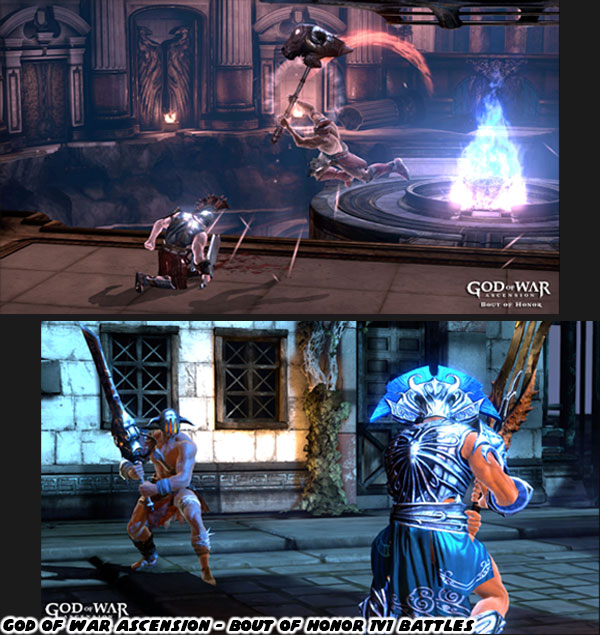
There were several different types of multiplayer games. Team Favor of the Gods, Capture the Flag, Match of Champions, and Trial of the Gods. They didn’t all necessarily have to be 4 vs 4 battles. They could be enjoyed with smaller groups, against a boss, such as Hercules, or with a one-person wins all challenge. Those that had a score to settle with an online opponent could even call them out in a 1V1 Bout of Honor.

The four main weapons, and five secondary weapons helped make the multiplayer game unique. It allowed audiences to discover what sort of armament, and play style suited them best. Some players were defensive, some preferred magic, and others just threw themselves headfirst into battle. There were certain combinations of armors, and weapons that worked best for them. Players could even switch patronage to a different god if they wanted to explore what special features they offered.

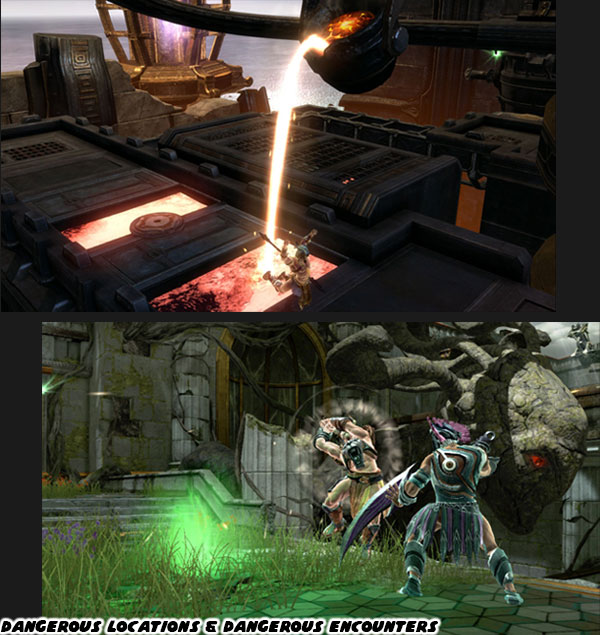
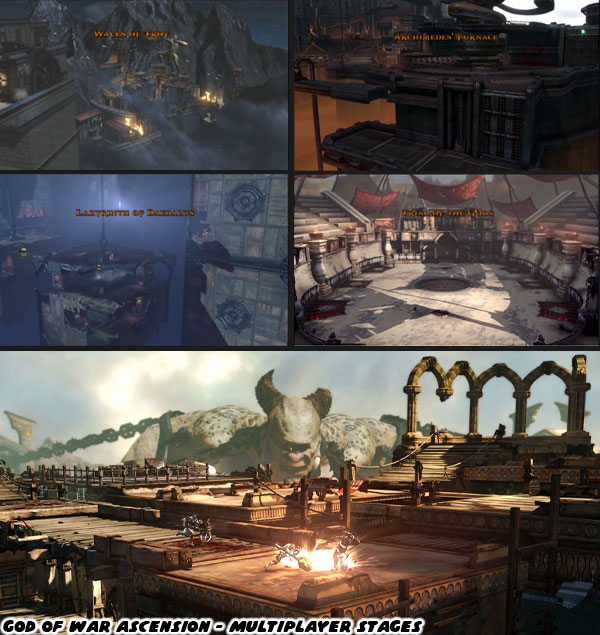
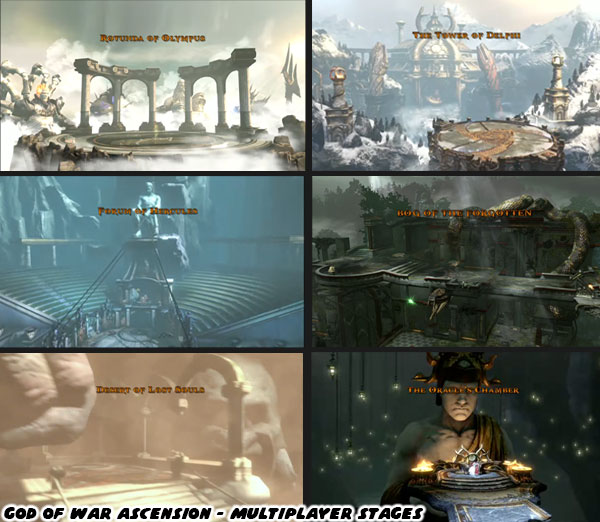
The stages were by far the most impressive thing that Sony Santa Monica delivered for the experience. They contained multiple objectives, traps to spring onto opponents, goals that evolved as the stage progressed, and were layered so that the action was distributed evenly on every corner of the map. Almost every location was a call back to a place that Kratos had visited during his journey. These included several sites from Ascension, such as Archimedes Furnace within the Statue of Apollo, the Streets of Sparta, the Oracle’s Chamber, the Tower at Delphi, the Landing at Delos, the Whirlpool of Alecto, and the Canyons of Kirra.

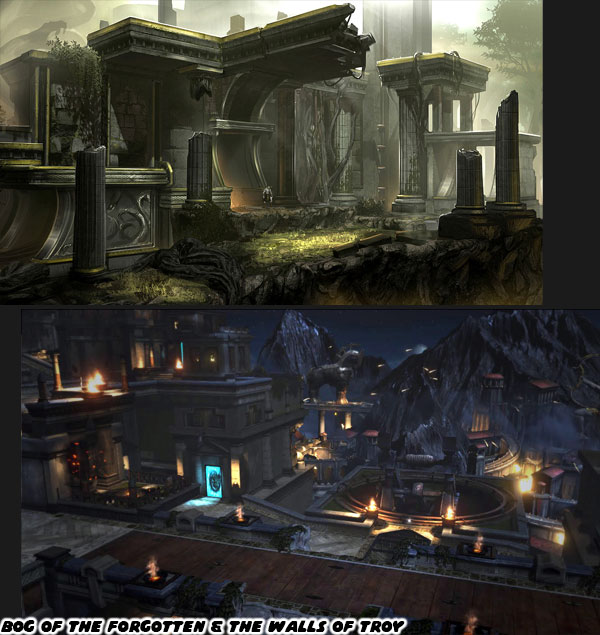
The other stages were essentially a love letter to the franchise. From GoW III there was the Chamber of the Flame, The Labyrinth of Daedalus, and the Forum of Hercules. We had fought Zeus, Skorpius, and Hercules at each spot respectively. We visited the Desert of Lost Souls, which was featured in the original GoW. It was the place that Cronos had wandered with the Temple of Pandora chained to his back. This time there was an enormous cyclops named Polyphemus (the cyclops from the Odyssey) menacing players from center. There was the Bog of the Forgotten. It was near the Ruins of the Forgotten, and the Temple of Euryale from GoW II. This temple featured the captured body of the giant gorgon Stheno. She was the sister of Medusa, and Euryale. The original stages created for multiplayer were brilliant as well. The Rotunda of Olympus, the Coliseum of Persia, and especially the Walls of Troy. The mythology geek in me absolutely loved the details that were packed in these stages. The Trojan horse, and Statue of Apollo were in the background of Troy, but teams could launch fireballs at both from a catapult in the foreground, and destroy them. The fact that I could revisit these locations again, and again made it feel like the classic GoW experience was infinite. The world of Ancient Greece lived on through these places. The fact that the stages were dynamic, and the teams were unpredictable meant that no tournament was going to be even remotely similar. 

Sony hoped that the multiplayer games, and DLC would continue to generate profit for the franchise. The company had plans to roll out new armor sets, weapons, and stages had Ascension, and the online matches continued to sell. Unfortunately the response from fans, and reviewers was tepid at best. Ascension didn’t sell the units that Sony wanted. Many felt as if the GoW series had just burned out. No matter how well this game was made audiences just didn’t show up in the numbers that Sony required. Which was a shame. In recent years many gamers that stream or have YouTube channels are coming around, and admitting that the multiplayer in Ascension was quite good. Not only that, there is nothing even remotely close to it today. It gave the series life well beyond its release date. 

I can only hope that in the future Sony considers creating a separate GoW adventure, and GoW multiplayer game so that the developers can focus on one thing at a time. That’s me wishing out loud. As amazing as Ascension turned out there was actually much more in the planning stages that was cut. In the next blog we're going to look at the ideas that the studio had developed for a co-op mode. For now I’d like to hear your thoughts on God of War Ascension. Did you play the multiplayer game? Do you think that the GoW series could work as an online multiplayer experience? Let me know in the comments section please. As always if you would like to sponsor me please visit my Patreon page and consider donating each month, even as little as $1 would help make better blogs and even podcasts!
follow the Street Writer on Patreon!

Monday, February 27, 2023

God of War Ascension, going to the ends of the Earth to find redemption

In God of War Ascension Kratos is on a mission to break his oath to Ares, the god of war. It started with a difficult boss fight, and a prison escape, but it wasn’t just any jail. He escaped from a prison made out of a living giant, the hundred armed Hecatonchires. Then he traveled through the port village of Kirra, in the search of an oracle to guide him. No soothsayer was as famous as the Oracle of Delphi in actual Greek mythology. I was grateful for the studio for doing such a deep dive into Greek history. I never imagined what the temple would have looked like, or how one would even reach it. Sony Santa Monica decided to set it in the peaks of a mountain. A frozen breeze gave motion to the environment. But so did gigantic mechanized snakes that powered the bridge leading to the temple. It was certainly a fresh take on stage design. There were a lot of enemies leading up to the temple, and an amazing encounter against both a Chimera, and a Manticore.
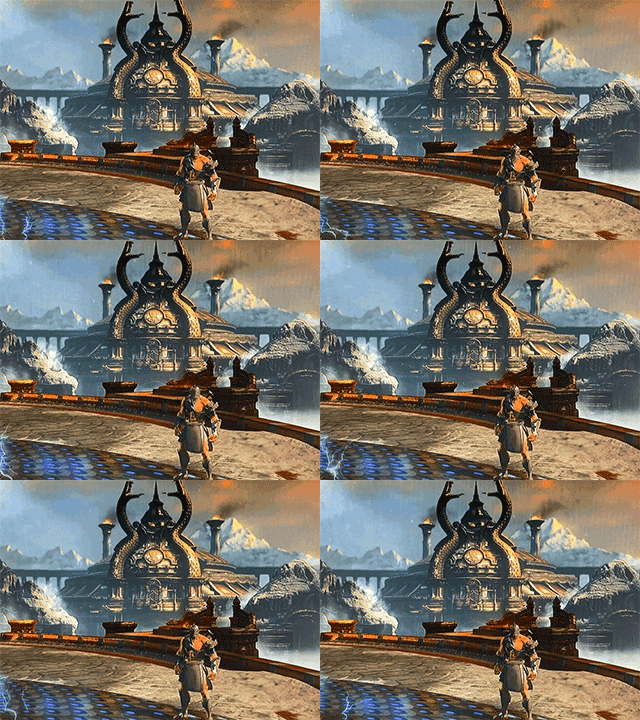
Once inside the temple Kratos discovers that some unscrupulous twins (labeled the False Profits by the developers) have sequestered the Oracle. They were ordering slaves around in her absence, and having them build tributes to themselves. When I saw the name Castor I instantly knew who they were. The brothers Pollux, and Castor were experienced sailors, and renowned horsemen. They had been featured in a few classic mythologies. Their most famous appearance was as Argonauts, traveling with Jason. Pollux was a demigod, the son of Zeus, and Queen Leda of Sparta. His brother Castor had the same mother, but his father was Tyndareus, the King of Sparta. Castor was mortally wounded in battle, and his brother begged Zeus to make him immortal. Zeus agreed so long as Pollux were willing to give up some of his godhood. When he agreed Zeus turned the duo in the constellation Gemini. Where they spent half the year on Olympus, and half the year in the fields of Elysium. The adventures of Jason took place before Kratos became a legendary captain in Sparta. It explained why Theseus was past his prime in GoW II, and why the twins were old in Ascension. Their age didn't matter as they could use the power of the oracle to make themselves young men.
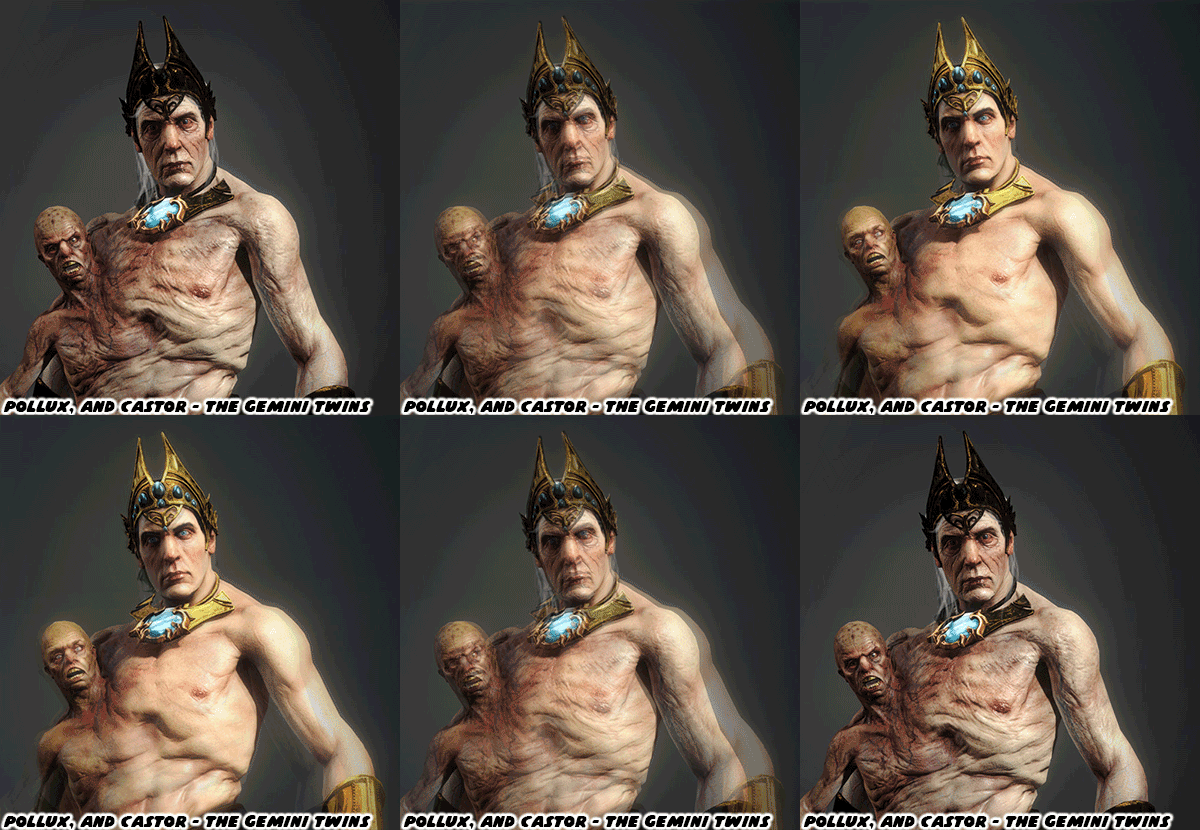
It wasn't enough for the art team, and animators to put two separate characters for to battle against. That would go against the library of other memorable bosses. What they did instead was make the brothers conjoined twins. The more powerful Pollux was sticking out of the side of Castor, just about where his liver would be. It was grotesque, and awesome at the same time. Anybody that had seen the movie Total Recall would get the punchline following the battle with the twins. Each brother actually had their own weapon, a sword, and a mace. When those weapons were joined Castor used it as a massive walking staff. The majority of the twins attacks were not physical but magical. They could decay the ground, and cause Kratos to fall to his death. They could also slow down time, and strike Kratos before he could react.When the twins sensed that they were losing the battle they decided to rob Kratos of his goal. They caused the Oracle to fall to her death. It was certainly a tough, but memorable battle against the duo. The Oracle survived the fall, but she was living on borrowed time.
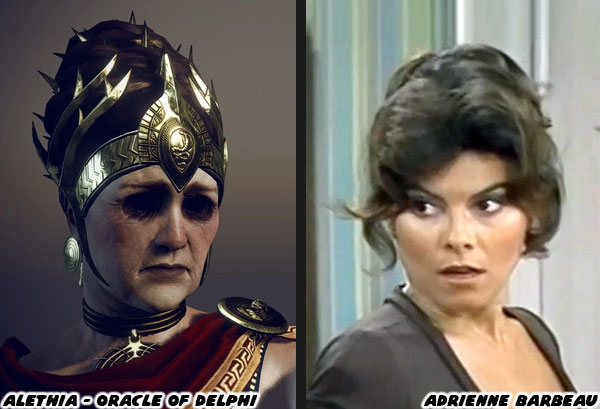
Kratos took the Amulet of Uroborus from the lifeless body of Castor. With it he could rewind the life of an object, or speed it up, and cause it to decay. Unfortunately he could not use its powers to reverse the injuries on Alethia, the Oracle of Delphi. Although she only existed in the game for a few moments I always thought the performance was one of the best in the franchise. I was surprised to discover who performed the role. It was Adrienne Barbeau. She was the sexy brunette character in a number of late '70s / early '80s movies, and TV shows. I first remember seeing her in the film Escape from New York in 1981, the same year my brothers, and I saw Clash of the Titans. Then she popped up again in 1982 in the films The Swamp Thing, and The Creepshow. She would turn up on TV over the years, and was always a fan favorite whatever she did. But I digress. Adrienne brought a lot of gravity to her performance. She explained to Kratos that her eyes were taken, and hidden away by the Furies because she could see the truth. A mysterious character named Orkos had been trying to aide Kratos through the adventure. She revealed that he was son of Alecto the Queen of the Furies. They both tried to warn Zeus that Ares, and Alecto were conspiring against him, and looking to take over Olympus. Orkos was imprisoned by them in the Hecatonchires, and Alecto imprisoned in her own temple. It was up to Kratos to retrieve her eyes, and break the magic of the Furies.
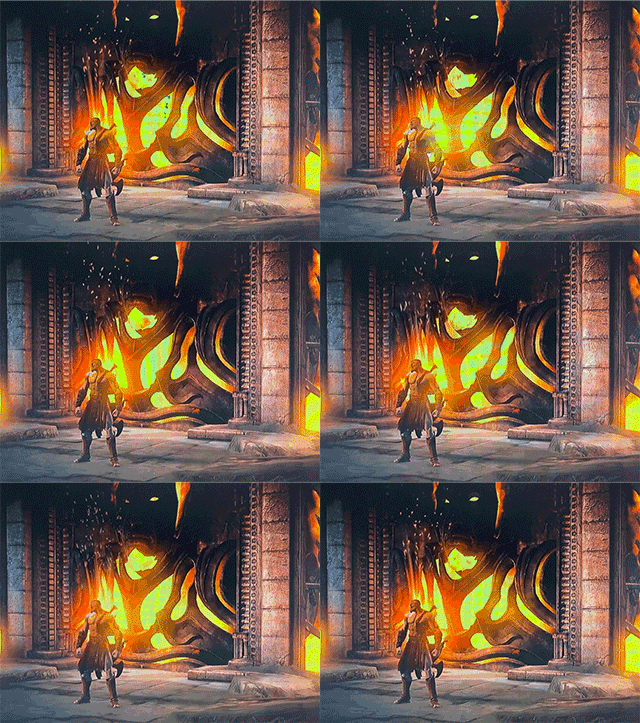
The moment with Alethia lasted only a few seconds, but in it you could see Kratos show a range of emotions. Most important he had a little bit of compassion for her as she took her last breaths. You could see Kratos take her hand, and offer her some comfort as she accepted her fate, and sent him to complete his task. These little moments were all throughout Ascension. T.C Carson got to show off his acting chops, and Kratos went through the spectrum of emotions while dealing with the cast. It was the first time the studio was using performance capture technology with the voice actors, and not solely with the stunt performers. We actually got to see Kratos be something other than just a rage machine. He had much more dimension than he did in GoW III. I was grateful for the studio for giving us a reason to empathize with him, and his impossible decisions. The other thing that I was grateful for was the studio not being scared of lighting the environments, and showing us what the PS3 was capable of. The look of the game was far removed from the infinite shades of gray, and mud that colored GoW III.
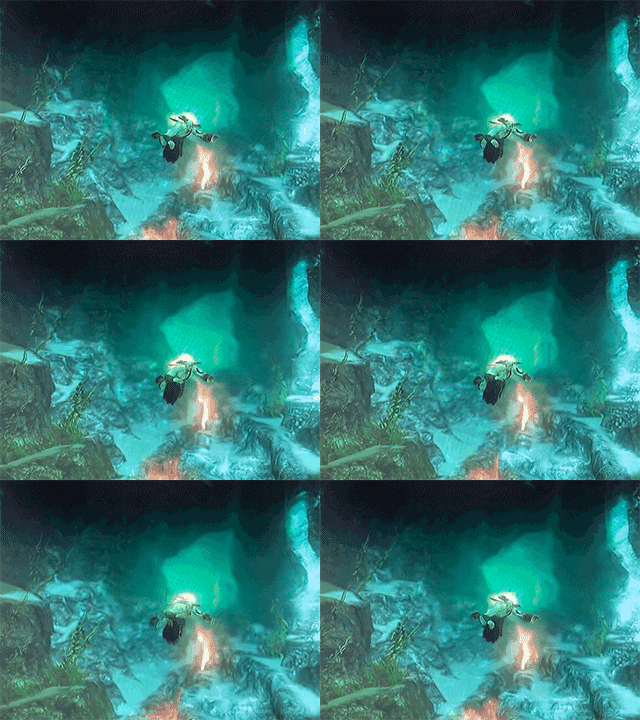
Kratos continues his adventures, while gathering additional power ups. With the Amulet of Uroborus he is able to create bubbles that slow down time, and allows him to strike at enemies that are almost frozen in space. He also gains the Oath Stone from Orkos, this allows him to create shadowy clones of himself that can fight, or help solve puzzles. A huge portion of his journey takes place on the Isle of Delos. The mathematician, and architect Archimedes has been busy at work on his masterpiece, the Statue of Apollo. This statue is the largest in the world, even on bent knee it is taller than the Colossus of Rhodes. A group of sailors that Kratos travels with considers Archimedes mad. Because he has sent all his workers home, and is determined to finish the statue all by himself.
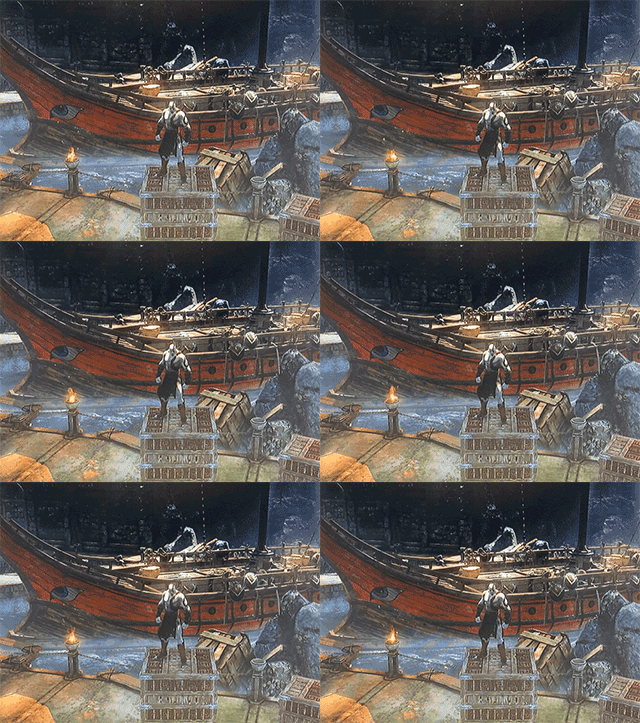
This location is notable for several reasons. It was one of the most important port locations in all of the Mediterranean. Settled around 3000 B.C. it was a prosperous location. In mythology the Isle of Delos is the birthplace of Apollo. He is the god of light, dance, wisdom, and music. He is also supposed to be an exceptional archer. Most important to the story of Ascension is that Apollo is the patron god of all oracles. He was blessed with wisdom, and prophecy. He shared this gift with the oracles, and was primarily worshipped in Delphi. The statue of Apollo was going to be a monument to the highly influential god. It was enormous in scale, easily as tall as the biggest modern skyscrapers, with a footprint dozens of city blocks wide. The statue was so big in fact that its size alone had a personality. Even in its ruined state it was as cavernous, and as dangerous to explore as the Temple of Pandora from the original GoW.
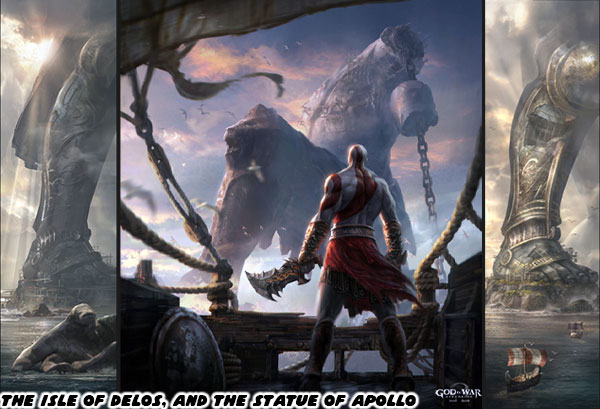
The designers working at Sony Santa Monica wanted the set piece to be awe inspiring. The concept art was painted, and repainted, with tiny details like ships, and birds being added to give you a sense of scale. This art was used to sell the game to vendors, and featured in magazine spreads. The 3D model created, and textured for the game was as majestic as the concept art. Kratos is dropped off at the port, and the sailors convince their captain to leave right away as they believe the island to be cursed. Kratos sees that there might be some truth to that as he has to fight off wave after wave of monsters sent by the Furies. He claws his way up each level. After several minutes of fighting, and climbing you realize that you’ve only made it to the ankle of the statue. It felt like it was going to take days to reach the top, and that was fine with me.
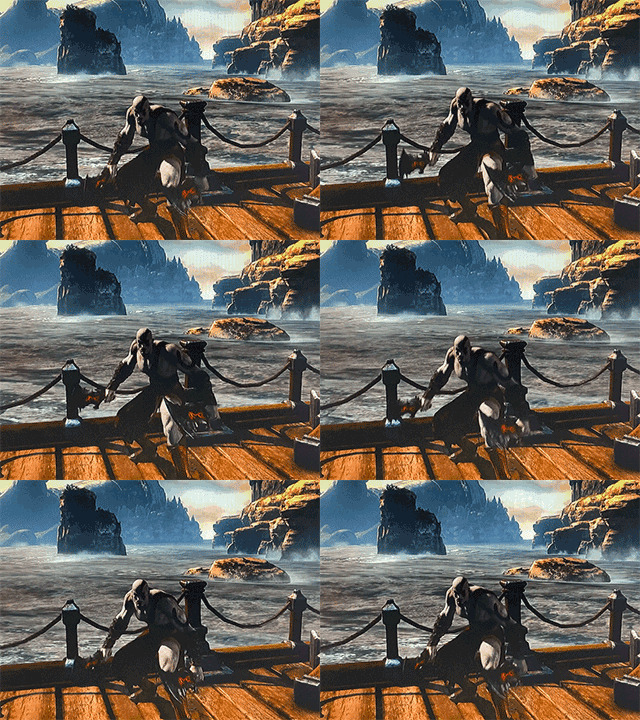
The traversal in the game was easily the best in the franchise. I think it was even better than the climbing mechanic used in GoW (2018). The studio realized that it was too simplistic to have a flat face with a slightly different texture than the surrounding areas. This signaled to audiences where Kratos could simply stick his Blades into the rock face, and start climbing. It made sense in the original game, but by GoW III the studio had no excuse to keep using that same type of level design. In Ascension Kratos could grab ledges, and pull himself along. It felt like the freestyle climbing used in other popular games like Assassins Creed, and Uncharted. His movement was natural. The animation flowed smoothly from climbing with just his bare hands, to bracing himself with his feet, and making realistic lunges to nearby ledges. Before you knew it you had climbed hundreds of feet. The camera would turn to show you a vertigo inducing shot of Kratos hanging by his fingertips over the ocean.
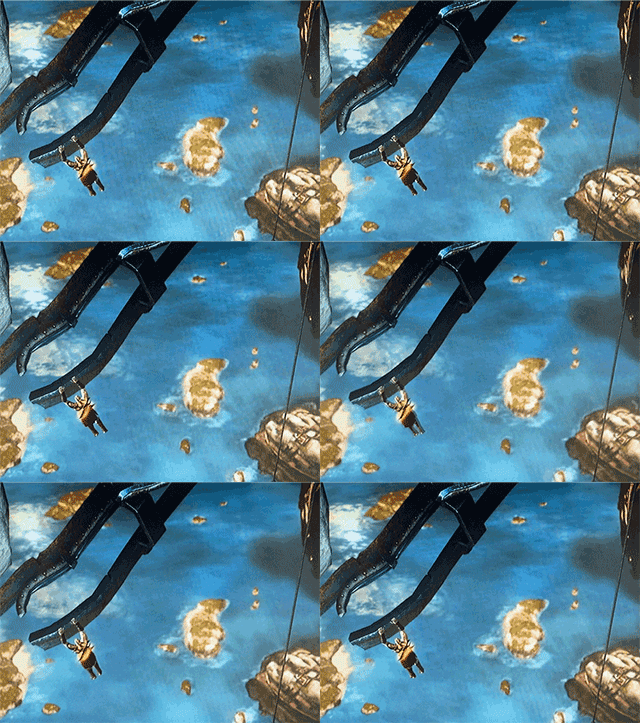
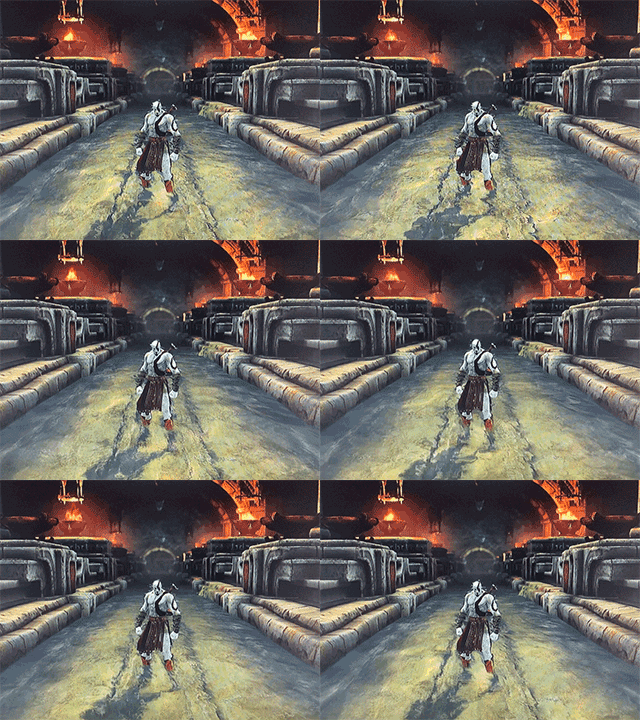
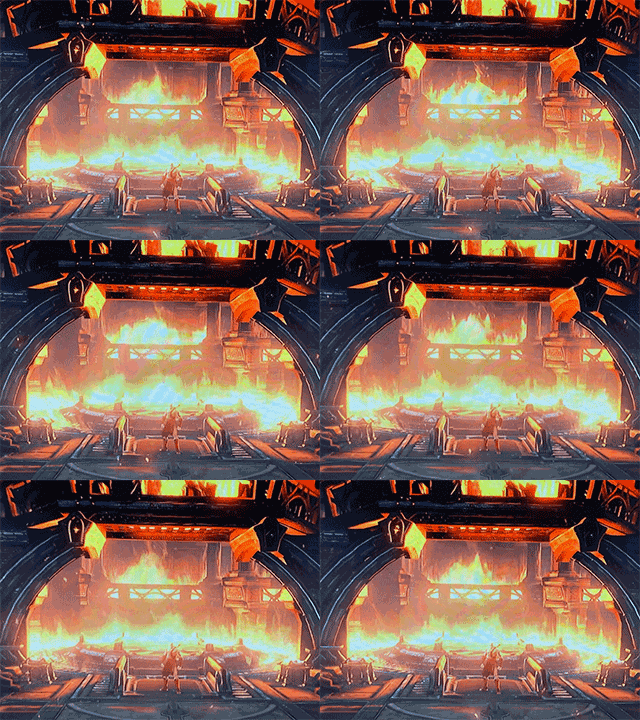
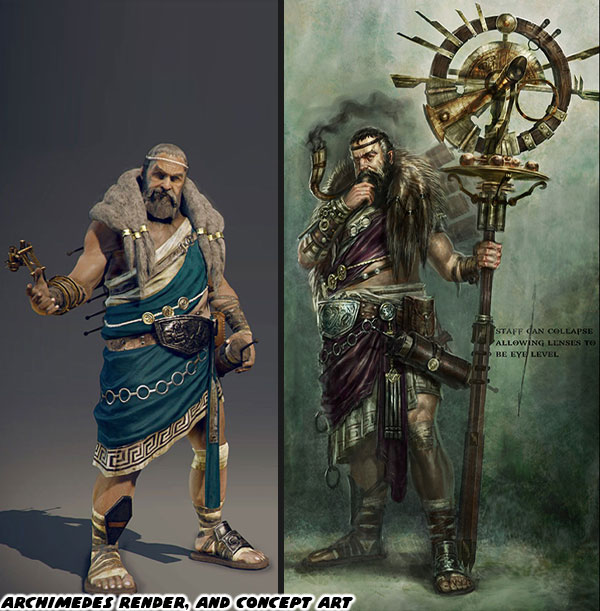
Kratos has to explore the dangers lurking within the statue on his quest. There is no ladder, or staircase inside the cavernous interior. To reach the highest level in the torso he has to activate the Forge. The genius of Archimedes is evident in every corner of the statue. In order to build the statue without having to wait for supplies he created a self-sustaining forge within. A conveyor belt of raw material, and molten metal would automatically move throughout the entire frame. It could be dumped where needed. Archimedes also developed a series of elevators, and pullies that raised the lantern of Apollo when it was finished. When Sony Santa Monica was developing the game they had a lot planned for the genius inventor. The concept artists had fleshed out dozens of concept illustrations for the character. In one version he had a metal plate stapled to his head from a previous injury. He wouldn't let a cracked skull stop him from working. He carried a staff that had acted as a surveying tool, but was capped with all manner of mechanical innovations. Plus he wore various gadgets on his belt, and wrist. He would interact with Kratos on several occasions, perhaps in the place of Orkos, and explain why he worked alone. All of this pushed the plot along. Sadly as time constraints hit the developers less, and less was made of Archimedes until his role was ultimately cut. Instead all we get are some of his notes, and a mummified corpse laying across his workbench.
The Furies hid the Eyes of Truth in the statue. They were doing everything they could to keep Kratos from reaching its secret location. Since they had a portion of the Primordial powers, essentially the forces that created the universe, this meant the Furies could create their own reality. They used it to create realistic illusions. These places were solid, with actual sites, sounds, smells, and even people. They were convincing enough to keep any mortal trapped in illusion for the rest of their lives. They tried to appeal to Kratos in a number of ways, through his lust, through his ambition, and finally through his family. Kratos was able to focus on what was real or not because Orkos gave him a pendant from his daughter Calliope, and a ring that belonged to his wife Lysandra. These items would help Kratos break through the visions. Often in an extremely violent manner.
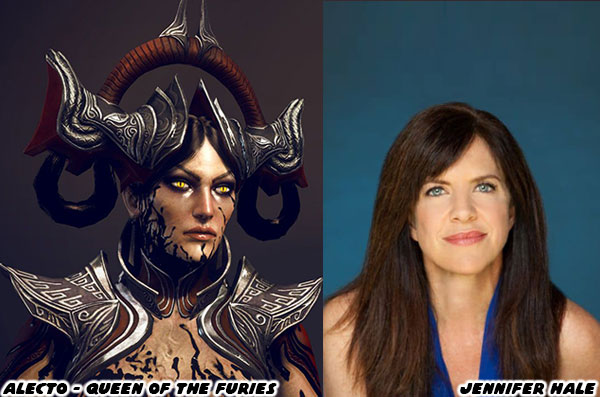
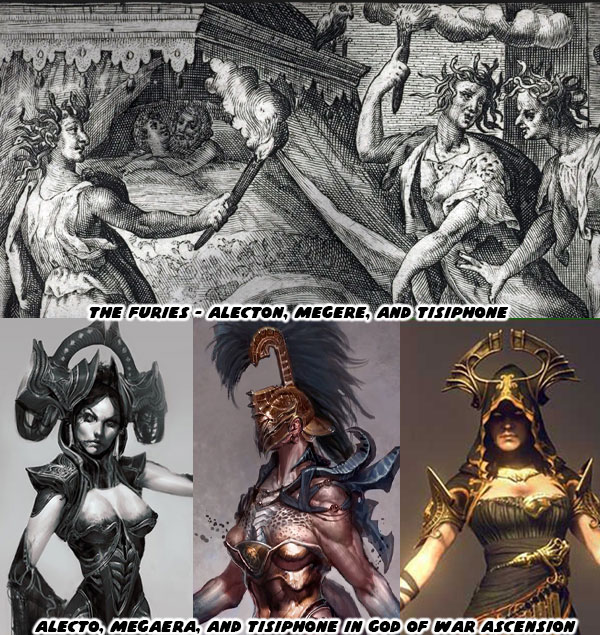
The actresses behind the three Furies all gave exceptional performances. Debi Mae West voiced Tisiphone, the Furie that tried to get Kratos to submit to his ambition for Sparta. She had also voiced the Fate Atropos, arguably the best design in GoW II. Nikka Futterman voiced Megaera, but pop culture geeks would recognize her as the voice of Asajj Ventress from Star Wars: The Clone Wars. Of the three I think veteran voice actor Jennifer Hale delivered a knockout performance as Alecto, Queen of the Furies. Game fans might recognize her from her award winning runs on Mass Effect, Star Wars: Knights of the Old Republic, Metal Gear Solid 4, and BioShock Infinite. Alecto's design was possibly the best female villain in the entire franchise, although Megaera's design was great as well. The closer Kratos got to the Eyes of Truth, and breking free from his bonds to Ares, the more determined the Furies became. None more than Alecto.
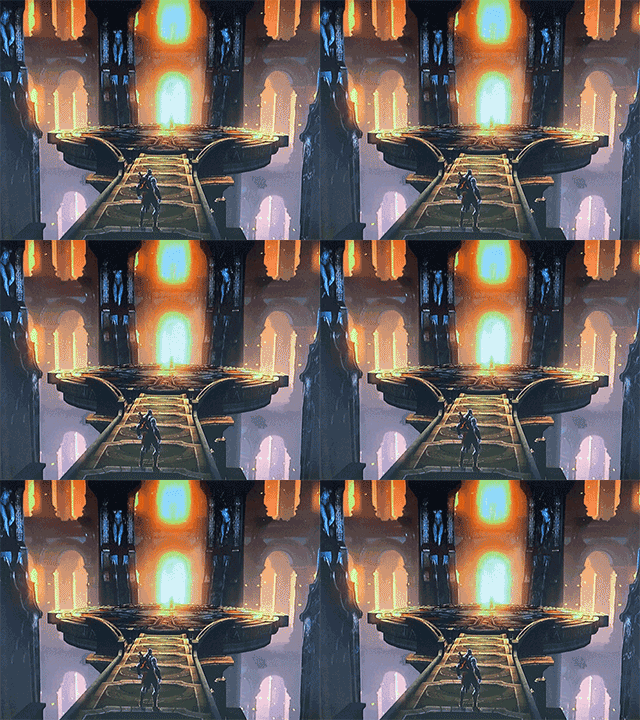
The team at Sony Santa Monica was hiding a big reveal for the final boss battle. Kratos had defeated Megaera, and had stolen the Eyes of Truth from Alecto. In doing so he forced her hand. She transformed into an enormous, squid-like beast, and pulled Kratos into the dimension of the Furies. A world made of inky illusions that she turned into a raging tempest. Those that had played the Ghost of Sparta would recognize the whirlpool battle was very similar to stage where Kratos was sailing into the Nexus of Atlantis. Not only that but there was a battle against an enormous sea creature, similar to the Scylla, also from Ghost of Sparta. The sea creature turned out to be Alecto's alter-ego. The queen was also known as Charybdis. She often appeared opposite the Scylla in Classic Greek Mythology. She would create ship-eating giant whirlpools. You could imagine that this reveal made the mythology geek in me instantly decide this was the greatest GoW adventure ever.
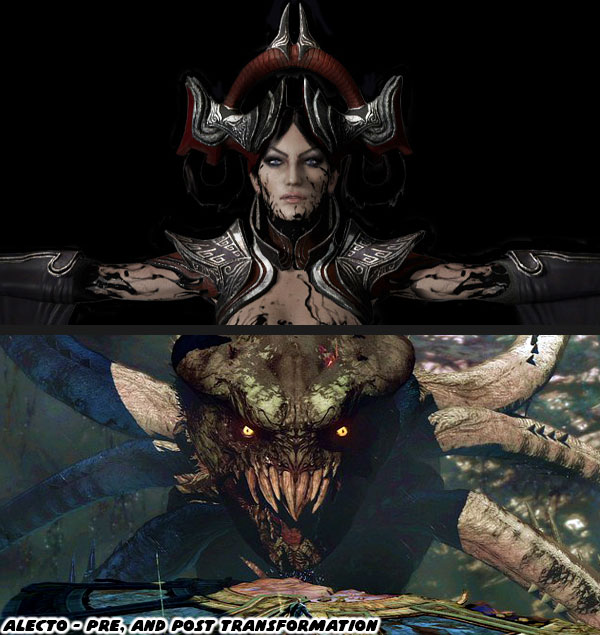
I think the final battle with Alecto/Charybdis was a way for Sony Santa Monica to do something they had always wanted to. This type of battle was a wish in their design notes going back almost a decade. Remember when I mentioned that Atlantis was originally going to be a playable stage in GoW II? As Kratos ascended the Tower of Atlantis he would see the Kraken swimming in the ocean, behind the magical waterfall. It would suddenly break through, and attack before Kratos could reach the summit. The battle with Charybdis is a wonderful mash up of the Atlantis whirlpool from Ghost of Sparta, and the proposed Kraken battle from GoW II. In a way it is even more dangerous because the ocean in the realm of the Furies is made of ink. It's impossible to see very far in the darkness, when the Charybdis appears it is meant to be a jump scare. As if the fight wasn't already stressful enough the soundtrack raises the stakes. Tyler Bates drops the Madness of the Fury Queen to really get our heart going.

The final battle is amazing. With the Three Furies defeated Kratos is able to learn the truth. Ares, and Alecto had conspired for Kratos to kill his family, and create false blood oath to Ares. When this deception was revealed Kratos was able to break his bonds. But it came at a price, the death of Orkos. It was a bittersweet ending for the Spartan. He would have a long road ahead of him following the events of Ascension. It would be one that I would follow him on again, and again for the next 18 years. God of War Ascension had even more to offer than a fantastic single player story. The multiplayer game may have been even better. I’d like to talk about that in the next blog. For now I’d like to know your thoughts on the game, and what you liked best about it. Let me know in the comments section please. As always if you would like to sponsor me please visit my Patreon page and consider donating each month, even as little as $1 would help make better blogs and even podcasts!
follow the Street Writer on Patreon!

Friday, February 24, 2023

God of War Ascension, a second chance to say goodbye to the Greek saga

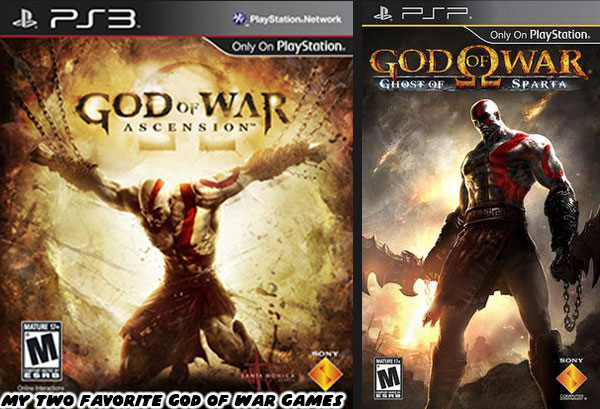
The final title I want to dig into for the current series is God of War Ascension. It is easily one of my favorite games of all time. to be fair it is actually an even toss up between Ascension, and the Ghost of Sparta as my favorite in the franchise. When this blog series started in January I talked about a conversation I had with my cousin about why I thought Elden Ring was going to win game of the year over GoW Ragnarok. He then asked which GoW I liked best. The best way I could do that was to compare the two games to the greatest dark rides ever made. In my opinion those would be the Disneyland versions of The Haunted Mansion, and the Pirates of the Caribbean. It’s all but impossible to choose one over the other because they are such unique, and memorable experiences. The Haunted Mansion came out after PotC, and incorporated many lessons learned from the previous attraction. That didn’t necessarily make it a better attraction, but stronger than it could have been for sure. I see Ghost of Sparta, and Ascension in a similar vein. There is a lot that the studios learned from the previous title, and even pulled the best elements into the new experience. I want to highlight the things that I truly enjoyed in Ascension.

Let’s start with the villains. We don’t learn who the main enemy is by the end of the game, but instead see them in the opening seconds. When Ascension starts we see Kratos has been captured, and is being tortured by a scarred female warrior with four bug-like arms sticking out of her back. We would learn that she was Megaera, one of the Furies from Greek mythology. They are also known as the erinyes, which is not to be confused with the character Erinys, the daughter of death from Ghost of Sparta. There are three furies in mythology, they were created from the blood of Ouranos / Uranus, when his son Cronos castrated him. They all have Primordial powers, and existed before the Olympians. In the game they became the oath keepers. If you swore a blood oath to a god they would hold you to it, and punish you for all time if you broke it. Megaera was striking Kratos at the start of the game. She was a goddess that caused jealousy, and punished people who committed crimes of passion, such as marital infidelity. Alecto was charged with punishing those who committed moral crimes with anger, especially when used against others. She was the goddess of Anger. Tisiphone was the one who punished crimes of murder: patricide, fratricide, and homicide. She was also recognized as the guardian of the gates of Tartarus. They didn't have exactly the same roles in Ascension, but seeing them visualized as anything other than gorgons was refreshing. A credit to the art team at Sony Santa Monica.

I would argue that the story, and tone of GoW III left audiences feeling a little let down. It didn’t really capture the look, and magic of the earlier titles. Even though it looked amazing, and sold well, it didn’t capture the spark of the previous games. I think that Sony Santa Monica went back to the drawing board. They studied their best work, as well as the work of Ready at Dawn to identify the elements that worked best. The studio had three goals that they wanted to accomplish, the first was a single-player game. I in my opinion a Greek saga that felt like a classic GoW adventure. The second was to create a multiplayer game that showed Kratos-like combat could make for entertaining online matches. The third was to make a two player co-op game featuring Kratos, and another warrior. Let’s talk about the first goal. I honestly believe that the Three Furies were chosen as the villains in Ascension because they paralleled the Sisters of Fate from GoW II. They each had their own unique look, and could provide an independent challenge. In essence a series of progressively harder boss battles just as the Fates did. The other thing that Ascension did well was a return to the epic formula. It allowed us to follow Kratos as he traveled all over the Mediterranean. To visit unique regions, with their own climate, and atmosphere. Remember that in GoW III the entire game took place on Olympus.

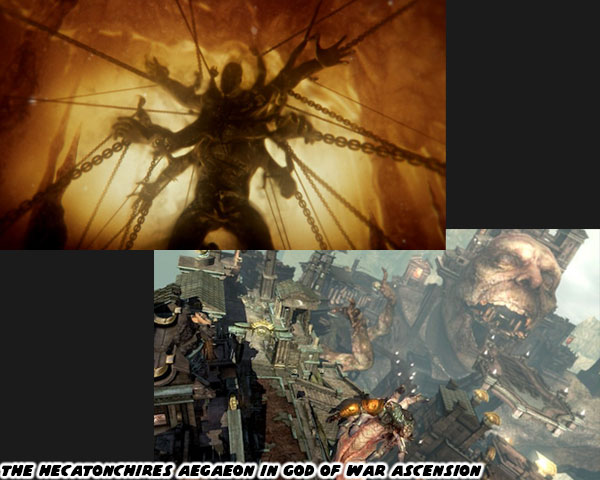
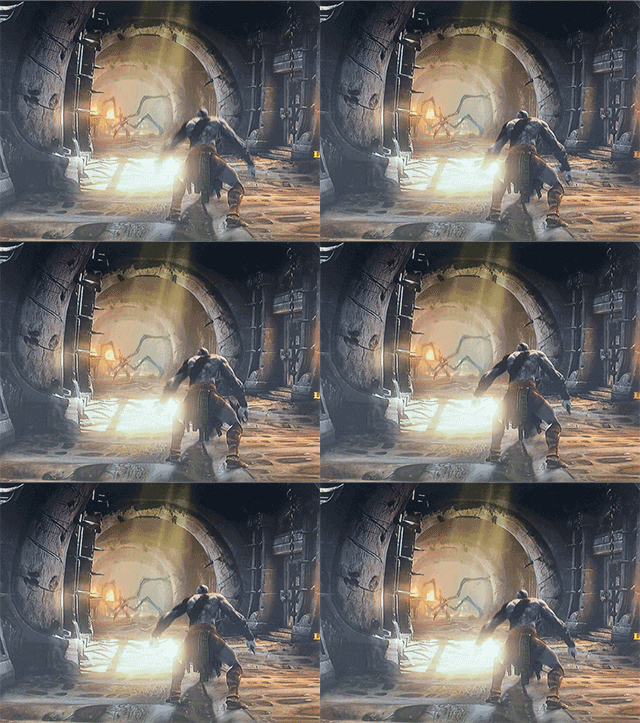
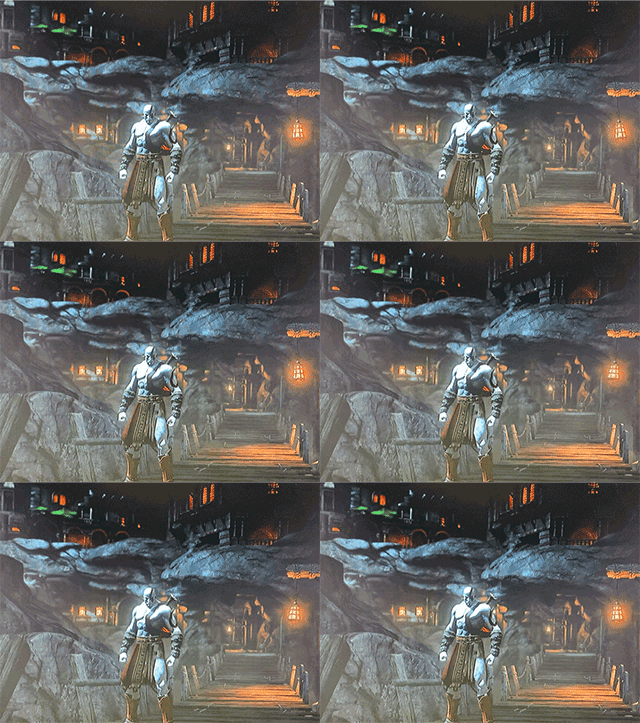
The first few moments of the game set the entire tone for Ascension. After breaking out of his chains Kratos chases Megaera all over the prison. It turns out to be a jail made of flesh. That of the gigantic Aegaeon the Hecatonchires. He was also known as Briaeros. If you remember the start of my series that was the name of one of the stars of the manga Appleseed. The Hecatonchires fascinated me as much as the titans had when I was growing up. The movie Clash of the Titans was really the only time I remember seeing the Kraken, and titans in pop culture. So it was very rare to see them mentioned anywhere else. I never saw what a Hecatonchires looked like in classic tradition, not in any art book from any library. I had to rely on my imagination. Did they look like trees with hands at the end of each branch? Did they look like the statues of Shiva? I had no idea what the Ancient Greeks had envisioned when they wrote about them. The fact that this mountain-sized monster was the basis of an entire group of stages made that mythology loving kid in me go absolutely crazy. I was geeking out at seeing the hundred handed giant just as hard as the first time I saw Cronos in the original GoW.

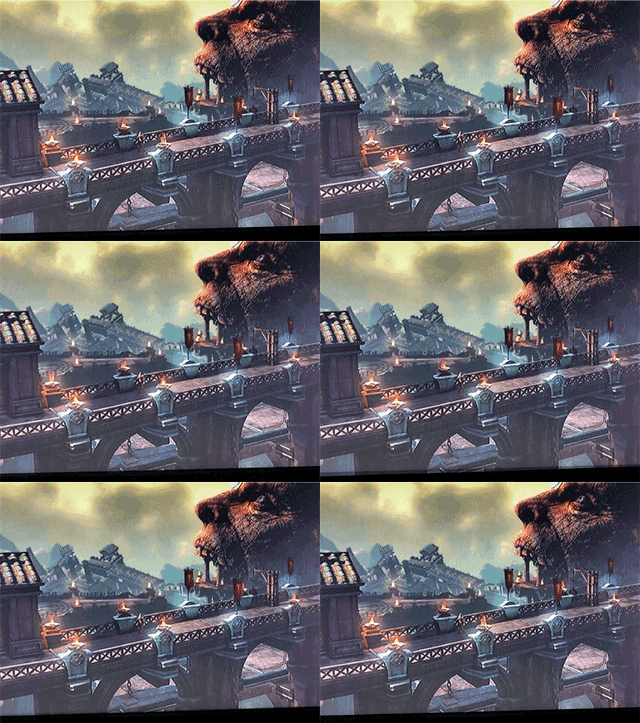
The team at Sony Santa Monica, and Director Todd Papy were raising the bar on stage design. There were technological leaps between GoW, and GoW III respectively. Look at how quickly things changed in the first stage epic battles. They went from the Hydra in a storm, to the Colossus as he staggered around the port of Rhodes, to fighting on the shoulders of Gaia while she climbed Mount Olympus. This time Kratos chased down Megaera as the entire stage came to life around him. It turned, twisted, and folded all over in real time. The jail cells, and buildings implanted into Aegaeon's forearms tore apart, and collapsed as Kratos ran, slid, and climbed through them. You would fight off one gigantic enemy, only to have a larger one pop up, and take its place, and then another. Eventually Kratos was nothing more than an ant-sized character on the screen as he was fending off a creature whose entire head couldn't even fit on the screen. It was the type of spectacle that always made for the most memorable encounters in the game.

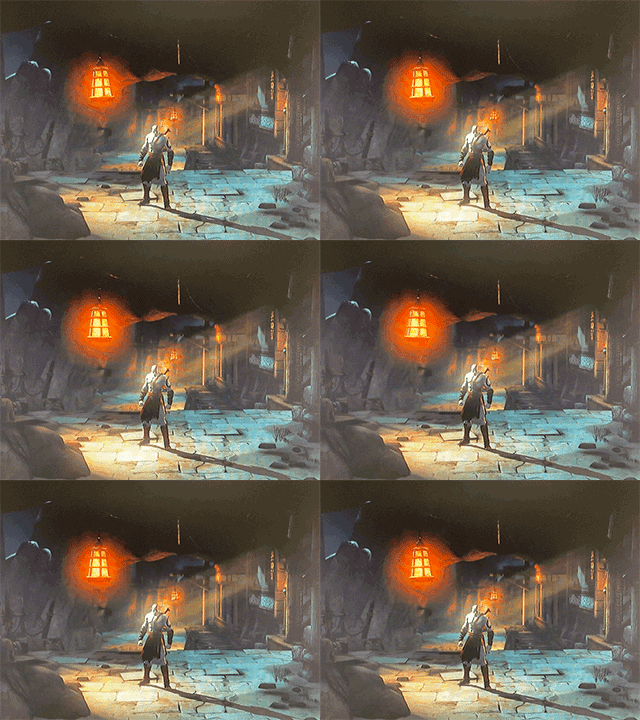
No sooner does one battle wrap up than we are taken to another time, and another place. Ascension is told in a series of flashbacks, and then jumps back to the present. It can be disorienting, and took me a few play throughs before I understood the sequence of events in the game. The leaps in time I think were part of the reason this game wasn't as well regarded by fans of the series. I appreciate what the studio was trying to do, playing with the narrative was something that other sequels did well, but Ascension could have used a more linear series of events. That's possibly my only criticism for the game. Each place we were taken to was just as memorable as the Hecatonchires. We managed to move all over the Mediterranean over a span of a few hours. For example I absolutely fell in love with the look, and atmosphere of the port town of Kirra. We arrived to it during the night, and returned back from the adventures during day break. Sony Santa Monica learned how to properly light stages set at night. I could now make out the details of the locations, see the unique architecture, landscape, paint schemes, and various clues layered in each location. Playing in the dark was not as laborious as it was in GoW III.

One of the reasons I didn't enjoy the modern GoW (2018), and Ragnarok as much as the earlier games were the lack of civilians, and other NPCs sprinkled throughout the stages. The different realms were enormous, however the lack of other humans, or humanoids made them feel like empty parking lots. You could spend all day traveling between them, and never see, or hear another person. The addition of a traveling companion, whether Atreus, Mimir, Freya, or the occasional dwarf to upgrade tools was nice, but it wasn't the same thing. Earlier GoW titles sprinkled people throughout the encounters. Even when they weren't seen, at least they were heard. Think of the people shouting from the streets of Marathon in The Chains of Olympus. The studio managed to sell the absence of civilians in most of the games because Kratos was passing through during a battle. The only other mortals he would see were soldiers defending their city. In Ascension there were prisoners, sailors, artisans, and warriors in appropriate places. When there weren't it is because of a tragedy, or conflict. At the statue of Apollo all the workers were sent home, and for the city of Kirra it was the destruction of their fresh water source, and the poisoning of their wells. The citizens fled the town, and left the fires in their homes burning. It was fun visiting locations where the workers had just left, it made the world feel lived in. Every visual cue in the game was accompanied by great sound effects, and foley work.

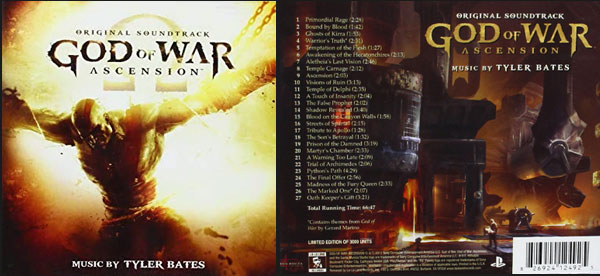
Sound, and music has always been a big part of the GoW franchise. Ascension is no different, and in my book has possibly the best score in the series. This is not a knock on the other composers. The music in this game was by Tyler Bates, but he credits the previous composers, specifically Gerard Marino, for creating the template. He calls out hints of Marino's original theme twice in the soundtrack, especially in the song Warriors Truth. My favorite new song in the game is the Ghosts of Kirra. In it you can hear hints of a Middle Eastern influence. It was something alluded to visually in the design of several stages in other games. Sometimes they were subtle, liked the domed roofs in the Port town of Rhodes. Or plainly obvious like the Sphinx statues in Kirra. It would be fair to think you are listening to an Adhan, or Muslim call to prayer in the background of the song. It would remind you that there was a lot of cultures cross pollinating in this part of the world. African, Persian, Middle Eastern, as well as Roman. The music of the era wasn't all lyres, and pan flutes.

As far as timelines go Ascension takes place earliest in canon. This is shortly after Kratos kills his wife, and child, and decides to break his oath to Ares. He doesn't yet have access to all the magic, and abilities he would pick up as he got older. He has yet to give himself in the service of all the gods. This early adventure allows Sony Santa Monica to reimagine how Kratos would learn to use magic. They did this by allowing him to plunge his Blade of Chaos into an urn for one of the gods; Ares, Poseidon, Zeus, and Hades. Every few stages Kratos earns another new power. Players can then switch between the different properties that each god blessed the swords with. There is an advantage to each power, some allowed Kratos to earn Red Orb experience, or recover Health, or deal extra damage to groups of opponents. The balance between the magics was well done, and helped make the game play unique.

It feels like Kratos has to travel to the ends of the Earth in this game, and yet he ends up back at the beginning of his journey by the end. If there was something that I especially enjoyed in storytelling, it was a tale that went full circle. I’m going to dive a little more on the adventure in the next blog. If you played the game I’d like to know what you enjoyed about Ascension, and how do you rank it when compared to the other games in the series? Let me know in the comments section please. As always if you would like to sponsor me please visit my Patreon page and consider donating each month, even as little as $1 would help make better blogs and even podcasts!
follow the Street Writer on Patreon!