This blog has spent a lot of time talking about cars and racing games, Sorry if I lost you along the way. I was just trying to chronicle my gaming interests, especially the titles that I had the fortune of seeing debut in my lifetime. I will actually use the next few blogs as a buffer for a different genre but once we go back to my original topic I think you'll be pleasantly surprised. One of the earliest memories that I had of the arcade were of little alien ships in a row dripping down over a city. The animation was crude by todays standards, the colors lacking and the gameplay very rudimentary yet for some reason I couldn't look away. Space Invaders by Taito
was a groundbreaking experience and became a smash hit in the USA as distributed by Midway, and in Japan as distributed by Namco. It was not the first video game set in space. That distinction actually went to
Spacewar, a computer simulation game from 1962. In 1977 the company
Cinematronics released an arcade version called Space Wars. The game was fairly popular because the first Star Wars film was released that year. Yet space-themed arcade games were barely getting started. The demand for an actual Star Wars video game wouldn't hit a fever pitch for a few more years.

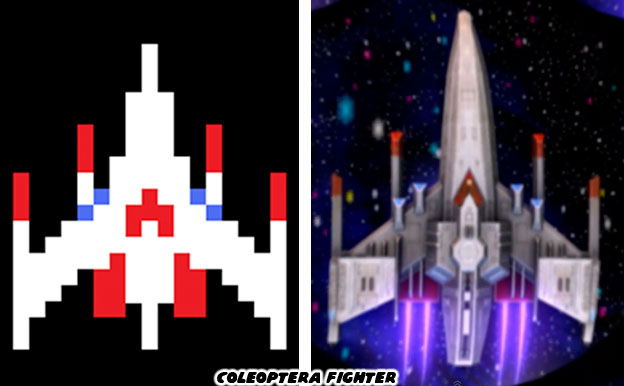
An upstart called Namco took a chance at entering the arcade industry. This company had found moderate success with their first two games, breakout-style games named Gee Bee and Bomb Bee. Yet they knew they needed to have a hit in order to survive. They looked at what was hot and where they could improve upon it. The company had the audacity to replicate the Space Invaders formula almost verbatim. Galaxian debuted in 1979 and introduced the world to full color space combat. It had more detailed graphics than Space Invaders and added enemies that flew in patterns and attacked the player. There was no cover and the opponents were relentless in their assault rather than slowly descending from the top of the screen. The addition of a simple "soundtrack" and stars that scrolled in the background gave it a sense of weight and dimension. The arcade game had the potential to become the new source of entertainment. Galaxian gave audiences just a hint at the elements that would become important down the road. I was barely five when the game came out but could tell that it was very good. For years I thought that it was a sequel to Space Invaders, both games were distributed in the US by Midway. Only later on did I learn that Midway and Atari had been distributing games that should have been labeled Namco.

Galaxian was considered the godfather of the shoot-em-up or
SHMUP genre but it was not alone. The US had been leaning towards cutting-edge vector engines which provided sharper graphics and even more realistic physics. Atari was leading the charge and had two completely different takes on the science fiction genre. Asteroids was one of the biggest hits for the company. For the first time audiences could fly all over the screen, rather than be stuck going left and right. All the while shooting at angular blocks, which were supposed to be asteroids as they floated across the screen. The occasional flying saucer would appear as well offering a combat element. The game had captured the sense of endless momentum that space was supposed to have. Based on the razor sharp graphics and realistic control scheme I assumed that this was some sort of training simulator. There were games in color that were set in space, yet they were cartoonish and unrealistic by comparison. Asteroids was in black and white and I assumed it was a decision that Atari made to make it play like a military simulator. In my young mind I assumed that the astronauts orbiting the Earth were shooting asteroids out of the sky. This was clearly the way that they got ready for their missions.

A year later a new experience from Atari had debuted. Missile Command was in color and the vector graphics technology seemed much better than before. The game controlled completely different than other titles, this one relied on a track ball and a button. This time around the simulator was training me to defend the major cities of the US (and sometimes the moon) from a Russian nuclear strike. To be honest I was never any good at it. I enjoyed watching the explosions go off and never tried to learn a strategy to help me protect the targets. As I saw the older arcade players go through the stages I could appreciate how much concentration and reaction skills were required. The best players at the local arcade seemed to be psychic. They could predict where the next missile was coming from and could actually send out countermeasures before the nukes had even appeared on screen. I couldn't wait to get older and become better at the games, or at the very least develop some of those psychic abilities myself.

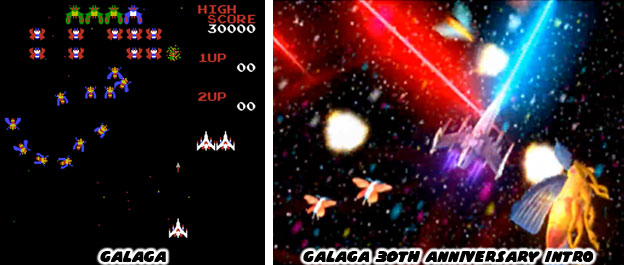
My fascination with the realistic games that Atari had put out was short lived. The successor to Galaxian arrived in 1981. Galaga was the pinnacle of science fiction graphics and gameplay as far as I was concerned. The third Space Invaders-type game was the best yet and I was not the only person that thought that. It became the biggest selling SHMUP of all-time. It caused a shortage of ¥100 coins in Japan. Arcade owners could not put the coins back into circulation fast enough for the market. And there are people that think that Angry Birds or Flappy Birds is a phenomenon! There was a Galaga machine at every mall and arcade that I visited. They could even be found at the pizza parlor and corner market. Players could not get enough of the game. The constant battle against waves of swiftly moving "space bugs" required genuine skill to get through. The patterns that the alien ships used to create their formations were dizzying. Again the older players used their second sense to predict where the enemies were coming from. They would start firing and destroy the opponents before they even came on screen. There was even a challenging
bonus round stage for players to really put their psychic powers to the test. The game had a catchy jingle that would play after the player put in a quarter. In fact
the game had several songs that played through the course of the levels. As I got older the senior visitors to the arcade accepted me as a regular. They began to clue me in to their tricks, it was like being welcomed into a private club. Except instead of secret handshakes players traded secret codes under their breath in the corners of the arcade. Many knew each other by their scoreboard initials alone. I was one of the few that could fit their entire name with the three letters provided on the game over screen. To get better at Galaga they advised that I could line up my shots ahead of time by using the high score counter at the top of the screen and the player counter at the bottom of the screen. Even though the stars were constantly flying by the counters never budged.

Sega was aware that the industry was incorporating more science fiction titles into their portfolio. As one of the bigger publishers they wanted to show the world that they could create superior experiences. Zaxxon debuted the year after Galaga yet it was not as well remembered. The isometric shooter gave a sense of 3D not yet seen in any other game. Instead of playing in the depths of space with nothing but the stars to keep players company Zaxxon featured a series of enemy bases for players to raid. It offered audiences a taste of the trench run at the end of the first Star Wars film without having to pay George Lucas for the license. The highly
detailed backgrounds included missile strikes, laser turrets, electrified barriers and oncoming spaceships. There was a tremendous amount of color and fidelity, which was something that the games of the early '80s were often lacking. Yet there was also the difficulty with the gameplay which ended up hurting the overall experience. Even with an altitude meter it was difficult to gage the position of enemy ships and missiles. Players had to rely on the shadow cast by the ship to determine their height, as well as where shots hit when approaching narrow passages. Sometimes shots would fly by opponents yet their return fire would hit players. It could be maddening how arbitrary the combat felt. Isometric games were few and far between for these reasons. To complicate matters the game had a fuel meter at the bottom of the screen and players had to constantly shoot at fuel containers in order to keep going. Zaxxon received a few sequels in the arcade and on several of the consoles that the company produced. To celebrate its 30th anniversary Sega released a Temple Run-style game called Zaxxon Escape. The
webpage and trailer showed how different it is was compared to the classic arcade game. The use of the name and sudden shift in gameplay raised the ire of the fan community. The mobile title was a fun game, but it certainly was no Zaxxon.

Sega learned their lessons early on and tried again to beat their competition and establish their dominance in the genre. Buck Rogers: The Planet of Zoom used the scaling sprite technology that the company had featured in Turbo and would improve upon in OutRun and Space Harrier. The game was a different attempt at making a 3D experience out of two-dimensional sprites and it worked fairly well. Buck Rogers was a hero from pulp comics and radio programs. He was quite possibly the first science fiction hero to get featured in the arcade medium. In the game players flew Buck's spaceship through various dimensions and shot down UFO's and enemy carriers. I remember the game being very frenetic, not to the scale of modern SHMUP "Bullet Hell" shooters, but in the sense that the bright colors and flashing lights were a distraction. They hurt the sense of awe that flying in three dimensions was supposed to provide. I saw very little of the game outside of a few local arcades. I would say that it was lost in time even faster than Zaxxon.

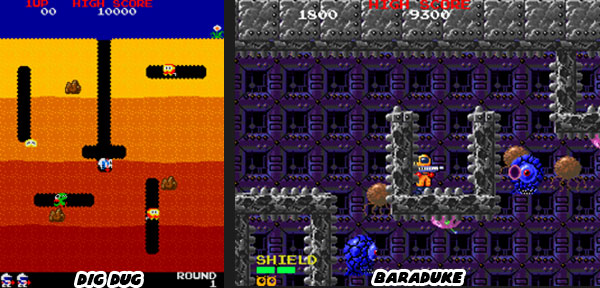
Namco on the other hand was enjoying their position. Their game engines lacked the processing power and graphics technology that Sega was promoting. Namco made up for it by offering great gameplay. In 1982, the same year that Sega had Buck Rogers in the arcade, Namco released Xevious, it was another of the most successful shooters of all-time. Xevious was the first Namco game to feature a scrolling background. It was even an more of a direct ancestor to the SHMUP than Galaga. It set the precedence that would be copied by the entire industry from Capcom's 1942 to Tecmo's Raiden and everything in between. From a player persecutive Xevious offered a much more rewarding experience than Galaga. Players felt like they were making progress as the game went on, rather than simply surviving wave after wave of enemy squadrons. Every assault on an enemy compound was a rewarding challenge, rather than a frustrating battle as was the problem with Zaxxon. 1982 turned out to be a very good year for Namco. The studio had Pole Position and Dig Dug out in arcades and were still making a hefty return on Pac-Man from a few years prior. The unofficial sequel Ms. Pac-Man and Super Pac-Man were also adding to the Namco coiffeurs. That revenue would have to be funneled into R&D because Sega and Atari were ready to revolutionize the space shooter. The next blog will feature these titles, I hope to see you back for another chapter in the series.
If you would like to sponsor me
please visit my Patreon page and consider donating each month, even as little as $1 would help make better blogs and even podcasts!