Showing posts with label mr driller. Show all posts

Monday, December 25, 2023

The Wreck-it-Ralph cameo that almost was - A 1UP classic from July 26, 2012

Here is a bit of trivia that I learned over the San Diego comic con. The film Wreck It Ralph is a nod to the classic arcade games however getting all of the licensed characters on the screen took a lot of hard work from Disney's legal department as well as the directors and producers themselves. The animators and designers were working with placeholder characters when they were framing key scenes in the movie pending approval to use characters from legal. For example, in the trailer Ralph is in a game character support group with villains from various games. The host is Clyde, one of the ghosts from Pac Man, had not gotten approval from the publishers at Namco Bandai. To get around this the animators had a generic ghost figure, a white sheet with eyeholes cut out of it floating in the air. Everyone could tell who it was supposed to represent without raising the ire of Namco. The animation team cited that he looked like the the ghosts featured in the Charlie Brown cartoons. They would create simple animatics of scenes like this to present to the publishers in order to get their approval. What was most interesting was that in many instances the creators of the characters had to approve of the likeness. They would provide the designers with notes on how they should and should not act.

Disney legal had to not only work with publishers but also had to find out who owned the rights for the characters in North America versus Japan. Given the amount of cameos they were planning the legal department was working overtime securing rights for the film's domestic and international release this holiday season. The creators and owners of the most classic characters were very protective of them. The writers were surprised to the response that they got when they proposed who one of the unemployed characters should be.
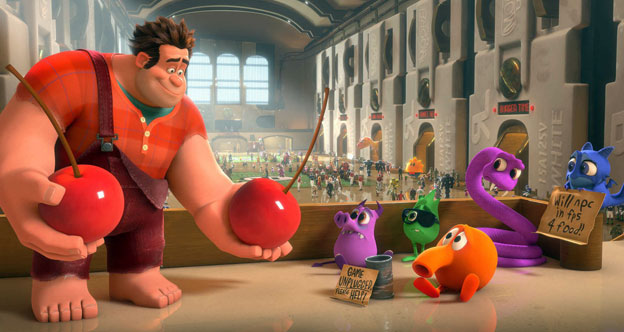
In the film Ralph comes across Q*bert, Coily, Slick, Ugg and Wrong-Way. The characters from the game Q*bert are begging in game central. Their cabinet was unplugged and they were now unemployed characters. Ralph gives them a cherry from the Pac Man game as a sign of support. This scene was written to show compassion on the part of a character that was supposed to be an apartment-wrecking bad guy. It was also a chance for fans of the arcade classic to remember some long-lost characters and rekindle a sense of nostalgia. The scene probably would not have worked if Disney had tried to insert other characters in the role. Think of all the easily identifiable classic characters and villains from the arcade and imagine which audiences would remember and feel pity for. It was doubtful that Peter Pepper or the dinosaurs Bub and Bob would have elicited the same reaction.
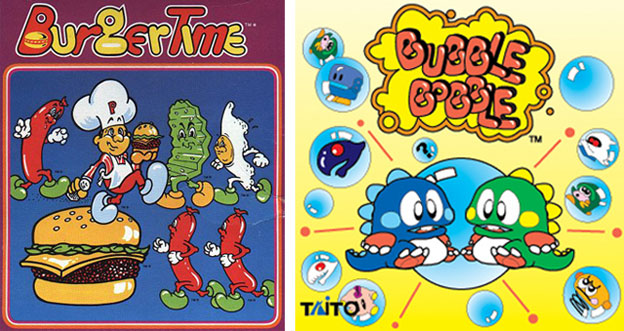
The heroes from Burgertime and Bubble Bobble were not the original choice for the scene and neither was Q*bert. When Disney was trying to get the rights for characters they approached Namco for more than the Pac Man characters. The hero of Dig Dug, Taizo Hori (a play on the Japanese word horitai zo "I want to dig"), was going to be the unemployed character. This stopped the people at Namco dead in their tracks.
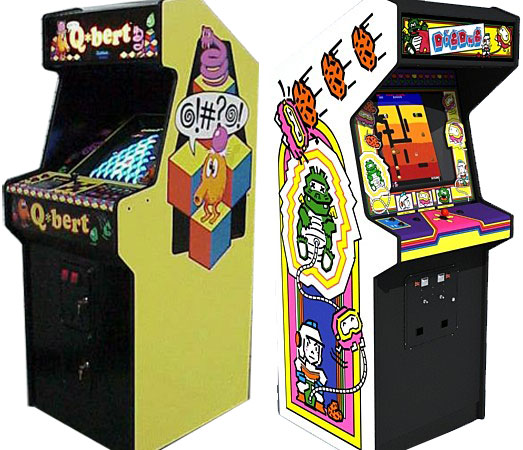
The team at Namco looked at the Disney people and said that there was no way that Taizo would ever be unemployed. His job was to dig, it was what he had been doing for the better part of 30 years and what he would always be associated with. They nixed the idea and forced Disney to look for other characters. When the story was relayed to me by entertainment writer Jim Hill I told him that Namco actually had a very good reason for rejecting the Disney proposal. Taizo was a legacy character, it would have been quite an insult to Namco and the Japanese to have him begging for food. While he was not as big as Pac Man, Namco's superstar icon, Taizo actually filled a very prominent role in the Namco library.
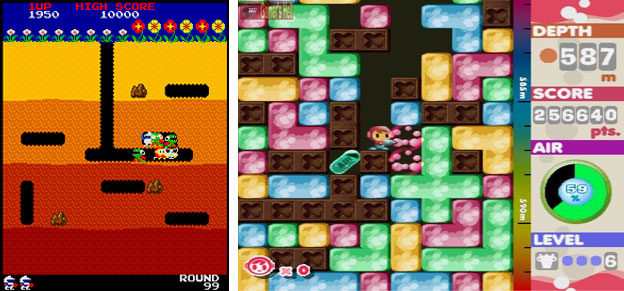
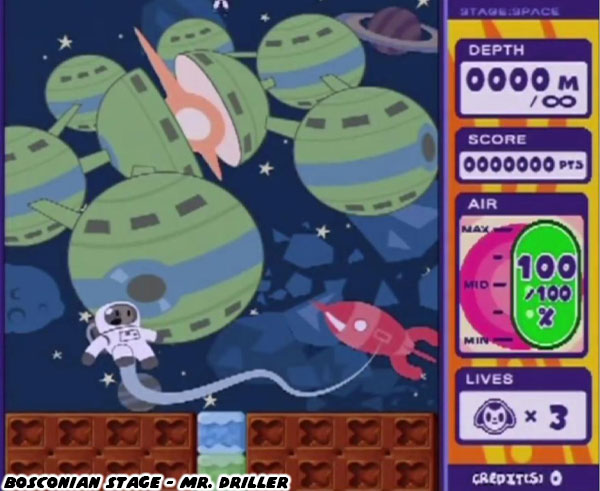
Dig Dug was not a one-hit wonder. It had gotten sequels in the arcade and on home consoles. Not to mention that Taizo was the father of Susumu Hori, the arcade hero better known as Mr. Driller. The puzzle games and title characters had become synonymous with Japanese arcades and in some ways with Japanese family structures as well. More than that they had a cult-like following because of how obsessed Namco was in fleshing out the characters and universe of Dig Dug and maintaining canon.
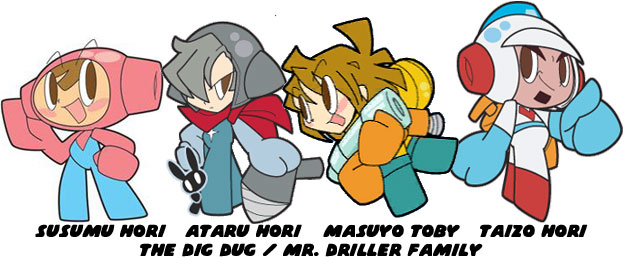
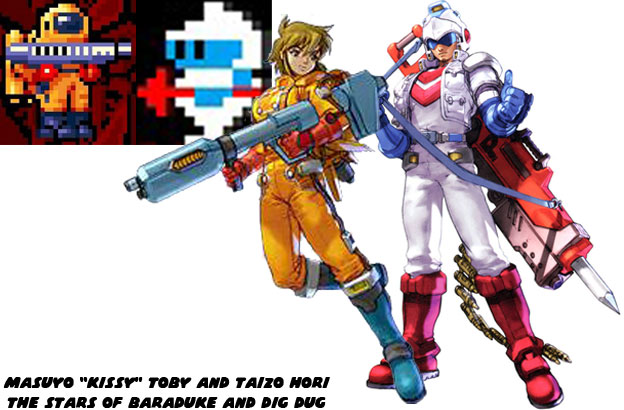
The family included elder son Ataru Hori, younger son Taiyo Toby (not pictured) and mother Masuyo "Kissy" Toby. The latter three actually had an estranged relationship with Taizo. It could be interpreted as a reflection of the relationship between families and one Japanese male archetype. The father would appear tender and compassionate at first but would become aloof and selfish as the family grew, eventually leading to destructive tendencies, see the term Yandere for more specific examples. This archetype was most commonly seen in Japanese soap operas and anime shows. As adult males became part of a salaryman grind in real life they would often mirror the characters from the shows. Adults would spend less and less time with their own families and begin to experience a disconnect with their own children. The love that the parents had for their children was unconditional however, even if they did not readily show it. If and when Mr. Driller gets in a jam he knows that his brothers and both parents would put their differences aside to rescue him.
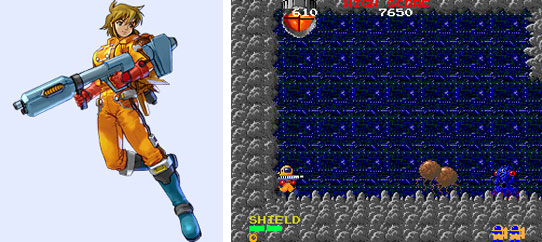
To further complicate issues for Namco and Disney the wife of Taizo and the mother of Susumu was a hero in her own right. Reflective of the proud Japanese society she would not allow her mate to be caught begging for scraps. Masuyo was the star of the science fiction shooter Baraduke, known better as Alien Sector in some arcades. She was the original sci-fi heroine in videogaming. In fact, her appearance as a female in power armor, hunting aliens and criminals in an underground labyrinth predated the characters and game of Metroid by a full year. Masuyo was a soldier in the UGSF (United Galaxy Space Force) before she mothered Mr. Driller.
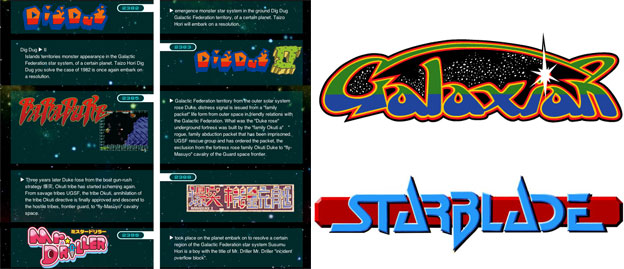
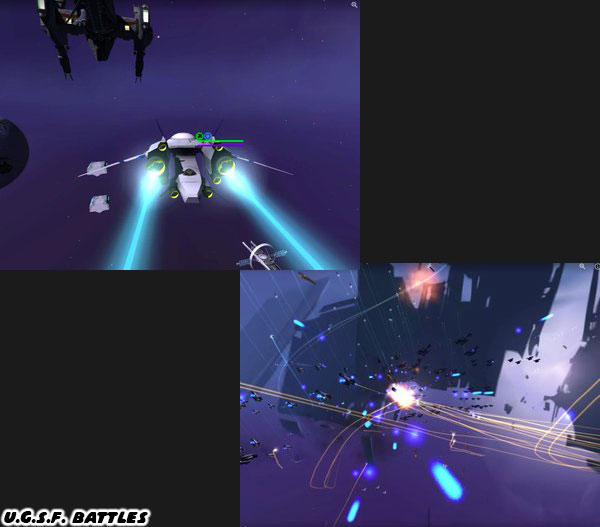
The Dig Dug, Baraduke and Mr. Driller continuity actually fell into the larger UGSF Timeline. Namco's long-running science fiction shooter series which was begotten by Galaxian (Galaga) in 1979 had dozens of titles appear in the arcade, home and mobile consoles. Those that know their videogame history would remember that Galaxian was Namco's first hit before Pac Man. The company owes as much of it's success to the UGSF series as it does to Pac Man. Titles like Operation Star Blade were considered spiritual successors to Galaga. Star Blade and Galaxian 3 (Attack of the Zolgear) were actually groundbreaking titles, they were among the first science fiction shooters made out of 3D polygons and used cutting-edge arcade technology for storage like laserdiscs. Namco had a 3D hit four years before Disney released Pixar's Toy Story. Disney was trying to tell a story using icons from a universe they knew little about.

The Hori family were made up of individual heroes from UGSF continuity. They were very popular in Japan even if they were hardly well known in the USA. Reducing the importance and symbolism of the characters so that Ralph could get over with audiences would have been a disservice to Namco. It was possible that the writers of Wreck-it-Ralph were not aware of what Dig Dug meant to the grand scheme of arcade culture and history. Thankfully they found a suitable replacement with Q*bert, more than that he was a character whose unusual language could also be used for comedic effect. Could nostalgia be used for great dramatic effect? There were plenty of great films that had done that. Toy Story 3 was a great example but videogames were something unique. What would Wreck-it-Ralph have to give the game playing audiences in order to win them over? We shall look at this in the future. As always if you would like to sponsor me please visit my Patreon page and consider donating each month, even as little as $1 would help make better blogs and even podcasts!
follow the Street Writer on Patreon!

Thursday, August 28, 2014

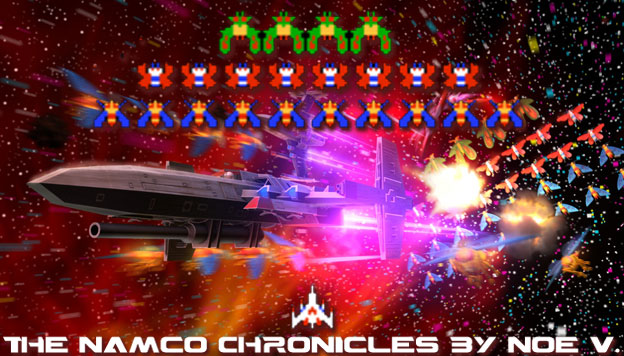
The Namco Chronicles, part 9...

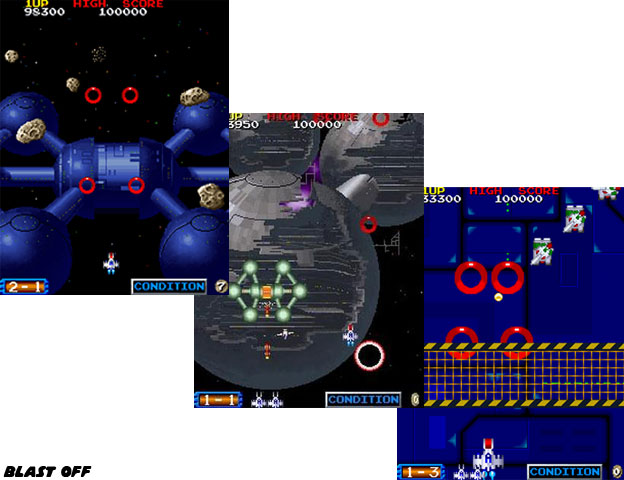
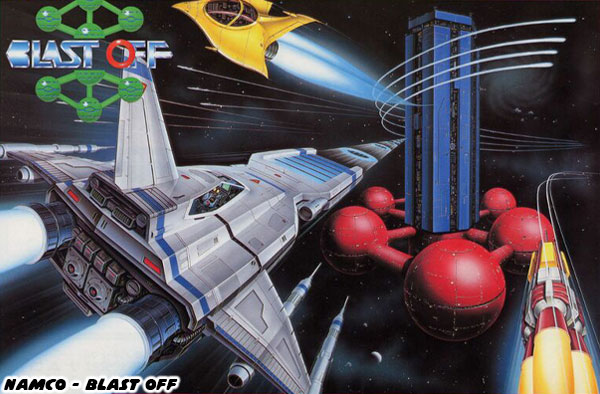
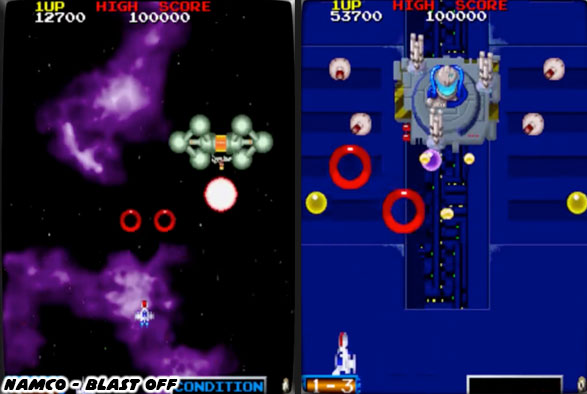
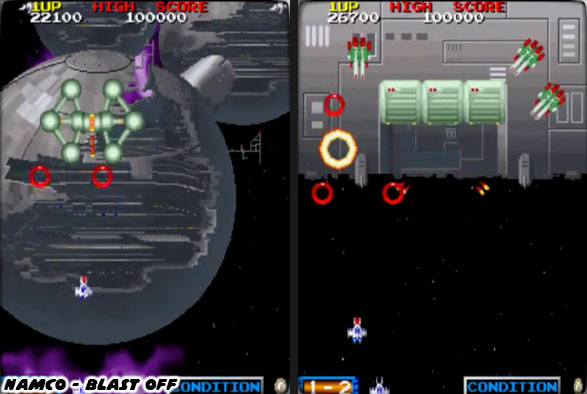
The first time that I realized the games in the Namco universe were connected was actually by accident. It was around 1989 and the arcade scene was pretty strong. It would still be a few years until Street Fighter II dropped and forced every company to get into the genre. So there was a lot more diversity for the few years leading up to it and that was a good thing. A new space shooter from Namco had appeared at about that time. The game was titled Blast Off and looked interesting for a number of reasons. The graphics were bright and colorful. Gone were the blocky ships that I remembered while growing up. The new ship had more fidelity than before, the proportions were slightly cartoonish but it was a small oversight. The backgrounds were amazing. There were several graphic layers that the artists had worked with to create an amazing sense of depth.

Players would fly through plasma clouds, above twinkling stars and galactic clusters. It felt like a redo of Galaga that was closer to the vision of the designers. The enemy types were more detailed but still flew strafed opponents in dizzying patterns, the larger ships were there to provide a bigger challenge and the end of every level was met with a boss battle. Unlike other SHMUP titles which forced players to stick with one weapon type until they could earn an upgrade Blast Off gave players multiple weapon configurations. Players could switch between the weapon types on the fly. There were variations of a wave, laser and photon cannon that allowed players to shoot forward, diagonal, sideways and even behind the player. This completely changed the strategy when fighting waves of enemies. Sometimes diagonal or sideways lasers could help get through a particularly tough stage better than any forward facing weapon.

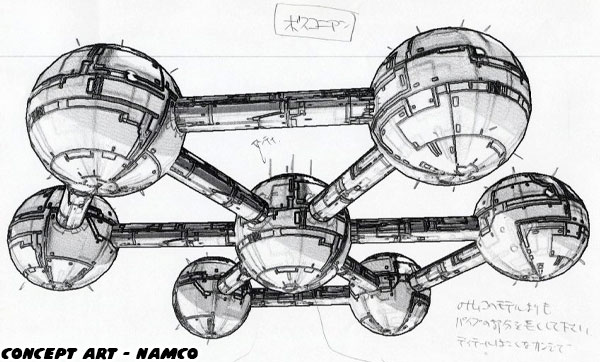
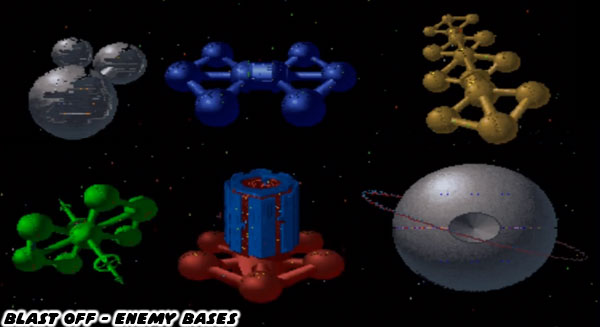
Where the game really came together was in the layout of the missions. Every level consisted of three missions. The first mission was set in deep space as the player was en route to a target. They would engage with small reconnaissance craft and a few scattered larger ships at this point. The second stage was much closer to the objective and players had to fight against wave after wave of tougher opponent classes. In the background of each stage players would catch a glimpse of the level boss. It was an enormous base with six spheres connected to a hexagonal hub. When players finished the second mission they would see the ship fly towards the enormous target. The third mission actually took place inside of the base. The camera would zoom in on players and present a more detailed close up of the ship once inside of the base. Players fought through increasingly difficult areas, filled with sentry cannons and tanks as they went into the heart of the station. If players could defeat the mechanical core, which was protected by a complex series of rapidly moving cannons then they would finish the stage. Players would fly out of the base and watch it explode from a distance. They would then continue on deeper into space and fight larger and more challenging stations. The largest of which appeared like a row of Death Stars connected at the hip.

It was the sense of scale that really made Blast Off stick out in my mind. Namco had done a great job at taking a format that I thought couldn't really be improved upon and broke it wide open. Granted, when it came to video games the SHUMP format was the one I was terrible at. By comparison my big brother excelled at those titles but wasn't very good at racing games. I was good in many other genres but didn't quite have the patience or determination to see most SHUMPS through to the end. Blast Off could be considered slow and simplistic to many veterans but for me it felt like a perfect challenge. The idea of being the solitary fighter taking on an entire fleet in deep space was something I couldn't pass up. It was like the best parts of Star Wars, Battlestar Galactica and every other space adventure rolled into one.

Also, unlike earlier space shooters this one had a beginning, middle and end. The game did not just get faster and harder, like the earlier Namco hits. Blast Off started with the fighter leaving a space carrier with an electronic fanfare that sounded an awful lot like the John William's Superman theme. During the end credits the player would revisit the site of every boss station and see its debris floating in the distance. Eventually they would land back at the home base, the biggest hero in the entire galaxy. It was a rare SHUMP that I managed to beat in the arcade and only with a handful of quarters. In my book it was perfection. That was of course until Namco released Starblade.

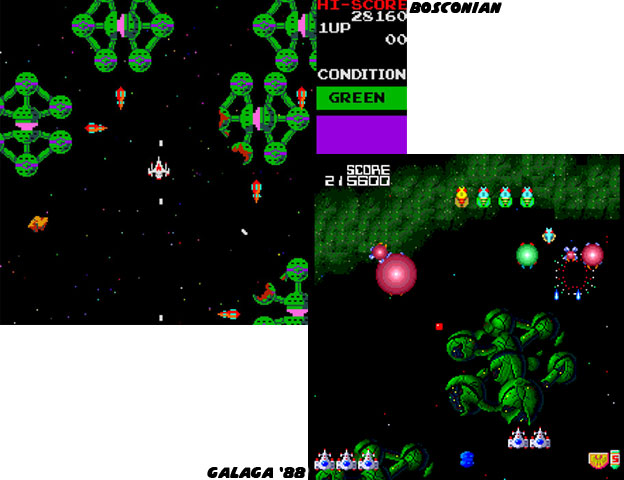
It wasn't long after I had played Blast Off than the pieces suddenly started to fit together. I was walking by someone going through Galaga '88. I noticed a number of improvements that the company had made to the original shooter. Even though I was still in junior high at that time a wave of nostalgia had washed over me. I remember being very young and playing the original Galaga in the corner market. Galaga '88 had improved in the visual and gameplay department by a wide margin. While the majority of the game still took place on single screen levels the enemy types were much more challenging and diverse. It was the jump from location to location using warp technology that caught my eye. Players could see the final destination getting closer each time they defeated a stage and the ship would disappear into hyperspace.

The effect would be revisited in the 3D games like Star Ixiom and Starblade. One of the backgrounds looked eerily familiar to Blast Off. There was an enormous hexagonal space station that was destroyed floating in the distance. There was no way that this game was related to Blast Off was there? As the player went through the stage he got closer to the debris. There was no mistaking it. The Galaga ship was fighting near the remains of the same space stations that I had beaten earlier. When I looked at the title screen I saw that Blast Off was released after Galaga '88. So it was some sort of sequel? I remember seeing ships that were very similar to those in Blast Off and Galaga '88 but much earlier. I just couldn't remember where. I bugged my parents to take me to different arcades every weekend so I could look for the other Namco games that might be related to Blast Off. Finally I came across the game in Cerritos, in an arcade that had some older titles still in circulation.

It turned out that the ancestor to both games was a 1981 gem called Bosconian. It was built on the Galaga engine but featured completely different gameplay. In the title players could fly and shoot in eight directions and they had to destroy enemy bases that were hexagonally shaped. The neat thing about the game was that players could fire lasers from the rear of the ship so they couldn't be caught off guard by opponents. This was clearly the inspiration for the weapon types and villains featured in Blast Off. Bosconian was also notable because it was the first Namco game, possibly the first arcade game ever, to feature a continue screen. When I discovered that there was a lineage to the Namco space shooters it blew my mind. I felt like I was living through some sort of Dan Brown conspiracy that had been kept secret from the world. No other studio seemed to grasp the nuances of keeping true to a legacy. Instead they produced games that had nothing to do with each other. Namco was focused on the evolution of a genre and never forgot where they came from.

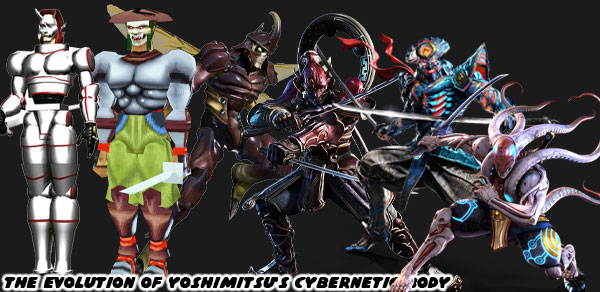
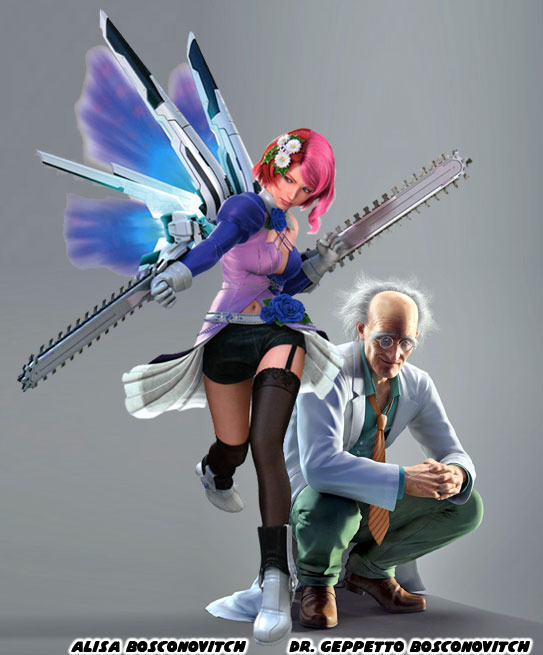
A few years later the origins of the word Bosconian were revealed, at least in canon. The alien life forms were very advanced technologically but also very hostile. They sought out planets to conquer and transform. It was up to the brave Galaxians, the people that traveled to the edge of space as members of the UGSF, to protect humanity. The name Bosconian was derived from one of the most brilliant minds in the Namco universe Dr. Geppetto Bosconovitch. The scientist formerly employed by Mishima Zaibatsu was a genius with few peers. Dr. Bosconovitch had appeared as an important figure throughout the Tekken series. In the game history he had created the cybernetic arm and later cybernetic body for Yoshimitsu, the leader of the Manji Ninja Clan.

He also created the Prototype Jack (P-Jack) combat cyborg. He was not only good at cybernetic components but also developed the bio-weapons Roger and Alex. Those were creatures that appeared like a velociraptor and kangaroo with boxing gloves. The scientist was not without his rivals however, Dr. Abel was a scientist also working for the Mishima Zaibatsu that became a bitter enemy. Dr. Abel focused his efforts on mind control technology and could command some of the characters in the Tekken series to do his bidding. He also reanimated Brian Fury and destroyed the peaceful Jack cyborg models at every opportunity.

Dr. Bosconovitch developed the "Cold Sleep" program as a form of suspended hibernation. It also seemed to stop the aging process. He tested it out on Nina and Anna Williams, top level assassins that worked for the Mishima Zaibatsu and G Corporation respectively. He intended the Cold Sleep program to preserve the life of his terminally ill daughter Alisa. When Alisa succumbed to her disease Dr. Bosconovitch made an android in her likeness and assigned her to be the bodyguard of Jin Kazama, his new employer. It was the brilliant mind of the doctor that would be remembered centuries after his death. When a new technologically advanced alien species was discovered the UGSF named them Bosconian.

As I got older and was able to travel further and further I managed to play more games in the arcade by Namco and their contemporaries. I was also lucky enough to travel with my brothers and friends to Little Tokyo and see what Super Famicom / Super Nintendo Games were hot and what the real gems were for the Playstation and Saturn consoles. I was very eager to find out where Namco would connect their next game to the Bosconian legacy. It turned out that a little-known PC game from 1994 was another missing link from the company. Star Luster was an amazing remake of an old NES title.

It even featured updated versions of the classic chip tunes. In this title an evil alien race called the Battura were causing strife not long after the Bosconian Wars. The game took place in the same continuity of Galaga ’88 and Blast Off but featured a first-person perspective instead of a vertical one. It was the template that Star Ixiom would use for the Playstation a few years later. Seeing Namco stay true to their continuity for as long as I could remember made me fans of the company. I admired their own science fiction IP and had more respect for it than most licensed space games. I was curious to see what else the studio had tied together through canon. As it turned out Tekken was not the only game that had a connection to UGSF continuity. The seeds of the series had been planted in a different title. The next blog will feature this game. As always if you would like to sponsor me please visit my Patreon page and consider donating each month, even as little as $1 would help make better blogs and even podcasts!
follow the Street Writer on Patreon!

Tuesday, August 26, 2014

The Namco Chronicles, part 7...

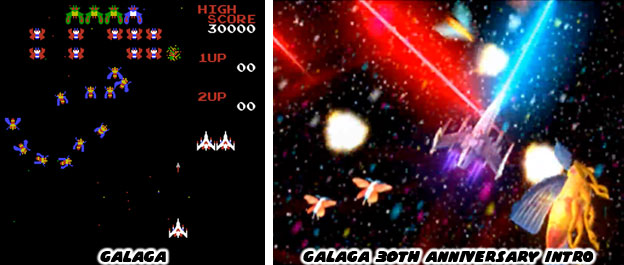
Namco showed that they were a major player in the arcade industry with the success of Galaxian in 1979 and its follow-up Galaga in 1981. The games were so successful that they helped their US distributor Midway grow by leaps and bounds as well. The success of the Pac-Man, Ridge Racer, Tekken and Ace Combat titles helped cement Namco's position as leaders in entertainment. The space shooters from the company had always done well historically. Each game was an innovator for the genre, whether it introduced a scrolling background, added a bonus stage or chaned formats from sprites to 3D polygons.

Namco was willing to experiment with their formula in order to keep the experience fresh but most important to keep audiences engaged. Something that won over fans was consistency with the genre. The most celebrated titles had a familiar feel to them. The fingerprints of the developers were all over the games even when they were in a completely new genre. Why was this? Because the development teams kept copious notes on each and every game they had created. This was nothing new to the industry. The teams working behind every great series could fill volumes with concept designs, notes, background, programming lessons and even blueprints. What separated Namco from their contemporaries however was something more obsessive.

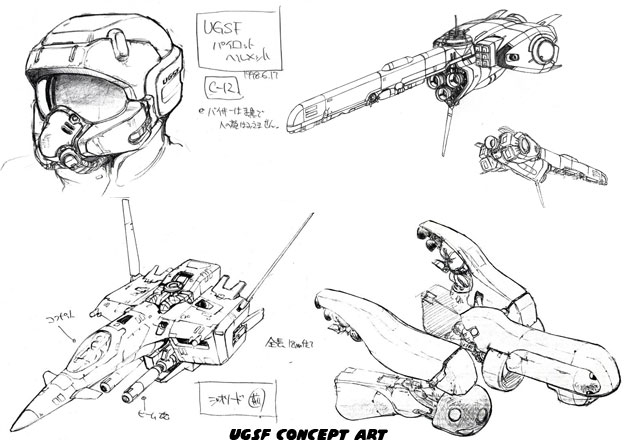
The designers would lose sleep over details never seen by audiences. In order to build a better game the developers had to become intimate with the fictional world they were creating. In the case of the space shooters it would be fleshing out the canon of the UGSF (United Galaxy Space Force). Absolutely no detail was overlooked. The signage on the spaceships, both good and bad had to be planned out. The colors, framework and layout of ships were cataloged. Bases, planets, weapons and technology all had to be meticulously detailed. Even though the company had no plans to create a game where the pilots inside the ships were ever seen the designers still kept notes on them. The layout of the cockpit, seats, displays, the shape of the helmets, the cut of UGSF uniforms for both officer and soldier ranks, what the space suits looked like, if they were strapped with a weapon and even how their rank would be displayed had to be considered. Certainly many modern AAA studios could show how their teams of artists did the same thing during the development of a modern blockbuster. Of the current studios none would have allowed their designers the leeway to focus on things that would not appear in any way shape or form in the finished game.

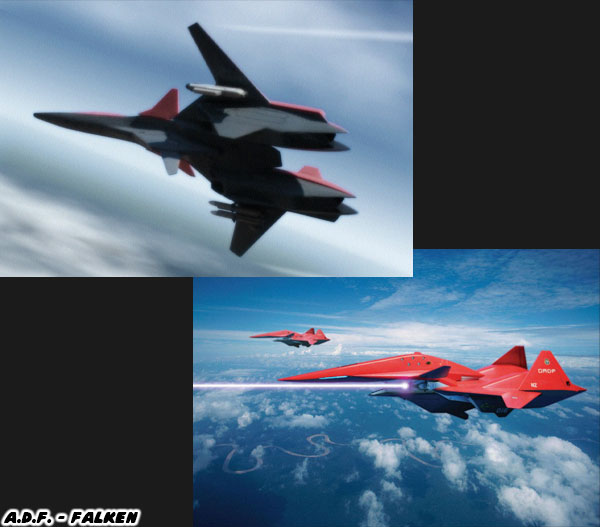
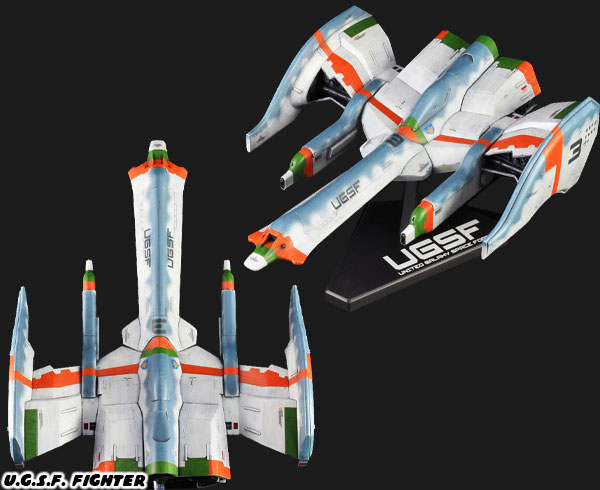
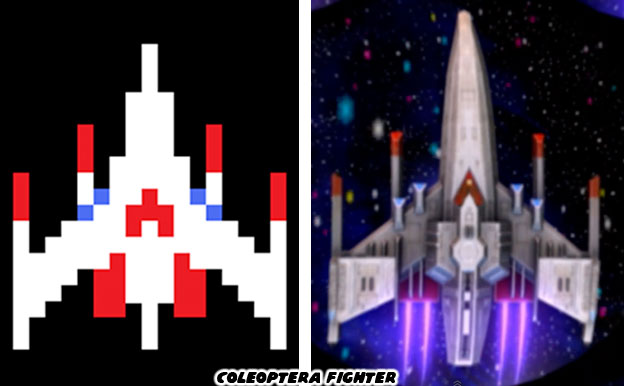
The insanely detailed notes and volumes of concept art became shared knowledge in the offices of Namco. In many cases these things decorated the walls of the offices. It wasn't an employee working here or there that seemed to know the particulars of the science fiction world Namco was developing it was the collective that knew about it. They all contributed to the development of the UGSF canon over the years. The studio did not seem to forget even the tiniest little detail either. For example, when people think of the ship featured in Galaga they might imagine a tiny white space jet that could be joined at the wing to another. If the fans were asked to draw it from memory they might even be able to sketch out a design that resembled the blocky ship from the arcade hit. Yet the people at Namco had a lot more in mind than audiences could have ever imagined. First off it had a name and class. The star of the game was the Coleoptera Fighter. In other Namco games the ships would become much larger, more defensive and carry different names. The fighters appearing in many of the early Namco hits were limited by the capabilities of the graphics engines and not by the imagination of the developers.

The artists wanted to present a spaceship that would hold up to the greatest designs from film and animé. Fans could identify T.I.E. fighters and X-Wings with just a few pixels, unfortunately for Namco they had to rely on the imagination of gamers to fill in the details missing for their own craft. Something similar could be said of the gameplay of those early UGSF hits. The designers had epic space battles in mind while planning out the adventures. They had grow up on a steady diet of amazing shows and animation, including Captain Harlock, Space Battleship Yamato and Star Wars. They wanted to capture the action featured in those titles but allow the audiences to become the heroes of the story. Of course it was tough to include any sort of story with the limitations of the early arcade hardware. With barely any memory, a few tones from the sound board and a limited color palette the developers at Namco had to focus on making a fun game first and foremost. They would have to pack away their ambitious goals until technology had caught up with their imagination. The people working on the space shooters were not alone with these struggles.

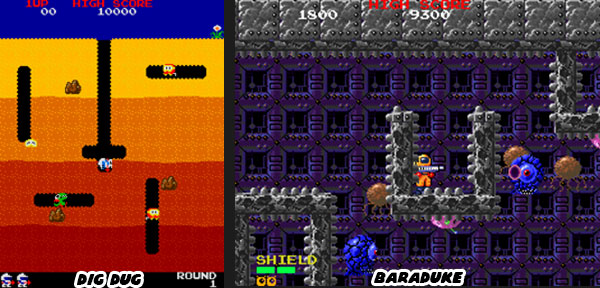
Other groups within Namco worked on different genres. One in particular worked on maze games for the studio. Mappy and Pac-Man had done very well in the genre. Yet even those designers had to explore the boundaries of what was possible. They introduced elements of science fiction into the format. The first of these new experiences was Dig Dug. The hit from 1982 made little to no sense to the western gamer. Try to describe the game to someone, especially a non-gamer. There was a little blue man that would dig tunnels with a jackhammer and then shoot at dragons and orange masked balls with an air hose. He would then inflate them until they exploded and that's how you earned points. It sounded like a bad acid trip rather than a video game. Thirty years later it still did not make any sense. Not that it mattered though because gamers in the west and east could not get enough of the experience. It was a challenging maze game that introduced all sorts of new elements and enemy types. It also created some memorable mascots along the way. Baraduke raised the bar on space exploration. The title from 1986 wasn't a puzzle game but actually allowed the main character to travel through an alien outpost instead, running, flying and shooting everything along the way. The hero of this game was actually a female, a UGSF soldier named Masuyo "Kissy" Toby. It was a fantastic concept that had predated heroines like Samus from the Metroid series. While the mascots featured in those games were blocky little characters the designers always kept in mind some more realistic representations of them for future use.

It was about this time in the '80s that Namco began working in earnest to shape the UGSF continuity. The designers began looking back on their catalog of games and began finding relationships between the various titles. The company decided that Masuyo was actually the estranged wife of Dig Dug himself, a fellow that went by the name of Taizo Hori. The name Taizo Hori was actually a play on words, in Japanese his name sounded like "I like to dig." The two characters had kids which would appear in games that followed many years later. Susumu Hori, Ataru Hori and Taiyo Toby came into their own in a series called Mr. Driller and Star Trigon at the end of the '90s and start of the new millennium respectively. The reasons why Hori and Toby were separated were never revealed by Namco. Some artists speculated why they were an estranged couple but nothing definitive was ever posted.

It would not be the first time that mature themes were explored in science fiction. The origins for Baraduke were rooted in the film Alien. The movie was one of the first to combine horror and science fiction equally well. The film starred Sigourney Weaver as a space explorer named Ellen Ripley. In it her team of miners came across an extinct alien settlement. When one of them became infected with an alien parasite it quickly turned into a life or death struggle for the entire crew. The entire tone of the film was handled very seriously. There was nothing remotely fantastic about the content as was the case with Star Wars, instead the story played out as an earnest drama should. Violence and gore aside it certainly was not meant for children. The 1979 movie forever changed the landscape of cinema and became a cultural touchstone for what space exploration could become.

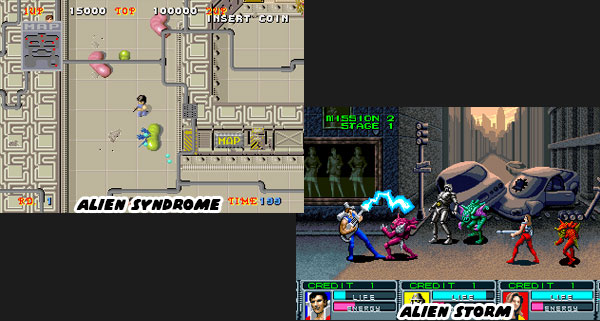
Alien had influenced the designers at several Japanese studios when it debuted. Sega's Alien Syndrome from 1987 and Alien Storm from 1990 were two completely different takes on the genre, one was serious and one was very over-the-top but both had hints of the classic film in it as well. The 1986 hit Metroid for the original Nintendo Entertainment System was also influenced by the film. Through all of the changes in science fiction and gaming over the past 40 years Namco would stay focused on their own continuity, They kept grinding away at the UGSF universe and never lost track of what could become. When the industry began to change its operations to focus on 3D engines Namco was already ahead of the curve. Many of the developers working at the studio had a good idea as to what the next great hits from the company would be.

The advancement of 3D graphics in the arcade and on home consoles turned out to be the biggest gain in company history. The programmers and animators could finally put on screen what they had spent an entire generation only dreaming of. Even the iconic battles in Galaga became more mesmerizing when visualized as actual 3D engagements. Solvalou, Galaxian3 and Starblade were the first chapters in a run that no other studio would be able to match. The next blog will look at the nexus of the UGSF at home. I’d like to hear about it in the comments section. As always if you would like to sponsor me please visit my Patreon page and consider donating each month, even as little as $1 would help make better blogs and even podcasts!
follow the Street Writer on Patreon!