Showing posts with label shmup. Show all posts

Wednesday, March 20, 2024

Married to the Sea, part 2 - A 1UP classic from February 7, 2008

Welcome back ye land lubbers. When we last left off I was speaking in general terms about my love of the sea and the boats and subs that inhabit it. What makes the sea so great is how much it can change. One minute it's calm and smooth like a sheet of glass, the next it's 70 foot waves and a dark tempest that could snatch away grow men like leaves in a strong wind. But just under the surface the ocean remains calm. Quite and interesting dynamic. Today we'll take a look at this mysterious world under the sea to some history-defining games. A good number of these titles are older than you, some are older than me but I've played almost all of them in the arcade or console as the case may be.

You can break down a sea adventure into one of three types, those with a submarine, those with an underwater personal watercraft and those based on the surface of the ocean. I won't talk about the third because few are adventure games and most are boat or jet ski racing games like Wave Race or Hydro Thunder. Those you should already be familiar with. The first two sea adventure genres have had a few sleeper hits in their time. I'll highlight the submarine ones today.

The submarine genre is one of the few that can claim to have a deep-rooted arcade legacy. One of the earliest electronic games was Sega's Periscope, released in 1968 and Midway's Sea Raider released in 1969. The gimmick for many of the submarine games has been a reliance on the periscope, a form of control unique to actual submarines.
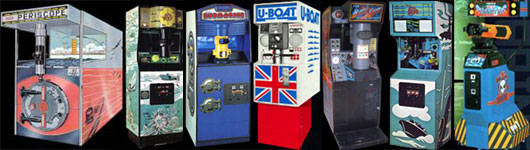
Unlike traditional arcade screen where everyone could see what you were playing, gamers on sub games could peer into their own screen which displayed a CRT or mini LCD. The player had the firing buttons at the thumbs of the periscope handle with some crosshairs on the display to help target enemies. While this gimmick worked in arcades for over 30 years it was not always the most popular format for players.
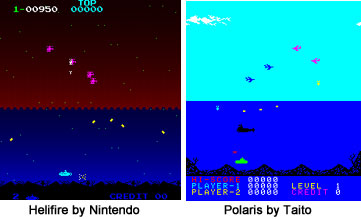
It didn't take too long for companies to begin applying the SHUMP (or shmups) formula to the submarine genre. While the flying ship in most SHUMPS can only fire forward the submarine was unique because it could fire torpedoes forward and missiles straight up. This allowed developers to come up with games that could be played like Space Invaders but with attackers from the side as well. Early adopters of this format included Midway's Submarine in 79, Taito's Polaris in 1980 and Helifire by Nintendo also in 1980. But it wasn't until 1981 when the side-scrolling aspect of the SHUMP was also applied to the submarine game.

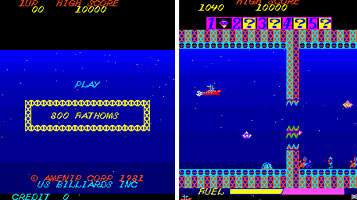
The Battle of Atlantis by Comsoft featured colorful underwater environments where ships and sharks would attack you. Amenip's Mariner game (aka 800 Fathoms) also came out in 1981. This game expanded on the the themes of exploration and diverse locations through which you had to pilot your sub while also taking on advancing enemies. While not as memorable as their sky and space contemporaries, the submarine SHUMP would survive for decades.
A fast-paced arcade FPS shooter using the periscope was released by Taito in 1989. It was called Battle Shark and was probably better remembered for having a main character that looked just like Charles Bronson.
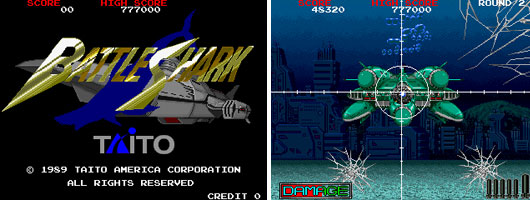
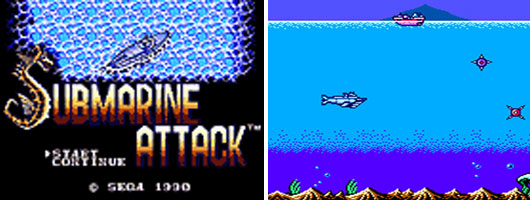
The designs in Battle Shark were all great, plenty of sci-fi subs battling it out over sunken cities. The only sticking point was the periscope. It was large and clumsy, it also felt dated. So the remaining classic sub games were all played with traiditonal joystick or game pad. The best of the early console adopters was Submarine Attack, released in 1990 by Sega for the Master System. It was a throwback to the classic arcade SHUMP and had a quiet following.
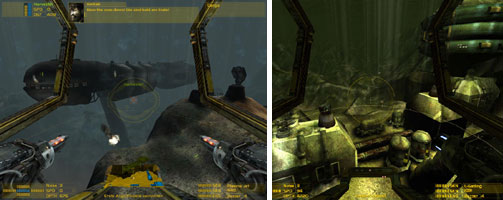
Over the next few years we would see all sorts of attack sub games for the Genesis, PC and Nintendo. Some console titles based on popular movies like the Hunt for Red October. One of the more original titles from recent years featured a mini sub that controlled like a combat fighter. The series was called Aquanox and it was set in the near-future so the tech was semi-believable. Plus it was a nice change of pace to be fighting in underwater cities rather than storming through the clouds or off in space.
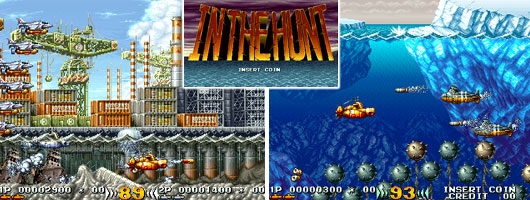
Of all the submarine SHUMPS ever made, my favorite by far has to be Irem's 1993 sleeper-hit In the Hunt aka Kaitei Daisensou. This game should look and feel very familiar to fans of the Metal Slug series because it was made by the same people.

Here is where I have to make an aside as to what makes In the Hunt and Metal Slug such a classic. It goes back to 1990, before the Irem and SNK designers joined forces and founded Nazca to develop the Metal Slug series. Most SHUMP developers are looking for a hook, a gimmick to make their game memorable. It's hard to come up with something memorable when Japan cranks out so many SHUMPS year after year. In some cases it is the design of the ship and enemies that stick with fans. The large grotesque monsters and falcon-like hero ship featured in R-Type helped put Irem on the map. Other developers rely on cartoony, anime-inspired designs with soft bubbly graphics like Cotton by Success.
The people at Irem had been experimenting with a fusion of hyper-realistic designs and cartoon-like animation. The "style" that they were working on began to gel in the early 90's. Air Duel was a SHUMP that featured traditional air combat with hundreds of enemies and gigantic bosses, what set the visuals apart was the highly-detailed graphics on every plane and even in the backgrounds. The attention to detail was nothing short of maddening. For the next game they took this level of detail and then threw it in a blender with an artistic style that can only be called genius.

In the Hunt was the first title that Irem made featuring the fantastic, over-the-top vehicles and levels that eventually made Metal Slug so great. All of the obscene detail was in the game, every billboard, car, truck, railroad tie and sewer could be counted individually. On some levels if you looked closely you could even make out pedestrians running for their lives, they could not have been more than a few pixels in height! This unique style of presentation, superb animation combined with the classic submarine SHUMP formula and fantastic bosses made In the Hunt the best sub game ever made. Fans would clamor for a sequel but Irem had other plans.
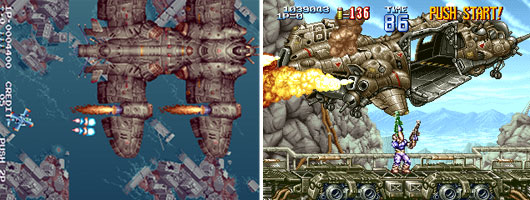
They took the stylized world featured in Air Duel and In the Hunt and applied them to a side-scrolling run and gun game in 94. The game is better known as Gun Force II / Geo Storm. While the designers still hadn't made the main characters completely cartoony, nobody can deny that the template for Metal Slug had been created between those two titles.
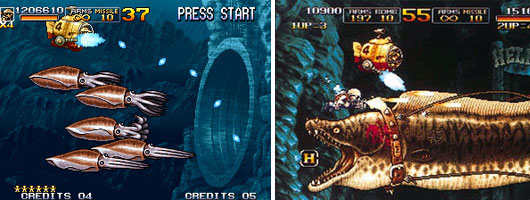
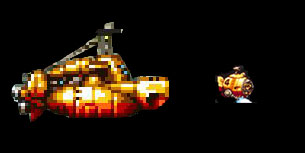
I am not a super fan of Metal Slug but I do like the designs. My favorite Metal Slug level takes place in Metal Slug 3 because it is the only time we are introduced to the Metal Sub, a nod to In the Hunt. What you might not notice is that the Metal Sub and scale of Metal Slug is much smaller than that of In the Hunt. The sprites featured in both games are relatively the same size, however proportionally they are different. The sub in In the Hunt is about five times bigger than the Metal Sub. It would be great if the next Metal Slug game could begin incorporating more scale in their series so that if a player jumped into a larger tank or a larger plane then the camera would pan back and allow us to see more of the world like In the Hunt. Of course even if the camera pans back you would still keep the same level of detail that Nazca is famous for.
But that is just me thinking out loud again. Making a sprite-based game is a lost art and it seems that nobody has the dedication to keep the format alive. If Nazca wanted to have a complete meltdown then they would take my advice and feature a scalable world with infinite detail. They wouldn't get far before running out of time and money, but damn would it be a pretty game.

Let's end this aside and finish with In the Hunt is the best submarine SHUMP ever made. I hope that you have played it and if not go track down a copy online or in the arcade. You won't be sorry! If you think my blog on underwater-based videogames is over then you don't know me very well! Tune in tomorrow for the final part of this series.

As always if you would like to sponsor me please visit my Patreon page and consider donating each month, even as little as $1 would help make better blogs and even podcasts!
follow the Street Writer on Patreon!

Monday, August 18, 2014

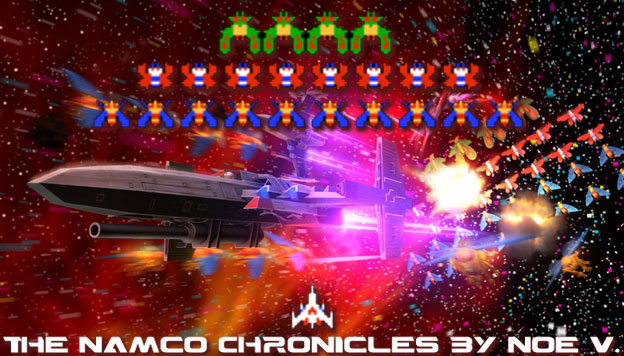
The Namco Chronicles, part 1...

This blog has spent a lot of time talking about cars and racing games, Sorry if I lost you along the way. I was just trying to chronicle my gaming interests, especially the titles that I had the fortune of seeing debut in my lifetime. I will actually use the next few blogs as a buffer for a different genre but once we go back to my original topic I think you'll be pleasantly surprised. One of the earliest memories that I had of the arcade were of little alien ships in a row dripping down over a city. The animation was crude by todays standards, the colors lacking and the gameplay very rudimentary yet for some reason I couldn't look away. Space Invaders by Taito was a groundbreaking experience and became a smash hit in the USA as distributed by Midway, and in Japan as distributed by Namco. It was not the first video game set in space. That distinction actually went to Spacewar, a computer simulation game from 1962. In 1977 the company Cinematronics released an arcade version called Space Wars. The game was fairly popular because the first Star Wars film was released that year. Yet space-themed arcade games were barely getting started. The demand for an actual Star Wars video game wouldn't hit a fever pitch for a few more years.

An upstart called Namco took a chance at entering the arcade industry. This company had found moderate success with their first two games, breakout-style games named Gee Bee and Bomb Bee. Yet they knew they needed to have a hit in order to survive. They looked at what was hot and where they could improve upon it. The company had the audacity to replicate the Space Invaders formula almost verbatim. Galaxian debuted in 1979 and introduced the world to full color space combat. It had more detailed graphics than Space Invaders and added enemies that flew in patterns and attacked the player. There was no cover and the opponents were relentless in their assault rather than slowly descending from the top of the screen. The addition of a simple "soundtrack" and stars that scrolled in the background gave it a sense of weight and dimension. The arcade game had the potential to become the new source of entertainment. Galaxian gave audiences just a hint at the elements that would become important down the road. I was barely five when the game came out but could tell that it was very good. For years I thought that it was a sequel to Space Invaders, both games were distributed in the US by Midway. Only later on did I learn that Midway and Atari had been distributing games that should have been labeled Namco.

Galaxian was considered the godfather of the shoot-em-up or SHMUP genre but it was not alone. The US had been leaning towards cutting-edge vector engines which provided sharper graphics and even more realistic physics. Atari was leading the charge and had two completely different takes on the science fiction genre. Asteroids was one of the biggest hits for the company. For the first time audiences could fly all over the screen, rather than be stuck going left and right. All the while shooting at angular blocks, which were supposed to be asteroids as they floated across the screen. The occasional flying saucer would appear as well offering a combat element. The game had captured the sense of endless momentum that space was supposed to have. Based on the razor sharp graphics and realistic control scheme I assumed that this was some sort of training simulator. There were games in color that were set in space, yet they were cartoonish and unrealistic by comparison. Asteroids was in black and white and I assumed it was a decision that Atari made to make it play like a military simulator. In my young mind I assumed that the astronauts orbiting the Earth were shooting asteroids out of the sky. This was clearly the way that they got ready for their missions.

A year later a new experience from Atari had debuted. Missile Command was in color and the vector graphics technology seemed much better than before. The game controlled completely different than other titles, this one relied on a track ball and a button. This time around the simulator was training me to defend the major cities of the US (and sometimes the moon) from a Russian nuclear strike. To be honest I was never any good at it. I enjoyed watching the explosions go off and never tried to learn a strategy to help me protect the targets. As I saw the older arcade players go through the stages I could appreciate how much concentration and reaction skills were required. The best players at the local arcade seemed to be psychic. They could predict where the next missile was coming from and could actually send out countermeasures before the nukes had even appeared on screen. I couldn't wait to get older and become better at the games, or at the very least develop some of those psychic abilities myself.

My fascination with the realistic games that Atari had put out was short lived. The successor to Galaxian arrived in 1981. Galaga was the pinnacle of science fiction graphics and gameplay as far as I was concerned. The third Space Invaders-type game was the best yet and I was not the only person that thought that. It became the biggest selling SHMUP of all-time. It caused a shortage of ¥100 coins in Japan. Arcade owners could not put the coins back into circulation fast enough for the market. And there are people that think that Angry Birds or Flappy Birds is a phenomenon! There was a Galaga machine at every mall and arcade that I visited. They could even be found at the pizza parlor and corner market. Players could not get enough of the game. The constant battle against waves of swiftly moving "space bugs" required genuine skill to get through. The patterns that the alien ships used to create their formations were dizzying. Again the older players used their second sense to predict where the enemies were coming from. They would start firing and destroy the opponents before they even came on screen. There was even a challenging bonus round stage for players to really put their psychic powers to the test. The game had a catchy jingle that would play after the player put in a quarter. In fact the game had several songs that played through the course of the levels. As I got older the senior visitors to the arcade accepted me as a regular. They began to clue me in to their tricks, it was like being welcomed into a private club. Except instead of secret handshakes players traded secret codes under their breath in the corners of the arcade. Many knew each other by their scoreboard initials alone. I was one of the few that could fit their entire name with the three letters provided on the game over screen. To get better at Galaga they advised that I could line up my shots ahead of time by using the high score counter at the top of the screen and the player counter at the bottom of the screen. Even though the stars were constantly flying by the counters never budged.

Sega was aware that the industry was incorporating more science fiction titles into their portfolio. As one of the bigger publishers they wanted to show the world that they could create superior experiences. Zaxxon debuted the year after Galaga yet it was not as well remembered. The isometric shooter gave a sense of 3D not yet seen in any other game. Instead of playing in the depths of space with nothing but the stars to keep players company Zaxxon featured a series of enemy bases for players to raid. It offered audiences a taste of the trench run at the end of the first Star Wars film without having to pay George Lucas for the license. The highly detailed backgrounds included missile strikes, laser turrets, electrified barriers and oncoming spaceships. There was a tremendous amount of color and fidelity, which was something that the games of the early '80s were often lacking. Yet there was also the difficulty with the gameplay which ended up hurting the overall experience. Even with an altitude meter it was difficult to gage the position of enemy ships and missiles. Players had to rely on the shadow cast by the ship to determine their height, as well as where shots hit when approaching narrow passages. Sometimes shots would fly by opponents yet their return fire would hit players. It could be maddening how arbitrary the combat felt. Isometric games were few and far between for these reasons. To complicate matters the game had a fuel meter at the bottom of the screen and players had to constantly shoot at fuel containers in order to keep going. Zaxxon received a few sequels in the arcade and on several of the consoles that the company produced. To celebrate its 30th anniversary Sega released a Temple Run-style game called Zaxxon Escape. The webpage and trailer showed how different it is was compared to the classic arcade game. The use of the name and sudden shift in gameplay raised the ire of the fan community. The mobile title was a fun game, but it certainly was no Zaxxon.

Sega learned their lessons early on and tried again to beat their competition and establish their dominance in the genre. Buck Rogers: The Planet of Zoom used the scaling sprite technology that the company had featured in Turbo and would improve upon in OutRun and Space Harrier. The game was a different attempt at making a 3D experience out of two-dimensional sprites and it worked fairly well. Buck Rogers was a hero from pulp comics and radio programs. He was quite possibly the first science fiction hero to get featured in the arcade medium. In the game players flew Buck's spaceship through various dimensions and shot down UFO's and enemy carriers. I remember the game being very frenetic, not to the scale of modern SHMUP "Bullet Hell" shooters, but in the sense that the bright colors and flashing lights were a distraction. They hurt the sense of awe that flying in three dimensions was supposed to provide. I saw very little of the game outside of a few local arcades. I would say that it was lost in time even faster than Zaxxon.

Namco on the other hand was enjoying their position. Their game engines lacked the processing power and graphics technology that Sega was promoting. Namco made up for it by offering great gameplay. In 1982, the same year that Sega had Buck Rogers in the arcade, Namco released Xevious, it was another of the most successful shooters of all-time. Xevious was the first Namco game to feature a scrolling background. It was even an more of a direct ancestor to the SHMUP than Galaga. It set the precedence that would be copied by the entire industry from Capcom's 1942 to Tecmo's Raiden and everything in between. From a player persecutive Xevious offered a much more rewarding experience than Galaga. Players felt like they were making progress as the game went on, rather than simply surviving wave after wave of enemy squadrons. Every assault on an enemy compound was a rewarding challenge, rather than a frustrating battle as was the problem with Zaxxon. 1982 turned out to be a very good year for Namco. The studio had Pole Position and Dig Dug out in arcades and were still making a hefty return on Pac-Man from a few years prior. The unofficial sequel Ms. Pac-Man and Super Pac-Man were also adding to the Namco coiffeurs. That revenue would have to be funneled into R&D because Sega and Atari were ready to revolutionize the space shooter. The next blog will feature these titles, I hope to see you back for another chapter in the series. If you would like to sponsor me please visit my Patreon page and consider donating each month, even as little as $1 would help make better blogs and even podcasts!
follow the Street Writer on Patreon!