Showing posts with label submarine. Show all posts

Monday, December 1, 2025

The Big Game Idea: Level 1 (middle) - A 1UP classic from Sep 20, 2006

Below is a series that I originally ran on 1UP in 2006. In it I proposed an original video game based on the Incredible Hulk. I called it "The Big Game Idea." Over a few weeks I described the graphics, game play, visuals, and plot from beginning to end, including bonus features. I made a few minor edits, but it is more or less exactly the same as it was almost 20 years ago. I hope you enjoy it.

Heya peeps, I guess my early title sounded a little too religious for some. Not to worry, some things get changed in pre-production and that's only my first title idea, it can still change. Today we'll look at the second part of level 1. Each level consits of three stages in case you were wondering, like all good stories each chapter of the game has a beginning, middle and end. All of these small stories are threads in the overall plot.

Now let's pick up at the end of the first portion of level 1. If the player successfully destroys the Orion missile before it can enter orbit then here's what happens next.

CINEMA: The Hulk falls from the sky as the Orion Missile breaks apart and explodes in the upper atmosphere. The Hulk lands in the North Atlantic with a big splash. He treads water and looks around as pieces of the Orion Missile crash in the distance.

The water explodes nearby and the Hulk turns to see a battleship bearing down on him.

Level 1 Middle
Location: In the Atlantic Ocean.
Objective: Destroy the naval ships.
Learn: How to swim, dive and dash underwater. Jump and power jump. Lock on a target at a great distance and jump to it. How to regain strength and stamina.
Unlock: Thunderclap.
Level Design: The Hulk can swim or jump between the ships in the ocean. He can also climb up their side if he falls into the water.


Most of the details on the ship can be destroyed or turned into weapons. These include the turrets on the battleships and the aircraft on the aircraft carriers. If the Hulk grabs onto a submarine it will begin diving. The Hulk enters a mini game that allows him to disable the submarine's torpedoes. The Hulk cannot run out of air if swimming underwater.


Remember that I said this game is not a sandbox environment. The ocean is really only about two virtual square miles. The water is choppy, with big waves and great physics, inspired by the water physics in Hydro Thunder of course. The Hulk can swim very fast, motorboat fast but if the Hulk swims too far from the ships then their shells will blow him out of the water and severely injure him. Players learn to stay close to the ships until they are destroyed. On one side of the map there is an aircraft carrier and on the opposite are two battleships. A submarine patrols the area between the ships.


The player learns to target lock and jump between the ships in a single bound. If the Hulk lands in the water, or is hit by a missile mid-air then he has to face the submarine challenge. This challenge was inspired by the Hydrus, electric eel, level in Shadow of the Colossus. The Hulk can crawl along the surface of the submarine when underwater and will not drown when the submarine dives. If the players slides off the face of the attack sub he remains underwater for the minigame portion where the submarine fires torpedoes and the player has to deflect them or tear them apart. If the player is successful then the submarine and Hulk surface. Now the Hulk can swim to the other ships and continue the fight until they are disabled.

What do you think so far? Just wait until the end of Level 1!

The Hulk has so far only faced machines in combat. You'll never guess where the next battle takes us! Would you play this game if it were real? Tell me in the comments section. As always if you enjoyed this blog, and would like to sponsor me please visit my Patreon page and consider donating each month, even as little as $1 would help make better blogs and even podcasts!
follow the Street Writer on Patreon!

Wednesday, March 20, 2024

Married to the Sea, part 2 - A 1UP classic from February 7, 2008

Welcome back ye land lubbers. When we last left off I was speaking in general terms about my love of the sea and the boats and subs that inhabit it. What makes the sea so great is how much it can change. One minute it's calm and smooth like a sheet of glass, the next it's 70 foot waves and a dark tempest that could snatch away grow men like leaves in a strong wind. But just under the surface the ocean remains calm. Quite and interesting dynamic. Today we'll take a look at this mysterious world under the sea to some history-defining games. A good number of these titles are older than you, some are older than me but I've played almost all of them in the arcade or console as the case may be.

You can break down a sea adventure into one of three types, those with a submarine, those with an underwater personal watercraft and those based on the surface of the ocean. I won't talk about the third because few are adventure games and most are boat or jet ski racing games like Wave Race or Hydro Thunder. Those you should already be familiar with. The first two sea adventure genres have had a few sleeper hits in their time. I'll highlight the submarine ones today.

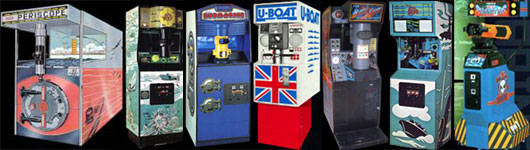
The submarine genre is one of the few that can claim to have a deep-rooted arcade legacy. One of the earliest electronic games was Sega's Periscope, released in 1968 and Midway's Sea Raider released in 1969. The gimmick for many of the submarine games has been a reliance on the periscope, a form of control unique to actual submarines.

Unlike traditional arcade screen where everyone could see what you were playing, gamers on sub games could peer into their own screen which displayed a CRT or mini LCD. The player had the firing buttons at the thumbs of the periscope handle with some crosshairs on the display to help target enemies. While this gimmick worked in arcades for over 30 years it was not always the most popular format for players.

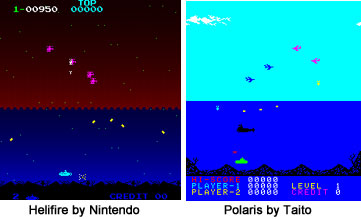
It didn't take too long for companies to begin applying the SHUMP (or shmups) formula to the submarine genre. While the flying ship in most SHUMPS can only fire forward the submarine was unique because it could fire torpedoes forward and missiles straight up. This allowed developers to come up with games that could be played like Space Invaders but with attackers from the side as well. Early adopters of this format included Midway's Submarine in 79, Taito's Polaris in 1980 and Helifire by Nintendo also in 1980. But it wasn't until 1981 when the side-scrolling aspect of the SHUMP was also applied to the submarine game.

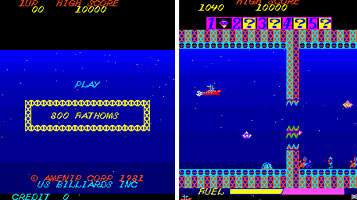
The Battle of Atlantis by Comsoft featured colorful underwater environments where ships and sharks would attack you. Amenip's Mariner game (aka 800 Fathoms) also came out in 1981. This game expanded on the the themes of exploration and diverse locations through which you had to pilot your sub while also taking on advancing enemies. While not as memorable as their sky and space contemporaries, the submarine SHUMP would survive for decades.

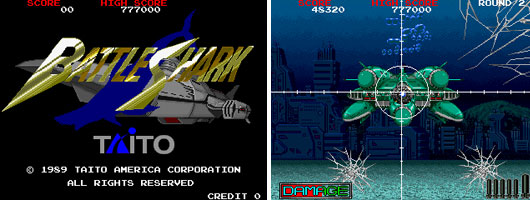
A fast-paced arcade FPS shooter using the periscope was released by Taito in 1989. It was called Battle Shark and was probably better remembered for having a main character that looked just like Charles Bronson.

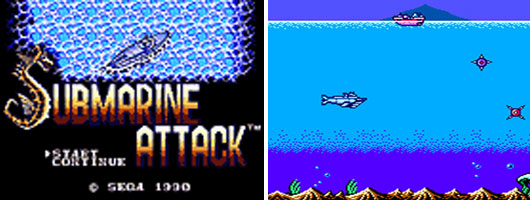
The designs in Battle Shark were all great, plenty of sci-fi subs battling it out over sunken cities. The only sticking point was the periscope. It was large and clumsy, it also felt dated. So the remaining classic sub games were all played with traiditonal joystick or game pad. The best of the early console adopters was Submarine Attack, released in 1990 by Sega for the Master System. It was a throwback to the classic arcade SHUMP and had a quiet following.

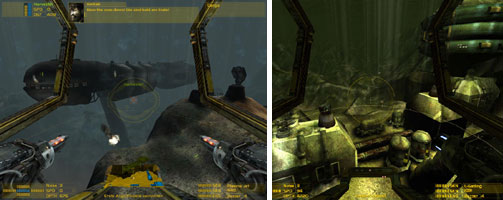
Over the next few years we would see all sorts of attack sub games for the Genesis, PC and Nintendo. Some console titles based on popular movies like the Hunt for Red October. One of the more original titles from recent years featured a mini sub that controlled like a combat fighter. The series was called Aquanox and it was set in the near-future so the tech was semi-believable. Plus it was a nice change of pace to be fighting in underwater cities rather than storming through the clouds or off in space.

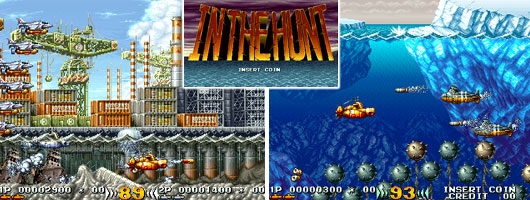
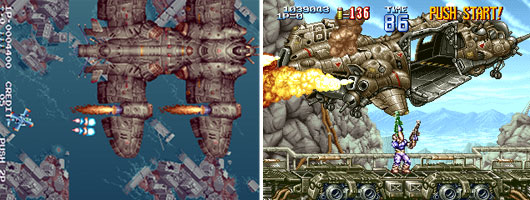
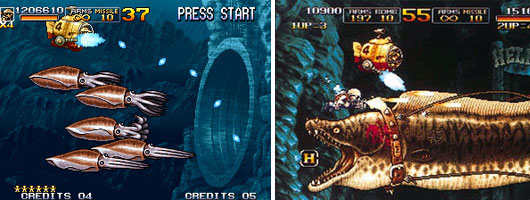
Of all the submarine SHUMPS ever made, my favorite by far has to be Irem's 1993 sleeper-hit In the Hunt aka Kaitei Daisensou. This game should look and feel very familiar to fans of the Metal Slug series because it was made by the same people.

Here is where I have to make an aside as to what makes In the Hunt and Metal Slug such a classic. It goes back to 1990, before the Irem and SNK designers joined forces and founded Nazca to develop the Metal Slug series. Most SHUMP developers are looking for a hook, a gimmick to make their game memorable. It's hard to come up with something memorable when Japan cranks out so many SHUMPS year after year. In some cases it is the design of the ship and enemies that stick with fans. The large grotesque monsters and falcon-like hero ship featured in R-Type helped put Irem on the map. Other developers rely on cartoony, anime-inspired designs with soft bubbly graphics like Cotton by Success.

The people at Irem had been experimenting with a fusion of hyper-realistic designs and cartoon-like animation. The "style" that they were working on began to gel in the early 90's. Air Duel was a SHUMP that featured traditional air combat with hundreds of enemies and gigantic bosses, what set the visuals apart was the highly-detailed graphics on every plane and even in the backgrounds. The attention to detail was nothing short of maddening. For the next game they took this level of detail and then threw it in a blender with an artistic style that can only be called genius.

In the Hunt was the first title that Irem made featuring the fantastic, over-the-top vehicles and levels that eventually made Metal Slug so great. All of the obscene detail was in the game, every billboard, car, truck, railroad tie and sewer could be counted individually. On some levels if you looked closely you could even make out pedestrians running for their lives, they could not have been more than a few pixels in height! This unique style of presentation, superb animation combined with the classic submarine SHUMP formula and fantastic bosses made In the Hunt the best sub game ever made. Fans would clamor for a sequel but Irem had other plans.

They took the stylized world featured in Air Duel and In the Hunt and applied them to a side-scrolling run and gun game in 94. The game is better known as Gun Force II / Geo Storm. While the designers still hadn't made the main characters completely cartoony, nobody can deny that the template for Metal Slug had been created between those two titles.

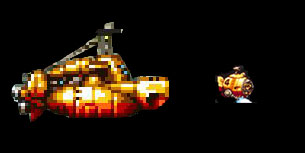
I am not a super fan of Metal Slug but I do like the designs. My favorite Metal Slug level takes place in Metal Slug 3 because it is the only time we are introduced to the Metal Sub, a nod to In the Hunt. What you might not notice is that the Metal Sub and scale of Metal Slug is much smaller than that of In the Hunt. The sprites featured in both games are relatively the same size, however proportionally they are different. The sub in In the Hunt is about five times bigger than the Metal Sub. It would be great if the next Metal Slug game could begin incorporating more scale in their series so that if a player jumped into a larger tank or a larger plane then the camera would pan back and allow us to see more of the world like In the Hunt. Of course even if the camera pans back you would still keep the same level of detail that Nazca is famous for.

But that is just me thinking out loud again. Making a sprite-based game is a lost art and it seems that nobody has the dedication to keep the format alive. If Nazca wanted to have a complete meltdown then they would take my advice and feature a scalable world with infinite detail. They wouldn't get far before running out of time and money, but damn would it be a pretty game.

Let's end this aside and finish with In the Hunt is the best submarine SHUMP ever made. I hope that you have played it and if not go track down a copy online or in the arcade. You won't be sorry! If you think my blog on underwater-based videogames is over then you don't know me very well! Tune in tomorrow for the final part of this series.


As always if you would like to sponsor me please visit my Patreon page and consider donating each month, even as little as $1 would help make better blogs and even podcasts!

follow the Street Writer on Patreon!

Monday, March 18, 2024

Married to the Sea, part 1 - A 1UP classic from February 6, 2008

Hey there friends, now don't get all bothered about the title of this series. I really didn't go out and get married, but if you'd like to send me wedding gifts then I'd gladly accept them. This blog series deals with my fetish fascination with the sea. It all goes back a long time ago, before some of the peeps on 1UP were even born. All my life I've been a fan of vehicles. Cars, trucks, trains and planes fascinated me. My mom says one of my first words was "train" for every time I saw one I'd point and say "ten, ten." Of all the vehicles in the world I hold a particular interest in ships and submarines. It must have something to do with being born and raised in Long Beach. The Queen Mary was always on the horizon, the Port of Long Beach was just across the LA River and the beach even nearer. The creatures of the sea interested me to no end and I often longed for ways to see them in their natural habitat. Say, who wouldn't want a bathysphere, deep sea diving suit or submarine to call their own?


I spent lots of time doodling whales and sharks in my notes, the octopus was always my favorite, always thinking that the seven seas were infinitely large. I'd wonder what it would be like to pilot a mini sub, deep-sea research sub or even massive nuclear sub. Later did I realize that not every kid grew up near the beach or even a large body of water, so they didn't share the same interests. Too bad for them!

You can put some of the blame Disney for the early influence as well. The movie 20,000 Leagues Under the Sea, the park rides the Submarine Voyage and Pirates of the Caribbean were very strong memories of my childhood. These things taught me to fear and respect the creatures of the deep. They showed how amazing ships were. The Submarine Voyage in particular introduced me to the underwater narrative, themes of Atlantis, mermaids and sea monsters that sparked my imagination.


I understood that many of my childhood friends dreamed of being the star quarterback for a super bowl team or even becoming an astronaut and exploring space. These things never interested me. Piloting a submarine was an achievable goal, something tangible. The sub was a window to another world, far more fascinating than space travel. There was life underwater, changing terrain, vast unexplored areas, many wonders yet to be discovered. In space there was nothing but... space. Cold, dark empty space for millions and millions of miles in every direction. In my lifetime we would never have the resource to visit other planets with the speed that we could visit other continents. Space travel was a science fiction dream but the real application of science was exploring the sea. To be a pilot of a sub that explores the ocean floor, treading through the unknown, it would be the closest we'd ever come to finding out what it would be like to discover life on another planet.

The toys my parents got me reflected this curiosity. My favorites were the toys that could float. Submarine toys with action figures were my favorite. My big brother had the majority of the G.I. Joe's and vehicles. Some of the Cobra boats were really keen but early in childhood I preferred to play with Adventure People from Fisher Price. These were action figures of everyday heroes. Some came with camping gear and a kayak, others had motorcycles. Some drove dragsters and funny cars. One had a parachute and a couple with scuba gear and a boat. My parents must have got me all of the sets that Fisher Price made, most of them I still have in the garage, those that I'm missing I can easily go to eBay for.
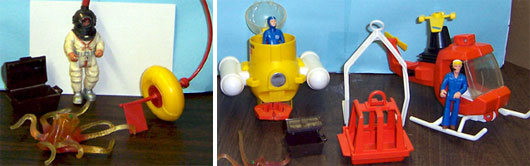

My two most favorite sets were the deep sea diver with octopus and treasure, and the submarine and helicopter set. I figured that a deep sea diver must feel like an astronaut leaving the shuttle. He is weightless, tied to a lifeline and his suit is a self-contained atmosphere. So while I'd never take a ride into space I could imagine that I wasn't missing much. I spent years having all sorts of adventures with these toys. Unlike Eddie Murphy my childhood bath time toy was a floating submarine, I never had to fight a brown shark. I'll consider myself very lucky for being that kid. Even today I am fascinated where I hear a story about the game studio that looks like the inside of the Nautilus. Or when news reports surface of giant squid footage, I'm all over it.

Granted I don't play with toys anymore (wish I had the time though) and the only things I collect are the odd Hulk toy and the occasional vinyl figure. I realize that it's been 30 years since I've seen anything as playful as the old Adventure People series... that was until recently. You may not know that Mattel bought out Matchbox a few years ago. Those would be perennial rivals Hot Wheels versus Matchbox under the same label. Some of the best Mattel toy designers are now collaborating on new products for Matchbox. Mega Rigs is a series that features interchangeable parts. It's not a Lego system where you can build anything but instead more generic one where you can swap out wheels for tank treads or tack on a helicopter propeller. I thought the series was okay, mostly because it allowed kids to create their own vehicle combinations. Some time ago they created a Mega Rig ship and submarine one as well. My interest was piqued but I didn't buy them as the toys were a bit pricey for my budget. So I just let them go. Over the holiday season I saw that the big retailers Sams Club, Costco, Target began offering special boxed sets of Mega Rigs. There was a bundle with the ship and submarine in one set for a low price.


One variation of this set offered an extra motor, one offered a shark. I chose the latter and picked it up just to have. Both ships float and each comes with all sorts of accessories and figures. While they aren't as large (in scale) as the Adventure People toys they were still pretty big. These toys helped remind me of my childhood and love of the sea. They made me want to share these interests with you. Of course this is a videogame blog so I have to connect the dots. Tune in tomorrow when we look at the best submarine videogames.

As always if you would like to sponsor me please visit my Patreon page and consider donating each month, even as little as $1 would help make better blogs and even podcasts!
follow the Street Writer on Patreon!

Friday, February 26, 2016

Building a gaming legacy, the Games Workshop series, part 9...

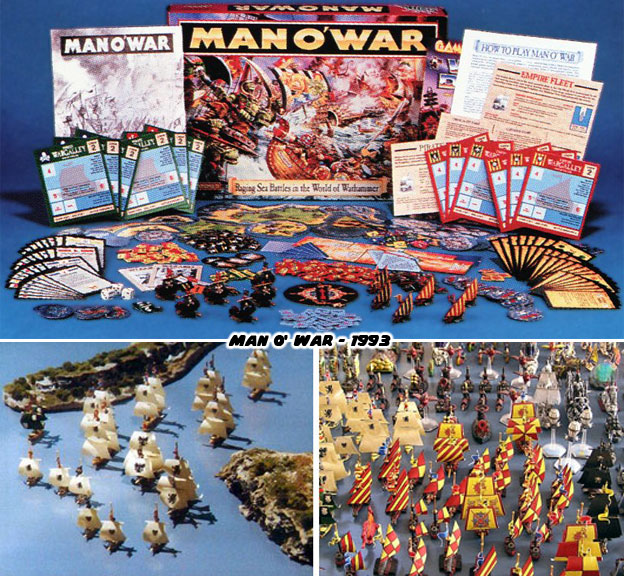
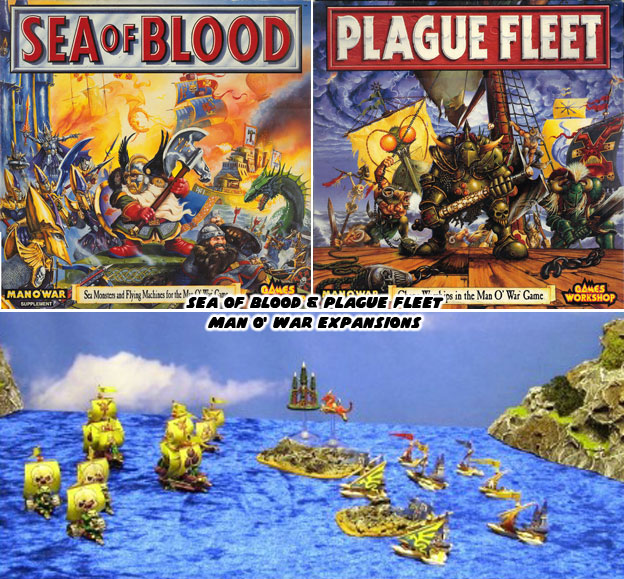
The system I'll be highlighting today did not come before Battlefleet Gothic but it did have a sizable following and possibly was the better of the two systems. The title is top notch storytelling and easily one of the most underrated tabletop games ever released. Man O' War is set during the Warhammer Fantasy era rather than the sic-fi setting of Warhammer 40,000. Both are still about naval battles but of course one is in space. When most people think of fantasy naval battles they might think of pirates and clipper ships, and the game does have that, however it extends far beyond their imagination. Man O' War is set in the canon of the classic Warhammer universe. This is a world where magic exists, also where creatures like dragons and ogres patrol the countryside and where humanity has made alliances with dwarfs and elves. The ancient world of Warhammer is not without its own interesting factions and science. Gunpowder does exist as are some basic steam machines so ranged weapons and explosives do make the naval battles more interesting. The ships themselves are very diverse, with small rowboats, paddlewheels, schooners and massive galleons making up just some of the ship types. The biggest of the wooden ships in Man O' War are far greater than the biggest wooden battle ships ever built and on par with modern battleships and aircraft carriers. The scale of conflict in the Old World is just as intense as any battle in 40K. This is what makes battles in Warhammer Fantasy so unique. In most fantasy stories there are maybe two great battles that involve every army on the face of the planet at least once a century if not once every thousand years. In the universe of Warhammer these epic clashes happen every other day. Tens of thousands of warriors live and die for battle on every corner of the map. As it turns out these battles also take place on the open sea. Games Workshop developed a system that allowed just about every race in the system to field their own navy.


The battles out to sea were every bit as fantastic as the land skirmishes were if not more. The ships used by the Empire, the classic one not the Space Marine one, were exaggerated versions of the classic wooden warships we know and love. The biggest ones crewed an entire city's worth of soldiers and had hundreds of cannons lined up row after row on the sides. The biggest ships had enough firepower to cripple a small nation. When they did battle it was a sight to behold. Some of the enemies had equally impressive ships and featured their own special weapons. Some ships were crewed by the undead, they would row after opponents without tiring. Other ships were piloted by agents of Chaos, their ships were surrounded by clouds of poisonous gasses and the sails were pushed by strange magical energy. Some of the elvish ships unleashed dragons from their hulls, not unlike aircraft. The industrious dwarfs had ironclad ships and had small helicopters and balloons that they could send out to drop bombs on opponents. The Dark Elves had ships that were castles built on the backs of enormous sea dragons. It was a scale of fantasy and combat that hadn't been attempted by any other system. The Games Workshop magazine, White Dwarf, kept audiences up to date on the latest happening on the high seas of the Old World. We discovered that not only were the ships something to be reckoned with but there were sea creatures and even the god of the seas that the kingdoms had to do battle with.


Just like the other games that the studio released during the late '80s and early '90s the entire experience was in the box. Friends could share the game, take it to their local hobby store and compete against the locals. The counters and "islands" were pre-printed cardstock, making it easy to imagine a ship raiding a port town, or setting up an ambush with your fleet on the far side of a volcano. All a gamer had to do was supply a table to enjoy the game, a blue tablecloth was optional. Hobbyists had tremendous fun creating three dimensional islands and forts as terrain pieces. Like the previous systems Games Workshop followed up with some expansions that added more unique elements to the title. The Plaguefleet and Sea of Blood expansions came out in 1993, right on the heels of the release of Man O' War. Thanks to the monsters and rules of magic the ocean became far more dangerous than any land encounter that could be found on land. Chaos had a tremendous presence on the sea and even the little seen Chaos Dwarfs got in on the action. Their ships belched black smoke, were loaded with armored rockets and stained the water around them. Everything they did was a gritty version of their heroic cousins. The grudges the two sides had was palpable. These were just some of the rivalries that could be settled in The system lasted for many years and built a cult-like following. Sadly it never got a chance to experience any success on the PC or home consoles.


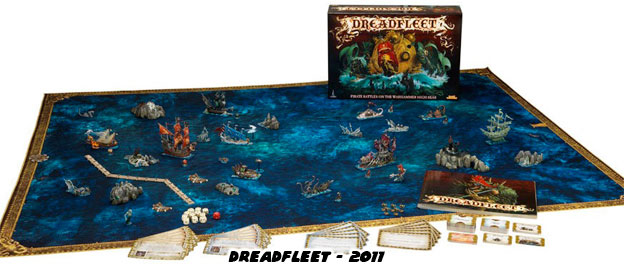
When Man O' War was discontinued there was a tremendous sense of loss in the community. Original systems, that had amazing miniatures, tight rules and a high level of production value were hard to come by. Most games of the nautical nature were flat card stock games that left much to be desired. It seemed that this would be the way things would have to be since not many studios were interested in naval tabletop games. That was until almost two decades later Games Workshop got a clue and decided to revisit the world of Warhammer Fantasy ship to ship combat. Senior designer Phil Kelly had an idea in his head that he had been honing for years. He had been working on a cast of heroes, of scoundrels and rouges that exist on the outskirts of the Warhammer universe. Unlike the generals that are celebrated in the lore of Warhammer these men and women and monsters that Kelly had dreamed up were instead the masterminds of the secret wars. These were the conflicts that are never remembered and never spoken of in Warhammer canon. They are the pirates rather than privateers that do battle against the forces of Chaos and evil races that would wipe humanity off the planet. Phil presented these characters in a novel titled DreadFleet. His game was named on that story. It was a manifestation of this unique vision of the Old World.


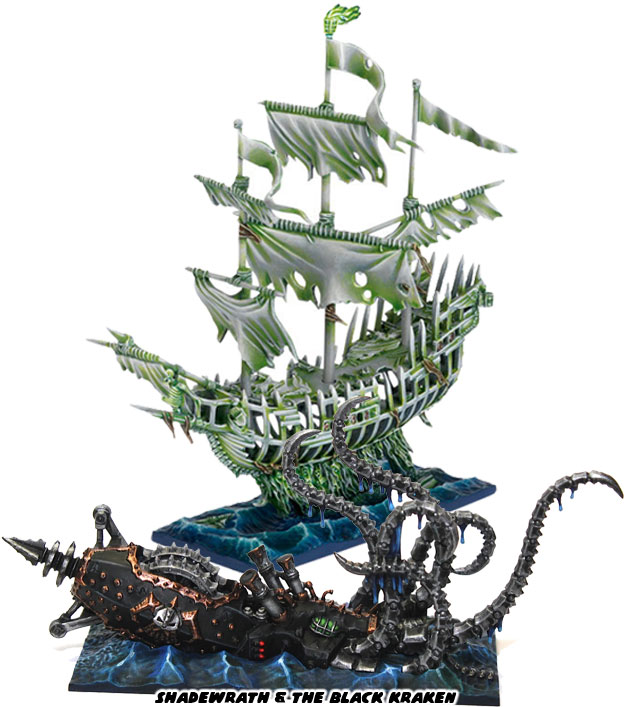
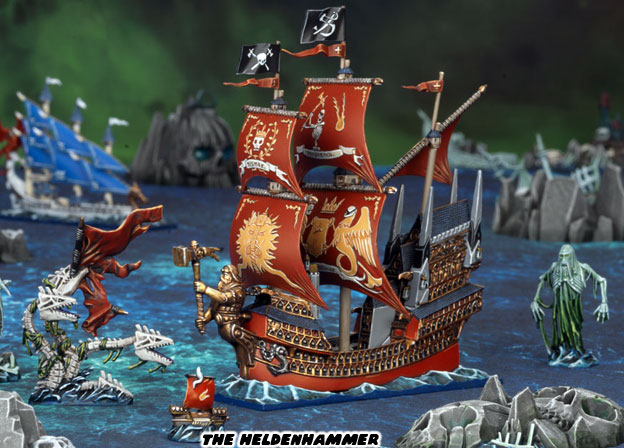
Mr. Kelly created a self-contained game in the tradition of the classic GW titles. Yet instead of having generic ships as there were in Man O' War this new game featured unique ships that represented the peak of each race. There was a ghost ship, a Vampire Count ship, an Elvish and Dwarf ship, the humanoid rat men known as Skaven had a ship made of the living copse of a giant fish, the undead legions from Nehekhara has a ship as well. There was even a mechanical submarine from the Chaos Dwarfs known as the Black Kraken. These would never be reproduced elsewhere and were in a scale much larger than the ships in Man O' War so that players could make out an insane amount of detail. There were beautiful models, for the good and evil sides, as well as terrain pieces all using the latest plastic modeling techniques. There were some playing card pieces but almost every important piece was represented with a miniature. The studio had even created a mat to play on, it was printed with brilliant hues that simulated a stormy ocean. It could be rolled up and folded without cracking or fading. I don't think something of that scale had been done by the company in almost 20 years! Dreadfleet was among one of the freshest game experiences in a generation and it really brought back all of the memories that made Man O' War such a great system as well.


Dreadfleet won several awards and gained critical acclaim yet it never became the phenomenon that Games Workshop had hoped. Nonetheless it should be remembered for being a return to the elements that put GW on the map in the first place. With a number of classic Games Workshop systems getting mobile releases as well as getting adapted for the PC on Steam then perhaps there might be space to be reintroduced to the Man O' War. If not then at the very least there might be a chance to see Dreadfleet get a new lease on life.

The worlds that Games Workshop had created was fantastic no matter what era you looked at. It didn't matter if it was the ancient world of Warhammer or the futuristic world of Warhammer 40,000. If you focused on just one part of the continuity chances are you would find an amazing game to build out of it. The next blog will explore the systems that focused on these details. As always if you enjoyed this blog and would like to sponsor me please visit my Patreon page and consider donating each month, even as little as $1 would help make better blogs and even podcasts!

 follow the Street Writer on Patreon!