A blog about my interests, mainly the history of fighting games. I also talk about animation, comic books, car culture, and art. Co-host of the Pink Monorail Podcast. Contributor to MiceChat, and Jim Hill Media. Former blogger on the old 1UP community site, and Capcom-Unity as well.
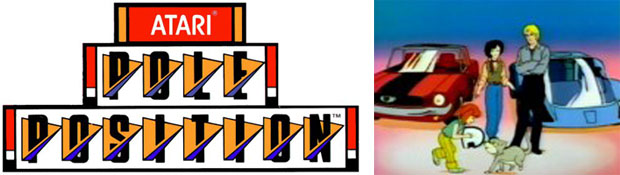
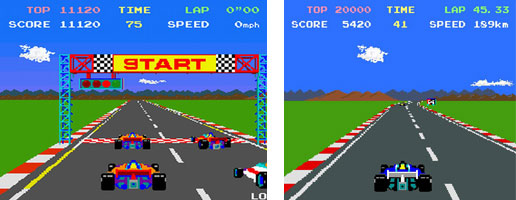
Pole Position, released in 1982 is a legend to gamers. Those that
grew up in the arcade could never forget the intro music and line
"Prepare to qualify." If ever there was to be a hall of fame
for gaming then consider Pole Position to be the first racing game
inducted. It's bright graphics, large car sprites and demanding
control defined the first great attempt at making a modern racing
game. The billboards in Pole Position featured popular Namco
characters like Mappy and Pac Man, further ingraining itself onto our
young impressionable minds. It was so popular that it even spawned its
own Saturday
morning cartoon.
The original Pole Position earned many a fan but when the sequel came
out it really found its groove. Pole Position II introduced three new
tracks, one of which was based on my beloved hometown track of Long
Beach. The inclusion of Seaside won over a lot of the people in the
southland including my friends and brothers. Both versions of Pole
Position were very demanding. The cars were very delicate and the
slightest bump would cause them to explode. Like Monaco GP there was a
high and a low gear, nothing inbetween. High score runs required
amazing reflexes and solid racing strategies, making it a frustrating
at times but still a highly enjoyable experience.
Most racing game fans cut their teeth on Pole Position. They will
always have a soft spot for the title even with the age of the PS3 and
Xbox 360 racing juggernauts.
It comes down to more than
nostalgia as the game continues to find audiences with the Pole
Position Remix for the iPod / iPhone. I salute this arcade gem
for helping push the world toward more realistic racing games. However
the Formula-1 game that I played even more than Pole Position or Super
Monaco GP was the one that was least realistic. Come back next week to
find out what game that was! But be sure to come back tomorrow as I
have an extra special interview lined up for you.
Did you ever enjoy this classic arcade game, or did you play it on the home consoles? Let me know in the comments section please. As always if you would like to sponsor me please visit my Patreon page and consider donating each month, even as little as $1 would help make better blogs and even podcasts!
Japan never went through a hot rod renaissance, a whole DIY culture
built around hopping up pre-war iron. The topics I spoke of last week
with regards to hot rod culture, car caricatures and drag racing were
almost completely unknown in Japan. Auto racing they understood and
also arcade gaming. The combination of both made for a couple of the
greatest arcade titles ever, the Monaco racing series.
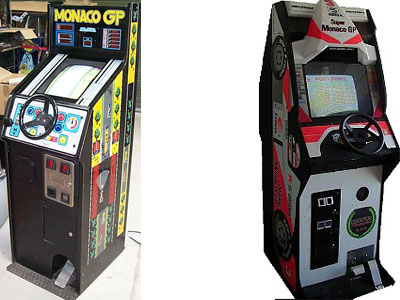
The original
Monaco GP released in 1980 was possibly the first racing game
that I remember being in color. It was also unique to me in how it
played and how the graphics were presented. The steering wheel and
pedals were similar to the earlier racing games from the US, but the
4-speed gear shift had been replaced by a 2-speed shift. Like other
Japanese racers people could move between low and high and high gear
and pray that nothing was in the way while in high gear. Most of the
Atari and Kee Games racing hits of the time were from a top down
perspective where players saw all of the track and controlled their
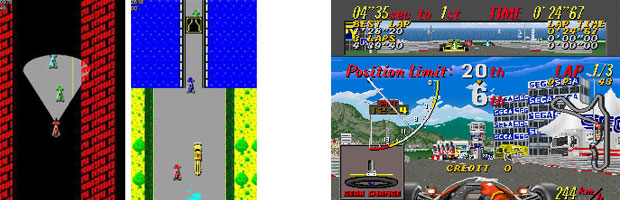
car as they drove around. Monaco GP continuously scrolled up where
paths and opponents would constantly be changing. This game also went
into tunnels where drivers could only see opponents that crossed in
front of the headlights. This added a very interesting dynamic to the
game. However as fun as this game was in the arcade, it was not an
accurate reflection of actual Formula-1 racing. This was Sega trying
to figure out what the whole racing genre was about, a decade later
they had just about perfected the template.
Super Monaco GP was the definitive racing game in the early 90's.
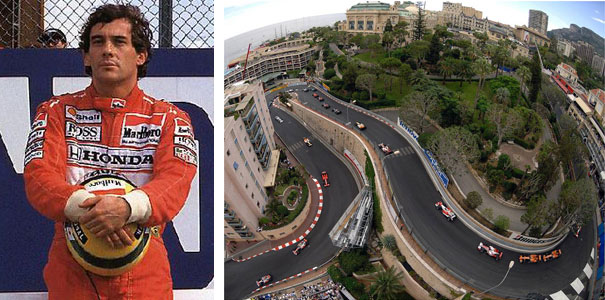
Sega capitalized on a great gaming engine and an even bigger name. Ayrton
Senna was the racing prodigy from Brazil. His name was growing by
leaps and bounds and was on the fast track to surpassing every major
sports star ever. He was a charismatic driver with an amazing ability
and a big heart. His life was about racing on the biggest stage and
fans adored him for it. Sega signed him to be the poster boy of Super
Monaco GP, the cap on their F-1 racing legacy. Whereas the original
Monaco GP played nothing at all like a real race the new title was
extremely accurate. The track was based on the real-world Monaco, one
of the most beautiful and challenging courses in the world.
The F-1 car is the pinnacle of racing machines, with a wide stance
and a low profile it is the jet fighter of the automobile world,
seemingly flying around the track and subjecting the driver to obscene
g-forces. If the F-1 is a jet fighter then the top fuel dragster is a
rocket ship. For only the dragster can claim to go any faster or push
the driver any harder... however that is only in a straight line. Most
racers around the world dream of competing on the global F-1 circuit.
To achieve a world wide celeb status rivaling any sports or Hollywood superstar.
Sega's new and improved cabinets for Super Monaco GP featured more
accurate steering wheels, gas and brake pedals. Where they were
superior to every other racer to-date was in the shifting department.
Gone was the unrealistic low and high gear from the early Japanese
games, gone was the clunky 4-speed from the American games. Super
Monaco GP had force feedback steering but that was not its major
advancement to the genre. It was the first arcade game to feature the
paddle-shifters. These were tabs located underneath the steering wheel
where drivers could shift gears by fingertip. Paddle shift technology
was just then being introduced into real F-1 racing and had become the
next evolution in transmissions. Today we can find paddle shifters on
several performance cars and daily drivers, but almost 20 years ago
this was cutting edge tech and only available on the most expensive
racing cars.
The new Super Monaco GP was also set in a cockpit view with a
rearview mirror and gages set up on the display. Races at this level
can sometimes come down to microseconds so all of the important
information had to be available on screen. The position for the grand
prix itself was even determined in qualifying, unlike other racing
games where you usually start dead-last. There was some repetitive AI
that could be exploited on the circuit but all-in-all this was an
amazing game that made a decent transition to the Genesis. This was
serious racing and despite the lack of polygon technology Sega managed
to capture the look and feel of Formula-1.
I remember visiting the arcade in the Lakewood mall over and over
trying to set new track times. There was a player that frequented it
also and we never crossed paths except for seeing our respective names
on the leader board. One day I was playing when the other person
happened to walk into the arcade. That day I did the impossible, I
qualified in the pole position using an automatic transmission. The
other player couldn't believe it, he'd never seen a qualifying time
that fast and in automatic, he asked if I was the NOE guy. I said
"yeah, you must be AARON." He nodded. He told me that I
really should switch to manual if I wanted to capture the top times.
The auto transmission option prevented players from reaching maximum
speeds in the game, it was a baby setting that I had grown
used to. Somehow I made it work as Aaron and I battled for the top
spot for months. It's a lot harder to beat the game with an automatic
transmission but I'd done it time and time again. When I finally got
used to the paddle shifter I became unstoppable on the game, pushing
myself and the car as hard as Senna seemed to do year after year.
My memories of the original Monaco GP and Super Monaco GP were
tempered by the untimely passing of Ayrton Senna. A few years after
the game's release he lost control in a race and hit a wall in San
Marino, dying on impact. I've never had a racing hero pass away doing
what he or she loved. I've seen them get wrecked, catch fire even, yet
always walk away. This was a grim reminder of the life they pursue and
the ultimate price for living on the edge each and every race. It
served to remind me of my own mortality. Someday I would pass on,
would I be remembered, and be loved for all-time like Senna or would I
fade away into obscurity? I grew up a lot in the mid-90's yet my
passion for car games never diminished. Tomorrow I'll look at the
game that got the entire planet into Formula-1 racing. Those that have
been around for a while should already know what it is. I hope to see
you back.
Did you have any favorite race drivers? Or did you ever follow Formula-1? Let me know in the comments section please. As always if you would like to sponsor me please visit my Patreon page and consider donating each month, even as little as $1 would help make better blogs and even podcasts!