I am a van man. I represent a dying breed of USA car enthusiast. My pride and joy is a 1997, B1500 Dodge Ram Van. I've spent plenty of time and money keeping it running over the years. Most of the van is stock including the classic "Metallic Forest" paint. There is very little that I have to do to make it perform. It has a powerful V8 and is actually pretty quick despite its size. On the freeway some cars mistakenly try to pass me by going around, thinking that the van is moving slower than it actually is. Before too long though most fall back in the same lane when they realize I'm clipping along well ahead of traffic. Despite its size it actually gets decent mileage, better than some SUV and trucks even.
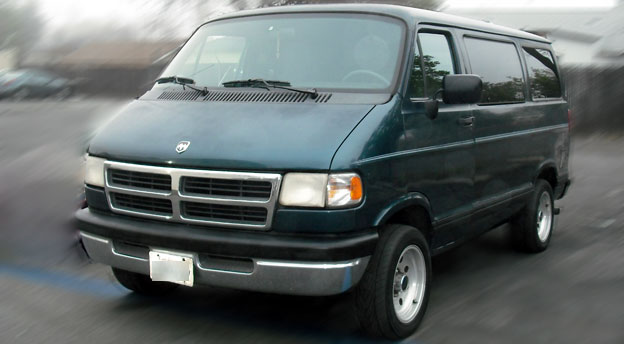
Unfortunately my model van went the way of the Dodo thanks to the economic crash and restructuring of Chrysler, the parent company. Around 2002-2003 Dodge completely changed the body on their van series. They ditched the windows and passenger seats and decided to go with a cargo-only build. The Ram label was switched out to the new Sprinter name.

The bland vans were based on the new parent company template. Mercedes Daimler bought up Chrysler and began streamlining production and cutting models in the US. The new van was actually based on the European Sprinter van by Mercedes. Daimler ended up owning Chrysler from 1998 through 2007 before Chrysler bought back controlling interest and was acquired by Fiat. Unfortunately Fiat never returned the van to its roots.

The Sprinter was ugly, garish and lacked the personality of the classic Ram vans. In fact, Daimler completely missed the fact that van culture was a genuine part of American history. The van enjoyed a sort of cultural peak from the late '60s through the '70s. In fact 1977 saw two dueling movies, the Van and Supervan. This was something that Honda did not overlook when they were trying to get more interest in their Odyssey Mini Van. They released a Van Gods commercial at the start of their new campaign. The use of airbrushed characters and iconography helped rekindle a sense of nostalgia for older drivers.
The follow-up commercials The Van is Back and Respect the Van relied on nostalgia in equal measure. Unfortunately neither Honda nor Daimler actually understood what van culture was all about. All automobile brands have followers and enthusiasts. Each car is not only a means of transport but also offers a way to express the identity of the driver. If a car could be considered a blank canvas then a van could be considered an entire wall, ready to be painted or decorated any way the owner wanted. The interior of the van was also open to more configurations than any car could ever handle. It could be stripped of seats and benches and made into a utility van, keeping tools and hardware safe from the elements. Or it could be fitted with a lavish interior, entertainment center and bed for traveling and entertaining. Some owners were able to find a balance between the practical and opulent uses for their vans. Unfortunately the passenger van disappeared at the start of the millennia and with it went the enthusiasts.
Or so I thought.
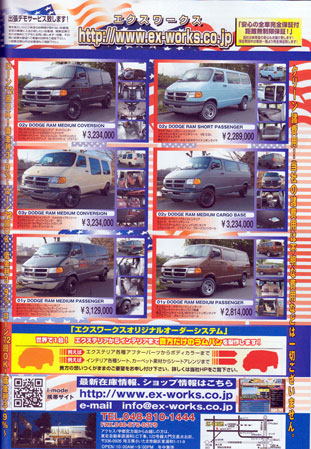
It turns out that a good number of Ram vans ended up overseas. The Sprinter van was a great choice for big city deliveries but it was not a good choice for rural areas. Japan had a larger concentration of narrow roads and mountain passages than the US or Europe making the top-heavy Sprinter van a poor choice for many. The more compact Ram was not only good for deliveries but as a passenger van it was much more spacious than the vans or mini-vans developed by Toyota, Honda or Nissan. It actually ended up creating a very strong following.
In the previous blog I had mentioned Go Nagata, the founder of the Setagaya Air Force Base. He was actually the senior correspondent for Neko Publishing's Daytona magazine. The magazine is dedicated to Western car culture and focuses on the Japanese that find, restore and roll around in American cars. As a Western car enthusiast Nagata was interested in word of a Dodge van group getting together to run a Grand Prix. He documented this in Daytona issue 255.

The title of his article was "D-Van GP a celebration of the stupid / foolish that came this year."

The image of a group of Dodge vans peeling around a turn did more than piqué my interest. It turned out that the D-Van GP had been a tradition almost as long as the Ram vans had been around in Japan.

The group raced on the Ebisu Circuit, specifically the West / Nishi course. Think of the Ebisu Circuit as a racing fan's Walt Disney World. There are multiple courses, racing schools and even a wild animal safari park in the middle of the expansive complex. It is exactly the type of place in which driving enthusiasts can spend and entire vacation.

It turned out that these were hardly anything but stock vans racing on the circuit. They had undergone a number of alterations to make them track ready. A tube frame was welded for strength. The transmission was completely changed out and motor tuned for racing. Some of the vans were even equipped with nitrous oxide. The suspensions on the vans were also completely redone and reinforced. The Dodge vans actually had great suspensions for commuting and cargo, however the wear and tear from high speed stops and starts would easily break down regular vans on a racing circuit.

When the Japanese auto enthusiasts got into something, they got into something all the way. Racing Dodge vans was no different. The same do-it-yourself mentality that was the roots of NASCAR was evident in the article. Month in and month out Mr. Nagata had demonstrated this on the pages of Daytona. Groups all over Japan would get together to strip down, hop up and trick out rides. Performance and style went hand in hand regardless of what make, model or even country of origin their rides were from. I was so impressed by their enthusiasm I was wondering what it would take to make my own van race ready.

The aggressive-looking vans may have been thought of as slow and cumbersome to most motorists but those that drove them knew how sporty they could be. The Japanese didn't approach the Dodge vans in the same ways that the US did in the '70s. There were no waterbeds, shag carpeting or disco lights on the interiors. These new vans were meant for a different type of hauling.

The enthusiasts that Mr. Nagata had written about were rare but not unique. The Japanese had been passionate about building racers with street roots as much as for the racetrack for several generations. In popular culture some of the most successful comics and cartoons celebrated car culture. The next blog will explore these things. As always if you would like to sponsor me please visit my Patreon page and consider donating each month, even as little as $1 would help make better blogs and even podcasts!