In 1985 Jaleco released the puzzle racer City Connection. It was a familiar maze type game in which you were supposed to color all of the pavement in one color before proceeding to the next stage. Along the way you were supposed to avoid the cops and try not running over a cat... To help get you out of a jam you could throw oil cans at the cops to cause them to spin out. Simple and to the point.
What caught my attention was the presentation of this title. Unlike Rally X this was not an overhead game but a side-scroller. The graphics were very bright and detailed. The backgrounds and music would change on every stage, taking the car all around the world. The freeways that player painted were multi-tiered. The car had the ability to jump up and down these different tiers. It was the jumping element that I found awesome. The car could jump on command for no other reason than "just because". It's compact, stylized body, looked very much like a Choro Q made these animations really stand out.
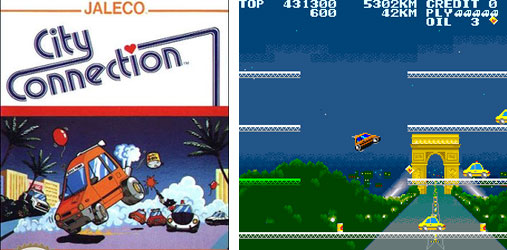
However the car in City Connection couldn't touch any obstacle without losing a life. It was far too fragile for my tastes. But I was intrigued with the leaping ability and how it could be used in a racing game. The one that had gotten the formula right had debuted a few years prior.
Bump 'n Jump (BnJ), Burnin' Rubber to my pals overseas was made by Data East in 1982 but released by Bally Midway here. It was an overhead racer, comparable to Monaco GP. However the rival cars in this game were far more stylized and aggressive. The player would have to fight for position and get a bonus for running an opponent into a wall. The cars were really odd looking, blocky and ugly and the only time you saw any detail was when the player car jumped. It was the jumping itself that really sold the experience. Players could move left and right mid-flight and land squarely on an opponent. Smashing them in the process and gaining a speed boost. Just like City Connection this feature never had to be explained, the car jumped as part of the game mechanic and it was fantastic.
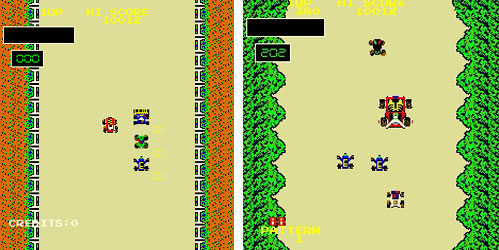
Players had to mind the courses as the walls of the tracks would zig and zag, pinching groups of rivals together and blocking the path. The car couldn't jump at any time either. It had to be going above a certain speed or else the jump button wouldn't register. Some tracks constricted, went to dead ends or had drop offs into the ocean. Players had to become masters of timing. They had to read the course, their opponents and know when to jump and where to stick their landings. Sometimes the landing was on a narrow piece of road in the middle of the ocean, from which the player had to leap off of right away.
The play, design and music were all memorable but what I always admired most about this game were the impressions it gave different artists and publishers. No two studios interpreted the game exactly the same. How did the car really look, who was the driver, what were the rivals? What was the plot of the game, if it even had one? Did any of this even matter? Or was it a sign of the early arcade experience, games existed for the sake of games and players made up the connections as they went along.
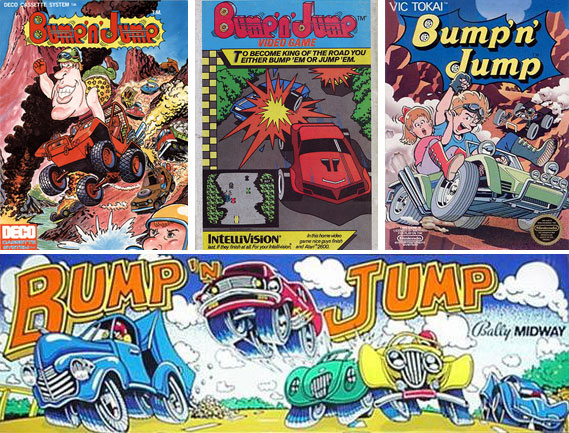
Bump 'n Jump appeared on several consoles over the years, many often much better-looking than the arcade original. The NES version was actually very impressive as it added a plot and purpose to the racer and opponents. The elements introduced in Bump 'n Jump would continue on through rival titles.
A year after Bump 'n Jump Sega released an isometric racing puzzle game called Up'n Down. This game featured a VW Beetle riding on a single lane road collecting colored flags. Other cars and trucks would be running along or against you trying to block your path or crash into you. The track continuously scrolled on a loop pattern until all of the colored flags had been picked up. The game was actually tricky for a puzzle racer. It was the first isometric game that I remember giving the cars a sense of mass. The beetle would lose momentum as climbing a steep or long gradient. Conversely downhill sections would provide a speed boost. The car could even go in reverse to collect a flag that lay around the corner. There weren't many games at the time where going in reverse was an option. The jump featured in the game allowed you to not only clear opponents but also sections of tracks. All the while you had to be mindful of rivals coming from ahead and behind as well as sections of track with gradients as opponents would sometimes also lose momentum and come rolling backwards into your path.
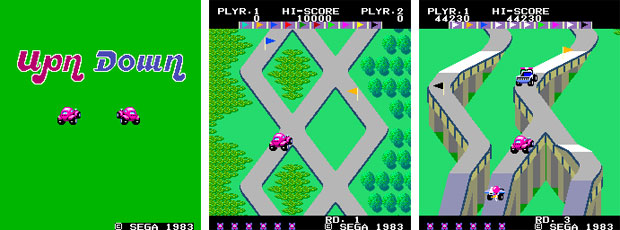
Sadly Up 'n Down didn't break enough ground to keep me interested. The wide open tracks of Bump 'n Jump and use of jumping were much more fluid by comparison. There was one game in the arcades that updated the idea of Bump 'n Jump, or ripped it off depending on your point of view.
In 1989 Capcom released Mad Gear. It was an atmospheric future racer in a familiar overhead setting as BnJ. It also featured similar mechanics involved with jumping, needing speed in order to jump and landing on opponents for a score booster. The game had lots of interesting details as tracks and accompanying music changed themes in each stage. Most of these tracks were floating a mile or so above the ground, how or why these roads were built never really mattered. They just looked cool as they ran underneath dinosaur bones or between Mayan ruins. These tracks predated the Sega racers by years. Here's a bit of trivia for you, the gang in the Final Fight series was named after this racer.
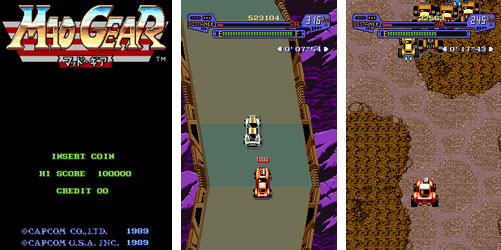
Opponents ranged from crazy bikers that would jump onto your car to massive segmented trailers which behaved like land trains. From time to time a helicopter would even fly overhead dropping bombs onto the track, and unlike Spy Hunter your car had nothing but a jump in its arsenal. Keeping an eye on the tracks and opponents was part of the challenge, as was finding fuel. The player was given a choice between three cars, each with their own strengths and weaknesses, the diesel truck did better on fuel but ran slower, the F-1 racer clipped along quickly but ate gas just as fast. The main car, the Mad Gear, was the balanced ride. Players that managed to complete the game on one quarter, and that was possible if the dip switches were set to normal, were rewarded with a free game and could choose to race in a different car. This second play through gave a definite ending where the car would thank you for the experience. I thought it was a nice detail that helped frame the universe the game was set in. The car was the partner in the race rather than a human navigator. An arcade version of KITT, complete with turbo boost jumping action.
I could understand that many arcade gamers couldn't get behind racing games where the car did fantastic things. However there was something about using the car as a weapon that intrigued them. Unlike games where the car was loaded with weapons and behaved like a FPS character, the car could still move and feel like a car but become the ultimate blunt force weapon. Come back next time to see the best drivers that kept that in mind.