Showing posts with label kobe bryant. Show all posts

Friday, June 14, 2024

Remix Culture, how Asian designers changed the game, part 8

In the previous entry of this series I mentioned which of Michael Lau’s 100+ gardener figures was my favorite. For those that missed it the character was Jordon, a seven-foot-tall basketball player from the gardener universe. His design hit me with the same force as seeing Lau’s original Maxx figure from a few years prior. It took me a while to understand fully why I enjoyed the figures as much as I did. The first thing I did was acknowledge that Lau had captured street culture in an entirely new art form. The gardeners looked just like my friends, and heroes in 1/6 scale. That was how I thought about it for decades.
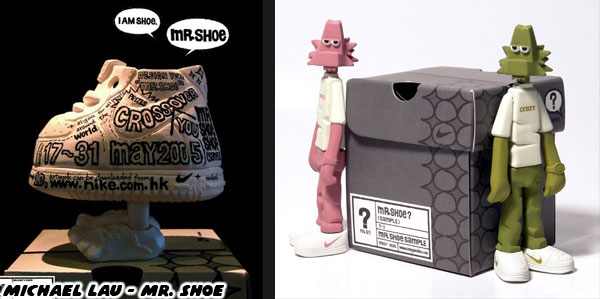
Only recently however did I realize why my reaction went much deeper than that. Lau’s gardener figures represented an idea, and not an ideal. As I said previously they were not an unattainable beauty standard like a Barbie doll. They were imperfect figures. The gardeners had buck teeth, big ears, acne, scars, and pot bellies. They were anxious, fun loving, brooding, competitive, and loving at the same time. They were as human as any one of us. They were also icons, representatives of the culture.
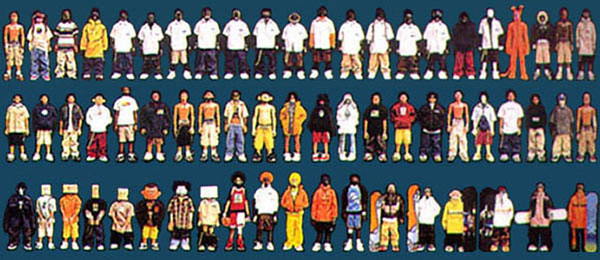
To me the gardeners were a perfect snapshot of the world I grew up in. Eventually I would grow old, and die. As would my family, and friends. No matter how well my hero Tony Hawk could skate, the wheels would eventually fall off. One day he’d finally hang it up, and leave behind his name, and legacy. Maxx on the other hand would always be the young, determined skater. He would forever be youthful, forever be idyllic, forever be a brilliant skater. By extension the culture we lived in would also last forever. Certainly characters like Mickey Mouse, Pac-Man, Mario, and Bugs Bunny could also last forever, but they represented corporate mascots, and not my family, and friends. At the core this was what I enjoyed best, the symbols that the gardeners represented. If I couldn’t collect every figure that Lau released, then I’d try to focus on the ones that I vibed the best with. 

My older brother was into 1/6 scale figures well before I was, but even he agreed that Lau was working on another level. He would point me at the manufacturers like Hot Toys, and Dragon Models as they made the comic book, sci-fi, and movie figures he collected, but also the more street-influenced designs. My brother also pointed me to Enterbay. They had the NBA license, and they were releasing highly detailed 12” figures. I couldn’t deny the quality of the sculpts. They easily captured the look of the actual pros they were based on. Their uniforms, and accessories were perfect. Even the shoes were correct for the player. When I first learned that my brother was spending on average $250 per figure I was shocked. I told him that there was no way the figures he was collecting were remotely worth what he was spending. Mind you he was collecting before I even knew who Michael Lau was. 

Without saying a word he took out one of his Punisher figures, and asked me to have a close look at it. As I held the figure I commented how heavy it was, and solidly built. It could hold any pose without loosening up. It really wasn’t anything like a Barbie doll. I turned it around, and around looking for imperfections, but there were none. The head sculpt was scary realistic. I could see the veins on his neck, the eyelashes on his face, and the scars on his head. The stitching on his trench coat was flawless, his boots, armor, and costume looked as if the comic book had been brought to life. I handed the figure back to him, and said that it was impressive, but I still wasn’t sure about the price. Without saying another word he opened the trench coat, and started removing all the weapons he was carrying. One by one he showed me the knives in sheaths had actual metal blades, that the magazines could be removed from his machine guns. When he opened the revolver and shook out the individual bullets in the cylinder I never questioned him again.

I explained to him that as much as I appreciated the absurd level of detail that went into the NBA figures that they just weren’t for me. I said for starters they were just out of my price range, no matter how much I loved a particular basketball player, I couldn’t justify the purchase. It didn’t stop me from being jealous of the people that were able to collect them without a second thought. My brother taught me that some artists sculpted, and painted custom heads for figures. Others made 1/6 scale uniforms, sneakers, and various accessories. I could invest as much, or as little as I wanted building a collection. I could buy an inexpensive generic 1/6 body, and get a custom head, and uniform of my favorite players. I’m not going to lie, I did consider going down that route. When I found out that some collectors turned entire rooms into entire 1/6 scale NBA courts, with working baskets, and Jumbotrons I just about lost my mind. I didn’t have that kind of space, let alone budget. That didn’t stop me from searching online for how much I could get selling my blood. My brother was leading me down a very scary rabbit hole.

Although I had no intention of buying an Enterbay figure, I was intrigued by their NBA accessories. An NBA locker complete with hangers, body wash, deodorant, and shampoo was surprisingly cool. It would make for a good backdrop in a pro basketball diorama. Then I found out that the company also recreated the various trophies from the league. These included the MVP, scoring, All-Star, and Championship hardware. Unfortunately most of these could only be acquired if you bought one of the deluxe figures, which could sell for up to double the price. Of course the best accessory that they offered was a scale hoop, and backboard. It even had a working play clock. It was absurdly cool, and prohibitively expensive. I could never justify those purchases. Or could I? Not too long ago one of Lau’s contemporaries created a custom version of Michael Jordan. Eric So had been at the game nearly as long as Lau. He had collaborated with Sprite, Motorola, Playboy, Adidas, and other high profile clients as well. His figure was subtle, like a CoolRain design. It was nice but not half as cool as the Jordon figure by Lau.

I was convinced that I would never find an urban vinyl figure that scratched the itch. Thankfully I had already stumbled across a set of figures way back in 2002. In order to capitalize on Lau’s popularity eBay, and toy importers were tagging every vinyl release from Hong Kong as being from Michael Lau. There were a few actual figures, but a lot of clones, and bootlegs as well. The one that stood out to me was a set of 1/6 scale figures called Super-X Basketball. The box art was very much in the Lau style. There were even smaller figures that had been released called action figure minis. These were slightly taller, and more articulated than Lego figures. Thankfully the demand wasn’t too high for the set, and I was able to score all five of both the large, and small figures relatively cheaply.

I was hoping that an unscrupulous seller hadn’t just walked off with my money. I had to wait forever for a giant package to arrive from China. When it did my brother joined me for the unboxing. The figures were everything I expected, and more. I started with the minis. As I opened the box, and foil package containing the figures I got a laugh at the packaging, and design. As with most unlicensed toys from China there was nothing in the packaging that said NBA, or would infer these were based on real people, or real teams. Yet long time basketball fans could gather everything they needed from looking at both the style of each character, the colors of their jerseys, and numbers as well.

Each of the minis not only came with a complete figure, but they also had an alternate top, with a basketball, and backpack as well. The figures were printed with their own unique expression, and hairstyle, or bald head depending on the character. In case you couldn’t tell the designers skirted copyright laws by letting fans infer who each character was based on. The colors on the jersey, and even style of font were based on existing NBA teams, and players. For those unfamiliar with the lineup #3 was based on Allen Iverson, his uniform was based on the Philadelphia 76ers. #34 was based on Shaquille O’Neal, and his jersey was modeled after the Los Angeles Lakers. The same applied to #8 who was based on Kobe Bryant. The manic-looking #15 was based on the high flyer Vince Carter from the Toronto Raptors. Rounding out the cast was #23 who was based on Michael Jordan from the Washington Wizards.
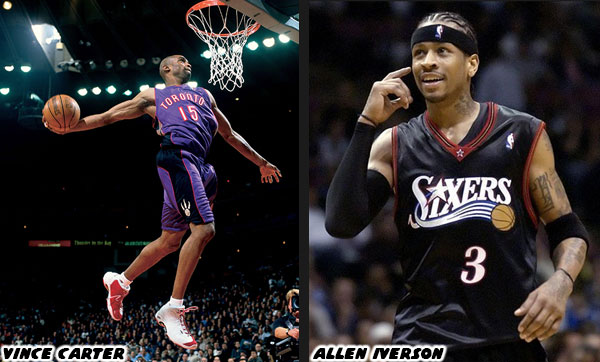
The figures were very much a snapshot of an era. Jordan had moments of brilliance during his Washington era, but he was about to retire while Kobe was coming into his prime. Iverson was one of the most influential point guards of all time, he was also one of the players that brought street credit into the pros. Shaq of course was still a force of nature. Carter was a human highlight reel with his incredible athleticism, and crazy dunks. These players not only represented a great cross-section of the all-stars, but could arguably be considered the greatest starting five of all time. 

It would be hard to imagine coming up with a superstar team of players from the present, or past that could beat all of the Super-X ballers in their prime. This was what I really loved about the crew, and about the gray era that the Hong Kong designers were working under. They were creating the spirit of the greatest team that never existed. When I opened up the larger figures I was in for a treat. But I’ll talk about that in the next blog. Were there any toys, sports, or athletes that you felt passionate about? Did you have a favorite basketball player? Tell me about it in the comments section please. As always if you would like to sponsor me please visit my Patreon page and consider donating each month, even as little as $1 would help make better blogs and even podcasts!
follow the Street Writer on Patreon!

Friday, September 18, 2015

How fight culture became fighting game history, part 35

Capcom had the greatest success in casting minority characters as fighters without relying too heavily on stereotype. They presented quasi-realistic fighters from various nations in each incarnation of the series. In order for gamers to pick up nationalistic cues they dressed each character appropriately. The military fighter from the US wore camouflage, the karate fighter from Japan wore a white gi and the Muay Thai fighter from Thailand wore shorts. Three of the black characters in the first three games were boxers but the three were unique. The original, Mike, was a boxer with street roots, he wore sneakers and battled with taped up hands. The second, Balrog / M. Bison, looked like a boxer in training. M. Bison was actually designed to be an evolved version of Mike, one that had achieved his dream and became a boxing champ but threw it away chasing women and money. The third boxer, Dudley, was dressed in a fine suit. He represented the champion boxer that never took his eye off the prize. In all Capcom had managed to respect the genre and their audience in equal measure by avoiding the stereotypes that seemed to keep popping up in the early SNK titles.

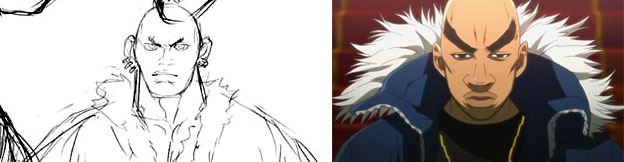
Street Fighter IV was released in 2008, it was 11 years after Street Fighter III had come out and a generation removed from the stereotypical fighters from 1994. A gamer might assume that in that span of time Japan had become more familiar with the various ethnicities that made up the USA. After all the internet had only served to make the world seem smaller by making trends move faster. That seemed to be the case at Capcom. During the early stages of character development a new fighter named King Cobra was created. The character looked interesting as he was a mash up of Hip Hop culture and traditional karate. He had a shaved head and sported and earring, his gi had a fur lined collar. The character looked very similar to Meera, a character from the manga Tokyo Tribe by Santa Inoue, Mr. Inoue had done an exceptional job of bringing Hip Hop culture, the language, music and fashion to his native Japan. He had followed it for as long as he could remember, which was interesting considering that the Japanese had been deemed an insular society by the rest of the world.


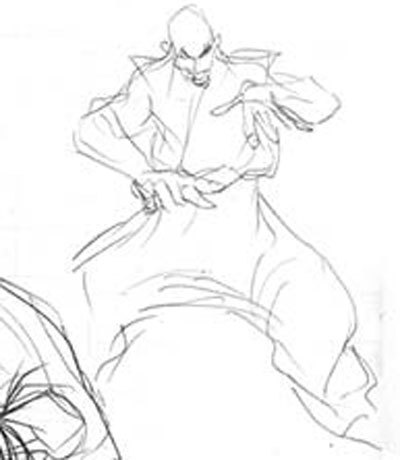
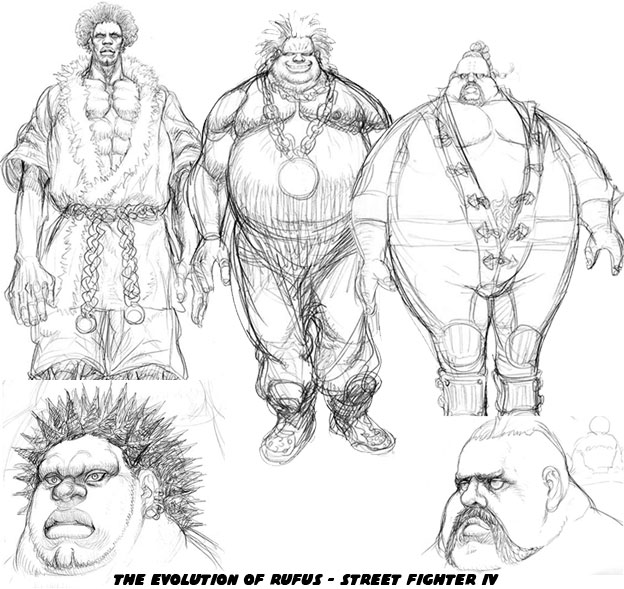
The designers at Capcom did not have to travel far to learn what made a black culture interesting and how to bring that into contemporary character design. Tokyo Tribe had done all the work and acted as a primer for urban trends. Readers could find out about mix tapes, graffiti, criminal organizations and thug life. Plus they could see how strongly it contrasted against the Japanese landscape but was acceptable as a youth movement. Meera was actually a villain in the series which made the points of reference all the more unique. King Cobra wasn't always a young karateka. In his earliest concept art he was actually a giant. He was designed to be a rival of Ken. The studio wanted Ken to have his own Sagat, or impossibly big obstacle.

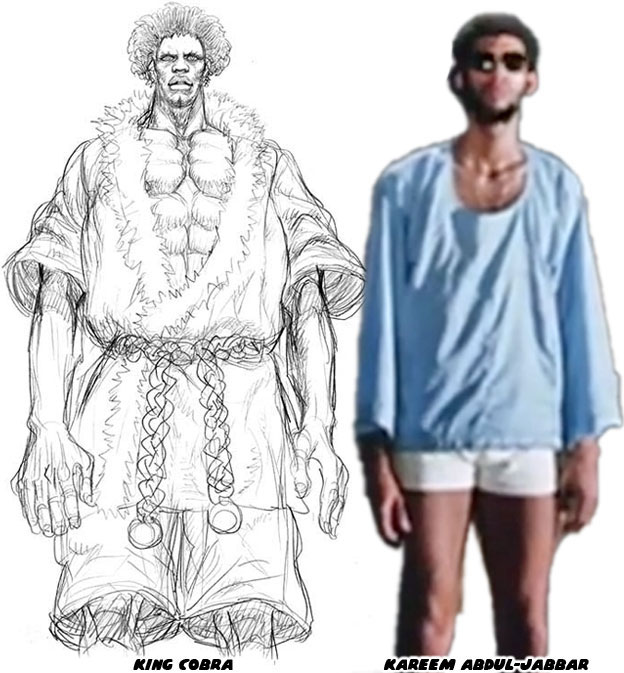
Before the Meera look King Cobra was tall and lanky with a big afro. The design was taken from Kareem Abdul Jabar, a villain from the Bruce Lee film Game of Death. Street Fighter IV designer Daigo Ikeno thought that the point of reference was a bit dated. Although martial arts film fans considered the piece timeless the character was not. Jabar was barefoot, sported tiny shorts and a long sleeve shirt. He looked a little silly by the standards of today. There didn't seem to be a strong unifying costume for the Jabar as there were for the other fighters that Lee had faced in the picture. Jabar was actually vacationing in Hong Kong when he decided to visit his friend and martial arts teacher. Lee took the opportunity to cast him in a role. The costume shop didn't have anything ready for the 7' 2" NBA center so he just wore whatever he had handy. This would explain the leisurely clothes.


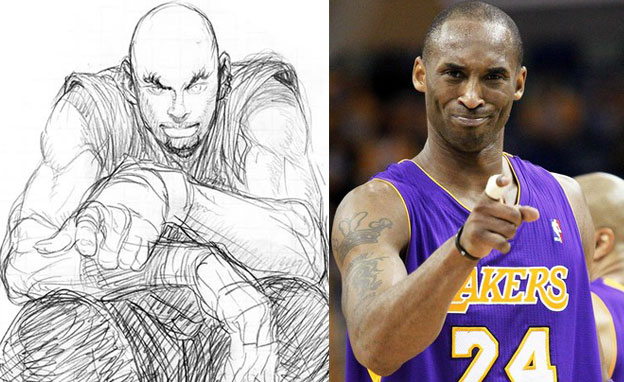
The original design of King Cobra / the Black Cobra gave away that the character was from the '70s, it was a step back to Mr. Jones territory. Ikeno was looking for a younger face and a more contemporary cultural touchstone. The Hip Hop elements seemed obvious. The character would be a young upstart looking to dethrone Ken. He would be equal parts attitude and ability with an homage to the Karate Kid (the original one, not the remake) thrown in for good measure. Ikeno wanted Cobra to be appealing to new players yet also threatening to the older guard. Abdul Jabar needed to be replaced as the template and even Shaquille O'Neal had become dated. Kobe Bryant became the most obvious choice. He was tall but not gigantic. He was slender but still very athletic. The face, the earring, the charisma and confidence of the young Cobra were very reminiscent of the Black Mamba, the nickname that Bryant gave himself.


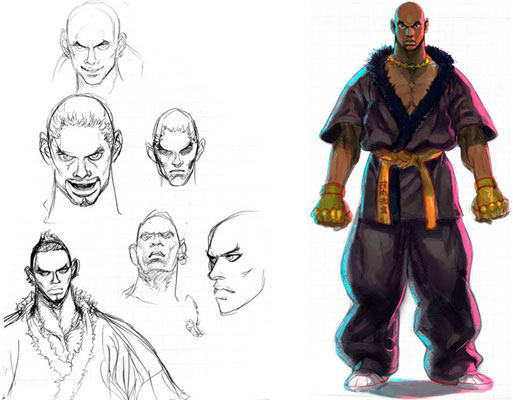
King Cobra was a character with an exceptional design. The color of his uniform was a solid black. It balanced the iconic white gi of Ryu. The color of the gi was contrasted by the gold belt and gold punching gloves of the character. These elements were repeated with the gold necklace. His costume looked classic but actually had a non-traditional cut. He was one of the rare SF characters that had a mid-sleeve gi. Ken, Ryu and the Brazilian Sean all wore sleeveless tops. The Japanese Makoto had a traditional long sleeve gi, but Cobra had a mid sleeve. The sneakers were a perfect modern touch. They were very subtle, and yet, could not be ignored. In the very first Street Fighter Ryu wore red slippers. It was much easier to imagine him traveling from town to town challenging opponents while wearing slippers.

Cobra represented just a hint of Hip Hop culture, truly an artistic global culture and not limited by USA ideals. It was just enough to remind audiences that he was the modern urban youth, not a jet-set playboy like Ken, nor a wandering solemn hermit like Ryu. The gold chain on his neck was not too bold or thick, he could never be confused for the Blacker Baron or Joe Fendi. He did not sport any sort of earrings, medallion or emblem that would have dated his appearance. His jewelry was very clean and simple. The ruffled edge of his gi gave him personality. The sneakers were classic, something that would have worked in any decade of the modern era. They were appropriate for the look that this character represented, a cue from the traditional and modern, not unlike the wrestling boots that contrasted the dress of Chun-Li. The sneakers were something that could be worn while traveling down city blocks walking into dojos and beating people up. The legend of the barefoot master did not make much sense in the modern city. Cobra was young and bold and not scared to bring just a little bit of his world into the Street Fighter universe. His design was not so bold as to try to change the universe and our attitudes towards the established characters. His belt and uniform reminded us that he was mindful and respectful of the martial arts.


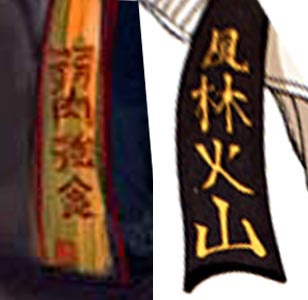
Yellow was usually the first belt awarded to students learning karate. However Cobra's belt had more of a golden hue to it, allowing us to ponder if he was a master and of what form. The characters on his belt spelled out an additional layer of detail from Ikeno. Most SF fans knew that Ryu had writing on his belt. Thanks to my friends Bob, Cesar and Lester for coming through with the translation and meaning. Ryu's black belt reads Fūrinkazan, literally "Wind, Forest, Fire and Mountain" It was paraphrased from Sun Tzu's The Art of War: "Move as swift as a wind, stay as silent as forest, attack as fierce as fire, un-defeatable defense like a mountain." This was an epic sentiment that shaped the character and personality of Ryu.

King Cobra had a different statement on his belt, Jyakuniku kyoushoku wich roughly translated to "survival of the fittest / law of the jungle." These things combined with the gold and black and cobra logo on the back of his gi made him a subtle homage to the Karate Kid villain Johnny Lawrance. It was yet an additional layer of detail that Ikeno laid down that would have gone over well with audiences. Certainly this was a design for a strong black fighter that would have been very appealing to Americans. It was much better presented and respectful of the fighting arts than Dee Jay or the basketball players mentioned in the previous blog. King Cobra followed the traditions of the classic characters yet visually did not have to bring up racial prejudices or gimmicks to make him stand out.


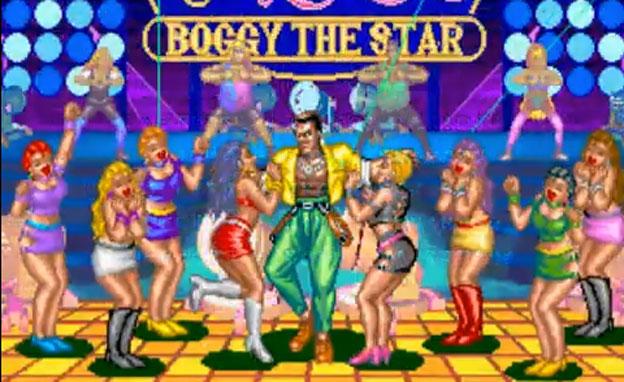
There was one thing that was troubling about the design, this was not something that was seen but rather unseen. Since the character was never finalized there were no models or animations to look at. Players didn't know that the original plan for the character was to give him "Breakdance Kung-Fu" as his fighting style. It was inconceivable that the designers at Capcom had really not caught up with the times. Just about everything worked well for Cobra except for his moves. The black-entertainer-as-fighter had died with Boggy back in 1994. At least players in the West had thought the stereotype had passed. Besides, breakdancing was considered a "fad" in mainstream US culture and only hardcore dancers still supported it in the States.

The connotation of all blacks being good dancers was a stereotype as old as the Sambo himself. One of the oldest ideas about blacks was very dehumanizing. According the slave owners the blacks were born with natural rhythm and an ability to dance. They insisted that the savages had no concept of self and that they "would even dance on the auction block." The decedents of the slaves were some of the early successful entertainers in turn-of-the-century America. Unfortunately many of them were paid to perform as minstrels. They had to act like clowns in black face makeup and be the ugly parodies of themselves that the racially charged audiences expected to see. They sang and danced on stage and in film so they could afford a better life. Unfortunately no matter how rich or famous they got they were still second-class citizens. They could not eat where they wanted, travel where they wanted or even consort with non-blacks without fear of reprisal by racist groups. African-Americans had therefore been very critical about their portrayal as dancers and entertainers rather than people first and foremost for most of the 20th century.


From the early black and white pictures to the first audio and full-color feature there had always been an African-American pioneer working in film. It took a long time for Hollywood and the rest of the world to appreciate the contributions of blacks not only in entertainment but in "American" culture. If someone made the mistake of assuming that they were natural at it they could be corrected. Blacks worked hard for everything they had become famous for, they put up with tremendous amounts of hate and bigotry while claiming a slice of the "American Dream." The lessons from history were obvious. If minorities wanted to be taken seriously in the arts or entertainment then they had to work hard for it. If they wanted to see minority characters in gaming then they had to become programmers, designers and developers as well. A generation would grow old waiting for the publishers to catch up.


Whether King Cobra was the Black Mamba in disguise, a positive role model like Dudely or a throw-away character like Boggy would never be known. The Japanese were merely reflecting US pop culture. They did not have the complete picture of black society in the USA. However not every developer relied on stereotypes while creating a lineup. Not every developer believed in the images that they had been fed by the media. Many travelled the world, did their homework and learned that different ethnic groups were much more interesting than any news clip or music video. When these designers went back to the drawing board they developed characters that were much more universally appealing. They accomplished this by incorporating actual cultural cues and details into their black figures. There were reasons why the genre survived the rise of the home consoles through the '80s and the arcade crash of the late '90s. Truly great fighting games had a diverse fan base made up of every ethnicity and background. When these players saw a diverse cast, one that they could identify with, they were willing to embrace the series. The audience would continue to support the publishers as long as they continued developing great games with a broad well-respected cast.


When the developers in Japan and the US took the time to incorporate real elements from history and society into their titles they accomplished something profound. They managed to expose the world to systems and cultures they might have previously never known about. The fighting genre was indeed very influential to a generation, but not in the ways that the politicians had made it out to be. It did not turn fans of Street fighter and Mortal Kombat into cold-blooded killers. It did however color the perception of young impressionable gamers by making them aware of how amazing the world really was. The next blog will explore the ways that one of the darkest times in modern history also changed a beautiful art form. As always if you enjoyed this blog and would like to sponsor me please visit my Patreon page and consider donating each month, even as little as $1 would help make better blogs and even podcasts!