Showing posts with label dinosaur. Show all posts

Wednesday, March 31, 2021

Who will rule The New Urth? A 1UP classic...

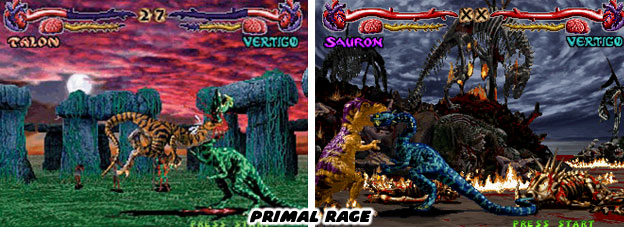
Primal Rage was released in the mid-90's. If you've never played the game let me sum up. It was a fighting game featuring giant monsters.


That hardly sounds like a description worth anything. Especially since I'm bringing up old games. Let me try and set the stage and put the game in context. After 1992, following the release of Street Fighter II, fighting games were en vogue. Every studio on the face of the Earth was scrambling to release a fighter of their own.

Countless crappy clones came out. Some were decent but the majority sucked. It seemed that while any studio could put together a fighter, they lacked what it took to make it great. The animations were choppy, collision detection was sloppy, the designs rubbish and the balance nonexistent. In the USA it seemed that while we lacked the polish of Funamizo and Okamoto's Street Fighter games, we made up for it with violence. None of the western fighting games as unique or violent as Primal Rage.


The story for Primal Rage was great sci-fi. A meteor crash destroys civilization and unleashes ancient gods from suspended animation. Tribes of men follow around these gods and worship them from the onset.

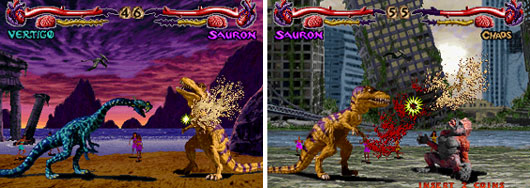
The art direction in the game is superb. The levels are all over-the-top designs for Earth gone savage. Cities lay in ruin, oceans have shifted and volcanos erupt in the background. Some levels are set around lush jungles while others in a frozen wasteland. All of the levels use bright colors, weather effects and dramatic lighting to achieve an original look and feel.


The main characters, mostly dinosaurs are very memorable. Many arcade gamers think that Atari came up with the look and feel of the characters all by themselves. Those that read comics know that the designs and color schemes were directly lifted from Ricardo Delgado's Age of Reptiles. Anybody that reads this blog, is into great art and comics should think about getting both Age of Reptiles trade paperbacks if you haven't already.

These creatures and the whole game are memorable because it marks the first time stop-motion clay figures were used in a videogame. The Neverhood claymation videogame was released a year or so after Primal Rage. Prior to that most fighting characters were hand drawn sprites as the 3D polygons in Virtua Fighter were crude by comparison. There is a certain charm to seeing actual, physical objects used as sprites. While many were awed by the CGI and polygon models in future games one could still appreciate the detail that went into the creation of actual clay figures for the game.


Atari released multiple updates for the game while it was in the arcade. The game was loose, unbalanced, choppy and subject to many glitches. Aside from that it was a fun experience. Fun in the sense that the controls were unique. There were four attack buttons and a joystick. Rather than inputting the commands like you would in Street Fighter II, players had to hold and release the buttons while moving the joystick. This completely changed the pace of the typical fighter and allowed for players to learn new strategies.

It is possibly the violence that everyone remembers most from the game. Mortal Kombat has already set the standard for shock in the arcade with the advent of the Fatality. Once the bar had been set there was nothing short of a Hellraiser game that could shock the average arcade player. Primal Rage was as close as we'd ever get to topping Mortal Kombat.


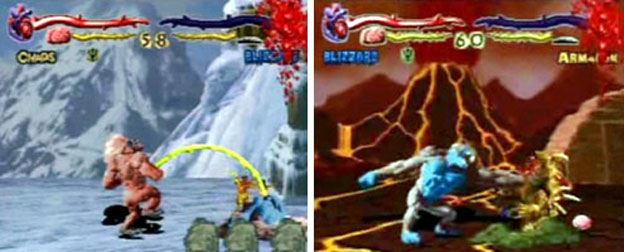
For many Primal Rage had crossed the line and set a new standard in depravity. Some fatalities had the main characters eating the flesh off of the opponent. Blizzard, a giant ape would pound his opponents into the ground and then punch the brain right out of their skull. Chaos, a different ape had ranged attacks consisting of projectile vomit and toxic gas farts. One of his fatalities was the "Golden Shower." Chaos would lift his leg and pee acid on the fallen opponent... I'm not making this stuff up people!


The spectrum of fighting games would shift over the next few years. Rare created Killer Instinct, whose fancy SGi sprites, brutal fatalities and massive combos won the average arcade gamer over. I wasn't that impressed with the title since it had all been done before in Primal Rage. The concept of juggling and opponent and setting off obscene combos I first saw in Primal Rage. One of my friends could easily top 77 hit combos in the game. That was impressive for the time.


Games like Killer Instinct feature automatic and cheap combos that you can pull on an opponent. The "vs" titles from Capcom feature hundred hit combos that can keep an opponent perpetually suspended until they die. This type of combo pornography has pretty much killed the fighting game. At least for me anyhow.


Primal Rage was just too far ahead of its time. Fighting characters that weren't human, unique control, a solid plot and fully realized world. In concept and execution it was a great title. The home console versions were decent but simply couldn't match the sound and detail of the arcade.


There was even a Primal Rage II in the works. Due to the cost associated with the fighter it was scrapped. Ask anybody that's played the majority of fighters in the arcade if they would like to have seen a Primal Rage II. Most would say yes. It would be a welcome change of pace from another damn Mortal Kombat.

Maybe one day the rights will get picked up and somebody will bring Primal Rage back from the dead. Hey, if new life was breathed into titles like Prince of Persia and Ghouls and Ghosts then there might still be a chance.

EDIT: Proof that Primal Rage characters can make any game more fun. If you would like to sponsor me please visit my Patreon page and consider donating each month, even as little as $1 would help make better blogs and even podcasts!
follow the Street Writer on Patreon!

Monday, February 19, 2018

The Giant Monster Series, part 7...


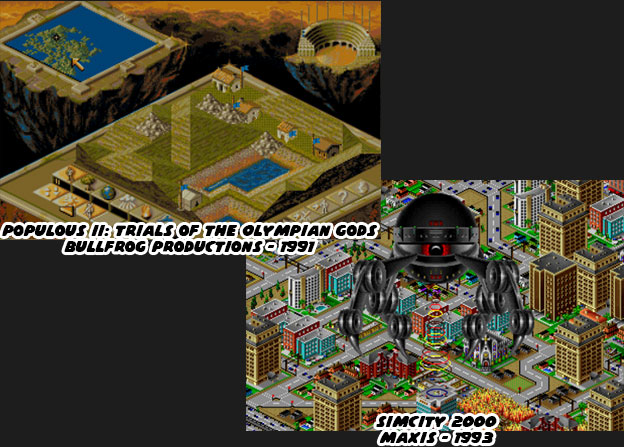
The giant monster games mentioned thus far had a common theme. They were all about fighting against the creatures or simply trying to survive against them. The draw for gamers was the fear and excitement that they felt battling them. There was a different type of emotional draw that could only be had by playing as the giant monster. In order to do this the game developers had to create new ways to experience the game. Giant monsters were not human and did not have the same limitations as them. The creatures could be as benevolent or malevolent as the designers allowed. In some genres the giant monster was considered a god simulation. Spore, Sim City and the classic Populous were examples of the god simulation or life simulation games.


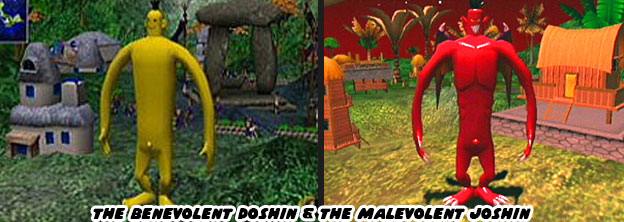
Players assumed the role of an invisible creator and could build life and architecture from the microscopic to the a global scale. To make things interesting players could trigger catastrophic events, or learn how to deal with them. Floods, alien invasions, giant lizard attacks and earthquakes were among the more unique game play elements. The invisible forces could build or destroy an entire civilization and because they could they would sometimes be worshiped by the in game characters. Such was the case for Doshin the Giant, a 1999 classic Nintendo Gamecube. Doshin was different from all the other simulation games because the character and his actions were not invisible. Players assumed the role of Doshin and tried to help the natives on the island of Barudo. The banana-colored Doshin could help shape the land for villagers, aid in the recovery from natural disasters and make their lives a little easier. As such he was asked to help unite the four tribes through his powers. The more he did for the islanders the larger and more powerful he became. Players could also turn on the villagers and become a destructive giant, Doshin would turn red and grow bat wings. He was known then as Joshin. In other simulation games players could become more powerful, only they never saw an on screen persona that represented themselves.


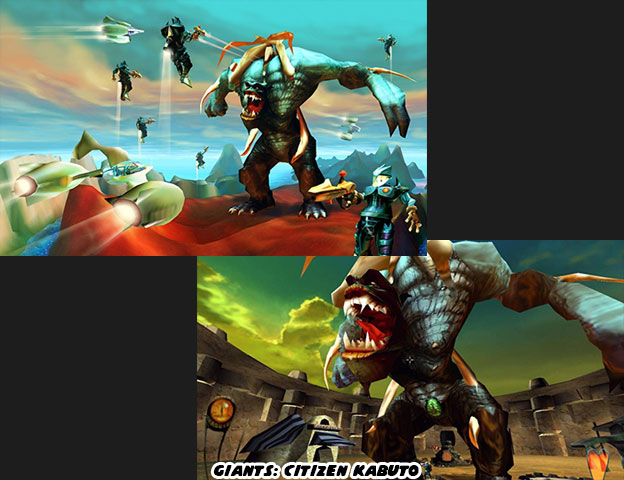
In 2001 Planet Moon Studios released a title whose plot was comparable to Doshin but whose gameplay was completely different. Giants: Citizen Kabuto was set on an island as well except this piece of land was traveling through space. On it three different races were battling for supremacy. Two of the races, the Meccaryns and Sea Reapers fought with weapons and magic respectively. Players could play as either of those races in a third-person perspective. The third race consisted of a single creature, a giant name Kabuto. Having control over Kabuto was a powerful contrast to the other races. The game played similar to other third person shooters except for Kabuto. The character towered over entire units and plowed though their ranks with ease. Kabuto did not have any weapons but instead relied on wrestling moves to damage opponents and their bases. The sense of power generated by Kabuto was great. When he ran he knocked over trees with ease. The other races could get flattened like insects every time he swung his massive arms. The game play was a stark contrast to Doshin, whose slow pace and friendly atmosphere felt more childlike and innocent. Apparently there was a difference between the video game gods.


A third type of giant monster god was heating up the charts in 1994. Atari used the popularity of the fighting game as the basis for Primal Rage. The game was set in a dystopian future where giant creatures were battling for control of the planet. Each of the Primal Rage characters was worshipped as a god; the god of life, the god of virtue, the god of decay, the god insanity, etc. The monsters created for the game took a page from the oldest of the giant monster heroes. Every character featured in the game was created from a clay, rubber and fur armature just like the 1933 King Kong model. The animators used similar stop-motion techniques to create the frames for the game. Instead of posting those frames to film they were digitized to video and sprites were created for the programmers to use. Model backgrounds were composited over digital paintings to create the levels. Actors in caveman costumes were also recorded to create the people worshipping the monsters on each level. These tiny humans would follow their god from level to level, growing in number as the player progressed. The monsters could snatch a human from the background and eat them for a health bonus.


The Primal Rage monsters blew the doors off the fighting genre. Up until then fighting games featured human-sized characters with traditional or fictional martial arts moves. The Primal Rage avatars could have easily snacked on the fighters from other games. When they battled they shook the ground and created natural disasters. The developers experimented with command inputs. Like Mortal Kombat (1992) and Killer Instinct (1994), the studios were trying to create controls that differed from the six button and joystick commands that Capcom had popularized in the Street Fighter series. For Primal Rage special attacks were activated when the player released the buttons rather than when they pressed them, making for a unique learning curve. The game was also the first title that I had ever seen that allowed infinite combos, a precursor to the combos that made the Capcom VS series so popular. The fights of the Primal Rage avatars were brutal and offered players a chance to kill an opponent at the end of a match. The fatalities in Primal Rage were every bit as brutal if not more so than those in Mortal Kombat. Monsters could literally punch the brains out of opponent skulls and eat the flesh off their bones. Arcade goers winced at some of the more gross acts players could perform. Some would argue that Atari crossed the line when they introduced a character that farted, vomited and even urinated on his opponents.


Allowing gamers to play as gods had gone to the head of developers. After all, up until that point most genres tried to create the action for human-scaled characters. Racing, shooting, role-playing titles all tried to create worlds that were believable for human protagonists. All of a sudden the developers found themselves creating worlds for monsters that were the top of the food chain. No natural creature or man made weapon could have stood up to the biggest of the Primal Rage characters. They could be as gross or violent as they wanted to because there was no one that could have stopped them.


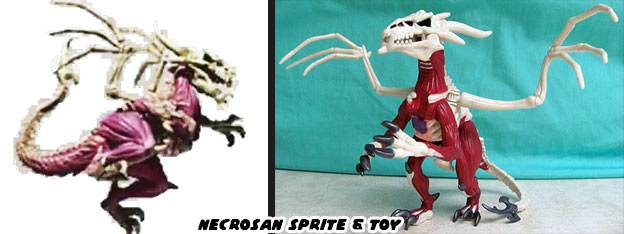
Well, the only thing that could have stopped them would have been a bigger and badder monster. Necrosan was the god of death. It was a dragon-like creature that was mostly bones but with portions of muscle and even intestine still attached to the skeleton. Players would have to defeat the creature had they wanted to claim the "Urth." Sadly the final battle was never realized. The arcade game had been published without an actual final boss. In fact it was released with unbalanced gameplay, known bugs and glitches. Patches were released over the months to arcade owners to help fix the controls and balance the fighters. Developers were hoping to introduce an actual final boss via an upgrade. Unfortunately development of that final boss and his official inclusion in a sequel was cancelled. It was proving to be too costly for Atari to continue supporting the series. The only known images of Necrosan were from concept art, sprites for the unpublished Primal Rage II, a comic book and a toy released before Atari pulled the plug. Those gods seemed to have limitations after all.


The giant monster offered unique game play opportunities for existing genres. They could enhance the sim, RPG, FPS or fighting game more than any weapon or magical attack could. Developers were finding it hard to create a niche for the giant monsters themselves. What many developers missed were lessons from their own history. Two studios showed what format worked best for the giant monster back in 1986. They created a template that would work again and again. The studios that paid attention to the model would achieve a certain level of success. The next blog will talk about the year that changed everything.