Showing posts with label atlantis. Show all posts

Wednesday, December 3, 2025

The Big Game Idea: Level 1 (end) - A 1UP classic Sep 21, 2006

Below is a series that I originally ran on 1UP in 2006. In it I proposed an original video game based on the Incredible Hulk. I called it "The Big Game Idea." Over a few weeks I described the graphics, game play, visuals, and plot from beginning to end, including bonus features. I made a few minor edits, but it is more or less exactly the same as it was almost 20 years ago. I hope you enjoy it.

When we last saw the Hulk he was battling the Navy in the Atlantic Ocean. If a player does enough damage to a ship it begins sinking. You hear sirens go off and actually see the sailors jumping into the water. The Hulk can swim around and push the sailors in the water but he cannot harm them. Eventually all the sailors swim to small life rafts. The player has to successfully sink all of the ships in the ocean, including the submarine in order to progress. Once they do so this is what happens next.

CINEMA: The Hulk is sinking into the ocean and crushing the front end of a submarine when a dozen depth charges go off nearby. He is knocked out and keeps sinking. In the background we can see an army of Atlanteans swimming toward the Hulk.

Banner wakes up inside of a cave. Water is dripping from the ceiling and there is a bank of computers and radioactive material lining the walls. He looks down and sees that many tubes are coming out of his arm. There is a small pool of water nearby and Prince Namor rises out of it with an Atlantean scientist under his arm.

"Banner, as I suspected." Namor says and drops the Atlantean. Namor goes to Banner and begins removing the tubing from his arm. "We have precious little time Dr. Banner. Attuma, the vile barbarian, has breached the gates of Atlantis and I fear that it is in part due to your alter-ego.

"What?" Says Banner.

"Price Namor is correct. Attuma has learned of the Hulk's radioactive blood and is infusing it with his own to give him tremendous strength." The Atlantean scientist explains to Banner as he helps him to his feet.

"How long?" Asks Banner.

"We detected a human fleet two days ago. The depth charges they used on the Hulk caused a break in Atlantis' defenses. Attuma and his barbarians seized the opportunity and have been laying siege to my kingdom." Namor explains.

"How long!" Banner points at his arm.

"We estimate that they captured the Hulk and drained you of your blood 10 hours ago... Yet still you live?" The Atlantean scientist explains. "Attuma must be using the plutonium rods from the ships the Hulk sank in order to keep your blood strong."

"I will destroy this lair. And you, Banner, will come with me and repay the damage caused by your human strife." Namor grabs Banner and walks back into the pool.

"But I can't breathe underwater." Banner says.

"This will help." The Atlantean scientist gives Banner an injection that turns his skin blue. "Try to breathe normally." The three dive into the water as Namor pulls them both through an underwater tunnel out into the ocean floor. He turns and presses a button on his belt. Explosives go off in the tunnel and the cave collapses in the background. The shockwave sends Banner spinning. He becomes angry and transforms into the Hulk.

"RARGH!!!" The Hulk looks at Namor and the scientist. "Why is Hulk blue? Who made Hulk blue?! Hulk is supposed to be GREEN!!!"

"Attuma did this to you." Namor smiles. "Attuma says he is the strongest one there is."

"Where is Attuma?!!!" The Hulk demands.

"This way. Follow me." Namor swims toward Atlantis.

Level 1 End
Location: Underwater.
Objective: Defeat Attuma.
Learn: Basic controls. Direction and camera movement. Punch / Kick / Small Combos. Grab and climb. Destroy the environment.
Unlock: Mega Directional Thunderclap.
Level Design: There is a small open area between the caves and Atlantis. Small groups of soldiers are fought here. Despite being called barbarians, both the good and evil Atlanteans have access to advanced weaponry, including pulse rifles and laser beams. The heavy artillery both sides use are shaped like sea-life. Think of the fish robots from Darius to get a better sense to the design and technology.

The closer the Hulk gets to Atlantis, the more soldiers and artillery show up. Eventually he catches up to Attuma who is rampaging near the heart of the city. Attuma becomes the first boss battle in the game.

The reason for setting the first mob battles underwater is to give players a chance to learn combos and tactics. The Hulk moves about 15% slower underwater, as does everyone else, so players can learn to range their opponents for different attacks. Barbarians will swim and dogpile on the Hulk and drag him to the ocean floor. The Hulk can walk on the ocean floor or swim. A player can spin the analog sticks to shake the barbarians off or using combinations of buttons along with the analog pads, they can grab and throw opponents off or even roll on the ground and crush the barbarians. The Atlantean buildings can be destroyed, especially after the Hulk learns his strongest directional Thunderclap.

This thunderclap is presented differently than the shotgun-like thunderclap in the original Hulk game or the dome-shaped thunderclap used in Ultimate Destruction. Thunderclaps are still directional but invisible now, they have no magical green glowing ring around them. We can still make them out because they distort the visuals like a transparent ripple. This shockwave travels away from the Hulk and blows things away with hurricane-force.

Attuma has a sword that sends bolts of electricity to keep the Hulk at bay. He is slightly larger than the Hulk but doesn't posess the same strength. This battle is based on an actual crossover between the Hulk and Namor. The game teachers players to charge up thunderclaps for ranged attacks and halfway through the battle with Attuma you unlock the mega thunderclap which allows you to completely level most of Atlantis with one strike.

CINEMA: The Hulk tears the box off of Attuma's stomach, green blood pours out from the box. Attuma passes out and begins shrinking. The Atlantean soldiers clear the remaining barbarians out of Atlantis. Namor grabs the Hulk and places him on the back of a whale. The whale begins swimming away. A soldier swims up to Namor and hands him a bag.

"Hulk, I will take you away from Atlantis. Away from the water men." Namor assures the Hulk.

When they reach the surface the Hulk turns from blue to green. He jumps off of the whale, walks under a tree and sits down. Namor flies over and opens the bag. He gives the Hulk a bunch of energy bars.

"These are for you." Namor says as the Hulk begins eating the bars.

The Hulk yawns and slowly turns into Banner. "Huh?" Banner looks around.

"Easy friend. The Hulk was able to subdue Attuma. Although his rampage still destroyed a good portion of Atlantis." Namor explains.

"I see." Banner says and continues eating. "So what now?"

"This is for you." Namor gives Banner the bag. "There is a change of clothes for you and some of your currency."

"Thanks." Banner says as he puts on a shirt. He digs through the bag, pulls out some money and stuffs it into his pocket. He puts the shoes on. "Little loose, they'll do." He nods to Namor.

"Where will you go now friend?" Namor asks.

"I have to keep on moving Prince. Just try to remain calm and keep on moving." Banner stuffs the rest of the energy bars back into the bag. "I'm probably headed west." He begins walking away.

"Take care then Dr. Banner. May the Hulk remain at peace." Namor jumps back into the water.

Banner enters a restroom at a train station. A wanted logo with his face is plastered on television monitors around the station. Banner searches in the bag and finds a razor. He shaves off his hair and continues digging in the bag. He finds some sunglasses and then quickly walks to a train as it departs.

Banner settles into a seat near the exit. He clutches the bag and rests his head as the train pulls away from the station. Banner becomes drowsy and notices that everyone else on the train is unconscious, some travelers are passed out in the aisles.

"What?" Banner tries to stand but instead falls onto the floor.


"We have located Dr. Banner." A couple of soldiers in gas masks and carrying machine guns walk into the train compartment. They grab Banner and drag him out.
END OF LEVEL 1

I decided to work the Atlantis level into the shape of the main story because I found it fascinating. Not many games begin with as many back-to-back battles, nor in such unique environments. This was the next best thing to taking the Hulk into space and having him fight on some weird alien planet (which may happen...). The level introduces players to other unique characters in the Marvel Universe, like Namor the Sub-Mariner. The color trade between the Hulk and Attuma was exactly as it was in the comic book. Plus it shows what a pallet swap looks like on the Hulk.

The long shots of Attuma in the background, while the Hulk fights barbarians, are pulled from the angles used of Ares when Kratos first enters Athens in God of War. Although you can move the camera in the game, many of the shots are semi-fixed to create an epic, almost cinematic feel.

Level 1 ends with a twist and a nod to the Bruce Jones version of Banner. Jones had written a few arcs with Banner as a fugitive, who kept changing his apperance and cutting his hair short. The game will pull from multiple stories and I'll try to clue you in to which plots I take my cues from.

So what happens next? You'll have to wait and see!
Now you can see why the Hulk makes for a great superhero game. There aren't many Marvel heroes that could survive at the bottom of the ocean. Does the game seem to be holding your attention? Tell me in the comments section. As always if you enjoyed this blog, and would like to sponsor me please visit my Patreon page and consider donating each month, even as little as $1 would help make better blogs and even podcasts!
follow the Street Writer on Patreon!

Wednesday, February 22, 2023

The God of War Challenges, how the journey continued after the games

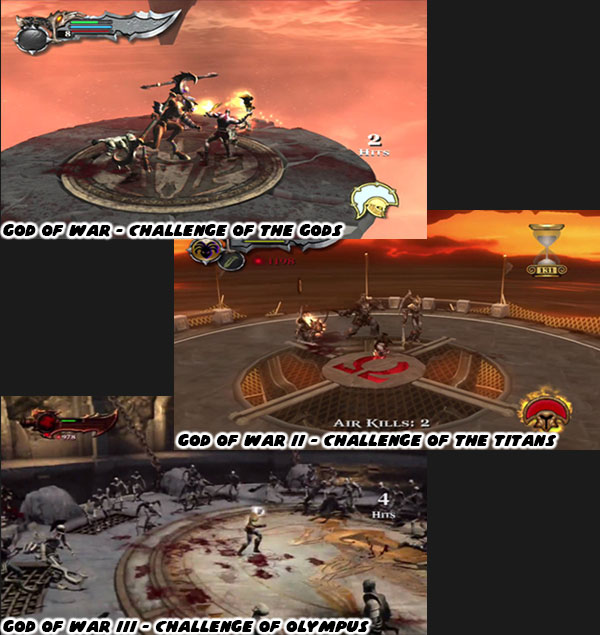
I’ve played through hundreds of video games in my lifetime. A small percentage of which I would consider among the best. The God of War series was unique because it was amazing across the board. Every title in the franchise looked great, played great, and provided the perfect challenge. As a mythology geek the stories, and characters kept a fire burning inside me. Also unlike other games once you played through this games the adventure didn’t necessarily end. You could raise the difficulty, and give it another try. Either in the search of secrets to unlock, or simply for the challenge. Sony Santa Monica seemed to know they had a great thing early on. They made sure to put in a lot of content, in addition to the main game. They wanted audiences to enjoy the experience they had created in different ways. This is how they came up with the Challenge of the Gods.

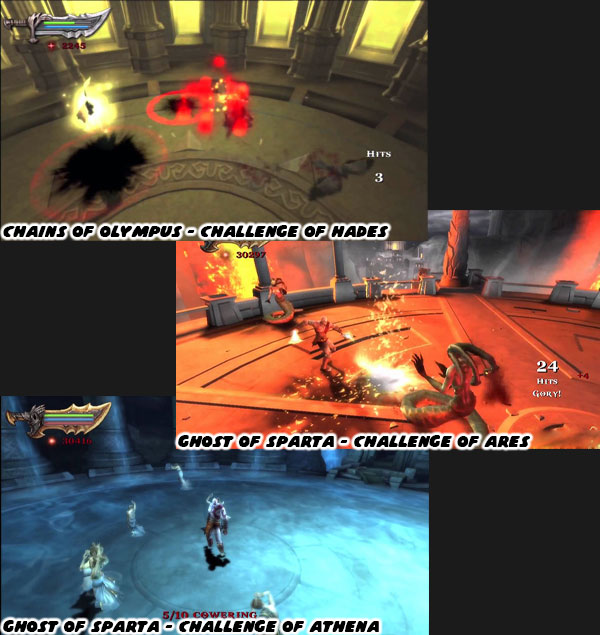
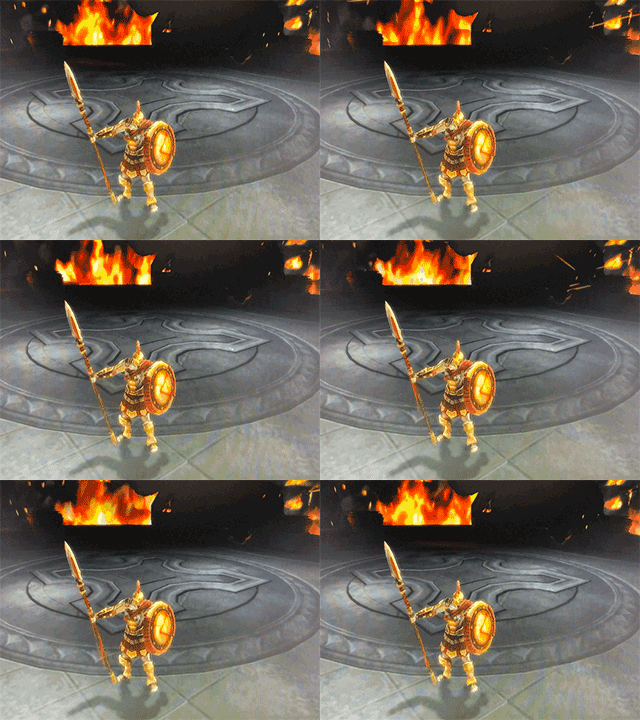
These were mini challenges featured in the series that allowed players to test their ability. Whether it was fighting a certain type of opponent, trying not to get hit, or wiping out a regiment, there was something unique to each trial. The challenges weren’t straightforward either. To raise the stakes most gave Kratos limited time, magic, or energy in order to complete. They may have seemed impossible at first, but players learned that there were attacks, and combos that made them possible. Audiences had to go with trial, and error in order to find which moves worked best. Doing this repeatedly actually made them better players. Suddenly the harder play throughs seemed less daunting. Completing the challenges rewarded the player with all sort of bonus content. You could earn concept art, making of videos, special skins, or other features that you could unlock during a play through. Of all the bonus games the one I enjoyed the most was featured in the Ghost of Sparta. You could fight within a Combat Arena. These were customizable battles that took place on a large circular stage. You could configure these fights in a number of ways. You could select the types of enemies, the number of enemies, the difficulty of them, and even whether or not they respawned. You could also choose to have infinite energy, or magic as well.

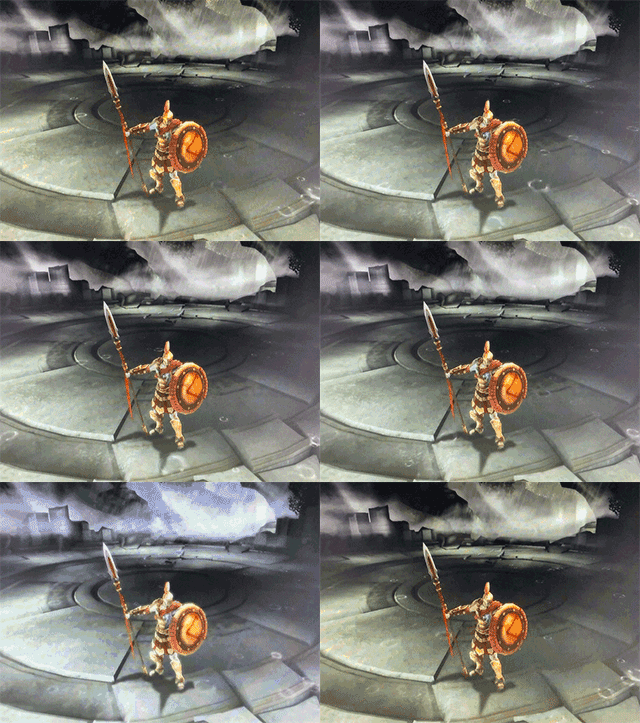
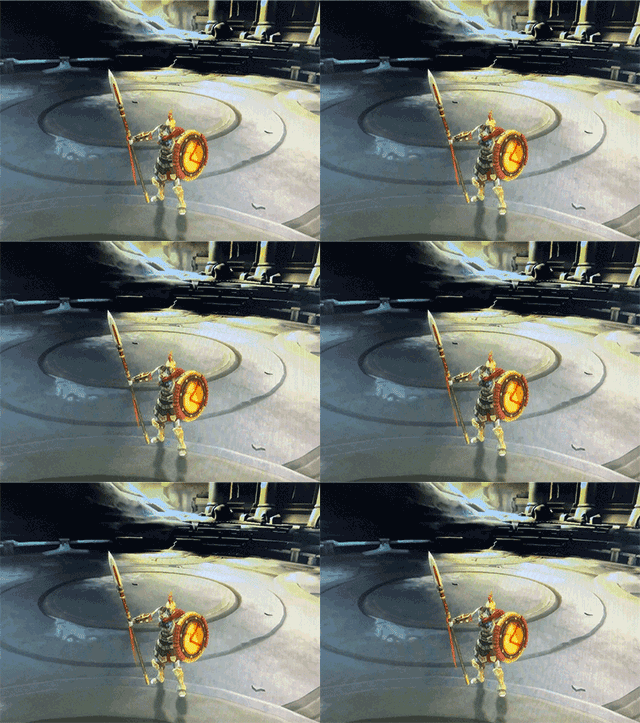
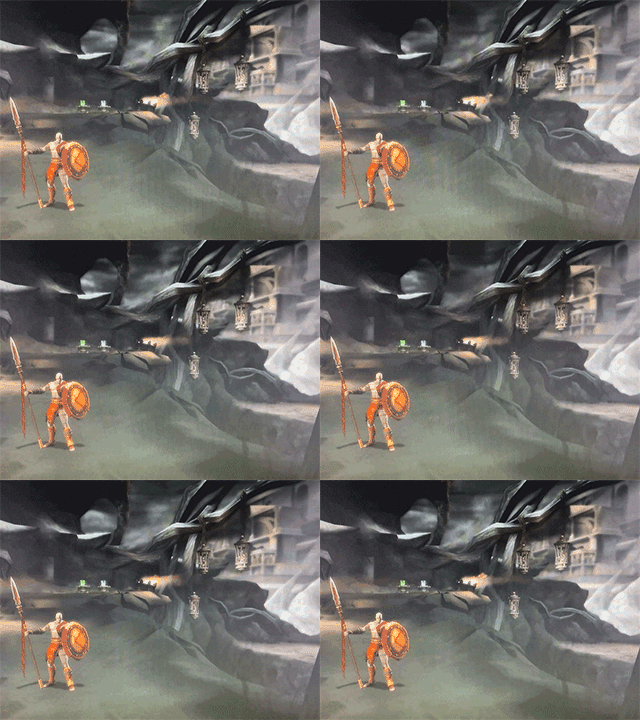
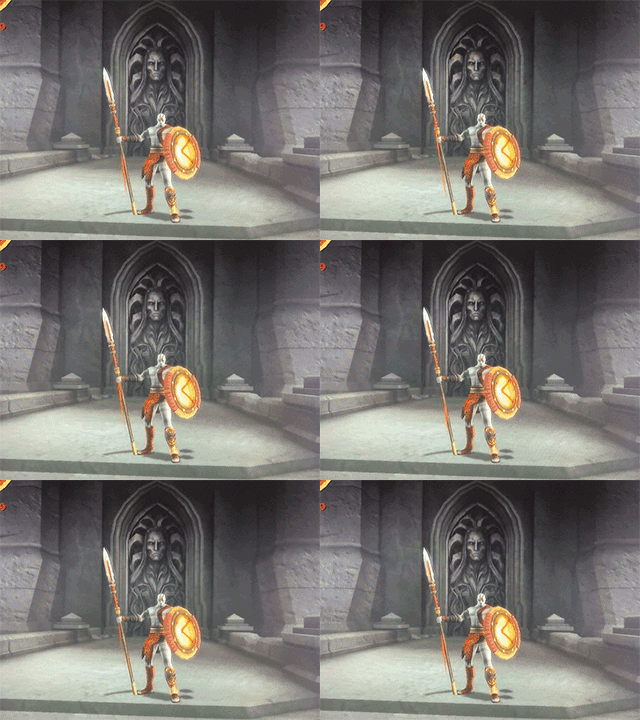
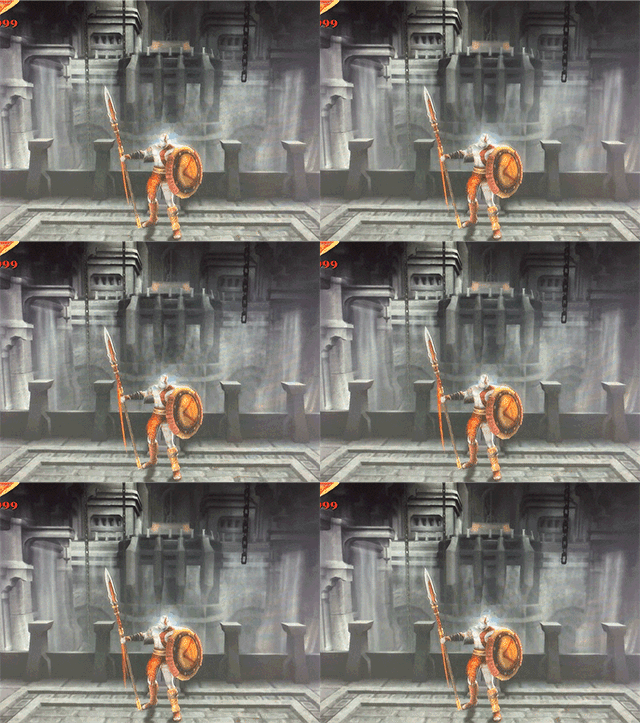
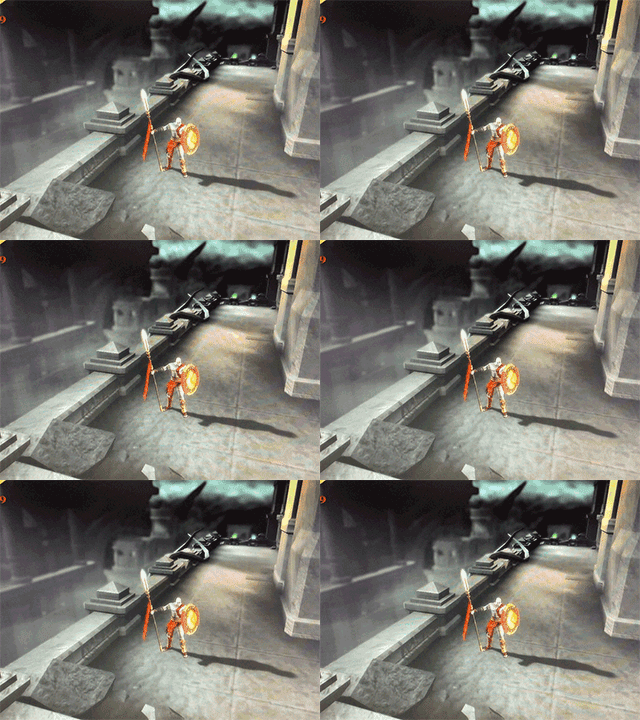
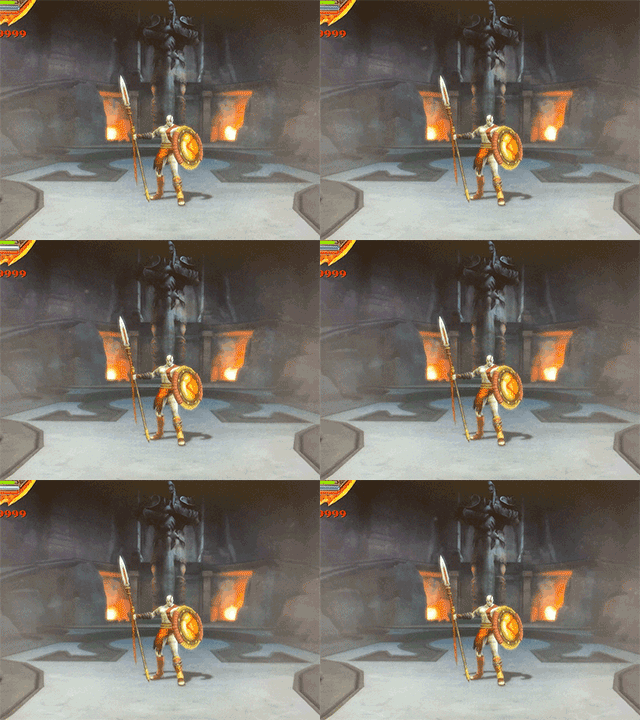
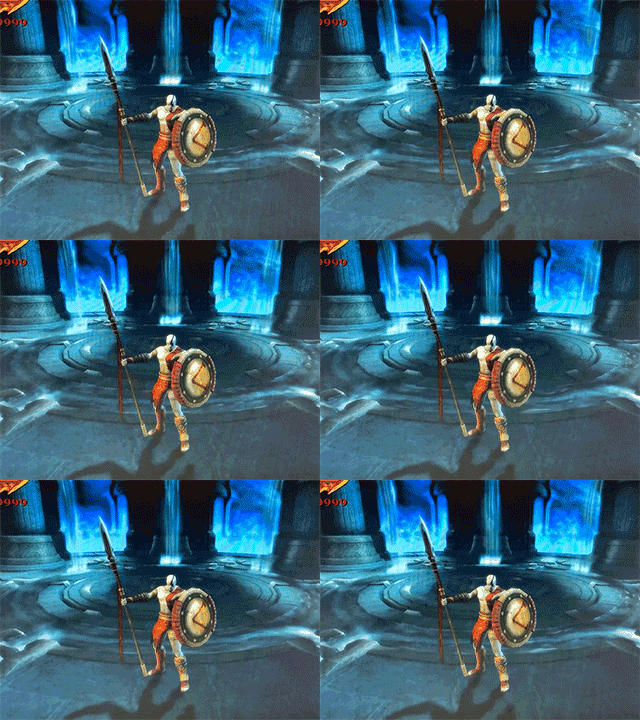
The Combat Arenas were first introduced in God of War II as the Arena of the Fates. They featured the stages that were created for the Challenge of the Titans. Each location was reminiscent of areas featured in the game. There was the Summit, which looked similar to the place where Kratos, and Zeus had their final battle in GoW II. There was the Barbarian, which was the location in the bogs where you battled The Barbarian King Alric. Lastly there was Daedalus, a circular platform with mechanized wings. Not every arena had to be a place visited in the game. It just had to carry the same design, and tone from the series. For example there was the Forest, which took place on a stone path in the middle of a rainstorm. There were no forest locations in the Ghost of Sparta, but it still matched the look of the game.

Each arena location told a story. Some were bold, others very subtle. For example the arena labeled Arctic. It had a frozen atmosphere similar to the Mounts of Aroania. If you looked in the distance however you could actually see a temple, and a statue of Zeus. This hinted as to where his temple was located in the GoW universe.


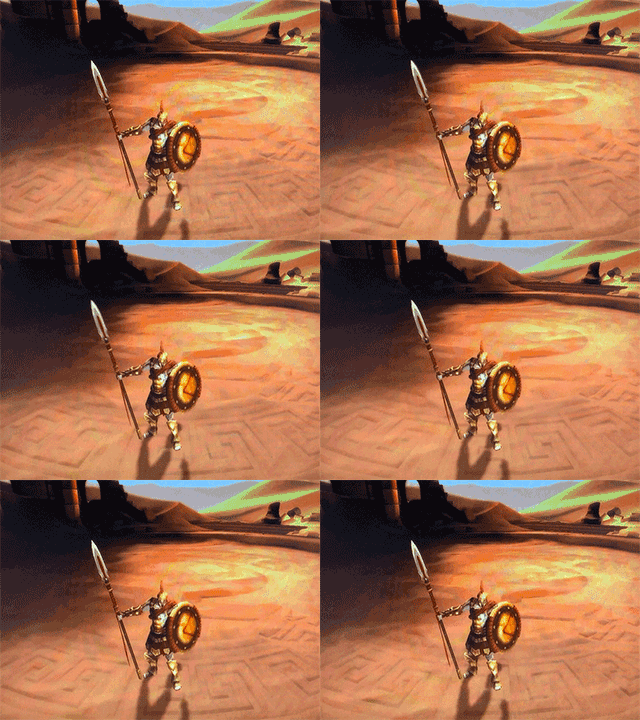
There was the Desert. Possibly the nicest looking background. A steady breeze blew sand across the ground. The sun was past midday. You could just about feel the heat. I imagined that this place was not too far from the Desert of Lost Souls from the first GoW. I greatly enjoyed the look of all these places, could appreciate fighting within them as long as I wanted, and with whichever enemy I chose.

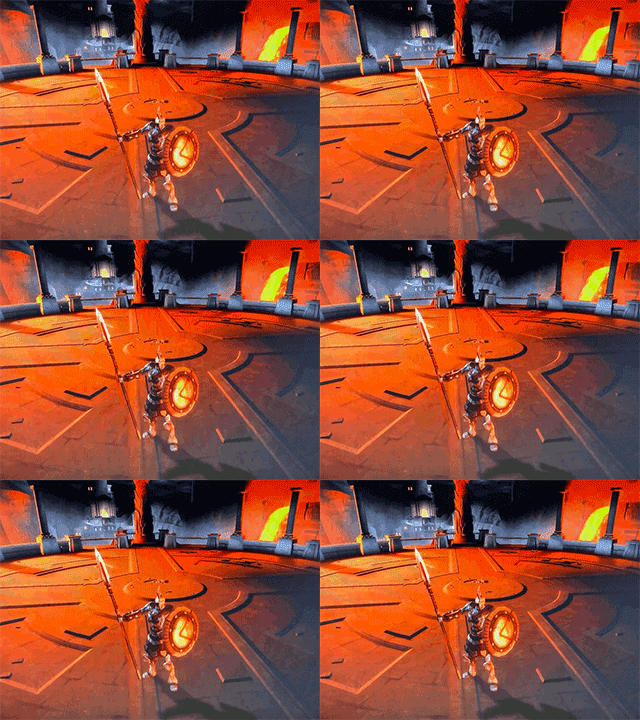
One of the most unique stages was Hades. It looked different than how it appeared in either GoW III, or the Chains of Olympus. It was dark, and mysterious, with harpies flying in the background, and lava waterfalls skirting the perimeter. It was certainly not a place that a mortal would want to visit.

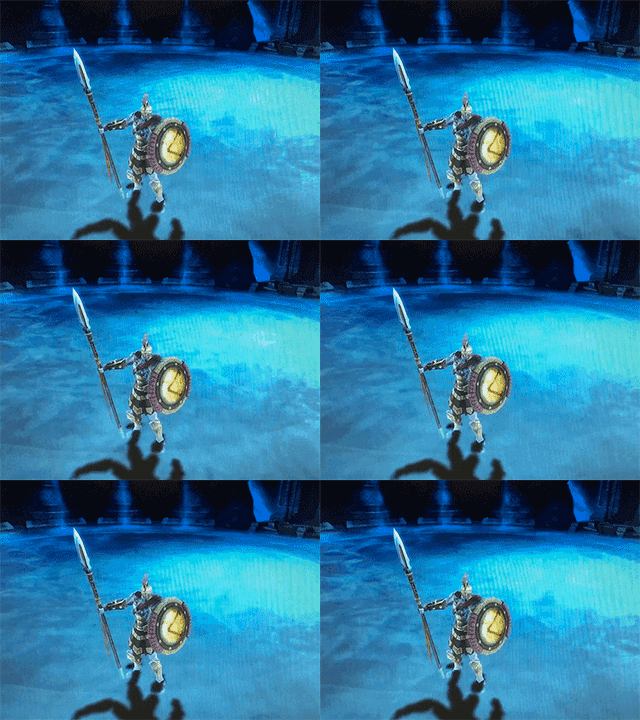
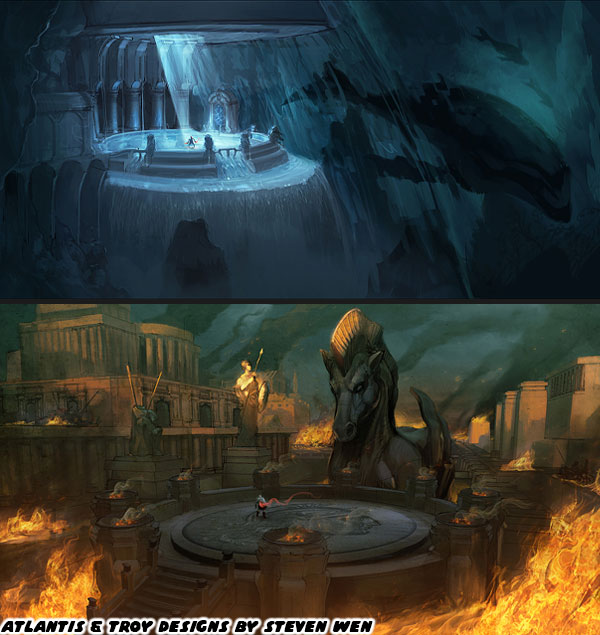
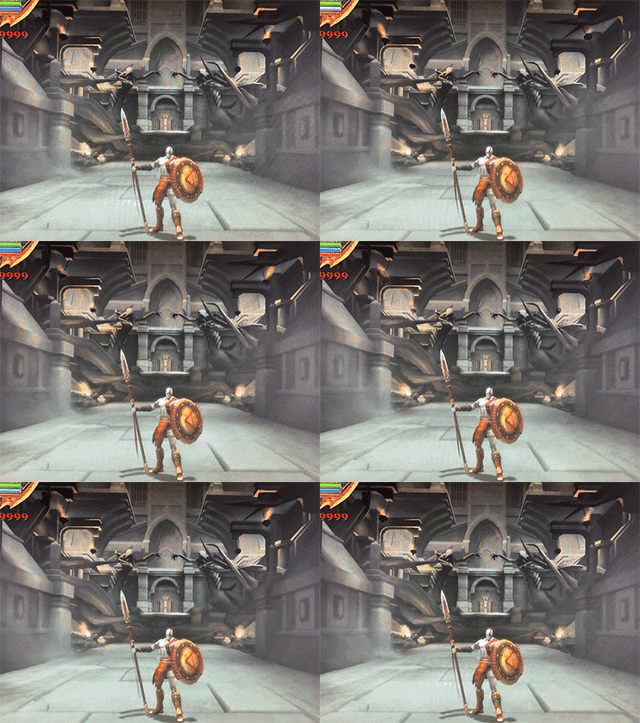
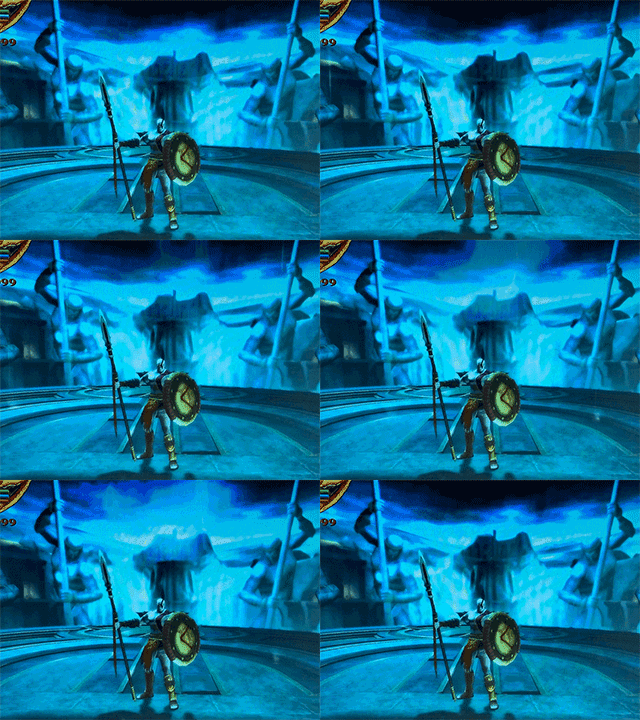
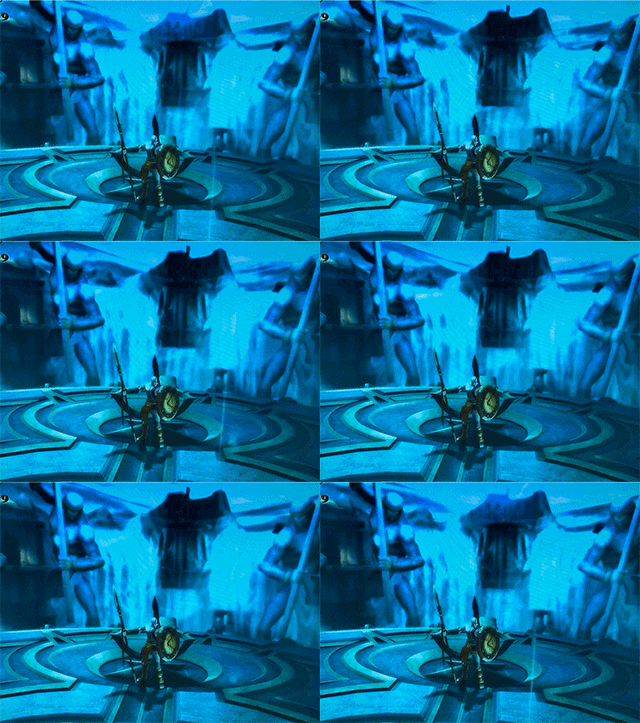
In my opinion there was a toss up between the two best arenas in the game. One of those was Atlantis. In the previous blog I talked about how the sunken city had been on the drawing board since GoW II was in development. This was around 2005. That stage wouldn’t formally be introduced until the Ghost of Sparta in 2010. The stage was part building, and part magical barrier where we could stare out in the abyss. It was the sort of fantastic world that Sony Santa Monica, and Ready at Dawn could bring us into.

You could really appreciate the planning for the stages if you looked at the concept art. Atlantis wasn’t the only location that the studios had always thought about taking Kratos through. In very early GoW II plans they were thinking of setting a chase, or action stage, through the city of Sparta, as they were under attack. There would be a huge battle, with flaming arrows streaking back, and forth across the sky.

Some of those plans, and settings were adapted by Ready at Dawn. The burning arrows, and spears were used in the opening moments of Chains of Olympus. The intact city of Sparta was put in the Ghost of Sparta. Whereas the city being destroyed became Crete, and Heraklion during the eruption of the Methana Volcano, as well as the collapse of Atlantis. Ready at Dawn honored the developers at Sony Santa Monica by putting an actual Troy arena in the game. Best of all playing the Challenge of Ares, the Challenge of Athena earned you red orbs that you could spend in the Temple of Olympus, and unlock all sorts of goodies. The best surprise in the game was the Grave Digger’s Shovel. It allowed you to unlock a special character in the Combat Arena.

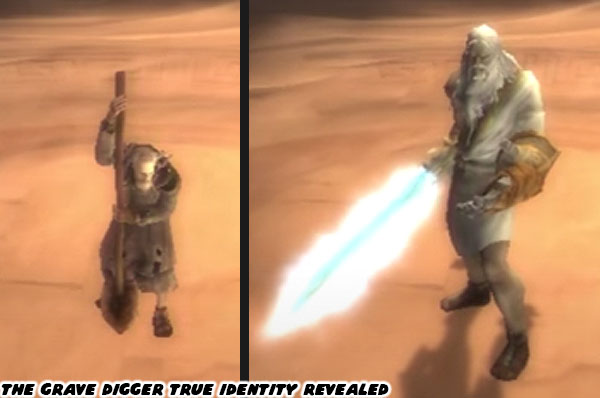
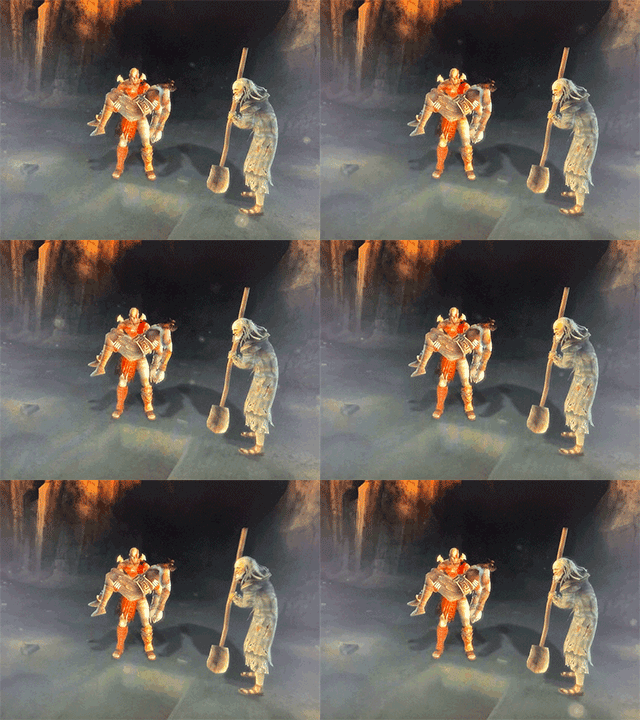
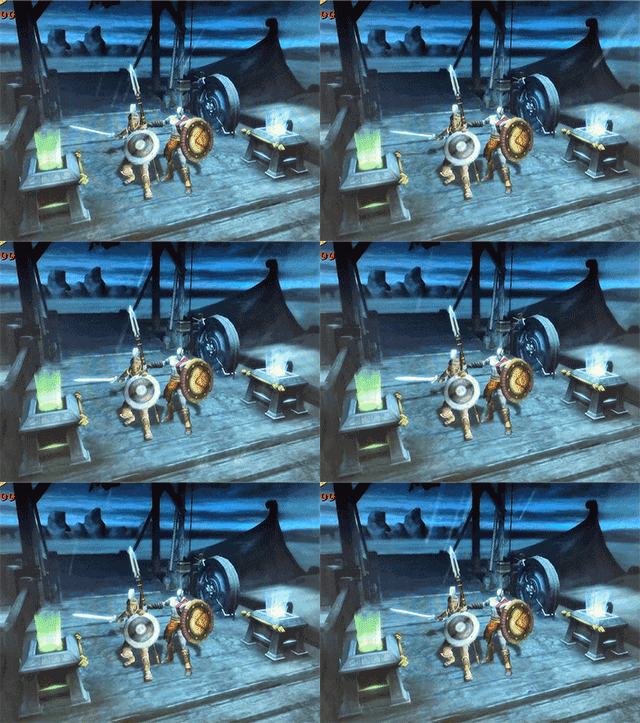
There had been a lot of speculation as to the identity of the Grave Digger from the series. Many had guessed that he was Zeus in disguise, especially since he referred to Kratos as son. It was nice to see this get officially confirmed in the game. When the arena stage begins we see the Grave Digger standing in place, for a second I thought I would actually be able to see him swing the shovel in combat. However he instead raises it to the sky, and a lightning bolt transforms him into Zeus, and the shovel into the Blade of Olympus. He not only fights with that, but in his left hand he has the Gauntlet of Zeus. The most powerful weapon from the Chains of Olympus. To say Zeus is O.P. would be an understatement. He doesn’t have a block button, but instead he’s blindingly fast. Rather than roll he can dash out of the range of most attacks. Also he doesn’t use any magical attacks. If you press the directional button, the ones that activate magic for Kratos, he instead makes one of four statements. “Feel the power of Olympus! I will crush you! Insolent Fool!” and the always classic “Die mortal!” The studio went so far as to actually animate his mouth when he talks.

It was great having Zeus as a playable character, but the team did make one change with his weapons. The Gauntlet of Zeus was a right hand weapon, but he sports it on his left. It’s a minor detail, but one that I noticed because of how much I replayed the Chains of Olympus. I’d like to know if you had a favorite challenge in the GoW series, or if there was one that you felt was absolutely impossible. Let me know in the comments section please. As always if you would like to sponsor me please visit my Patreon page and consider donating each month, even as little as $1 would help make better blogs and even podcasts!
follow the Street Writer on Patreon!

Monday, February 20, 2023

Ghost of Sparta, Kratos finds his brother, and battles death

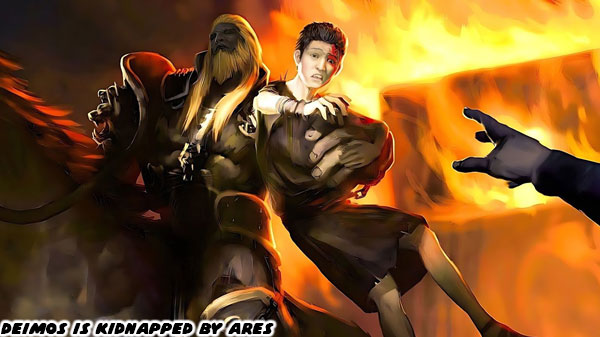
When we last saw Kratos he had returned to Atlantis to find the Death Gate. It was the portal to bring us into another world. The conspiracy to kidnap his brother was starting to come into focus. Sparta was attacked by an unknown army when Kratos was a young man. A massive figure on a war horse took his brother Deimos. Kratos tried to fight back but was knocked away. A female warrior was accompanying him, she said the Fates had warned that the one with the markings was destined to cause the fall of Olympus. Now that they had the marked one they were to leave the other boy alone. They rode away. We learned that it was Ares, and Athena that had attacked Sparta that night.

Ares needed to ensure Deimos would never fulfill the prophecy. Had he killed the boy then his soul would have ended up in Hades. Once there he could have gone to the fields of Elysium, or the pits of Tartarus. In either case he would have grown up in the land controlled by the Olympians. He would be able to train with other deceased warriors, and recruit like-minded souls. Eventually he would have raised an army like his brother, and then overthrown Olympus. Ares had to take Deimos as far from Olympus as possible. In this case it was the Domain of Death. The Olympians had no power over the forces that existed before them, the Primordial realms. He left Deimos in the charge of Thanatos, the god of death. The only way Ares could have entered this world was if he had a key. In his case he had the Skull of Keres, the goddess of death. He kept it hidden in his temple on Sparta.

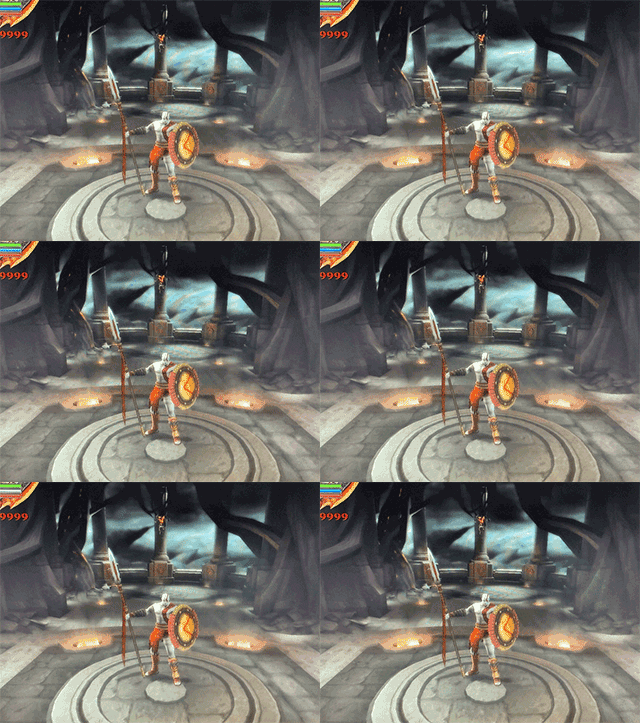
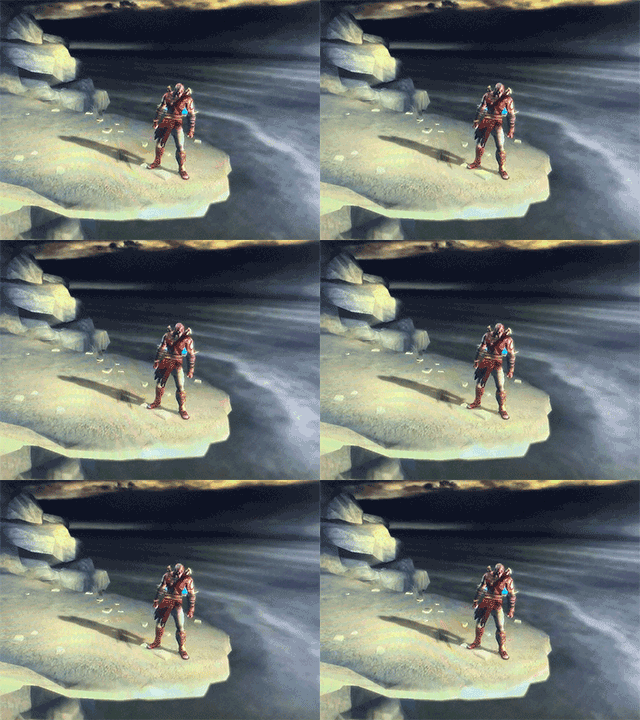
This portion of the game had brilliant design. It was as well themed as the other locations featured in the Ghost of Sparta. As far as we could see there was no sun, or moon in this place. There was no horizon. The realm of death went on to the infinite. In the background we could see a massive building.

Kratos made his way to the Temple of Thanatos. Avoiding supernatural birds, and vines that would strike him. The Bane of Thera allowed him to burn away the living plants.

When he reached the doors to the temple Thanatos spoke to him. It was the third time the effect had been used in the game. Thanatos was not happy that Kratos had trespassed into his domain. He challenged the Spartan to continue if he wanted to meet his destiny.

The only atmosphere in this place was a steady breeze. What I thought made is unique was that the wind carried dust. In every portion of this world there was dust. It was cascading down the walls. It was flowing down stairs, and pouring in through the cracks. I could only assume that this was the dust from where all things were made, and how we would end up. There were a few versions of the Bible through history that had a version of the phrase “From dust you have come, and to dust you shall return.” This was from the book of Genesis.

The Temple of Thanatos was eerie. The constant wind brought life to the stage even though there were no residents. The scale of this place seemed too massive for a solitary being. Of course it was all designed to be imposing. It was eternal, it existed before time, and would exist after the end of the universe.

There were several massive traps scattered within. They were large, brutal, and powerful enough to kill a god.

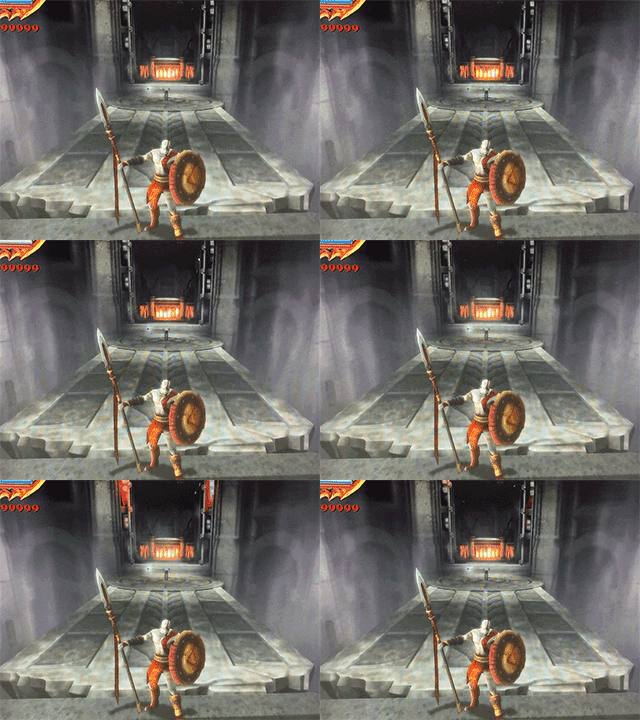
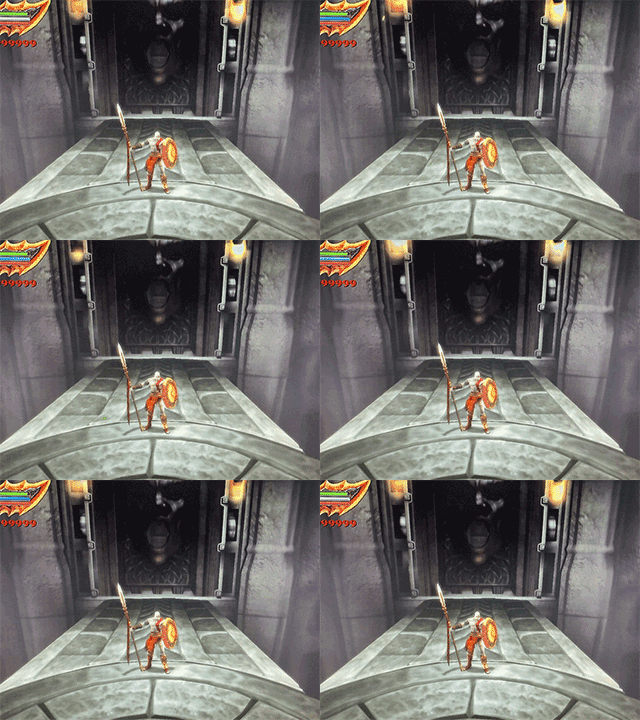
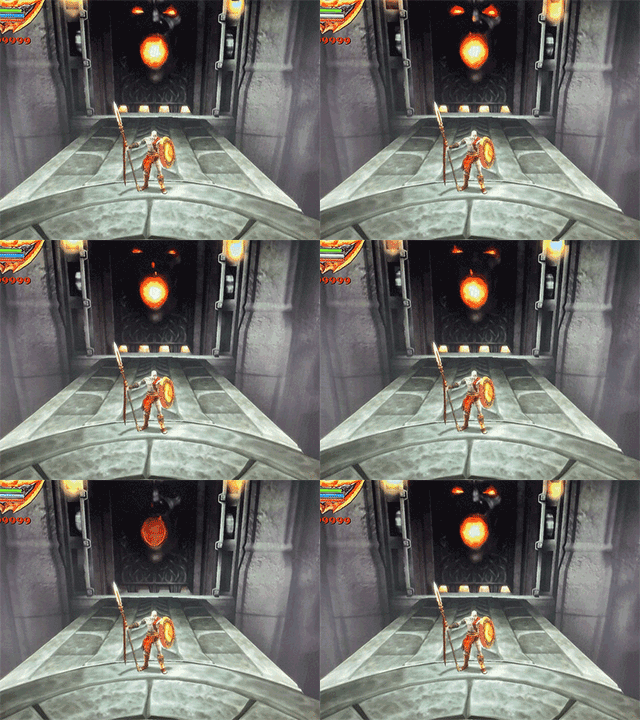
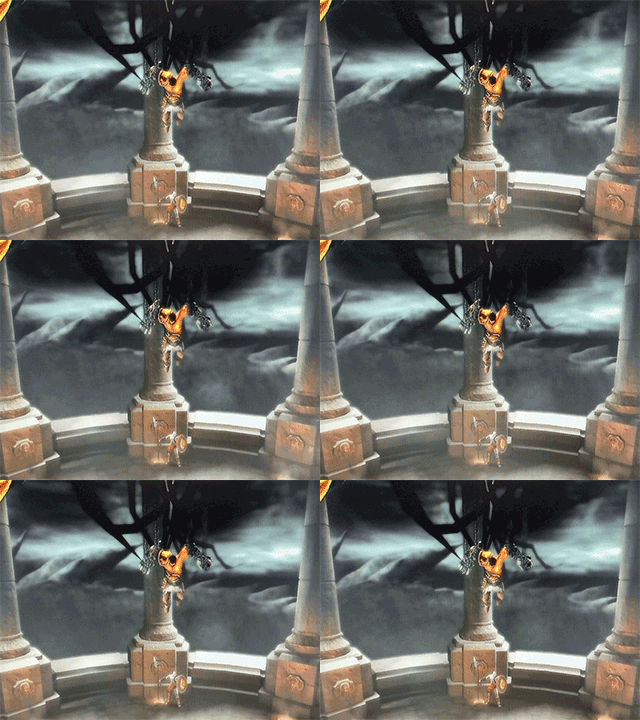
There was a rotating bridge separating the temple from the vault that held the prisoner Deimos. Fire would periodically shoot across the bridge, making it impossible to get across.

Kratos would need the Arms of Sparta to figure out the trap. He could use his shield to reach the bridge rotating mechanism. Then he could temporarily jam the gears on the vault with a spear attack. The gate on the vault would close, and allow Kratos a moment to rotate the bridge.

The fire would continue whether the gate was opened or closed. While it was down the face of Thanatos could be seen glowing with every burning pulse. It was an awesome sight.

Kratos eventually reached the inner vault, and found his brother suspended by chains.

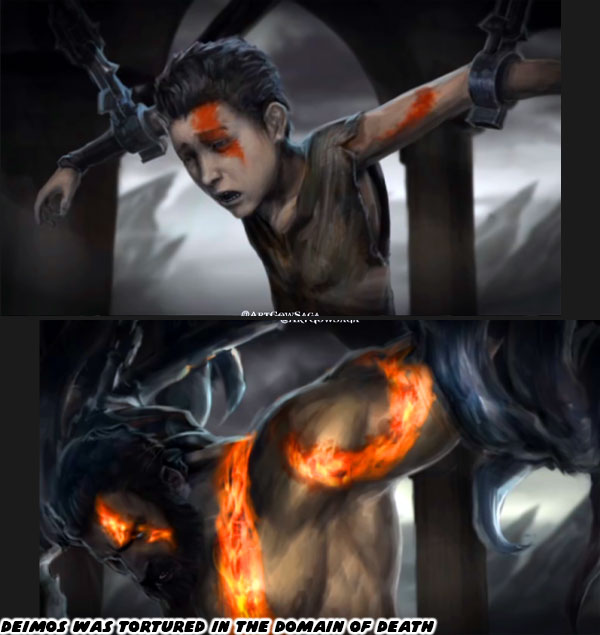
It wasn’t enough that Thanatos had imprisoned him. He had tortured Deimos for decades. His mind was not what it once was.

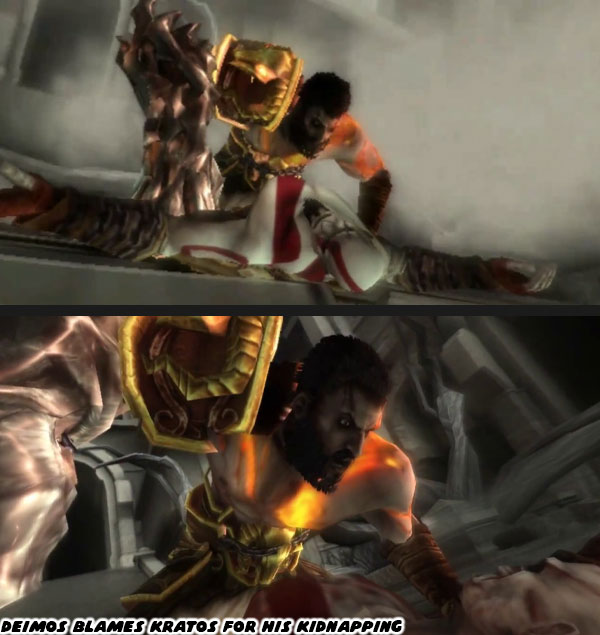
When Kratos lowered him it wasn’t a warm reunion. Deimos was filled with hate. It gave him strength, and power well above that of a normal human. The birthmark covering his body was now glowing with a similar rage to what filled Kratos.

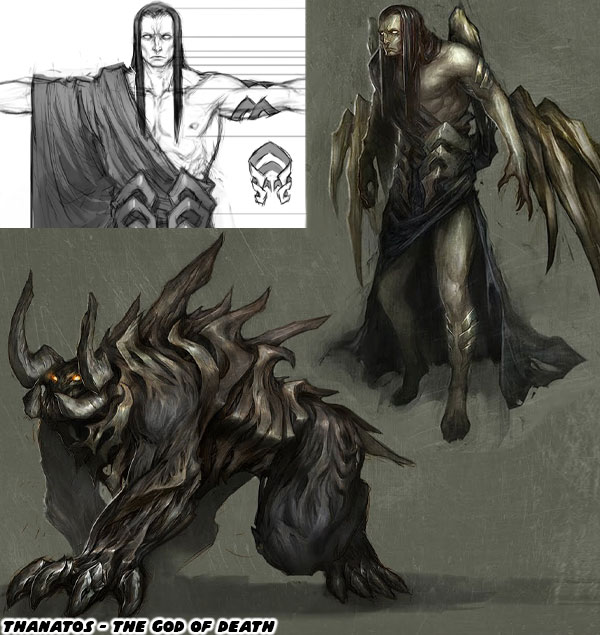
Thanatos had left Deimos with large metal gauntlets. He would be able to use them against his brother, or any person foolish enough to release him. Deimos brutally attacked Kratos during the boss fight, and hit Kratos hard enough to break his gauntlets. Kratos would not strike back because he still cared for his brother. Once Deimos stopped pummeling his brother Thanatos showed up. He was enormous, taller than even Zeus. He grabbed Deimos with his claw-like fingers, and walked away. He knew Kratos had killed his daughter, and now he was going to return the favor. He jumped away from his temple. Despite his injuries Kratos followed after.

Thanatos landed on the Suicide Bluffs in Athens. He was going to drop Deimos just steps away from where the original GoW game started. It was a brilliant callback to the title that launched a franchise. Kratos saved his brother, and they reconciled. Deimos remembered the advice that Kratos gave him as a child. “A Spartan never lets his back hit the ground.” He nodded, and gave Deimos the Arms of Sparta. The two started a hunt for the god of death.

What followed next was an amazing battle. Both Kratos, and Deimos could strike at the same time. Thanatos used a giant sword to deflect the Blades of Athena, and spear attacks. When the duo were getting the upper hand Thanatos would transform into a giant beast. The creature was far larger than the monster Erinys could turn into. Little by little they were able to break through Thanatos’ armor-like skin. Just as they had the god of death weakened he struck the brothers. Slamming them each against the cliffs with tremendous force. The godly strength of Kratos saved him, but Deimos was mortal. He didn’t survive the final strike.

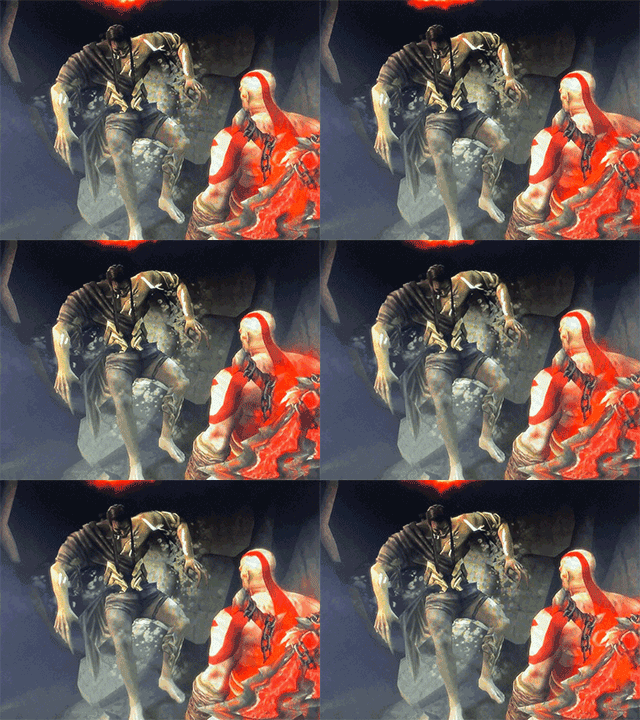
Kratos destroyed the giant monster form with his rage, then beat the human-sized Thanatos with his bare hands. As the god of death coughed up golden blood he filled in the blanks to the story. He told the god of war that the Sisters of Fate had already determined the marked warrior would destroy Olympus. There was no way to escape his fate. Kratos punched through his chest, and finished him. With his brother gone it was a hollow victory.

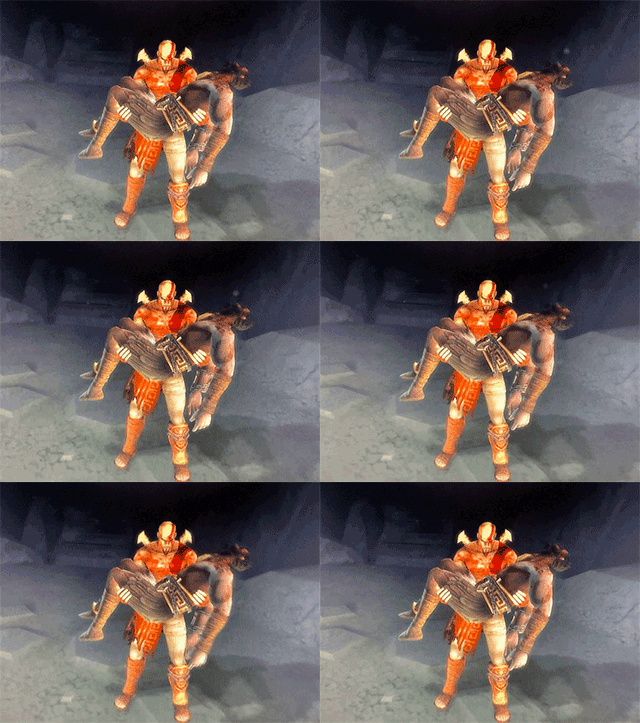
Kratos carries his brother up the cliffs, where an old friend is waiting. The Grave Digger appeared to Kratos as Crete was burning, and advised him to give up his quest. Now it was too late to do anything to avert his destiny. He has a hole prepared for his brother. Kratos lays him in the ground, and the Grave Digger begins covering him. Kratos wonders what he has become, the Digger replies “Death, the destroyer of worlds.” Athena appears through the portal of Olympus, and says now that he no longer had any ties to the mortal world she would fulfill her promise. She would wipe Kratos’ memories. He would no longer remember his family. Not his wife Lysandra, his child Calliope, his mother Callisto, or brother Deimos. He would remember only his life as a god. Kratos refuses, and uses the portal to return to Olympus. He vows to make the gods pay for what they did to him. His disdain for Olympus has grown tenfold. Athena regrets her decisions and apologizes under her breath, calling Kratos her brother. The seeds have been planted. We just witnessed the events leading into GoW II.

After the end credits we are treated to a special cut scene. The Grave Digger places the body of Callisto into the grave next to Deimos. He had a third grave prepared, and says “Now only one remains.” Then we see Kratos wearing his God Armor, sitting on the throne of Ares. It was a brilliant ending to a brilliant game. I said it at the start of the blog series, and I’ll say it again. This might be my absolute favorite GoW game, and easily one of my favorite games of all time. I’d like to hear from you. Did you play the Ghost of Sparta? What did you think? Did you have a favorite game in the series? I’d like to hear about it. Let me know in the comments section please. As always if you would like to sponsor me please visit my Patreon page and consider donating each month, even as little as $1 would help make better blogs and even podcasts!
follow the Street Writer on Patreon!

Friday, February 17, 2023

Ghost of Sparta, Kratos faces himself, and returns to where it all started

In the previous blog we covered Kratos’ battle with Erinys the daughter or death, his arrival at Sparta, and the fight with the Piraeus Lion. Kratos is trying to find out what happened to his brother Deimos. He was taken as a child by Ares, and assumed killed. On her deathbed Callisto the mother of Kratos, and Deimos says the truth is found within the Temple of Ares. Kratos takes a secret passage through the Jails of Sparta, and climbs out the other end. He is now at the Mounts of Laconia. Once agains the team at Ready at Dawn Studios created a unique environment for the game. It had its own weather, and color scheme. The hills were a deep clay red. Kratos scales the breezy peaks at dusk.

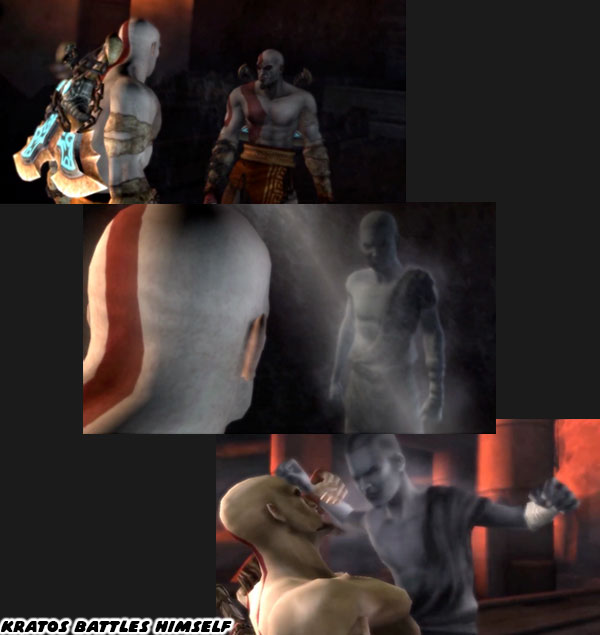
He arrived at the Temple of Ares just at nightfall. We could see Spartans pulling down a statue of Ares. The leader of his men told Kratos that they would soon be erecting a new statue in his honor. Kratos went into the temple, where the visage of Ares said to face himself, and learn the truth. Kratos went behind the throne reserved for Ares, and discovered a polished black stone, perhaps onyx. In its reflection he could see himself as a young man, he had no tattoos, and without the Blade of Athena.

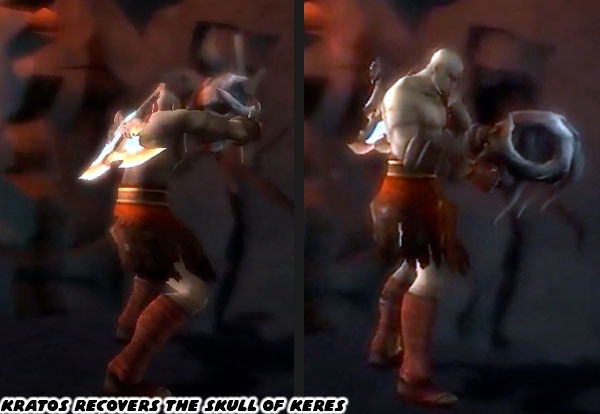
The younger version tries to pull him into the mirror. The two have an ugly fight. The younger reflection hurling insults at the god of war. Saying that he didn’t protect his brother, that he was a coward, that he abandoned him. Kratos gets the upper hand, shatters the wall, and forces the reflection back into the rock. Inside he discovers the source of its magic. There is a skull of a creature, it has horns, and larger than a human skull. It is the Skull of Keres, in Greek mythology the goddess of death. Kratos now realizes that he has to return to Atlantis, or what’s left of it.

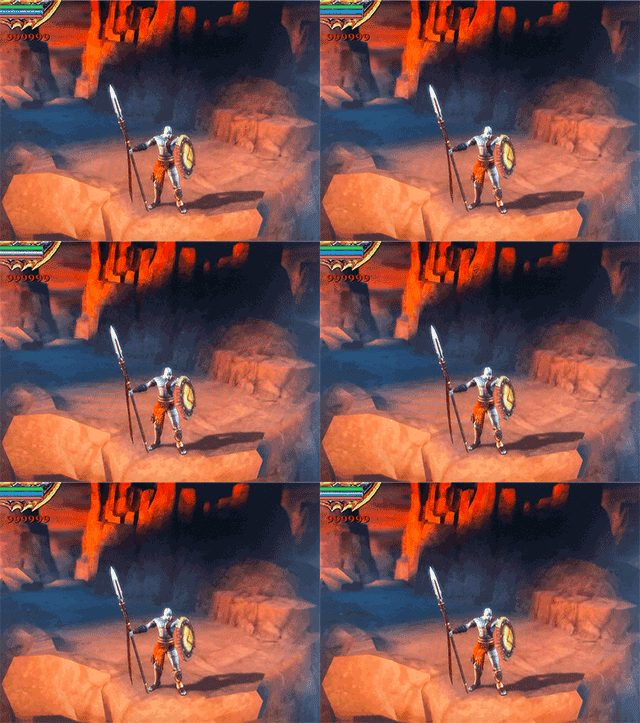
The Spartan leader in charge of demolishing the statue of Ares returns to Kratos, and gives him the spear, and shield that once belonged to him. These weapons were treated with great care, and respect, with the hopes that they would be returned back to the god of war. He seems to know that the next part of the journey is going to be the most dangerous portion yet.

As Kratos begins his travel through the Mounts of Laconia, and returns back to the Mounts of Aroania he comes across a frozen path. Inaccessible from a strong wind that freezes everything in its ascent. Kratos uses his shield to push against the wind. He reaches the source of the blizzard. It is the Shrine of Boreas. Frozen into the ground is the Horn of Boreas, the third, and final magic that he unlocks on his quest. Kratos can swing it overhead, and freeze his opponents. It is very similar in function to the Gorgon heads that he could use in previous games, except instead of turning to stone the enemies turn to ice, and can be shattered.

Kratos descends into the Canyons of Sorrow. We are starting to get close to Crete, and the still erupting Methana Volcano. We can see the sky starting to change from deep blue to ash. There is a path through the Canyon that is criss crossed with lava flows. Here we find the Rivers of Lament. We also discover a strange skinny man climbing through the caves, and telling the Spartan to stay away. As we follow him we find some items made of solid gold. There is a young woman face down in the earth, she is made of gold. We see ropes, and handprints along the walls made of gold as well. Even a few enemies are frozen in gold. The strange man is King Midas, and he is lamenting turning his daughter into gold. He was cursed by Dionysus with this power, and is clearly going mad. There is not a clear path through the Rivers of Lament so Kratos decides to end the king’s suffering, and make a path at the same time. He drags Midas against his will and hurtles him into a lava fall. It instantly turns to gold, with Midas trapped within.

It was a brilliant crossover with the classic tale of King Midas. Kratos came across all sorts of other fabled characters in his adventures, including Medusa in GoW, and Icarus in GoW II. Kratos makes it to the Port of Atlantis. In the distance we can see an enormous whirlpool, a collection of rocks, and a sunken city. Kratos takes his men, and sets sail to the heart of the whirlpool. The trip is very dangerous. Triton warriors continuously to leap into the ship the closer we get to The Vortex. Harpies, and lightning bolts start pelting the crew from above. The ship begins to speed up as it gets closer to the city. The ship gets dangerously close to the rocks on the edge of the whirlpool when a lightning storm breaks the mast, and hull apart. Kratos gets swept overboard, and pulled into the heart of the city.

A broken statue of Poseidon is cursing the Spartan. He vows that Kratos will pay for destroying his city, and condemning his worshipers. The Ancient City of Atlantis is breathtaking level design Even as it is deteriorating we can tell that it is surprisingly advanced. Water seems to be completely under the command of the magic, or technology powering the city. Between several columns we can see that we are underwater, a magical barrier keeps the pressure of the deep away. Atlanteans are running in terror, fearing that they have been abandoned, and their glorious city has come to ruin.

We get to the heart of the city, a place called the Nexus of Atlantis. It is the center of the whirlpool, and we can see four enormous statues of Poseidon are braced against the forces of the ocean. The sea is cascading in massive sheets over their shoulders, and yet somehow it never fills up the Nexus. The Death Gate is opposite of Kratos, however the bridge connecting it to the temple will not rise. The four statues of Poseidon are mechanized, but something is blocking them from raising the bridge. Kratos has to travel in, around, and under the Nexus in order to complete his mission. We swim through massive tunnels. We see enormous mechanisms, pumps, culverts, and drainage channels keeping the city from filling up completely. The forces under the Nexus are powerful enough to sweep away the god of war. He has to use all his strength, and pull himself along with the Blades of Athena in order to navigate the tunnels.

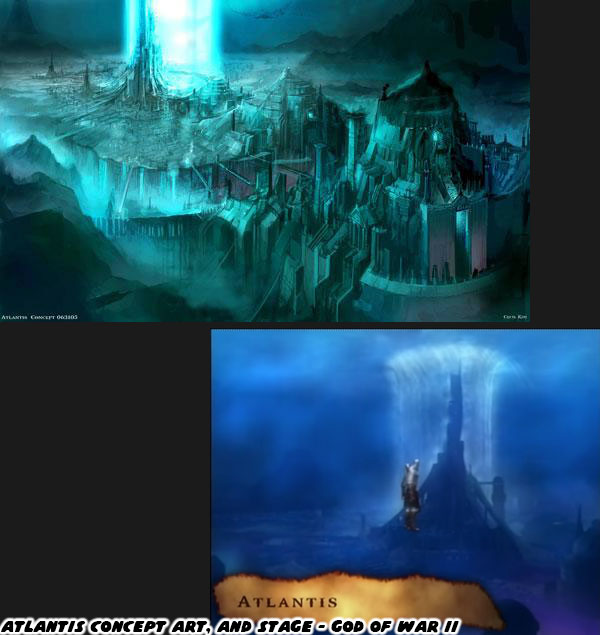
The City of Atlantis, Ruins of Atlantis, and especially Nexus of Atlantis are some of the most amazing environments ever featured in the GoW series. At the start of the game we get a glimpse of the Port of Atlantis, how it appears in its prime. Following the eruption of the Methana Volcano the top layers are broken off, and what we see is the oldest parts of the city. Like other ancient civilizations we discover that the Temple of Poseidon was built on top of older ruins. Surprisingly even the Sunken City of Atlantis has technology, to keep the ocean from swallowing it whole. This was part of the mythology behind the legends that created Atlantis. Sony Santa Monica had plans for Atlantis going all the way back to the development of God of War II.

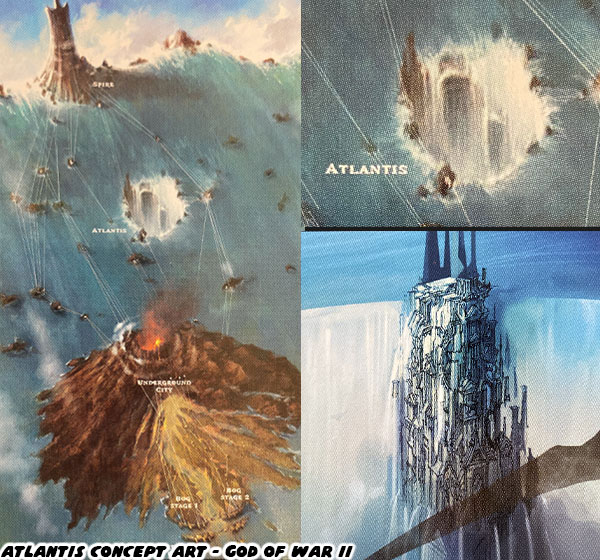
Concept artists Cecil Kim, Charlie Wen, and Stig Asmussen came up with the earliest plans for the fabled city. The studio was looking at the stage as one giant vertical encounter. It was going to exist between the Isles of Creation, and the Spire where the Sisters of Fate lived. In the earliest drafts of the game the Isles of Creation was a gigantic volcano. The front portion was a bog, similar to how it turned out in GoW II. The heart of the island was an underground city that Kratos would have to navigate. From there it would be a series of paths, and encounters in order to reach the base of Atlantis. This was very similar to how the Caldera, and Volcano Core of the Methana Volcano turned out in the Ghost of Sparta.

Sony Santa Monica had worked three or four months creating models, levels, and stage designs for Atlantis. Kratos would swim swiftly by following a deep sea current, similar to the East Australian Current scenes from the movie Finding Nemo. He would cut through a series of caves, as well as use portals to get him closer to the middle of the city. Players could see the size, and breadth of the city from magical barriers where water couldn’t enter the buildings he walked through. What made the stage truly special was that the Tower of Atlantis. It rose from the sea floor through a hole in the ocean. There were no rocks separating the ocean from the tower. It was some form of magic that kept the elements apart. From a below it appeared as if it was raining underwater. The tower had its own waterfalls cascading from the various levels. A completed stage would have undoubtedly looked as amazing as what Ready at Dawn Studios had delivered.

What many GoW fans never realized was that there was actually a part of the stage completed. Members of the team that got a chance to play through it lamented that audiences would never know what it was like. The Playstation Blog actually shares a page from the design document showing the game play specifically for the Atlantis Tower. Along the way to the top players would be teased a boss encounter. We would be able to see the Kraken circling the tower from the ocean side of the waterfall. As Kratos reached the top it would leap out of the water, and land on a platform. You would have to defeat it, and then reach the Pegasus (and not the Phoenix), perched on top in order to continue onto the Sisters of Fate. This idea was so well put together that Sony Santa Monica would revisit it in God of War Ascension. But that is a blog for another day.

In the Ghost of Sparta we have a version of Atlantis that is every bit as fantastic as the earlier concepts. However it is a hybrid magical technology that allows the Atlanteans to master the ocean. We saw it with the first magical weapon Kratos picked up, the Eye of Atlantis. But we also see it in the city proper. The water in various portions is electrified. The electricity can be harnessed to run the pumps that keep the water from flooding the city, and generate a barrier to keep the ocean from crashing inward. That electricity, and not Poseidon is what struck Kratos, and his ship as he approached the whirlpool. Electricity powered the statues of Poseidon as well.

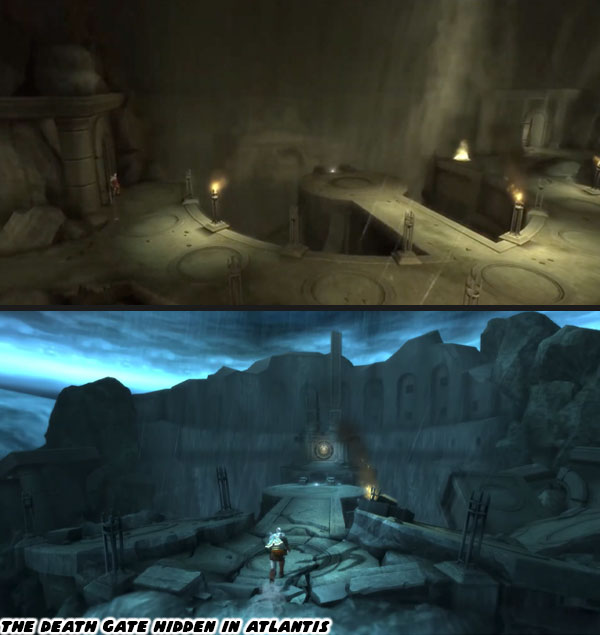
Kratos is able to steal a gear from an Automaton, and repair the statues that were blocking the bridge in the Nexus. When he returns he is able to use the Eye of Atlantis to power all four statues. In doing so they raise the bridge leading to the Death Gate. The game actually manages to go full circle. Which was something that made me extremely happy. When the adventure started we saw the Death Gate underneath Atlantis. It existed before the city, and even before the Olympians. The gods had enough reverence to the Primordials as to not mess with them, or their temples. They instead built around these places. The next time we saw it all of the Atlantean construction had been stripped away. Only the bridge, and portal itself remained.

The only way to reach, and activate the gate was by using the magic of death. Kratos used the Skull of Keres as a key. It would allow him to travel to the realm of death. This place was not the same as the underworld controlled by Hades. This was a place of true death for mortals, and gods alike. The final part of the Ghost of Sparta would have us visit the unknown, and see if Kratos could find his brother. I’m going to dig into that on the next blog. Until then I’d like to know which part of the game you liked best so far. Was it Atlantis? Was it the mountain stages? Let me know in the comments section please. As always if you would like to sponsor me please visit my Patreon page and consider donating each month, even as little as $1 would help make better blogs and even podcasts!
follow the Street Writer on Patreon!