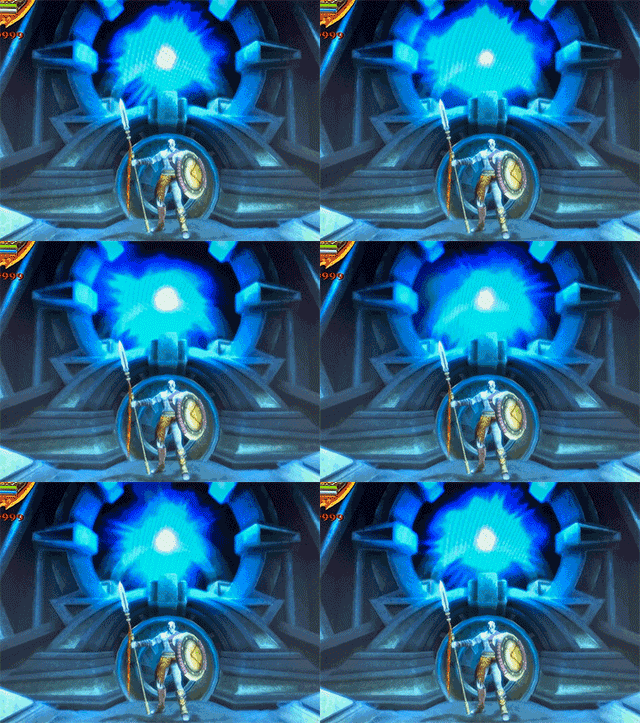
Showing posts with label crete. Show all posts

Monday, February 20, 2023

Ghost of Sparta, Kratos finds his brother, and battles death

When we last saw Kratos he had returned to Atlantis to find the Death Gate. It was the portal to bring us into another world. The conspiracy to kidnap his brother was starting to come into focus. Sparta was attacked by an unknown army when Kratos was a young man. A massive figure on a war horse took his brother Deimos. Kratos tried to fight back but was knocked away. A female warrior was accompanying him, she said the Fates had warned that the one with the markings was destined to cause the fall of Olympus. Now that they had the marked one they were to leave the other boy alone. They rode away. We learned that it was Ares, and Athena that had attacked Sparta that night.

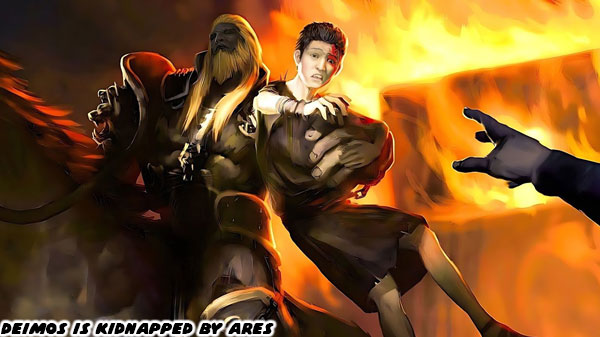
Ares needed to ensure Deimos would never fulfill the prophecy. Had he killed the boy then his soul would have ended up in Hades. Once there he could have gone to the fields of Elysium, or the pits of Tartarus. In either case he would have grown up in the land controlled by the Olympians. He would be able to train with other deceased warriors, and recruit like-minded souls. Eventually he would have raised an army like his brother, and then overthrown Olympus. Ares had to take Deimos as far from Olympus as possible. In this case it was the Domain of Death. The Olympians had no power over the forces that existed before them, the Primordial realms. He left Deimos in the charge of Thanatos, the god of death. The only way Ares could have entered this world was if he had a key. In his case he had the Skull of Keres, the goddess of death. He kept it hidden in his temple on Sparta.

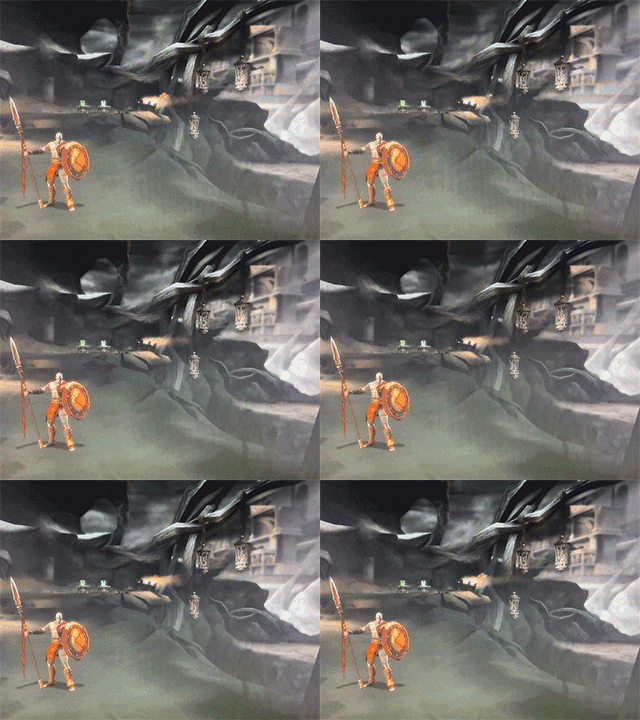
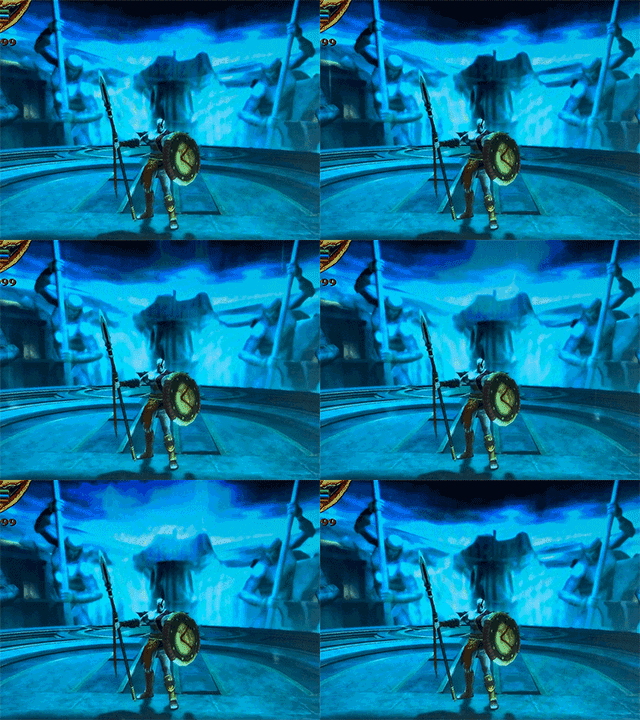
This portion of the game had brilliant design. It was as well themed as the other locations featured in the Ghost of Sparta. As far as we could see there was no sun, or moon in this place. There was no horizon. The realm of death went on to the infinite. In the background we could see a massive building.

Kratos made his way to the Temple of Thanatos. Avoiding supernatural birds, and vines that would strike him. The Bane of Thera allowed him to burn away the living plants.

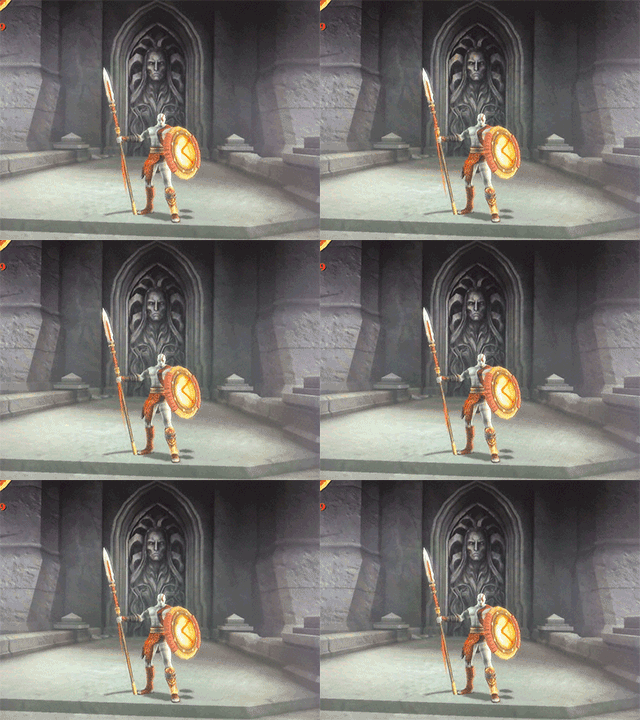
When he reached the doors to the temple Thanatos spoke to him. It was the third time the effect had been used in the game. Thanatos was not happy that Kratos had trespassed into his domain. He challenged the Spartan to continue if he wanted to meet his destiny.

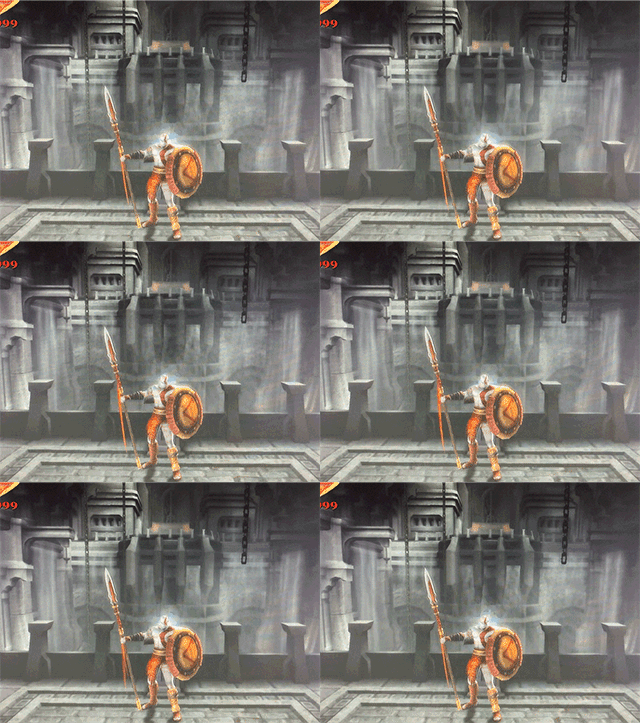
The only atmosphere in this place was a steady breeze. What I thought made is unique was that the wind carried dust. In every portion of this world there was dust. It was cascading down the walls. It was flowing down stairs, and pouring in through the cracks. I could only assume that this was the dust from where all things were made, and how we would end up. There were a few versions of the Bible through history that had a version of the phrase “From dust you have come, and to dust you shall return.” This was from the book of Genesis.

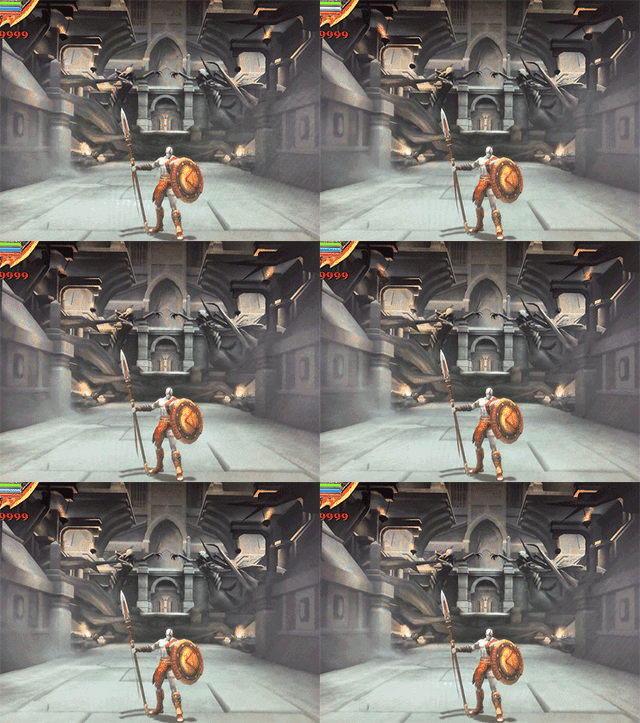
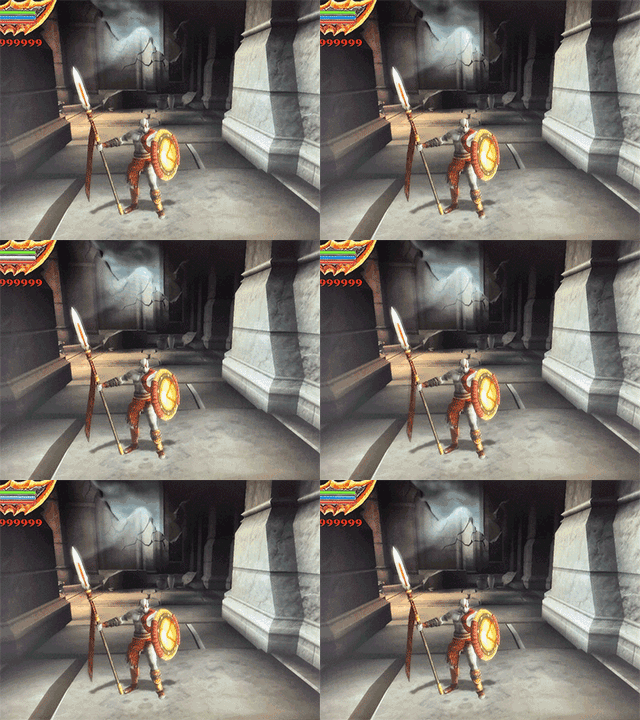
The Temple of Thanatos was eerie. The constant wind brought life to the stage even though there were no residents. The scale of this place seemed too massive for a solitary being. Of course it was all designed to be imposing. It was eternal, it existed before time, and would exist after the end of the universe.

There were several massive traps scattered within. They were large, brutal, and powerful enough to kill a god.

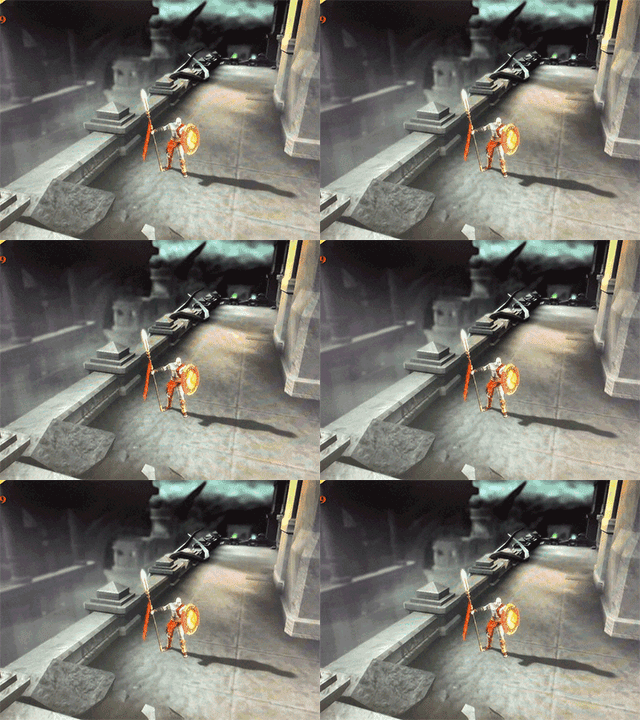
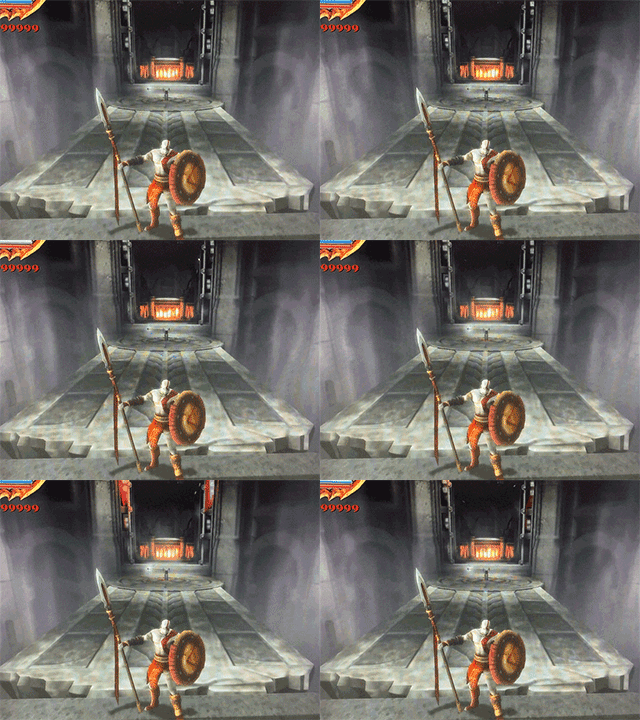
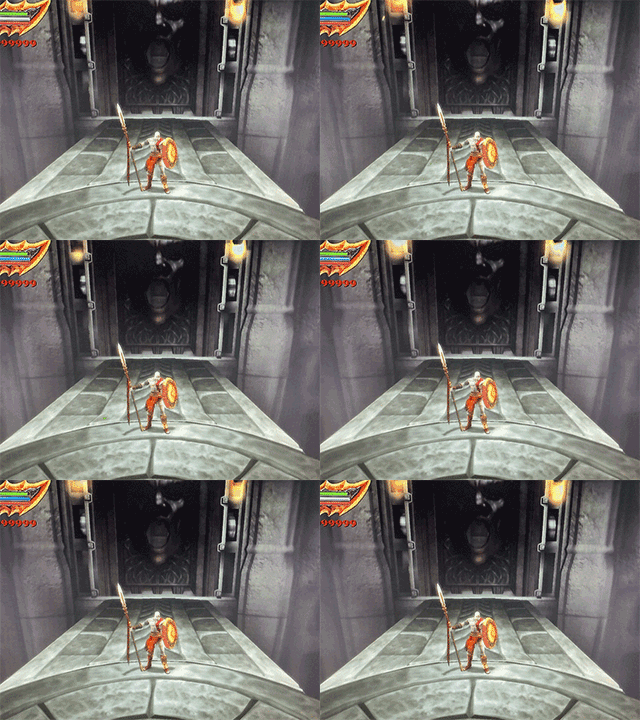
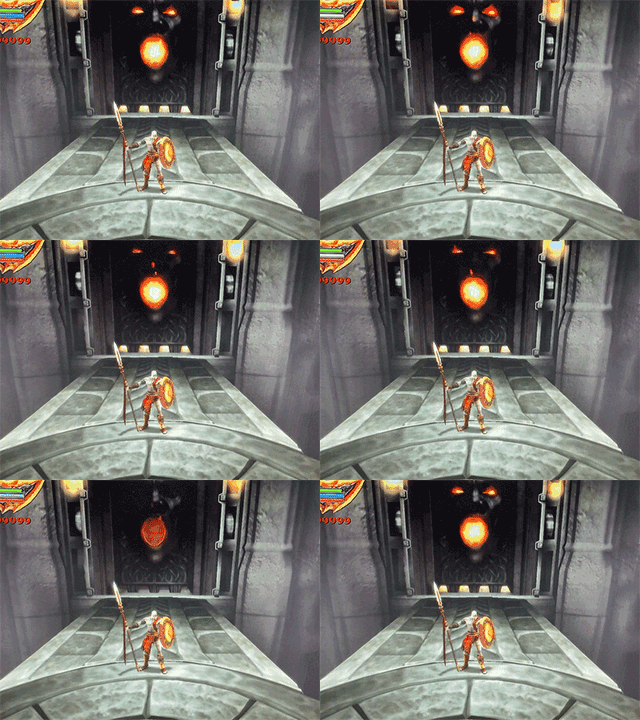
There was a rotating bridge separating the temple from the vault that held the prisoner Deimos. Fire would periodically shoot across the bridge, making it impossible to get across.

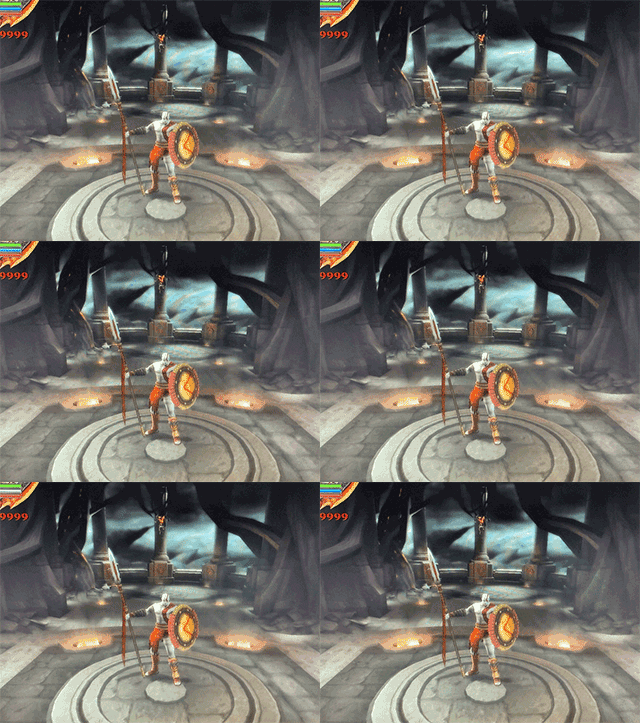
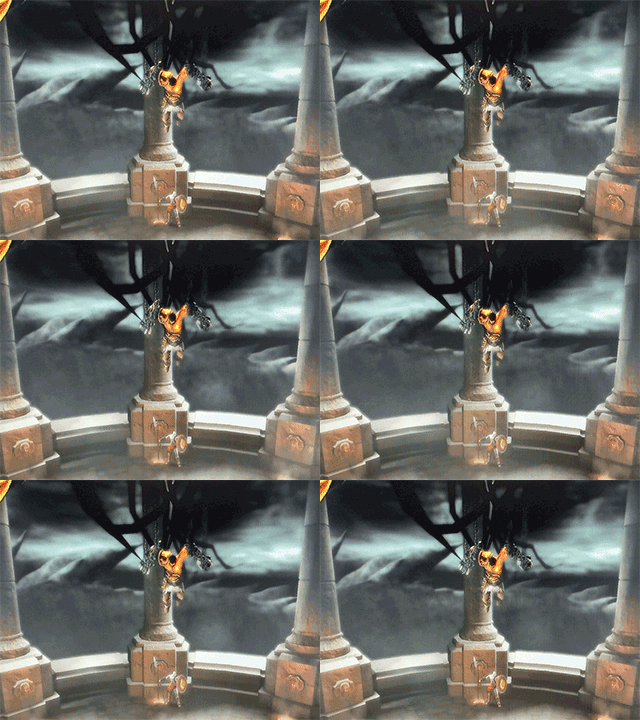
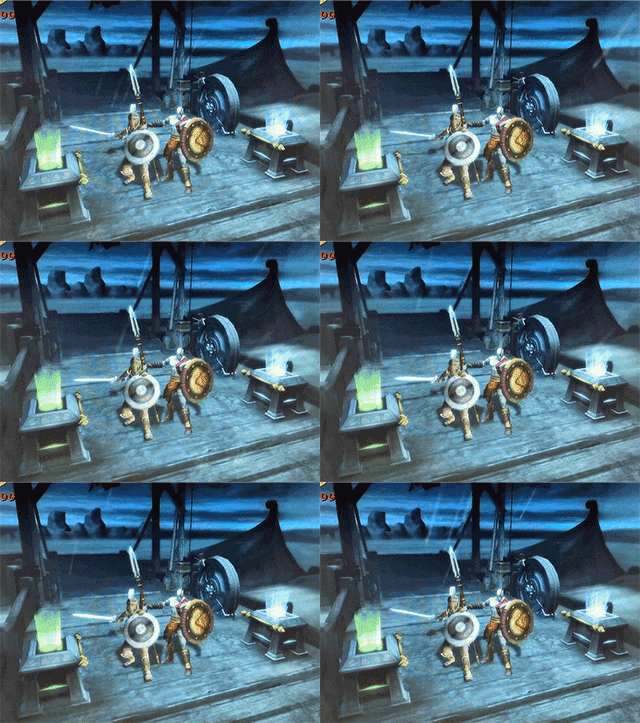
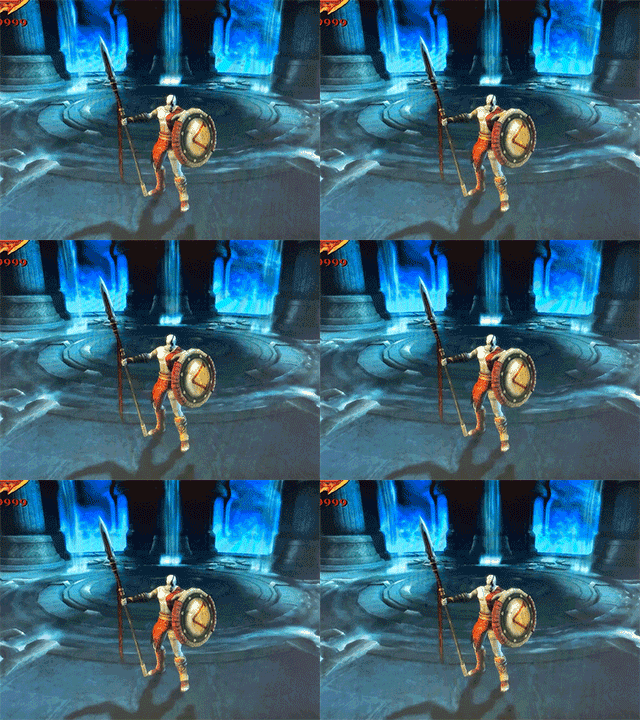
Kratos would need the Arms of Sparta to figure out the trap. He could use his shield to reach the bridge rotating mechanism. Then he could temporarily jam the gears on the vault with a spear attack. The gate on the vault would close, and allow Kratos a moment to rotate the bridge.

The fire would continue whether the gate was opened or closed. While it was down the face of Thanatos could be seen glowing with every burning pulse. It was an awesome sight.

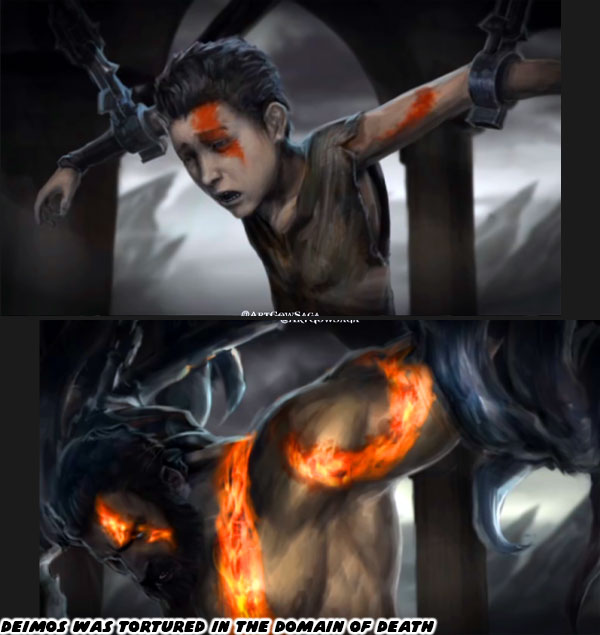
Kratos eventually reached the inner vault, and found his brother suspended by chains.

It wasn’t enough that Thanatos had imprisoned him. He had tortured Deimos for decades. His mind was not what it once was.

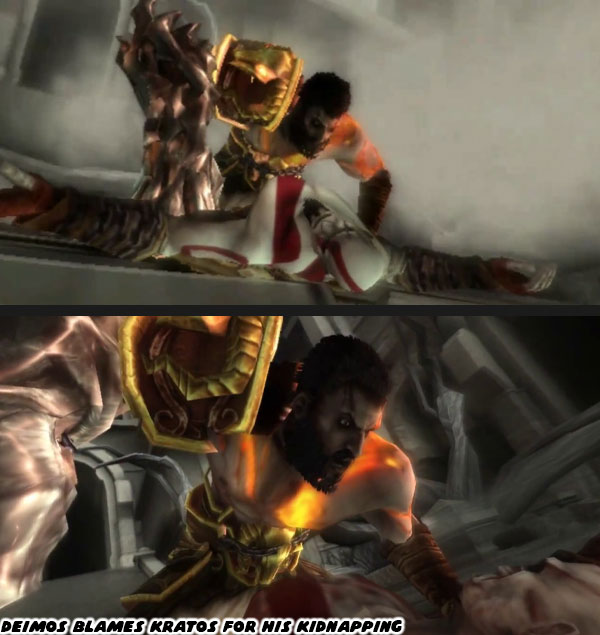
When Kratos lowered him it wasn’t a warm reunion. Deimos was filled with hate. It gave him strength, and power well above that of a normal human. The birthmark covering his body was now glowing with a similar rage to what filled Kratos.

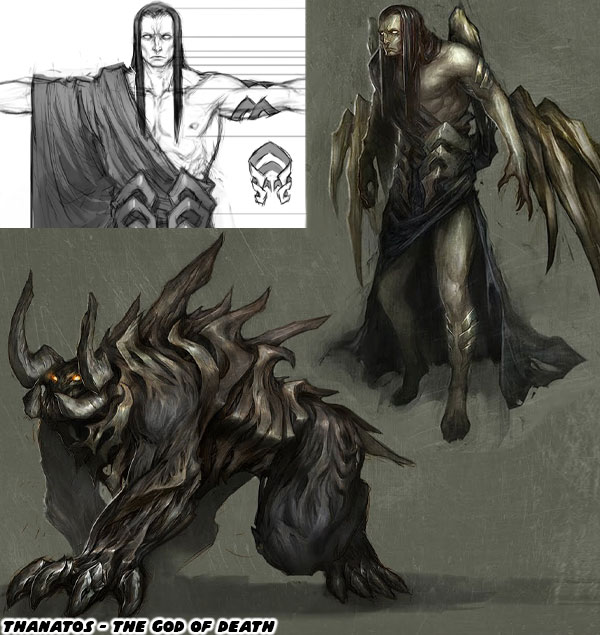
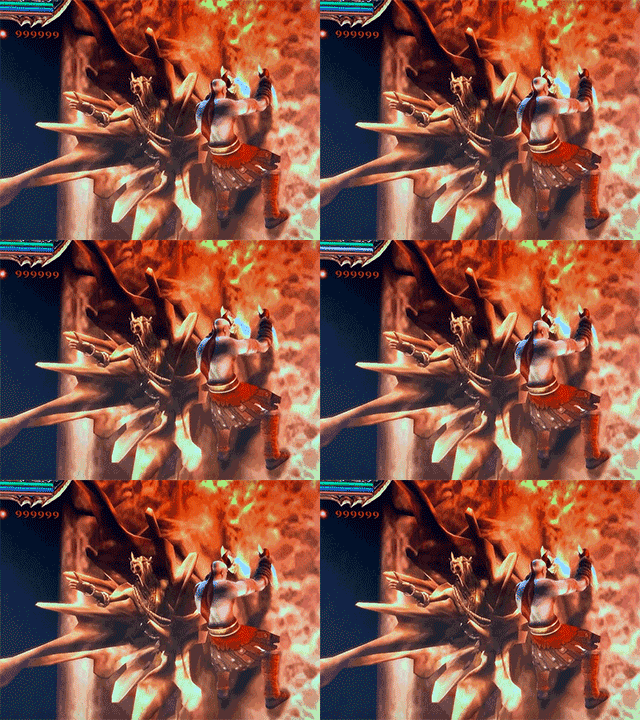
Thanatos had left Deimos with large metal gauntlets. He would be able to use them against his brother, or any person foolish enough to release him. Deimos brutally attacked Kratos during the boss fight, and hit Kratos hard enough to break his gauntlets. Kratos would not strike back because he still cared for his brother. Once Deimos stopped pummeling his brother Thanatos showed up. He was enormous, taller than even Zeus. He grabbed Deimos with his claw-like fingers, and walked away. He knew Kratos had killed his daughter, and now he was going to return the favor. He jumped away from his temple. Despite his injuries Kratos followed after.

Thanatos landed on the Suicide Bluffs in Athens. He was going to drop Deimos just steps away from where the original GoW game started. It was a brilliant callback to the title that launched a franchise. Kratos saved his brother, and they reconciled. Deimos remembered the advice that Kratos gave him as a child. “A Spartan never lets his back hit the ground.” He nodded, and gave Deimos the Arms of Sparta. The two started a hunt for the god of death.

What followed next was an amazing battle. Both Kratos, and Deimos could strike at the same time. Thanatos used a giant sword to deflect the Blades of Athena, and spear attacks. When the duo were getting the upper hand Thanatos would transform into a giant beast. The creature was far larger than the monster Erinys could turn into. Little by little they were able to break through Thanatos’ armor-like skin. Just as they had the god of death weakened he struck the brothers. Slamming them each against the cliffs with tremendous force. The godly strength of Kratos saved him, but Deimos was mortal. He didn’t survive the final strike.

Kratos destroyed the giant monster form with his rage, then beat the human-sized Thanatos with his bare hands. As the god of death coughed up golden blood he filled in the blanks to the story. He told the god of war that the Sisters of Fate had already determined the marked warrior would destroy Olympus. There was no way to escape his fate. Kratos punched through his chest, and finished him. With his brother gone it was a hollow victory.

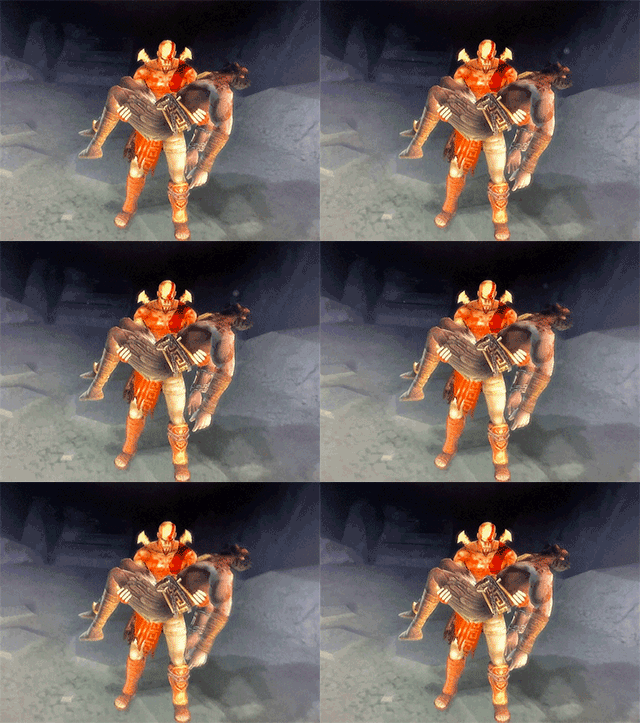
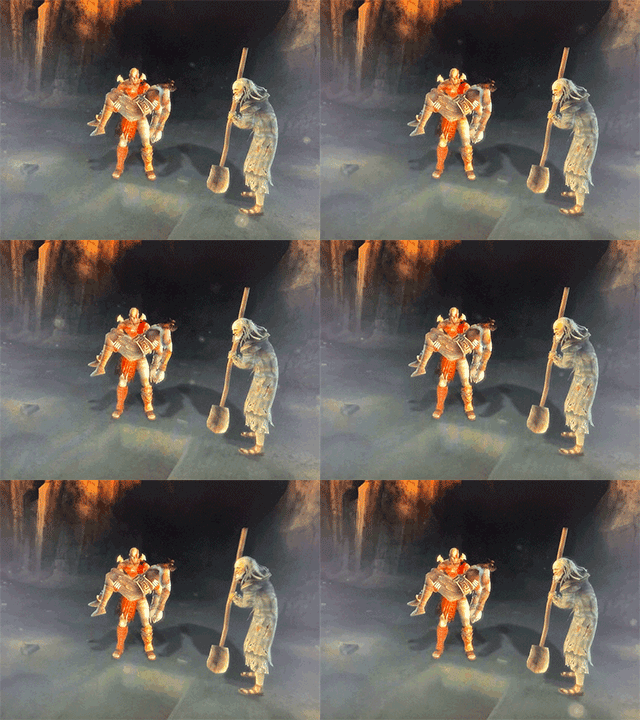
Kratos carries his brother up the cliffs, where an old friend is waiting. The Grave Digger appeared to Kratos as Crete was burning, and advised him to give up his quest. Now it was too late to do anything to avert his destiny. He has a hole prepared for his brother. Kratos lays him in the ground, and the Grave Digger begins covering him. Kratos wonders what he has become, the Digger replies “Death, the destroyer of worlds.” Athena appears through the portal of Olympus, and says now that he no longer had any ties to the mortal world she would fulfill her promise. She would wipe Kratos’ memories. He would no longer remember his family. Not his wife Lysandra, his child Calliope, his mother Callisto, or brother Deimos. He would remember only his life as a god. Kratos refuses, and uses the portal to return to Olympus. He vows to make the gods pay for what they did to him. His disdain for Olympus has grown tenfold. Athena regrets her decisions and apologizes under her breath, calling Kratos her brother. The seeds have been planted. We just witnessed the events leading into GoW II.

After the end credits we are treated to a special cut scene. The Grave Digger places the body of Callisto into the grave next to Deimos. He had a third grave prepared, and says “Now only one remains.” Then we see Kratos wearing his God Armor, sitting on the throne of Ares. It was a brilliant ending to a brilliant game. I said it at the start of the blog series, and I’ll say it again. This might be my absolute favorite GoW game, and easily one of my favorite games of all time. I’d like to hear from you. Did you play the Ghost of Sparta? What did you think? Did you have a favorite game in the series? I’d like to hear about it. Let me know in the comments section please. As always if you would like to sponsor me please visit my Patreon page and consider donating each month, even as little as $1 would help make better blogs and even podcasts!
follow the Street Writer on Patreon!

Friday, February 17, 2023

Ghost of Sparta, Kratos faces himself, and returns to where it all started

In the previous blog we covered Kratos’ battle with Erinys the daughter or death, his arrival at Sparta, and the fight with the Piraeus Lion. Kratos is trying to find out what happened to his brother Deimos. He was taken as a child by Ares, and assumed killed. On her deathbed Callisto the mother of Kratos, and Deimos says the truth is found within the Temple of Ares. Kratos takes a secret passage through the Jails of Sparta, and climbs out the other end. He is now at the Mounts of Laconia. Once agains the team at Ready at Dawn Studios created a unique environment for the game. It had its own weather, and color scheme. The hills were a deep clay red. Kratos scales the breezy peaks at dusk.

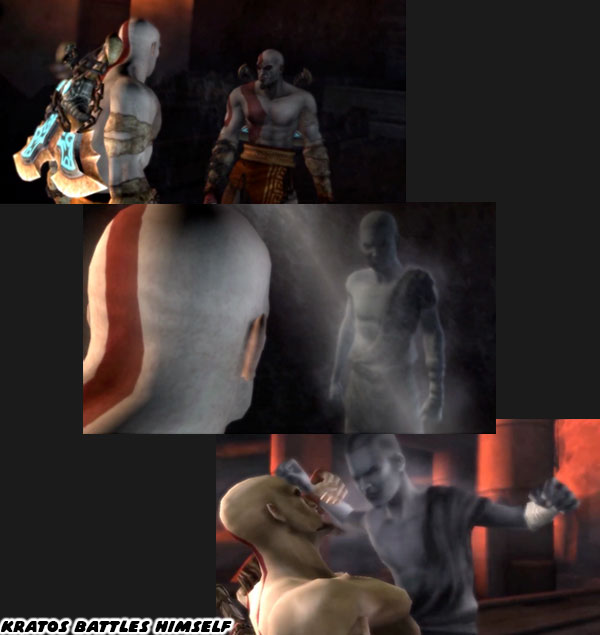
He arrived at the Temple of Ares just at nightfall. We could see Spartans pulling down a statue of Ares. The leader of his men told Kratos that they would soon be erecting a new statue in his honor. Kratos went into the temple, where the visage of Ares said to face himself, and learn the truth. Kratos went behind the throne reserved for Ares, and discovered a polished black stone, perhaps onyx. In its reflection he could see himself as a young man, he had no tattoos, and without the Blade of Athena.

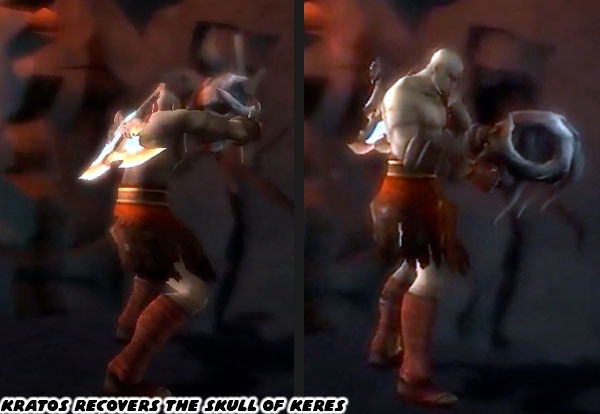
The younger version tries to pull him into the mirror. The two have an ugly fight. The younger reflection hurling insults at the god of war. Saying that he didn’t protect his brother, that he was a coward, that he abandoned him. Kratos gets the upper hand, shatters the wall, and forces the reflection back into the rock. Inside he discovers the source of its magic. There is a skull of a creature, it has horns, and larger than a human skull. It is the Skull of Keres, in Greek mythology the goddess of death. Kratos now realizes that he has to return to Atlantis, or what’s left of it.

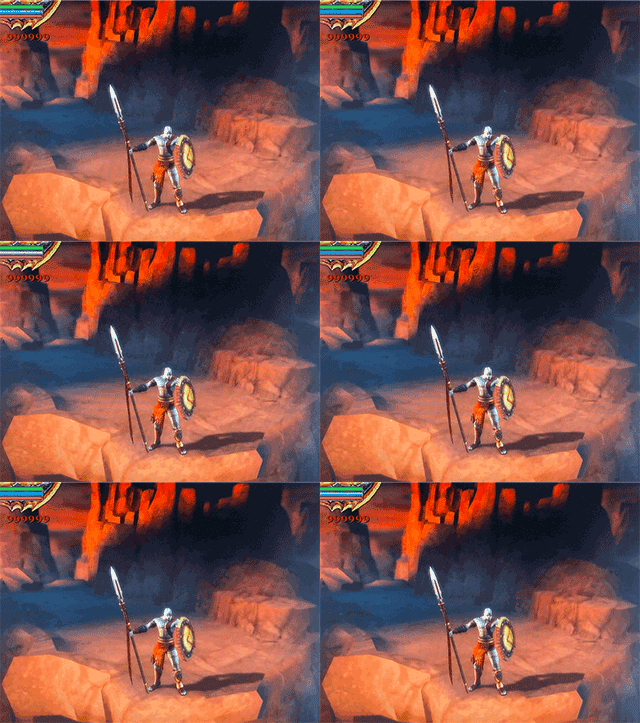
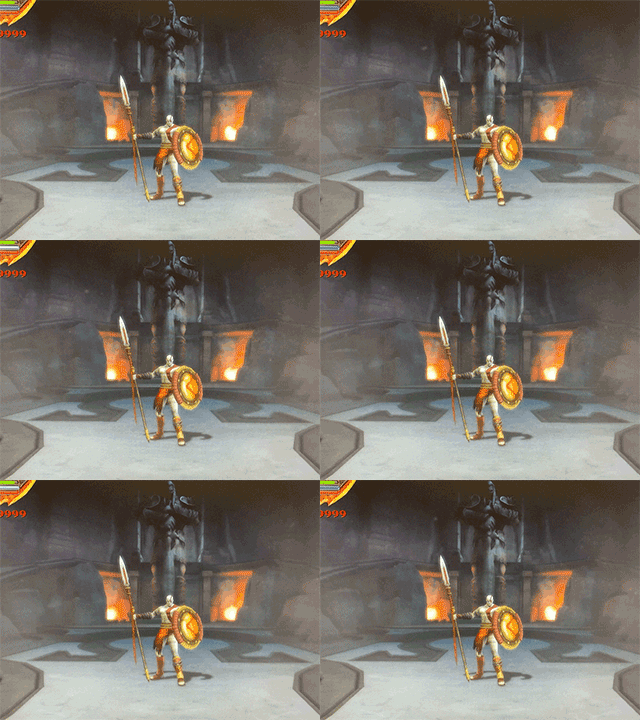
The Spartan leader in charge of demolishing the statue of Ares returns to Kratos, and gives him the spear, and shield that once belonged to him. These weapons were treated with great care, and respect, with the hopes that they would be returned back to the god of war. He seems to know that the next part of the journey is going to be the most dangerous portion yet.

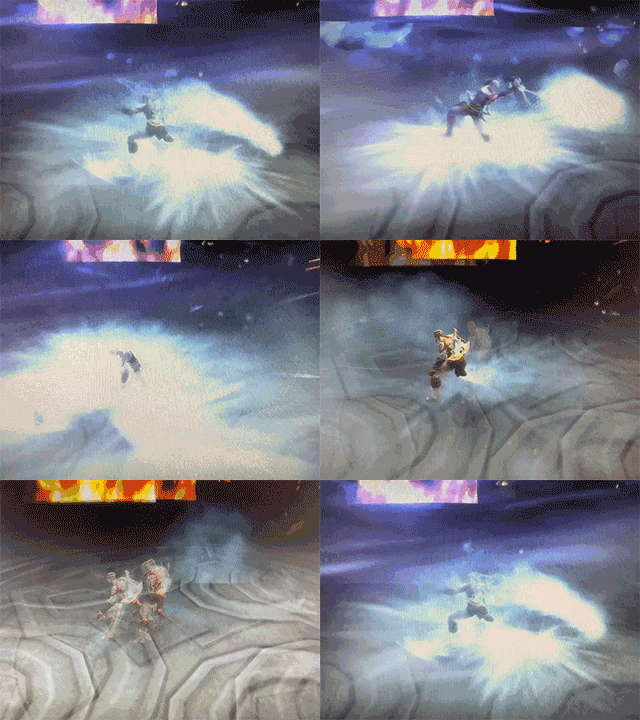
As Kratos begins his travel through the Mounts of Laconia, and returns back to the Mounts of Aroania he comes across a frozen path. Inaccessible from a strong wind that freezes everything in its ascent. Kratos uses his shield to push against the wind. He reaches the source of the blizzard. It is the Shrine of Boreas. Frozen into the ground is the Horn of Boreas, the third, and final magic that he unlocks on his quest. Kratos can swing it overhead, and freeze his opponents. It is very similar in function to the Gorgon heads that he could use in previous games, except instead of turning to stone the enemies turn to ice, and can be shattered.

Kratos descends into the Canyons of Sorrow. We are starting to get close to Crete, and the still erupting Methana Volcano. We can see the sky starting to change from deep blue to ash. There is a path through the Canyon that is criss crossed with lava flows. Here we find the Rivers of Lament. We also discover a strange skinny man climbing through the caves, and telling the Spartan to stay away. As we follow him we find some items made of solid gold. There is a young woman face down in the earth, she is made of gold. We see ropes, and handprints along the walls made of gold as well. Even a few enemies are frozen in gold. The strange man is King Midas, and he is lamenting turning his daughter into gold. He was cursed by Dionysus with this power, and is clearly going mad. There is not a clear path through the Rivers of Lament so Kratos decides to end the king’s suffering, and make a path at the same time. He drags Midas against his will and hurtles him into a lava fall. It instantly turns to gold, with Midas trapped within.

It was a brilliant crossover with the classic tale of King Midas. Kratos came across all sorts of other fabled characters in his adventures, including Medusa in GoW, and Icarus in GoW II. Kratos makes it to the Port of Atlantis. In the distance we can see an enormous whirlpool, a collection of rocks, and a sunken city. Kratos takes his men, and sets sail to the heart of the whirlpool. The trip is very dangerous. Triton warriors continuously to leap into the ship the closer we get to The Vortex. Harpies, and lightning bolts start pelting the crew from above. The ship begins to speed up as it gets closer to the city. The ship gets dangerously close to the rocks on the edge of the whirlpool when a lightning storm breaks the mast, and hull apart. Kratos gets swept overboard, and pulled into the heart of the city.

A broken statue of Poseidon is cursing the Spartan. He vows that Kratos will pay for destroying his city, and condemning his worshipers. The Ancient City of Atlantis is breathtaking level design Even as it is deteriorating we can tell that it is surprisingly advanced. Water seems to be completely under the command of the magic, or technology powering the city. Between several columns we can see that we are underwater, a magical barrier keeps the pressure of the deep away. Atlanteans are running in terror, fearing that they have been abandoned, and their glorious city has come to ruin.

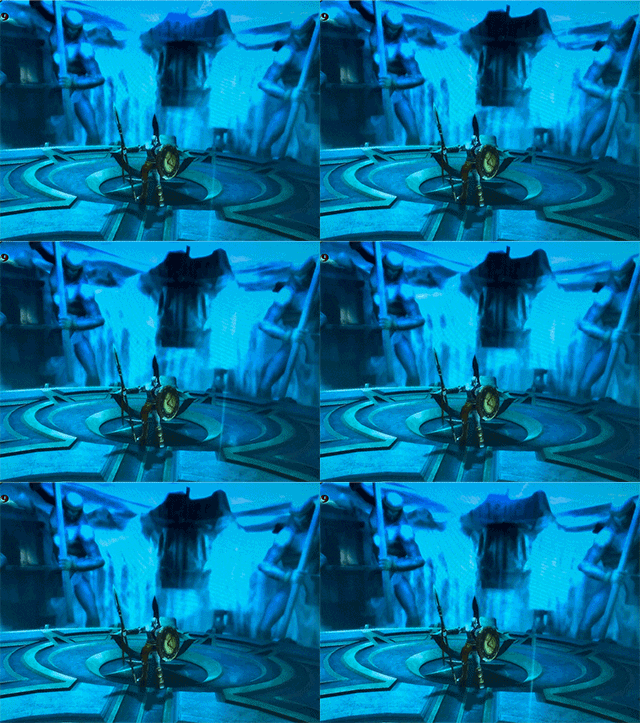
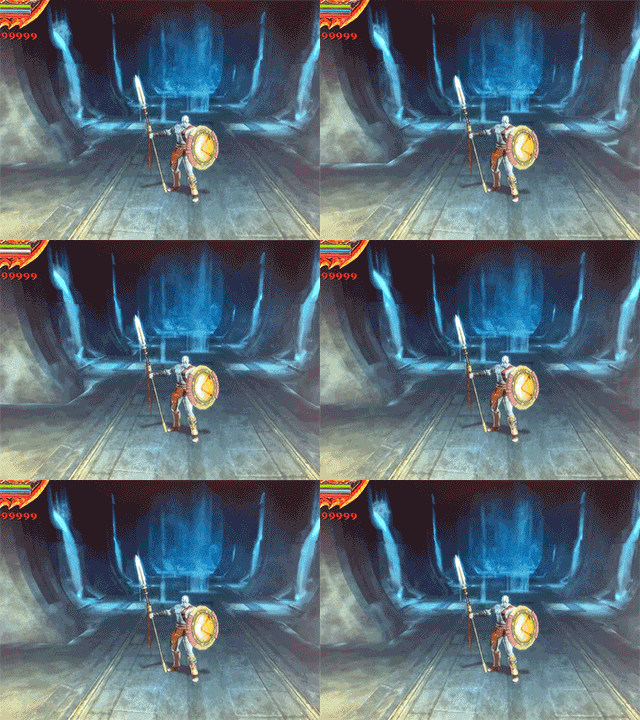
We get to the heart of the city, a place called the Nexus of Atlantis. It is the center of the whirlpool, and we can see four enormous statues of Poseidon are braced against the forces of the ocean. The sea is cascading in massive sheets over their shoulders, and yet somehow it never fills up the Nexus. The Death Gate is opposite of Kratos, however the bridge connecting it to the temple will not rise. The four statues of Poseidon are mechanized, but something is blocking them from raising the bridge. Kratos has to travel in, around, and under the Nexus in order to complete his mission. We swim through massive tunnels. We see enormous mechanisms, pumps, culverts, and drainage channels keeping the city from filling up completely. The forces under the Nexus are powerful enough to sweep away the god of war. He has to use all his strength, and pull himself along with the Blades of Athena in order to navigate the tunnels.

The City of Atlantis, Ruins of Atlantis, and especially Nexus of Atlantis are some of the most amazing environments ever featured in the GoW series. At the start of the game we get a glimpse of the Port of Atlantis, how it appears in its prime. Following the eruption of the Methana Volcano the top layers are broken off, and what we see is the oldest parts of the city. Like other ancient civilizations we discover that the Temple of Poseidon was built on top of older ruins. Surprisingly even the Sunken City of Atlantis has technology, to keep the ocean from swallowing it whole. This was part of the mythology behind the legends that created Atlantis. Sony Santa Monica had plans for Atlantis going all the way back to the development of God of War II.

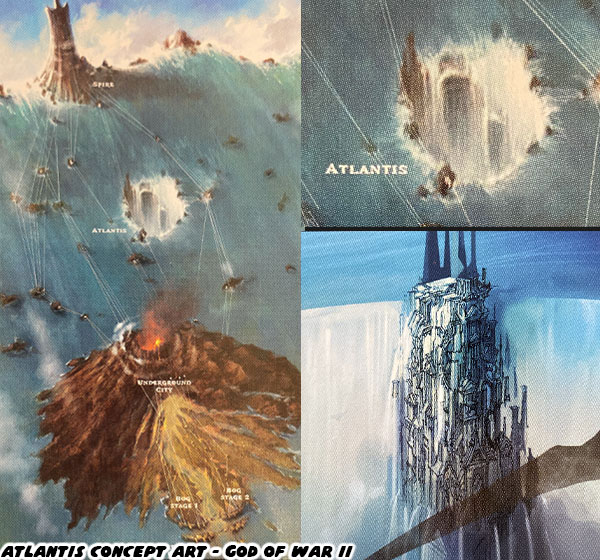
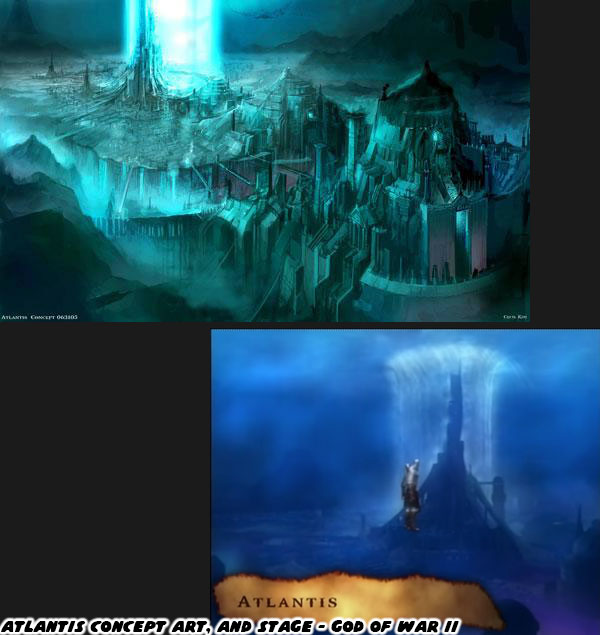
Concept artists Cecil Kim, Charlie Wen, and Stig Asmussen came up with the earliest plans for the fabled city. The studio was looking at the stage as one giant vertical encounter. It was going to exist between the Isles of Creation, and the Spire where the Sisters of Fate lived. In the earliest drafts of the game the Isles of Creation was a gigantic volcano. The front portion was a bog, similar to how it turned out in GoW II. The heart of the island was an underground city that Kratos would have to navigate. From there it would be a series of paths, and encounters in order to reach the base of Atlantis. This was very similar to how the Caldera, and Volcano Core of the Methana Volcano turned out in the Ghost of Sparta.

Sony Santa Monica had worked three or four months creating models, levels, and stage designs for Atlantis. Kratos would swim swiftly by following a deep sea current, similar to the East Australian Current scenes from the movie Finding Nemo. He would cut through a series of caves, as well as use portals to get him closer to the middle of the city. Players could see the size, and breadth of the city from magical barriers where water couldn’t enter the buildings he walked through. What made the stage truly special was that the Tower of Atlantis. It rose from the sea floor through a hole in the ocean. There were no rocks separating the ocean from the tower. It was some form of magic that kept the elements apart. From a below it appeared as if it was raining underwater. The tower had its own waterfalls cascading from the various levels. A completed stage would have undoubtedly looked as amazing as what Ready at Dawn Studios had delivered.

What many GoW fans never realized was that there was actually a part of the stage completed. Members of the team that got a chance to play through it lamented that audiences would never know what it was like. The Playstation Blog actually shares a page from the design document showing the game play specifically for the Atlantis Tower. Along the way to the top players would be teased a boss encounter. We would be able to see the Kraken circling the tower from the ocean side of the waterfall. As Kratos reached the top it would leap out of the water, and land on a platform. You would have to defeat it, and then reach the Pegasus (and not the Phoenix), perched on top in order to continue onto the Sisters of Fate. This idea was so well put together that Sony Santa Monica would revisit it in God of War Ascension. But that is a blog for another day.

In the Ghost of Sparta we have a version of Atlantis that is every bit as fantastic as the earlier concepts. However it is a hybrid magical technology that allows the Atlanteans to master the ocean. We saw it with the first magical weapon Kratos picked up, the Eye of Atlantis. But we also see it in the city proper. The water in various portions is electrified. The electricity can be harnessed to run the pumps that keep the water from flooding the city, and generate a barrier to keep the ocean from crashing inward. That electricity, and not Poseidon is what struck Kratos, and his ship as he approached the whirlpool. Electricity powered the statues of Poseidon as well.

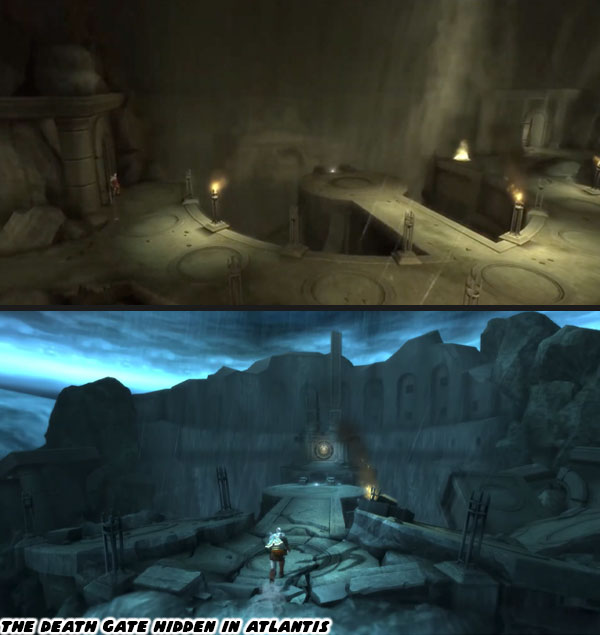
Kratos is able to steal a gear from an Automaton, and repair the statues that were blocking the bridge in the Nexus. When he returns he is able to use the Eye of Atlantis to power all four statues. In doing so they raise the bridge leading to the Death Gate. The game actually manages to go full circle. Which was something that made me extremely happy. When the adventure started we saw the Death Gate underneath Atlantis. It existed before the city, and even before the Olympians. The gods had enough reverence to the Primordials as to not mess with them, or their temples. They instead built around these places. The next time we saw it all of the Atlantean construction had been stripped away. Only the bridge, and portal itself remained.

The only way to reach, and activate the gate was by using the magic of death. Kratos used the Skull of Keres as a key. It would allow him to travel to the realm of death. This place was not the same as the underworld controlled by Hades. This was a place of true death for mortals, and gods alike. The final part of the Ghost of Sparta would have us visit the unknown, and see if Kratos could find his brother. I’m going to dig into that on the next blog. Until then I’d like to know which part of the game you liked best so far. Was it Atlantis? Was it the mountain stages? Let me know in the comments section please. As always if you would like to sponsor me please visit my Patreon page and consider donating each month, even as little as $1 would help make better blogs and even podcasts!
follow the Street Writer on Patreon!

Wednesday, February 15, 2023

Ghost of Sparta, and the greatest sub-boss in the history of the franchise

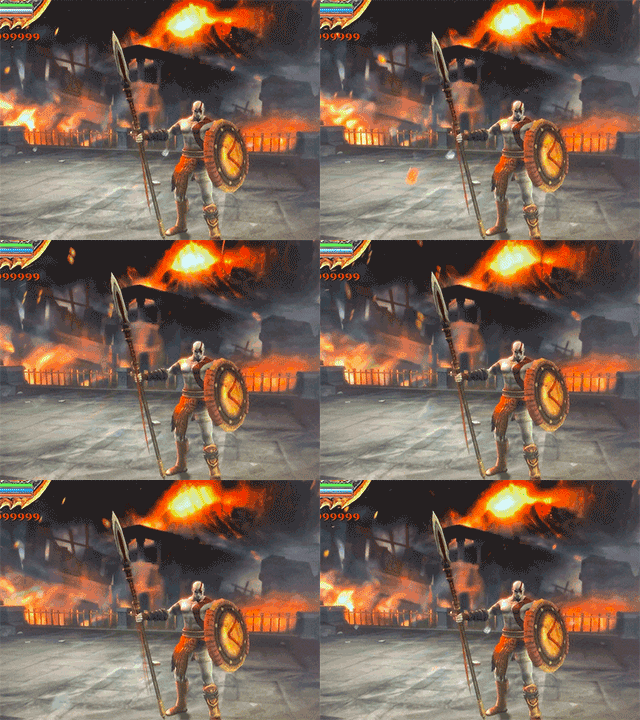
When we last saw Kratos he had just defeated the Scylla, and had escaped a collapsing volcano. In the ensuing explosion he got hurtled over the city of Atlantis. If not for his godhood he would have died from the impact. He was thrown from the Methana Volcano to Crete. The skies changed completely. At the start of the game we were in a raging tempest. Now everything was black with ash, and dust blew across the ground. We could see the volcano in full eruption in the background. It was hurtling enormous chunks of flaming earth in all directions. We could hear the screams of the villagers as their city broke apart. It was one of the most amazing stages I had ever seen in the GoW series.
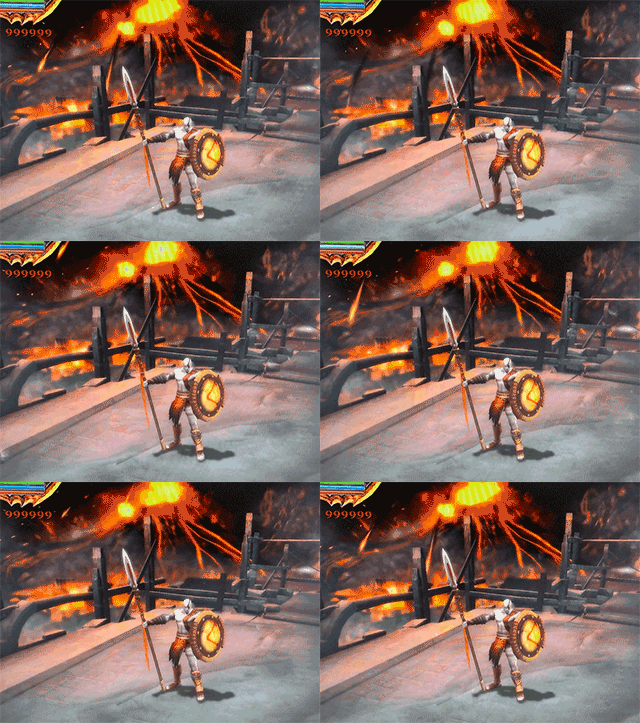
Kratos made his way across the apocalyptic landscape. Destruction was all around him. Walls, and temples collapsed in the distance, and we could see the Mediterranean Sea pouring into the fissures where Atlantis once stood. The god of war had to fight gorgons, harpies, and zombie-like Hoplite Soldiers under the burning debris. This portion of the game had so much going on that it took me several play throughs to catch all the details. In fact, it made me realize the level of depth that the series had always consisted of. From this point on rather than rush through each game I put on my Sony studio monitor headphones, and took my sweet time going through every corner of the levels trying to absorb as much as I could.
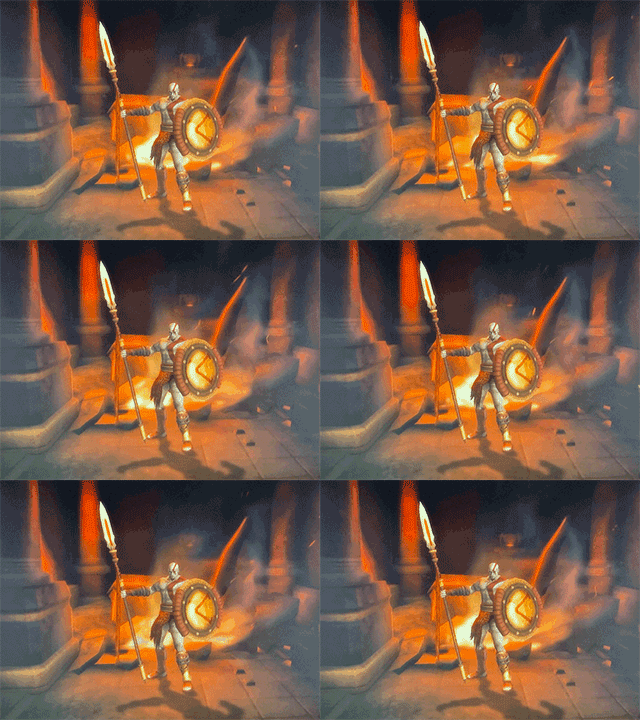
Slowing down the game play was something that modern developers had done in the GoW (2018), and GoW Ragnarok games, but was also the pacing changes seen in Uncharted, Tomb Raider, the Last of Us, Horizon Zero Dawn, and other AAA titles. The newer tempo forced audiences to slow down, and become invested in the world that Sony, and the other studios had created. It helped gamers, myself included, appreciate the level of depth that the developers had spent years working on. It was much easier to absorb the thousands of details created for the different realms. Sony Santa Monica accomplished this in GoW Ragnarok by having players spend 30+ hours traveling back, and forth between worlds, completing main, and side objectives. If modern games were built like the classic GoW titles then we would be able to rush through them in an afternoon, and completely miss years of work that went into creating them.
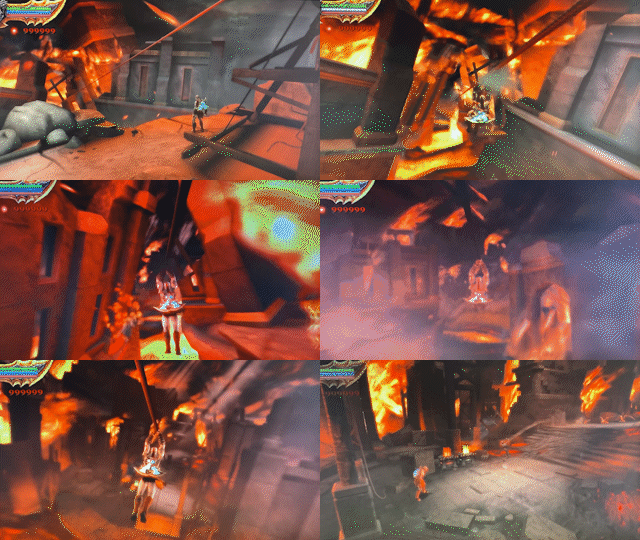
The developers at Ready at Dawn used the camera to frame the most important scenes in the game. It would close in during the combat scenes, then pan back while traversing so you could enjoy the spectacle happening all around. When they really wanted the gamer to feel like they were in the heart of the action they would completely surround Kratos in the smoke, explosions, and other effects generated by the game engine. One of my favorite shots in the game happens as Kratos is trying to get to the other side of Heraklion, the financial heart of Crete. I absolutely live for the 10 second rope slide in this game. Every game in the GoW series has a rope slide / chain slide scene. It’s a way to speed up travel from one area to another, but it can also be used to mask a new level loading. This time Kratos is sliding past blazing structures that are collapsing, but even a citizen that is on fire leaps out of a window, and into the inferno. This small detail lasts a half second, but is important enough to include. It is storytelling told through the action. No shot is wasted in the entire journey.
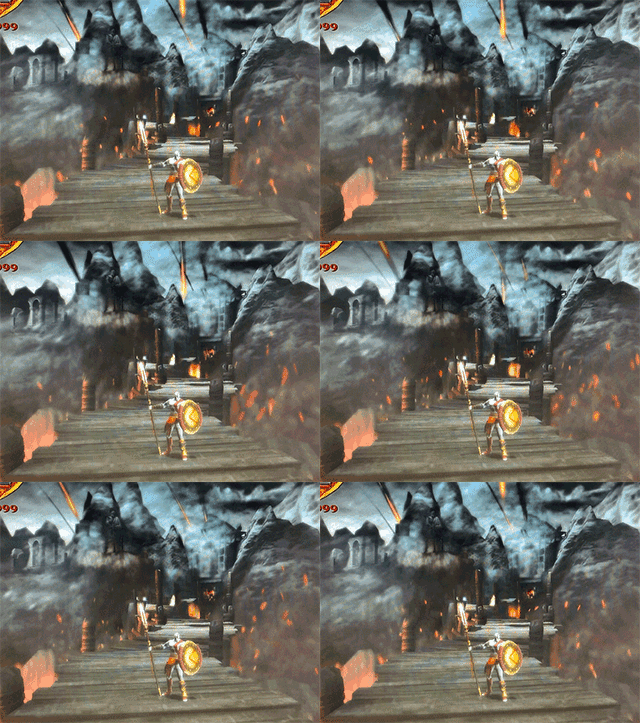
The Ghost of Sparta does a brilliant job of recreating the atmosphere from the various regions of the Mediterranean in a single adventure. We had already been in a tempest, and survived magma flows. There were ice, snow, and more weather events coming up. Can you name a portion of any modern GoW game that even had that type of diversity? Kratos defies Athena as she speaks to him from a statue in Crete. There is nothing she can say to get him to change his mind, and end his quest. He remembers that his brother was taken by two mysterious figures. We learn that they were Athena, and Ares in the darkness. Kratos makes it out of Crete, and begins climbing the hills. We’re some distance from the Volcano, but there are still fireballs hurtling through the sky. He reaches the Mounts of Aroania. The frozen cliffs where young Spartans would learn how to endure harsh elements, and survive against the wilderness.
A shadowy demon is in the distance killing a lone Spartan. She is interrogating him, and trying to get the location of Kratos out of him. He does not relent, and she leaves him bleeding to death. Kratos catches up, and praises the dying man’s strength. He thanks the god of war before he passes away. Kratos makes his way through the mountain, and eventually reaches the demon. She is gutting another soldier. It is Erinys the daughter of Thanatos, the god of death. Erinys, and Kratos have a massive battle. She can summon golden magic, and even transform into a gigantic bird.
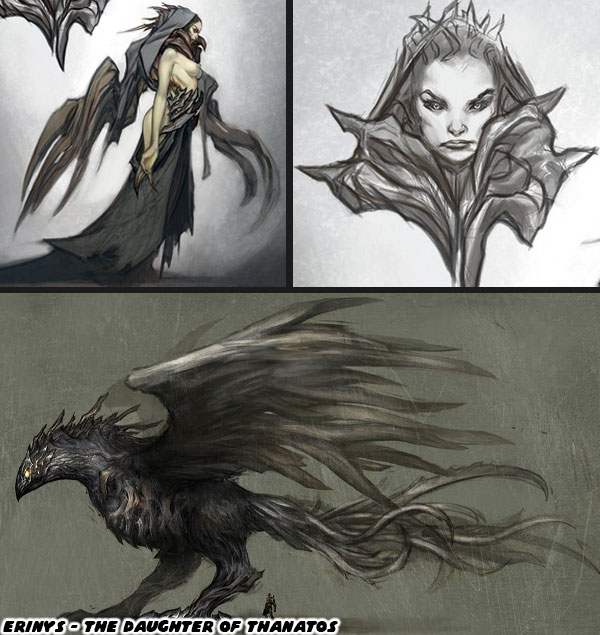
They have a tremendous battle where Kratos is dragged across the mountains until he gets the upper hand, and kills the goddess. The two crash in a rocky clearing. Kratos cuts off her arm, and steals her magic charm. It’s a small coil of an iron like material known as the Scourge of Erinys. It emits a golden spark that tracks down opponents, and steals their life force.
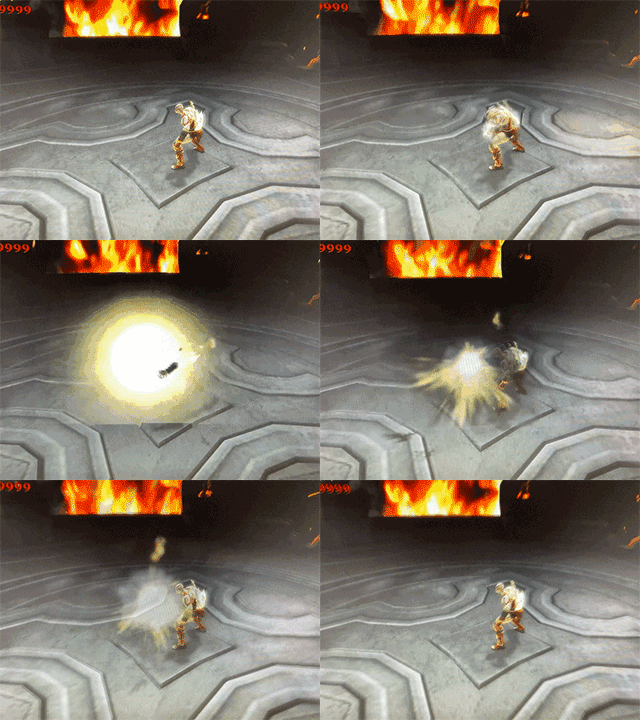
Kratos uses the magic to dispose of more demons trying to halt his progress. He walks a trail where we see other dead soldiers, overturned carts with arrows sticking out of them, and broken trees. Perhaps the work of raiders, or perhaps the remains of demon warriors that had just been there. As Kratos climbs the path we see the makings of an enormous wall, and a city behind. He has reached the gates of Sparta.
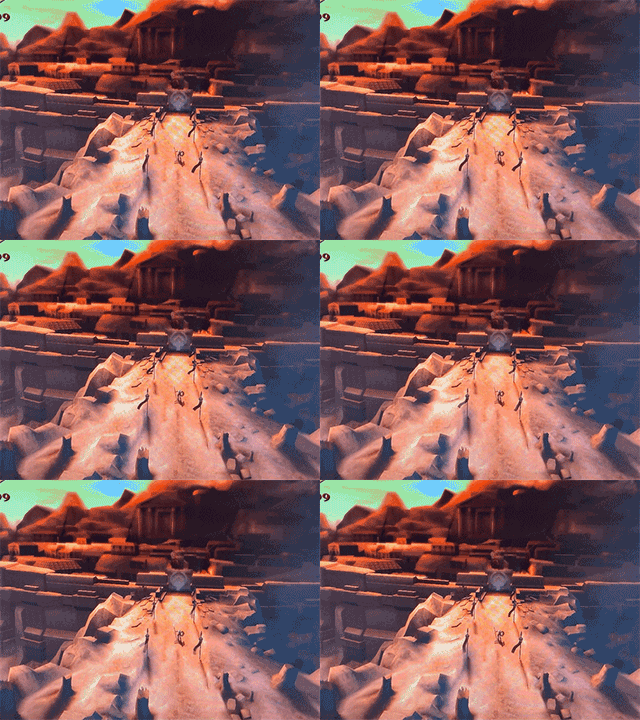
The game switches to a close, over the shoulder perspective, and the game play slows down tremendously. We cannot run, or fight, but instead walk through the streets. It is the type of slow, methodical pace of modern games, and it allows us to see his beloved home. His soldiers stand to attention, and the citizens hail the god of war. We see people shopping the fruit stands, enjoying a lively conversation, listening to musicians in front of a fountain. We hear the blacksmith sharpening his swords, and creating armor. A group of sex workers call out to the god, and beg him to join them. It would be the last time a sex mini game would be featured in the series. After handling his business Kratos continues. We see a Spartan teaching a collection of boys with shaved heads how to fight with a spear, and shield. Kratos keeps walking until he sees two boys practicing their spear combat in the streets. He is reminded of training with his younger brother. Deimos was born with a skin defect. A birthmark wraps across his head, back, torso, and arms. It was the tattoo pattern that Kratos would adopt after his brother was kidnapped. We can clearly see this detail in the cut scene. Kratos teaches his brother to be strong, even against bigger opponents. His final lesson was that a Spartan never lets his back hit the ground. His brother nods as he is helped back to his feet. Kratos snaps back to the present day.
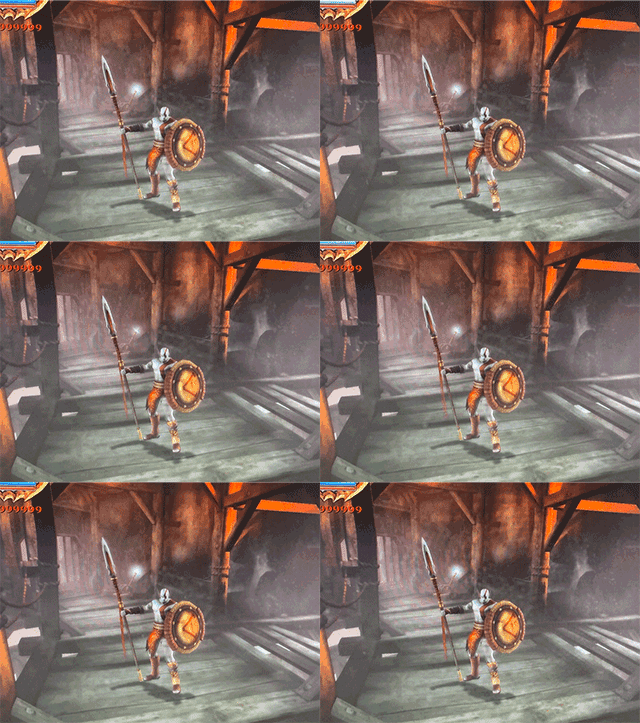
The path leading to the temple of Ares is hidden underground, through the Jails of Sparta. His men open the massive gate, and allow him to enter. Kratos descends into the prison where we go through the old, and echoing chambers. The level design is great, everything looks worn, and stylized. Heavy wooden doors with iron bolts anchoring them to the carved stone walls. Thick timbers shore up the walls. Coal embers provide light, and heat in the corners of the cell blocks. Metal gates, raised with thick chains separate the various cells. The air looks thick with dust. Every few moments we can see the dirt fall from the ceiling. This is where having headphones really comes in handy. Ready at Dawn put as much effort into the audio cues in the game, as they had with the visual details. This was especially evident as I was going through the jail. I could hear the murmuring of prisoners. The dripping of water. The cracking of torches, and the earth shifting, and falling. The chatter of monsters, hiding in the the recesses.
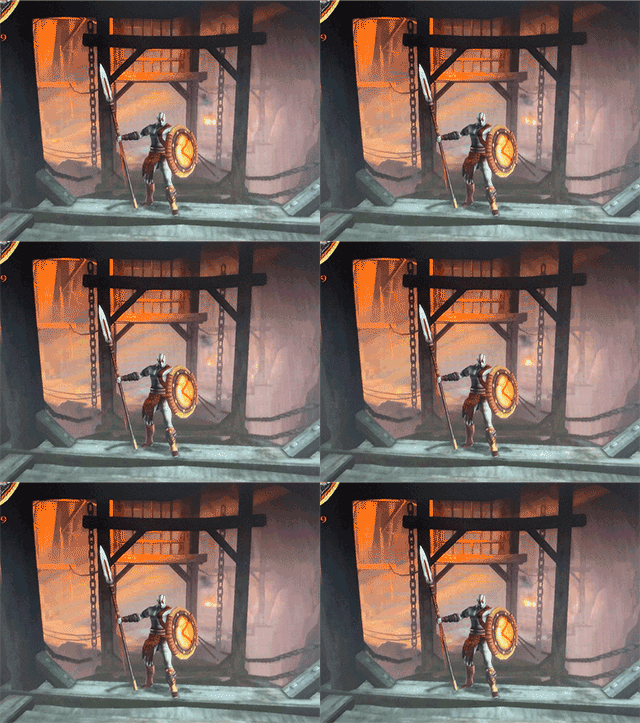
Kratos would pull a lever to move from one block of the jail to the other. In doing so a gate would go up allowing him entry. A timed release mechanism would pull the chains on other cells as well. Kratos would be acting as the executioner for the monsters that had been locked up. Every now, and then you would hear the roar of a lion. It sounded ferocious. Easily the most dangerous creature buried within the walls of the jail. I hoped that if would remain locked behind bars. There was a sound less intimidating echoing through the halls as well. In fact this sound was annoying. A whiny voice could be heard yelling. This guy would claim he was innocent. That he was only serving the true god of war. He challenged the audacity for the Spartans to lock him up, and demanded to be freed. This was our introduction to the Dissenter. When Kratos pulled the lever to allow him to enter the block his gate jammed, and dropped. However the timed locks inside the block still opened the cells. The fat-faced Dissenter praised Ares, and took off running. Kratos had to manually lift the gate, and continue through the prison. There was no sign of the disrespectful prisoner as I carried on. As I progressed through the jail I had no idea that my absolute favorite mid-boss fight in the entire history of the franchise was just around the corner.
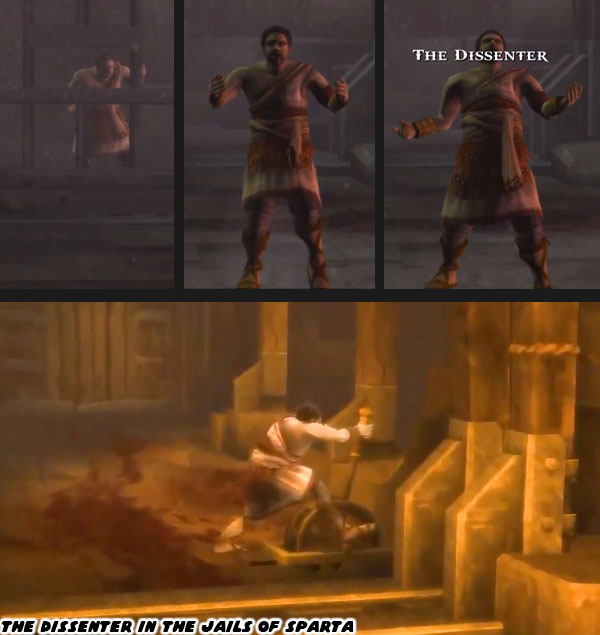
When we finally caught up to the Dissenter we could hear him struggling with a lever. He was calling out “Lord Ares give me strength!” I wish I had been paying a little more attention to the floor before I entered the room. There were a few splashes of blood in other parts of the jail, perhaps a bloody handprint from a former prisoner. However the floors, and walls in this block were smeared with blood. You could make out the streaks where something, or someone had been dragged across the floor. There were also enormous red paw prints, and claw marks carved into the cells. As Kratos enters the block the Dissenter is able to pull the lever, and drops the gates on him. Trapping him inside with an amazing mid-boss. A heavy wooden cell door, reinforced with iron bars lifts, and The Piraeus Lion leaps out. My jaw literally hit the floor when he appeared. I played through the entire encounter the first time with my mouth wide open.
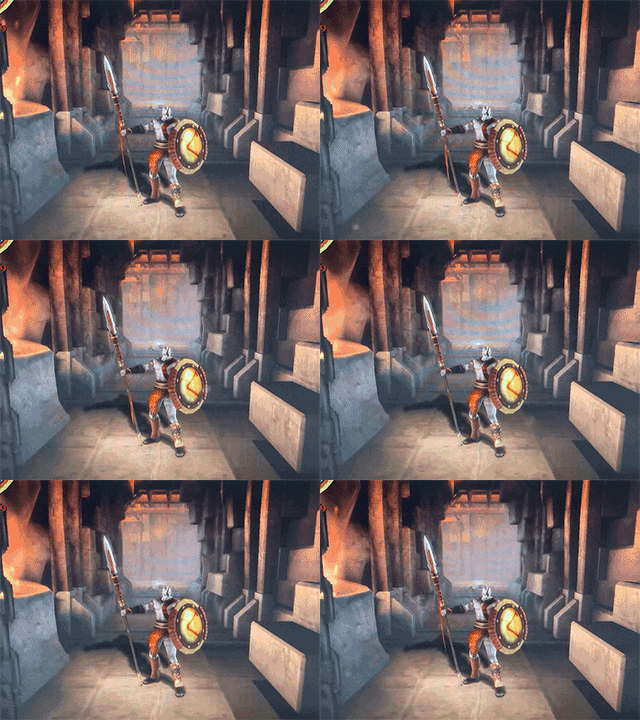
The creature was breathtaking in its design, and animation. It would stalk Kratos around the block, and cover its width with a single pounce. Its roar was so powerful that it could make you go dizzy for a moment. You could see its face was brilliantly animated as it growled, and snarled. It was hunting the god of war. This beast was far from any normal lion. He was absolutely massive, bigger than a horse, and almost as big as an elephant. On later play throughs I could tell that the model, and some of the animations were based on a creature called the Morpheus Beast from the Chains of Olympus. However this model was larger, and more aggressive. Earlier in the jail I had to fight a minotaur, which is normally a tough fight, but the Piraeus Lion dwarfed it in size, and strength. The lion was covered in scars, its hide, and mane had arrows, and swords sticking out of it. Who knows how many men had died trying to kill it, let alone capture it. This was some awesome storytelling using just the visual cues.
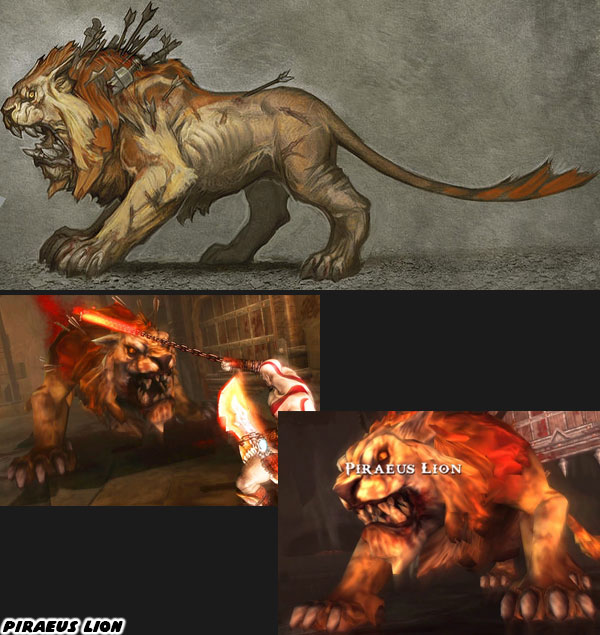
There were multiple reasons that I enjoyed this battle. Especially when compared to all of the other fights in the series. First, and foremost that this was the only time you fought the Piraeus Lion. He was a heavy hitter that would not be recycled in other locations, or wearing different skins like a cyclops, or minotaur. The other reason I enjoyed the fight was the stage itself. The entire Jails of Sparta portion was designed around the encounter. The audio cues, the roars, existed to intimidate us before we could even see him. The taunting Dissenter was bait to lead us into a trap. Although the series had featured monsters a thousand times larger it was the intimacy of the encounter that also mattered. We were not in the middle of Mediterranean Sea, or the shores of Attica. We were instead trapped inside a prison block, surrounded by stone, iron, and buried deep under the city of Sparta. This increased the tension much more than any other encounter I could think of. Lastly the reason I enjoyed this fight was the history, and mythology it was based on.
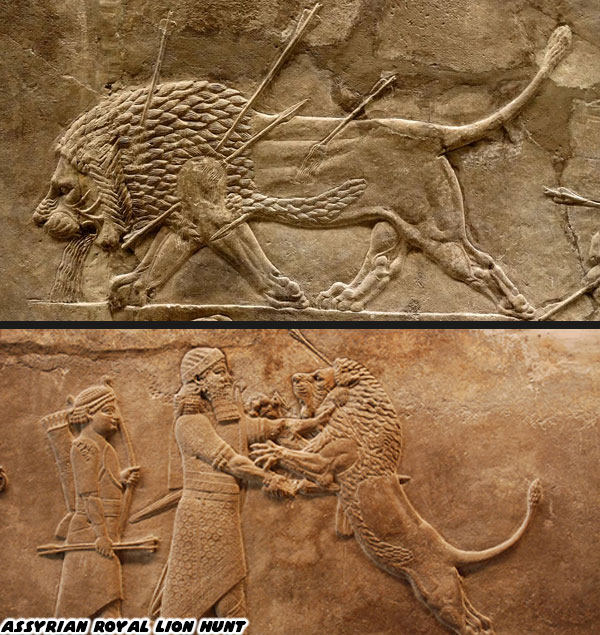
In ancient times the people of the Middle East were at the mercy of the Asiatic Lion. They were not as big as their African counterparts, but they were nonetheless dangerous. Leaders, and kings of the region would prove their bravery by hunting the lions. Many of these encounters were recorded on stone reliefs such as the Assyrian royal lion hunt, circa 660 B.C.. The visual representation of animals covered in spears, and arrows made them seem even more monstrous, and unforgettable. We had seen it repeated with cave paintings of wooly mammoths, Native American paintings of buffalo hunts, and Chinese paintings of tiger attacks. Thousands of years later this tradition still exited. We would see it with Moby Dick covered in harpoons, and scars, but more recently with the design of Seto, the wolf-lion father of Red in Final Fantasy VII. Sometimes the hunts against these animals were exaggerated to make the kings seem bigger, stronger, or braver than they actually were. This is where they created mythology.
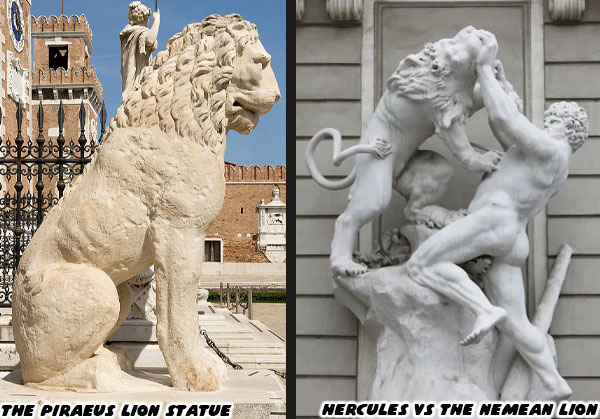
Ready at Dawn Studios was writing a new chapter in the story of Kratos. He had killed the gorgons Medusa, and Euyryale. He had killed the Hydra, Basilisk, and Scylla. Now he had defeated the Piraeus Lion. These encounters were the equivalent to the labors of Hercules. If you remember Hercules’ first labor was defeating the Nemean Lion. The golden mane of the lion was impervious to man-made weapons, and its claws were sharper than swords. The only way that Hercules could defeat it was by strangling it. This battle was celebrated in paintings, on pottery, and in statue form. The lesser known fact was that there was also a statue of the Piraeus Lion. The massive sculpture was a landmark welcoming travelers several millennia ago. It was originally located in Athens, before it was stolen, and moved to Venice. Kratos succeeded with his god forged weapons where the man made ones had failed. He was every bit as amazing as the gods, and demi-gods that inspired the franchise. But I digress.
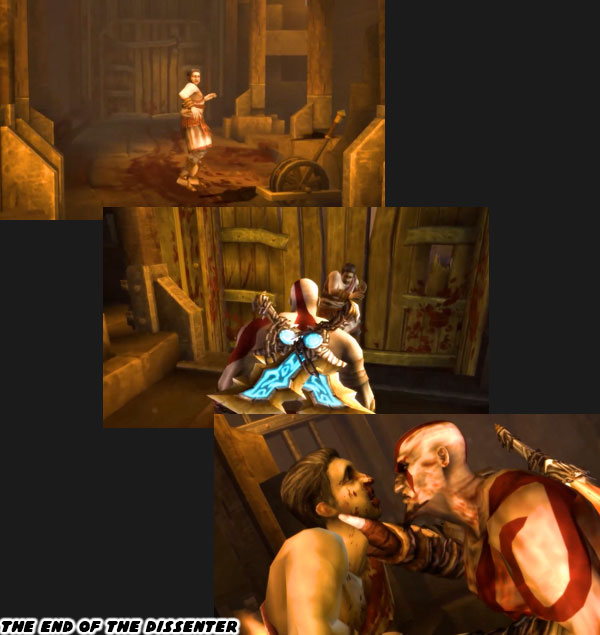
The entire time you are fighting the Piraeus Lion you can hear the Dissenter laughing, and taunting you from the other side of the cells. He says “Lord Ares is the true god of war” and “down with the impostor!” Of course he freaks out once Kratos kills the beast. He lets go of the lever, and tries running away. Unfortunately for him the other block doors won’t open. The game play slows down once more as it was on the streets of Sparta. We hear Kratos breathing heavy, and growling under his breath. He is now the monster stalking his prey. He grabs the Dissenter by the head, and throws him through the door. The Dissenter limps away, begging for his life. The other prisoners are taunting him, and looking for justice. Kratos shoves him through another door, and the Dissenter is now slumped over, coughing up blood. As Kratos picks him up by the throat, and buries the Blades of Athena in his torso his dying words are “Glory be to Sparta.” It brings a certain level of satisfaction to the player, but in a way the Dissenter wins because he never declares Kratos the new god of war. The next parts of the game were every bit as good as what came before. We are going to continue on the journey in the next blog. If you played through the Ghost of Sparta what did you think of of the Piraeus Lion fight? Let me know in the comments section please. As always if you would like to sponsor me please visit my Patreon page and consider donating each month, even as little as $1 would help make better blogs and even podcasts!
follow the Street Writer on Patreon!