In the previous blog I talked about a conversation I had with my cousin on whether Elden Ring, or God of War Ragnarok would win the 2022 game of the year. It got me thinking about the GoW series, about what made it stand out to me. Why did the adventures of Kratos resinate so much with me? I suppose it all goes back to the movies, and stories I grew up with. I’m a Gen-Xer, like most we were born in the 1970’s. It was a sweet spot where arcades were transitioning from pinball machines, to video game cabinets. So we were the first generation to enjoy the last of the mechanical games, and the first of the digital games. Also we were the generation that was introduced to home game consoles as well. I was lucky to have parents that took my brothers, and I to many different types of movies. Animated, live action, comedy, horror, action, suspense, and just about everything in between. Of course they’d tell us to close our eyes if there was nudity, but we enjoyed most everything we saw. Then of course we would watch TV after school, and see all sorts of classic films while doing our homework. It would be a few years before we got our first game console. So comic books, cartoons, and classic movies pretty much fed our imagination.
There were a few films that we always tried to catch on TV whenever they played. Chief among them were the ones featuring Sindbad, sometimes written Sinbad. The films covered the stories of the famous Arabian sailor. We got to see a world of fantastic adventures, filled with mythical monsters, evil wizards, and memorable archetypes. While we enjoyed the movies about Robin Hood, and King Arthur as well, it was always nice to see dark-skinned characters play the heroes. The Golden Voyage of Sindbad was possibly our most favorite. It didn’t hurt that
I had an instant crush on the chesty Caroline Munroe. The makeup, costumes, and special effects were amazing. We knew how green screens worked thanks to the local weatherman, but couldn’t figure out how they got giant monsters onto the same frames as the actors.
The scene where the evil wizard Koura brings the statue of Kali to life was forever burned into my memory. We’d eventually learn about stop motion animation, claymation, and the like. It was an animator named Ray Harryhausen that brought the fantasy monsters to life. I would be forever in debt to his creativity.
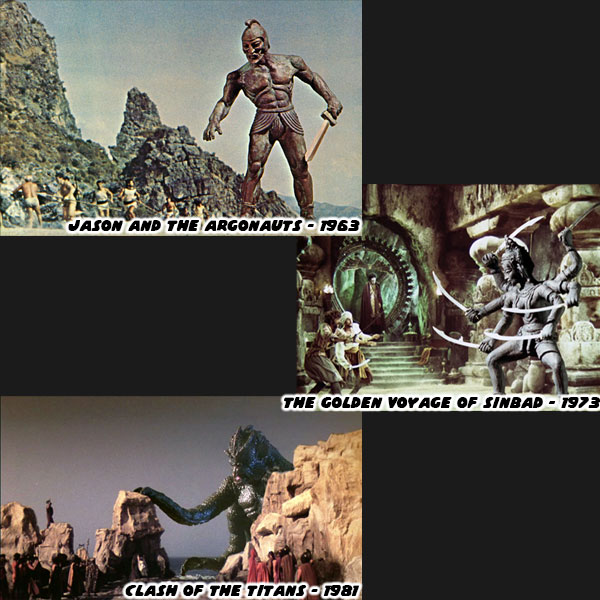
Every movie sparked questions from us. We were in awe of the myths from the Mediterranean, Middle East, Africa, and South Asia. Who were the Greeks? Who were the Romans? What about the Persians, Akkadians, Babylonians, and Sumerians? What was a colossus? Where did the giants come from? Were these based on actual legends? Were they original stories? Did these places, did these people exist in real life? Where did flying carpets, and genie’s come from? We’d pester our parents with these questions day, and night. Thankfully mom was familiar with many of the stories. She had grown up with seven brothers, and a sister. They learned all sorts of things in school. She told my brothers, and I about Shahrazad, and the Thousand and One Nights. She talked about how the ancient cities, as well as some of the magics, and monsters were even mentioned in the Bible. As practicing Catholics that was all I needed to hear. I was convinced that a lot of these fantastic stories were based on reality. The thing that really intrigued me was that every legend was built on an earlier story. Like it was King Solomon from the Bible that cursed all djinn, and made them servants. So demons, and monsters used to just run over ancient civilizations. The film Clash of the Titans was the first Greek mythology film we saw in a theater. I learned about the gods that existed before the Bible from that movie. More important, I learned that there were monsters called the titans that existed before the gods of Olympus. They all had names, they all had origins. The idea of something existing before the more well known gods inspired me. It created a desire to learn what came before. I wanted to read more about the ancient gods, and monsters. Of course there weren’t many story books about that in elementary school.
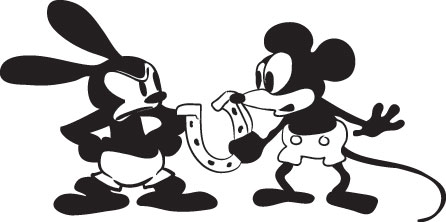
That desire to learn what came before never faded. It was how I discovered that Oswald the Lucky Rabbit existed before Mickey Mouse. At the very least our library had books about cartoons. My fascination with Oswald stayed with me for decades. It was the bit of trivia that I could always bring up to stump the other die-hard Disney fans in school. I never forgot about the titans, and when we took field trips to the main brach library in downtown Long Beach I would seek out the mythology books. I would find out the names of the heroes, people like Jason, and Perseus, and the adventures they went on. I’d wonder why the statues of the classic heroes were always naked, but seeing them wrestling monsters was proof to me that the stories were based on reality. Every now and then I’d learn the name of a titan. Oceanus, Hyperion, Coeus, Iapetus, and their young brother Cronus. I’d learn there were female titans named Rhea, and Phoebe as well. Studying that titans also had parents named Gaia, and Uranus to me meant that they must have been the ones that helped shape the cosmos. It was heretical thinking, but I was sure that the Catholic god was the one that created them, grew tired of their battles, and banished them from Earth. He ended their reign before the Olympian gods showed up. Teachers always wondered how I knew about Roman, and Greek gods whenever they talked about where ancient traditions like Valentines Day came from.
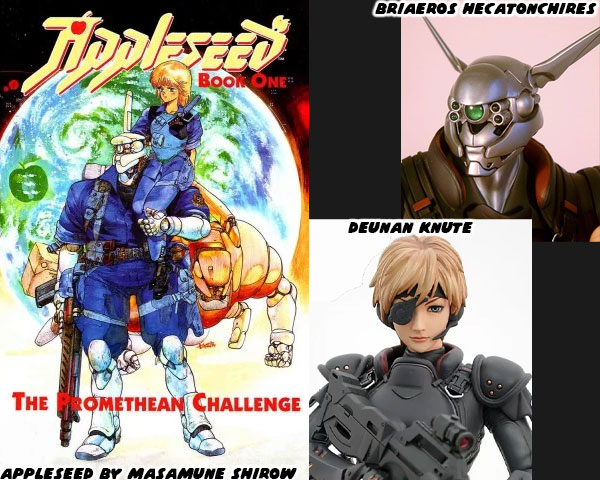
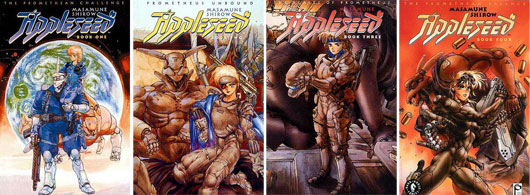
Middle school (then called Jr. High) was more of the same, picking up bits of information about the oldest mythologies. The comic world was undergoing a radical changing of the guard. Jim Lee, and Chris Claremont had redefined the look, and writing for the X-Men. Frank Miller, and Alan Moore made Batman a true heavy hitter. Peter David, and Dale Keown crafted brilliant Hulk comics. Mr. David had even introduced the Pantheon into Hulk continuity; Ajax, Hector, Agamemnon, Andromeda, Atlanta, Delphi, Jason, Paris, etc. These were just a few of the artists, and writers that exploded the comic book market. The indy publisher Eclipse, and later Dark Horse comics was translating a few Japanese mangas at the same time. It was how I discovered Masamune Shirow, and his Appleseed series. The post-apocalyptic story was brilliantly written, and illustrated. The fact that they used classic Greek names, but in a science fiction setting blew my mind. The cybernetic hero Briaeros Hecatonchires, and his girlfriend Deunan Knute were mercenaries recruited into the Olympus E-SWAT team. Nike, Athena, Poseidon, Aeacus, Hades, and Uranus were characters, and places visited in the series. Shirow’s groundbreaking mecha, and weapon designs, several of which were based on insects, were unlike anything I’d seen in any western comic. Shirow was quickly becoming an art god for me. The fact that Briaeros was a Black Mediterranean man underneath the cybernetic armor was also inspiring. Of course I was furious that the more recent CGI movies had white-washed him. The name Hecatonchires was the type of brain augmentations he had, the name was based on the hundred-handed giants that aided the Olympians in defeating their cousins the titans. Briaeros was the name of one of the three Hecatonchires. His brain implants were so advanced that they scared other cyborgs. It was said that he could control an aircraft carrier all by himself by plugging into its computer.
I remember vividly as a kid that several classes got a chance to take a field trip to the University of California Irvine. We were treated to an entertaining presentation in their massive gymnasium, where we were encouraged to go to college. Then we were allowed to attend an actual university class. We had a list of possible classes to sit in on, I was split between the science, and art classes. I sat in on the art, and it turned out to be a history class. The professor was discussing the importance of a classic Greek statue. I was absorbed by the details that he pointed out. The sculptor captured the correct anatomy of throwing a javelin, how the foot placement, turn in the hips, and torso was actually mid throw. There was a shift in balance, on the balls of the foot, and these were motions that happened in a hundredth of a second, but was accurately recreated in bronze. After the class wrapped up most of his students packed up, and left. I ran up to him, and asked if there were any statues, paintings, or other representations of the hecatonchires recorded. Because I only had the stories to go from, but wondered how the Greeks actually imagined a hundred-handed giant looked like. The teacher stared at me with a puzzled look. “Heck-a-ton-cries, uhh, I’m not sure what you’re referring to. I don’t think I’ve seen anything like that.” I insisted that they were the monsters that helped the gods defeat the titans. He nodded, and said “I’m not sure, sorry.” He couldn’t put away his notes, and get away from me fast enough. I’m sure he was wondering who the hell this young brown boy was asking such a strange question. I was deflated. How could a teacher that studied ancient art have no idea what I was referring to?
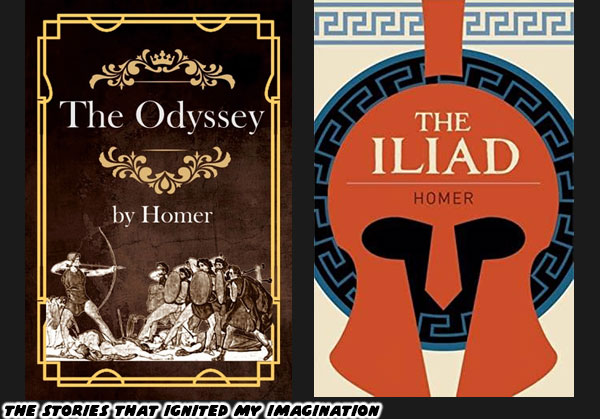
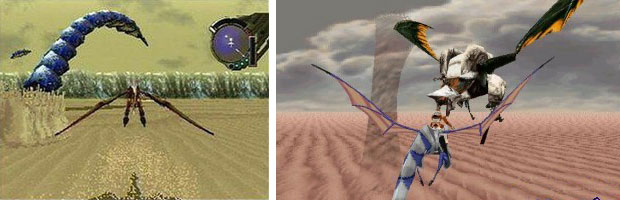
High school allowed me to finally get credit for my fascination with ancient myths. Each time an English teacher would assign book reports we’d get a list of acceptable titles to read, and write about. I’d gravitate to the oldest stories that I could find. I got a chance to read the Iliad, and the Odyssey over those years. It helped me discover the relationships between the various characters. It also allowed me to appreciate the classic movies when I rewatched them. The teachers would then add to my love of mythology by introducing Beowulf, and the other stories from the north. All the while my brothers, and I continued enjoying movies, and playing video games. They were evolving in the arcade, and at home. Stories became bigger, and more complex. The best games were soon rivaling Hollywood for our attention. It was only a matter of time before they would surpass cinema as the biggest form of entertainment. The ‘90s saw Final Fantasy, Zelda, and Phantasy Star made even more amazing with the introduction of 3D to home consoles. The Sega Saturn for example featured Panzer Dragoon. It was a rail shooter the likes of which we had never seen before. Sega had managed to create something fantastic with heavy influences from mythology, but in a fresh new way. Similar to how Appleseed reinterpreted the names, and relationships from the classic gods into science fiction.
As I got older I was convinced that my favorite games were created by people that also believed in ancient legends. Stories of heroes against impossible odds. Enormous beasts, swords, and sorcery were brought to life once more thanks to their talented teams. Video game studios rather than Hollywood still believed in the power of myth. In creativity, and imagination as being the most important element to a successful title. At least it was for a little bit. Even from the earliest days we saw how publishers tried to turn a popular IP, like Star Wars, into a video game. Sometimes these adaptations worked, sometimes they didn’t. Star Wars worked thanks to Atari working with vector graphics, the predecessor to polygon technology, and sound clips from the movie. Then there was E.T. a home console adaptation by Atari that was so bad that many think it tanked the industry, and
extra copies of the games were notoriously buried in the desert. I paid attention in English class how stories were built. How heroes, villains, and challenges placed to create drama. It made me watch movies, read comics, and play games with a more critical eye. I became very aware of how sequels worked, or didn’t in some cases. I’m going to talk a little bit more about this on the next blog. I’d like to know if there was something you were obsessed about as a kid that you carried into adulthood. Or was there a comic book, manga, or game that forever influenced you. Let me know in the comments section please. As always if you would like to sponsor me
please visit my Patreon page and consider donating each month, even as little as $1 would help make better blogs and even podcasts!