Namco seemed to take the lions share of arcade racing success through the early '80s. That was until Sega countered with OutRun in 1986. Well, to be fair other studios had also released innovative action titles that helped bring non-racing gamers into the arcade. Midway had Spy Hunter out in 1983, the various weapons and high speed action was unlike anything that Sega or Namco had every created. It stole a lot of thunder from the debut of Pole Position II that same year. Taito released their own copycat version of OutRun in 1987 titled Full Throttle. The red sports car and familiar mechanics felt forced to players. I did not see it last very long in arcades.
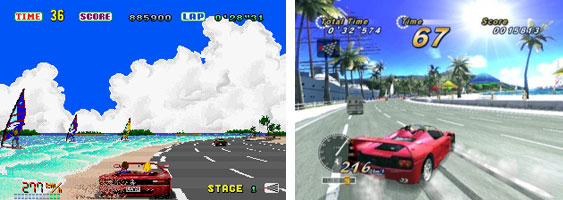
Taito quickly followed up with something that was much more innovative. In Chase HQ players had to chase down criminals in high performance cars on busy roads. Players would have to avoid tanker trucks and oncoming traffic and take down the crooks by ramming them before running out of time and fuel. It was a great balance between racing and action. The control was solid and the mechanics of hitting a turbo button at the right time to smash into an opponent was very influential. Some gamers might assume that the Boost and Takedown mechanic from the game Burnout was original. Chase HQ beat it to the punch by 13 years. Chase HQ revolved around black and white undercover agents in a Porsche clone, they were dressed and presented very much like the officers from the hit show Miami Vice. The Japanese were very good at following the trends and gave audiences what they wanted to see. They did it in every aspect of culture and industry and it helped them rise tremendously through the latter half of the 20th century. Despite a few cultural differences the majority of Japanese arcade hits also became US classics.
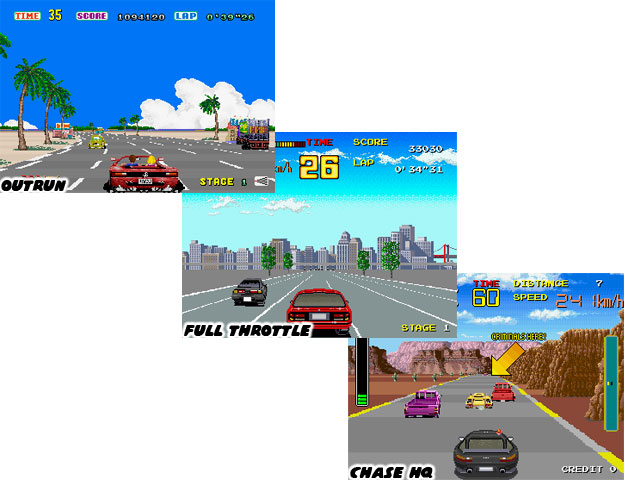
Namco was not about to give up on the genre without a fight. Pole Position had been their most successful racing game and by the end of the '80s they decided it was time to revisit the genre. In 1987 they released Final Lap, it was very much a spiritual successor to Pole Position. It had the familiar behind the camera angle and same real-world tracks like Suzuka. The graphics had been improved considerably and the sound and color palette expanded as well. It was difficult but not like the original, it was excessively hard. The largest issue for gamers was the control. Whereas players could turn the steering wheel quickly in Pole Position to correct understeer (drifting to the outside of the lane) or oversteer (having the back of the car slide to the outside) in Final Lap turning the steering wheel a fraction too far resulted in a spinout. It was next-to-impossible to take a turn at high speed without losing control. In most racing games there was a specific learning curve as to how the cars handled, perhaps it would take a player a few quarters to figure it out. Once players learned how sensitive the steering, acceleration and breaking was in a game then the only challenge was to post the fastest lap times. Players could often return to favorite racing games after a few weeks and not even lose their touch. yet those gamers never seemed to get any better in Final Lap. No matter how often they tried each game was like starting from square one. At least Namco made it so that cars could slightly bump each other without exploding.
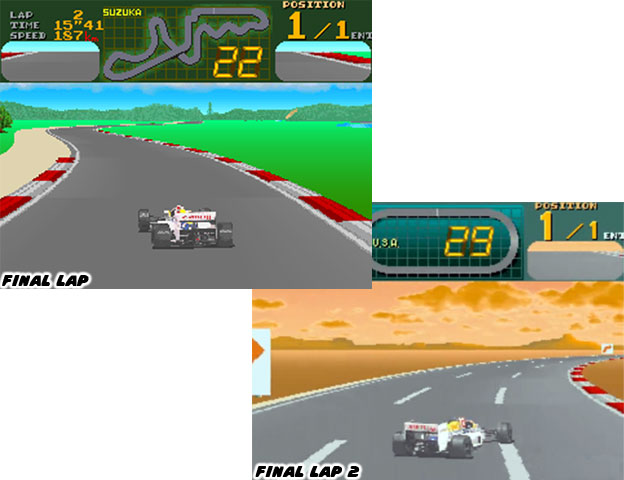
It was a humbling experience not getting better at the title. I've tried my share of racing games and was pretty good at Pole Position but could never get the hang of Final Lap. It was a shame too because the title looked very nice. Namco had returned the use of billboards from Pole Position advertising classic games and had really ratcheted up the details on the cars. It had all the elements to be an arcade hit but just never found its groove. What was curious to me however were the sequels that the game had. I guess it had found an audience and enough players on both sides of the Pacific to make it worthwhile to Namco.
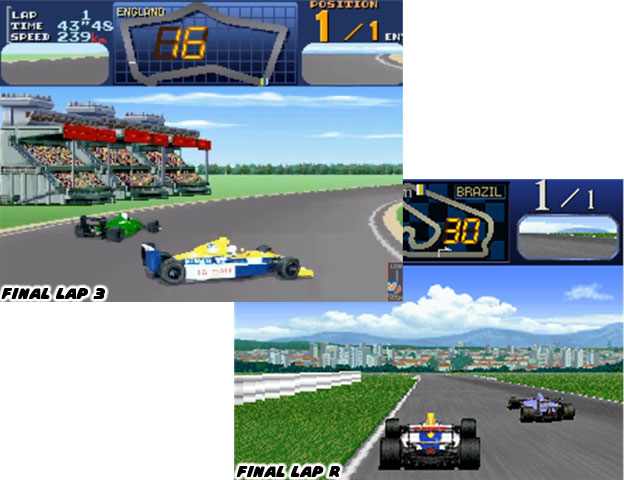
Final Lap 2 was released in 1990, Final Lap 3 in 1992 and Final Lap R in 1993. Each time a sequel came out I went to the arcade to give it another shot. I spent so much time and energy on each game that it really felt wasted in the end. A good portion of my allowance had been eaten up by those games and I could barely get my name on the leader board. I was learning quickly that while I had all the best intentions some games simply were not worth the effort. There were much more enjoyable racing experiences and I would spend much more time and money on those over the course of my life.
With all of the bad blood that I felt towards Final Lap in the arcade I must admit that the home version was a much better game. Final Lap Twin was released in 1988 for the TurboGraphix-16, the PC Engine in Japan. The game had some really great visuals but not as amazing as the arcade. Where it excelled was in ease of play and diversity. There were various racing classes that players could choose from and even different engine types, from V8 to V12. I didn't own a TurboGraphix but my friend Donald did. We spent the better part of the fall going over all of the various modes and writing down our codes so we could pick up later. The core of the game was the Formula-1 experience that felt more like an expanded Pole Position than Final Lap. That was fine by me. What we didn't expect to find was an RPG side game, the "Twin" experience that featured a kid going from town to town competing against racers with his remote control buggy. Imagine if Pokémon revolved around R/C cars instead of fictional creatures. It was a little bit like that. We went from place to place, searching high and low for hidden items, raced against some mean spirited kids and slowly powered up our buggy until it became a world champ car.
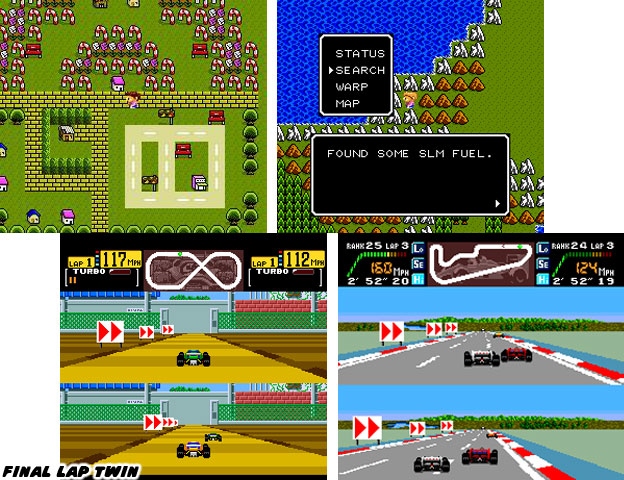
It was one of the rare games that managed to capture the spirit of an arcade hit with the playability of a console adventure. Other racing games would come along on the console that would add additional layers of depth and storytelling. Some were challenging racing titles but then turned into simulation experiences when they required players to invest their team winnings into R&D to design more aerodynamic bodies and more powerful engines. Finding a balance between driver and team manager would become something that arcade titles would never allow gamers to explore. Final Lap Twin was one of those games that showed audiences was the genre was capable of. Because of it I decided to keep giving Namco racers other chances.
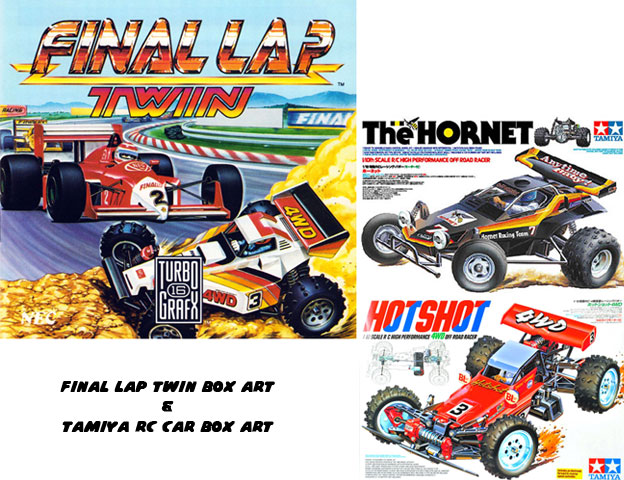
If the game did have something questionable in it I would say it was the box art. Players in the US were used to seeing really bad Western artists redo the box art for Japanese games. This one was different. It was the actual Japanese box art, and it was very well done. It featured a Formula-1 car and an R/C buggy tearing up their respective tracks. What I found funny about it was how much the artist was poaching from the illustrations used on actual R/C car boxes. Most notably the illustrations on classic Tamiya remote control cars and design of the RC10 from Team Associated. I learned along with the rest of my generation
that the artists working on the boxes were probably not gamers and would steal from whatever they thought they could get away with. Those artists however would be hard pressed to get one over on someone that loved cars in any format.
Namco did not generate the critical response to Final Lap that they were hoping for. It was exactly the type of opening that Sega needed in order to begin their arcade domination in the racing genre. The next blog will look at the titles that redefined the Formula-1 experience.
As always if you would like to sponsor me
please visit my Patreon page and consider donating each month, even as little as $1 would help make better blogs and even podcasts!