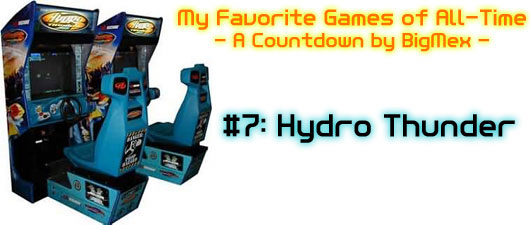
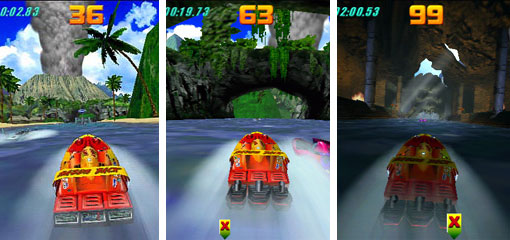
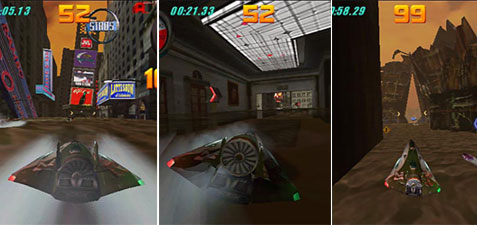
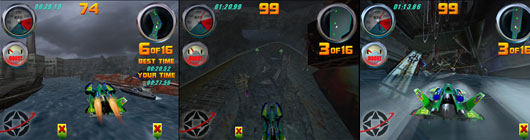
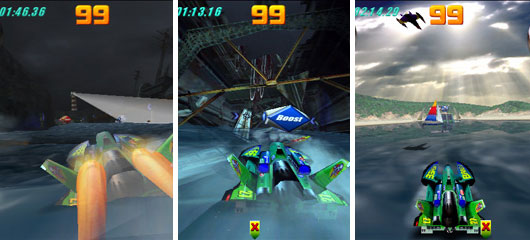
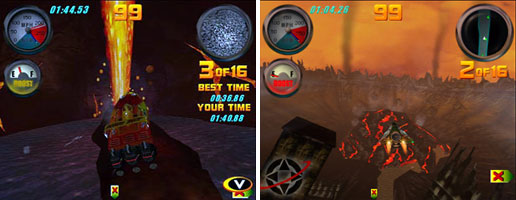
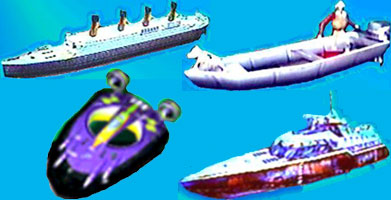
Without hyperbole Hydro Thunder was one of
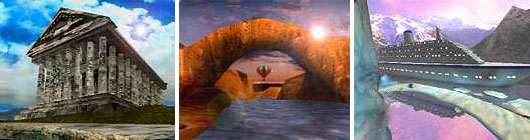
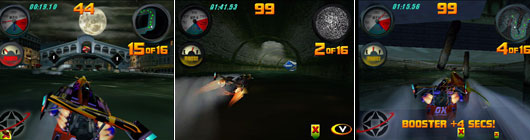
the greatest racing videogames of all-time. Created by Midway in 1999 and quickly ported over to the PC, N64, Dreamcast and Playstation. It developed a reputation as one of the most innovative racing titles around. What set this game aside from the rest were the use of high-powered racing boats instead of cars and levels layered with tremendous details, hidden paths and various secrets. There was an amazing sense of speed, power and precision that Midway captured through the use of multiple boat types as well as their ability to boost and even jump when powered up. While under boost they could charge through obstacles and even take down opponents via a "Mighty Hull" attack. This was done years before the Burnout franchise made the "Takedown" popular. When combined with some of the most original tracks ever to grace a videogame, Hydro Thunder was the perfect racing package. Unfortunately Midway made some cuts and closed down several development studios. A sequel to Hydro Thunder was started but never finished.

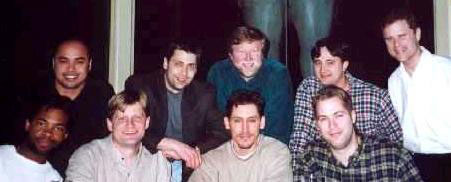
After a decade of waiting there was finally a named sequel, however it would not be the one that the original Team Hydro had started back in 2000. Hydro Thunder Hurricane would be a completely new title, built from the ground up by a new development team. The only bad news so far being that I haven't gotten a chance to play it. The good news was that in the summer of 2010 just about everyone will get a chance to play it from the comfort of their own homes. Here are the people responsible for Hydro Thunder Hurricane. Matt Small and Ralf Knoesel, Co-Founders of Vector Unit Inc.

They were kind enough to respond to an interview request shortly after debuting their game at PAX East. Here is Ralf, one half of Vector Unit, talking about the game in his own words.
How and when did your company get started?
Back in the Summer of 2007 Matt was working at EA Maxis and I was working at Stormfront Studios. We were both already 10+ year veterans of the gaming industry, so we were part of the transition from small (5-20) to the large (50-300) person teams it takes now to create high quality console games. One day we were reflecting on how much more fun it was to be part of a smaller team where each team member can make a real difference, so we started talking about founding our own company based on applying what we knew about making high-quality large games to the digitally-distributed console game market. In the Fall of 2007 we decided to go for it, so we each finished our projects we were working on for our respective employers, then founded Vector Unit in January 2008.
How did two people that had worked on licensed fantasy videogames; Lord of the Rings, Eragon, Spiderwick Chronicles... end up on the Hydro Thunder sequel?
We're big fans of water racing games generally -- the original HT and Wave Race 64 in particular. We also come from a watery background – Matt and I both led the team that developed Blood Wake on the original Xbox. So when we started Vector Unit, we decided to kick the company off with a new speedboat racing game that captures the spirit of those old games, with the addition of all the amazing new things that you can do with water physics on new consoles like the 360.
Was this a dream project that you pitched to a publisher or were you sought out to develop it?
The first game demo we made was an original speedboat racing game. The demo showed off the game's controls and our new fluid dynamic system. Microsoft was interested, and through talks with them the idea came up of making this a full-featured sequel to the original Hydro Thunder, which we started developing in April 2009.

Whom exactly has the license now if it is no longer Midway?
When Midway was acquired by Warner, the rights to Hydro Thunder were part of that acquisition, so now Warner owns the license.
Your previous boat action title, Blood Wake, was a fun game with positive reviews. Did you have plans for a sequel?
There was definitely interest in making a sequel, but in the end an agreement could not be reached. We were pretty bummed out by this, but we were glad to see Blood Wake become a Platinum Hit.
What lessons learned from Blood Wake (or any other of your games) were incorporated into HT Hurricane?
The biggest lesson learned from Blood Wake that we incorporated into HTH was the way we approached our physics model. If you take a realistic simulation as your foundation, then massage this to make the controls accessible and forgiving, you can end up with the best of both worlds: We feel that we were able to make a game which a Novice player can easily pick up and learn, while the more advanced player will notice all the intricacies which emerge from interacting with a complex water simulation.

Hydro Thunder was one of the best loved and best remembered arcade racing games, how closely did you follow the cues of the original game when designing a sequel?
Our goal was to create a game which captures the spirit of the original while providing the depth, controls, and graphics you would expect from a modern console title. One of the first things we did was to make a list of what people remembered most favorably from the original. This list, unsurprisingly, included the big drops, the over-the-top themed environments, specific boats, the high speeds, the secret shortcuts, the announcer, etc. The list is actually pretty long, but we were able to include just about all of these elements that made the original game what it was.

How much homework did you do or did you have a wishlist of things if you could work on a sequel?
When we started our research, we spent quite a bit of time playing the Dreamcast version, which back in the day was our favorite version of the original, with some of the best graphics of its time. It's a funny thing, however, what 10 years of technological advances can do, so the first thing on our list was to build new environments targeted at modern graphics hardware. Another feature which was important to us was to enable network play over Xbox LIVE, which will allow both old and new fans of the series to compete. Additionally, in order to make the single-player experience more compelling, we decided to include some more game modes.
Were there any criteria from the publisher when you were given the project or did they trust you to use your best judgement?
Throughout the development process, Microsoft has been a superb partner, taking a very hands-off approach, trusting us to do what's best for the game. It became apparent early on that we were in alignment with Microsoft's priorities.
Were you given assets, notes or direction from the never completed Hydro Thunder 2 arcade project? Or was this all up to Vector Unit?
We were given code and assets from the original HT, but not anything from HT 2. Initially we considered using some of the original assets, but it's been a long time since the original game, and the 360 is capable of so much more than the hardware was back in the day. In hindsight, looking at the boats, tracks, and gameplay we were able to create, this was the right decision.

The team that created the original Hydro Thunder reunited a decade later to form Specular Interactive. Their arcade title H2Overdrive is the spiritual successor to Hydro Thunder. Did you get a chance to play through this game? Any thoughts on it or the developers of the original game?
Unfortunately we have not had a chance to play H2Overdrive yet, since none of the local arcades have it. We watched all the videos and have read what we can about it, and were definitely inspired to try to cram even more animated surprises and insane set-pieces into our game. There's a rumor of a cabinet down in Santa Cruz (~2hr drive), so once we get some breathing room, we look forward to a field trip. We're huge fans of the original game and its developers, so we can't wait to play H2Overdrive and all future Specular titles.

What did you feel were the most important elements to preserve from the original HT when beginning work on HT Hurricane?
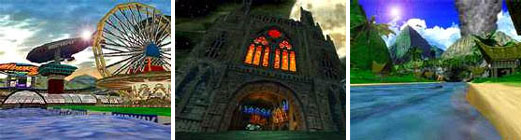
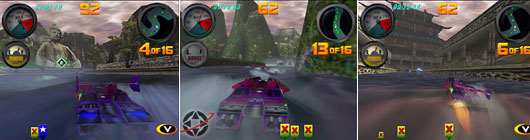
Aside from the core game mechanics, the most important element we wanted to capture from the original HT was the crazy over the top theme-park environments. Of course there are the huge drop offs, secret shortcuts and unexpected surprises, but there's also this heavily themed, storytelling quality to it, like you're on some crazy ride at an amusement park. For each track we came up with a kind of story that the track tells, leading up to some kind of crazy climax as you draw close to the finish line. That was key to capturing the feel of the original game.
How did you expand on the ideas in the original game?
The major new element is the interactive, dynamic water surface. Everything in the game affects the water as you're driving over it -- the other boats leave physical wakes, whirlpools and waves disrupt the surface, and triggerable elements like avalanches and explosions create these huge waves that toss the boats around. Because of all that stuff, the racing experience is a little bit different each time you race a track.
Can we expect the original lineup of ships to return? I noticed two ship that looked like different color versions of the Tidal Blade, are there now multiple colorways for the ships?
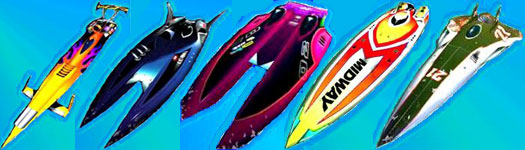
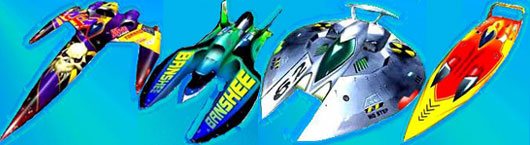
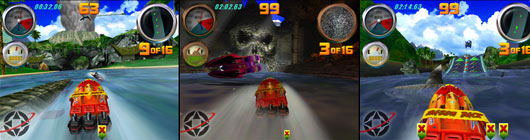
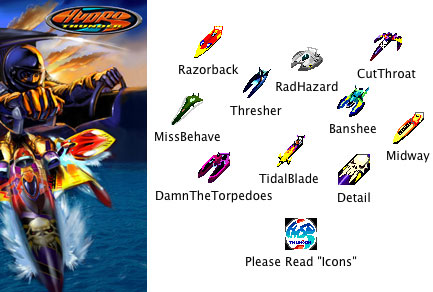
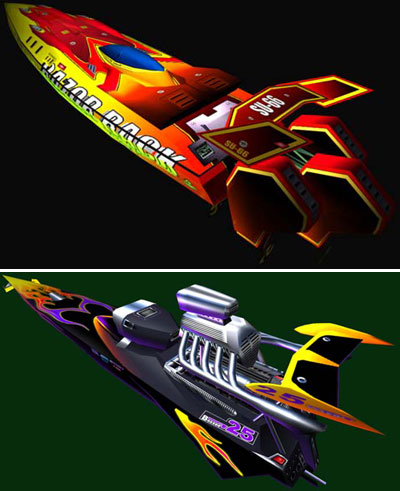
8 boats from the original game are making a comeback. They're all redesigned, but they're all recognizable -- Razorback, Tidal Blade, Rad Hazard. In addition to creating new models and textures with a lot of new detail, each boat has multiple skins so you don't have to all look the same online. Plus there are new transformation animations when you acquire boost; we tried to really punch those up to make them even more dramatic, with lots of engine parts and rockets and stuff unfolding out from hidden compartments.

How many new ships can we expect to see in HT Hurricane?
The original HT had such a memorable lineup of boats that we decided to focus our efforts on these, so we ended up with just one original design, bringing our total boat count to 9. However, there is an additional surprise boat in there, plus, being a digitally distributed game, we have the option to release more boats in the future as downloadable content (DLC). How many tracks will HT Hurricane feature? There will be 8 all-new tracks in HTH. One of them, Lake Powell, is artistically inspired from the original game, but the layout and the story it tells is all new.

What types of single player or multiplayer experiences can we expect?
For the single-player experience, in addition to racing against a field of 15 AI opponents, the player also has the option to participate in Ring Master and Gaunlet events. The Ring Master mode consists of a total of 24 unique slalom-like courses (Novice, Pro, and Expert courses for each of the 8 tracks), where the player is challenged to race against the clock while weaving in and out of shortcuts, and in the case of the Expert courses, making some tricky turns and jumps. The Gauntlet mode is at its core a time-trial, but with exploding barrels placed all over the place, which definitely raises the level of adrenaline. Moreover, the player also has the option to participate in Championships, which are series of events (races, ring masters, and gauntlets) where the player is competing with AI opponents to score the most points by the time the last event is finished.

For the multiplayer experience, we support up to 4 players in split-screen mode. On top of that, you can also play split-screen and online at the same time. When playing local (offline) split-screen, the human players are pitted against AI opponents championship-style, where after each race the players are returned to a lobby where they can change the track and their boats.
How does the online component work?
When playing on-line, an additional game-mode becomes available, namely the Rubber Ducky mode, which is designed to be played by 4 players or more. In this mode, one person on each teams chooses to drive a Rubber Duck, which is a bit slow and awkward to drive. Whichever Rubber Duck crosses the finish line first, that team wins. All the other players will tend to choose fast speedboats, which they can use offensively to smash the other duck or defensively to protect their own. This mode was inspired by the “Mini vs Enzo” phenomenon that players came up with by themselves while playing PGR 2 on the original Xbox.

Another huge part of our online implementation are the Xbox LIVE leaderboards. This is where players will really be able to show off their skills to their friends and the world. We expanded on the basic leaderboard implementation by adding a feature we call “Leaderboard Opponent”; when you play any single-player event with a LIVE-enabled profile (Silver or Gold), we look at the leaderboards to figure out which one of your friends is just ahead, then show you their time before the event starts. Then, while racing, you will see a split-time against theirs whenever you cross a checkpoint, then finally you are shown whether or not you beat them as you cross the finish line. If all your friends happen to be slower than you on a particular event, we instead query the world rankings to make your opponent the next best player in the world. Although this is a relatively simple feature, it allows players to interact without needing to be online at the same time. We have a lot of “Oh man, I almost had you, gonna try again!” moments at the office with this feature.

The AI was ruthless in the original game with boats sometimes pushing you off course or causing you to miss a boost. How difficult will the AI be in Hurricane?
The AI doesn't go out of its way to smash you, but it will keep a firm line, especially before critical turns. They do, however, become aggressive based on various criteria, in which case they get trigger-happy on their boost and a bit reckless. One more thing to keep in mind when dealing with the AI opponents is that if you time your passes right, you can use the drafting mechanic to help your overall finishing time.
To keep games close between players and AI boats, the original Team Hydro incorporated a "catch-up / ketchup" function where the AI could cut corners to keep pace with the race leader. Will this be Hurricane?
The AI does pretty well on its own, so it doesn't really need to cut corners. We did, however, add a new catch-up mechanic for multiplayer racing based on feedback from lots of focus testing. This feature, implemented after PAX, converts most of the boost powerups to mystery boosts (only in multiplayer events), which randomly give players anywhere from 1x to 8x boost. The farther you are behind the leader, the more of a chance you have to get more boost. This change has resulted in our multiplayer sessions being much more competitive and exciting, with lots more photo finishes. How will you balance the difficulty of the AI boats or courses during single-player races? We kept true to the original when it comes to difficulty. If you pick one of the “Novice” boats, which you do when you first start playing the game, the AI is also set to a novice level. Once you earn enough credits you will unlock boats in the “Pro” class. When you drive these boats, you will notice the AI being much harder to beat, but you are rewarded with more credits when you do. Finally, once you graduate to “Expert” boats, you will be faced with fields of mostly RadHazards, Razorbacks, and Cutthroats, and the AI will definitely be hard to beat. Regarding the courses, the more difficult tracks tend to be unlocked later in the game. However, there's nothing easy about winning a race on the first track (Lake Powell) with an “Expert” boat. And you know you're going to want to earn that Trophy for the “Golden Delicious” achievement!
The original HT had a number of secret courses and boats, are these elements returning here?
In the early stages of development we threw around the idea, but decided instead to focus on making the existing boats and tracks as awesome as they could be. It also helps to have the option of DLC after the game is finished.

The original HT also had great music and sound effects, who will be handling these elements in Hurricane?
We are working with an external audio contractor, Robb Mills, who is handling all of our music, sound effect, and voice needs. All the music in the game is composed and performed by him, and it turns out that he is quite a talented voice actor as well.
What are the challenges of creating Hurricane as an XBLA title? Are there any benefits of releasing this as an XBLA title?
The main challenge for a digitally distributed game compared to a retail title is of course the smaller budget/scope. Our goal at Vector Unit is to create big games in small packages, using an efficient development model, and I believe we have accomplished this with HTH. One of the benefits resulting from this increased efficiency is that we were able to keep our team size very small, which gave a real sense of ownership to each team member. Regarding the XBLA platform, while we were building our prototype on the PC, our engine was designed from the ground up to be cross-platform. So as soon as we received our 360 development kits, we were able to get stuff up and running extremely fast. As a testament to the developer-friendliness of the platform, we were able to focus on the gameplay and additional features from the start instead of fighting with the hardware. One additional benefit of being on XBLA is that our audience is guaranteed to have an internet connection, so we expect some really good leaderboard times to be posted!
How is the control scheme set up, with regards to steering, throttle and boost jump?
The default control scheme is relatively straight-forward. Steering is on the left thumbstick, throttle is the right trigger, boost is on the A button, and the boost jump is on the X button. Additional controls are brake (left trigger), switch camera view (Y button), reset boat (back button), look back (either shoulder button), and change music track (dpad left/right). We also support the Xbox 360 Wireless Racing Wheel, for which we created some custom force-feedback effects to mimic the boat driving through the waves.

Are there new control or gameplay features compared to the original?
One feature we knew was important from the start, which we kept from our original game demo, is the ability to control your boat while jumping through the air. While coming off a huge jump, for example, you can turn your boat to the right or left and use your boost rocket to steer away from an obstacle or simply help you hit that perfect landing spot to set yourself up for the next turn. We also used this as a tool to balance the boats, so some boats (e.g. Rad Hazard) are better at this than others (e.g. Thresher). Another feature we implemented is the switch powerup. These powerups are used to change the environment, such as raising ramps, opening gates, and turning on wave machines which, for example, allow access to a shortcut on the next lap. Another feature worth mentioning is the drafting mechanic. Our water simulation makes it possible for boats to leave physical wakes in the water. If you get into another boat's wake, you get a drafting speed boost, which makes passing other boats more exciting, and makes for some interesting strategy in multiplayer races.
How was the reaction to Hurricane at PAX?
Overall the reception was very positive. We had no idea what to expect going in, but we were pleasantly surprised that both fans of the original game and people who had never heard of it had a great time playing the game. Since this was an opportunity for us to interact with some hardcore HT fans, we were also able to get some great feedback, some of which we were able to squeeze into the game over the last couple of weeks.

How many boats / tracks / game modes were available at PAX?
Everything was playable in the PAX build. We had two kiosks and were there to guide players through the initial learning process, mostly on the Lake Powell and Asgard levels. Some attendees were able to come back when the floor was not so crazy-busy, so they were able to explore some other tracks and game modes. There were also some opportunities to set up online matches between 4 players by using 2-player split-screen mode on both consoles.
The version of HT Hurricane previewed at PAX East seemed to be missing the "Mighty Hull" attack, will it be returning in this game?
Actually the game will not feature the Mighty Hull attack. The main reason is that it was really important to us to create a fun, balanced multiplayer experience (both online and split screen), and getting blindsided from behind with the Mighty Hull was just not that much fun in MP games. The other reason is that we put more emphasis on overtaking and passing other boats by boosting and drafting in their wakes; it's really fun to try and time the perfect pass as you draft closer and closer to the boat in front of you, waiting for the perfect moment to slingshot past -- if you could just plow through them, we felt like it was a little less interesting.
Is there a target release date?
The release date has not bee set yet, but we expect it to launch some time this summer.

Will Hurricane support DLC?
The base game will definitely support DLC. If the game is as popular as we expect, it would make sense that we'll be seeing some more boats and tracks after the game has been released.
Are there any plans to recreate the original HT tracks as well?
No such plans are in the works, sorry.
If there is one detail that gamers should keep an eye out for, what is it?
Waterfalls, of course :)
I would like to thank Ralf and Matt for their time and wish Vector Unit all the best. Be sure to join the Hydro Thunder Hurricane page on Facebook to get more info on this upcoming racer.

If you would like to sponsor me
please visit my Patreon page and consider donating each month, even as little as $1 would help make better blogs and even podcasts!