
Brian Stupski is an impeccable artist. He is the last interview featured in my car series but far from being the least important. He is the designer behind Problem Child Kustoms (clever name!) a studio that has amassed a solid showing over the years. I first noticed his renderings in Rod and Custom. I didn't remember the name but I remembered the cars. Over time I would see the familiar style in different magazines, like all the great artists, a fingerprint that was unique in the world of auto art. I finally committed the name to memory and tracked down his website and blog. Thanks Google!
Brian has an eye for shapes and designs that perfectly compliment each of the project cars he's asked to render. As with all the great designers he lets enough of the original design cues through while adding subtle layers of changes to the car. Making the ride instantly recognizable but different in a way, more brutal and stylish. Studying his art makes me want to be a better illustrator. Brian is also one of the youngest designers I had the pleasure of speaking with for this series. Like the rest from my generation he still finds the time to play video games even though he's supposed to be focused on his career. He likes his sports, especially hockey and loved his cars. If Brian represents the future of custom design then all I can add is that the future is in good hands.
Noe V. Brian, thank you for the interview. We'll begin with the question I'm asking all my special guests. When did you first get bit by the car bug?
Brian Stupski: I was born into a "car crazy" family, so I suppose that I really never stood a chance of NOT being bit! My father was a mechanic, and my mother really enjoyed cars, to the point of being extremely involved in their car club, and even running the annual show a few times. I was even brought home from the hospital in a muscle car, a '66 Charger.
Noe: What were your favorite cars growing up, any favorites that the parents or family drove?
Brian: A '55 Chevy (my parents were big Tri-Five fans). I had a big thing for Chevelles, '68-'72 and first generation Camaros.
Noe: Did you have any heroes from racing or car culture?
Brian: My hero from racing is Tom (the Mongoose) McEwen. My other heroes would be Ed Roth, Charlie Smith, Thom Taylor, Steve Stanford and Gene Winfield.
Noe: What is your daily driver and what would be your dream ride? Brian:
My daily driver is a Buick Regal GS... My dream ride would be a '69 COPO Chevelle.

Noe: The Big 3 US auto makers are not doing very well right now. How do you feel about their situation?
Brian: In some ways, I can't but feel they brought this upon themselves by giving unions too much power. On the flip side, with people buying foreign-made products and the government backing foreign companies I feel they've been given an unfair shake.
Noe: Some argue that the car companies were hopelessly out of touch with the public, the designs of legacy cars bland and uninspired. If you could redesign a model or bring back a classic which would you choose and why?
Brian: I would bring back Oldsmobile. In doing so, I would concentrate on the premise of that make, which originally was technology and performance. Considering today's emphasis on technology and leaps in engineering performance, I think that it would enormously successful in the present.
Noe: How would the closing or the failure of the Big 3 effect future generations of designers and artists?
Brian: Beyond crashing what remains of our economy, it would require American designers to adopt the aesthetics and techniques currently utilized by foreign carmakers. Obviously, it would change the face of American car design which has always been a unique art form.
Noe: We can't focus on the negative only. Is this a chance for the auto makers to unleash new technology, legacy designs and green fuel to regain their status?
Brian: Most definitely, but you have to wonder how committed they would be to this change when it was brought about my force. I sincerely hope this is the turning of a new leaf and that the new designs in technology will create cars that can hopefully inspire future generations of hot rodders and car designers.
Noe: Let's (pardon the pun) switch gears and talk about your design background. How did you discover your talent for art?
Brian: I always drew as a kid. As soon as I could hold a pencil that's all I would do and it was almost always exclusively cars.

Noe: How did your family or teachers help encourage your talent?
Brian: My family was always very encouraging by giving me drawing supplies and asking me to draw. My art teachers encouraged me by exposing me to artists and designers with whom I shared a similar style. However, math and science teachers were not so receptive. I often heard that, "You'll never make a living drawing cars".
Noe: I've had the good fortune of interviewing legends and personal favorites Thom Taylor, Tom Daniel and George Trosley for this series. Growing up did you have any inspirations from the world of car design?
Brian: Guys like Tom Daniel, Larry Wood, Dave "Big" Deal, Dave Bell and Steve Austin were huge influences. I more or less knew I wanted to design custom cars the first time I saw a Harry Bradley drawing. Add to this my infatuation with CARtoons Magazine and Mort Drucker's incredible character art in MAD Magazine and my future was inevitable.
Noe: Which school(s) did you go to? How important was a formal education to your art and career?
Brian: I studied fine art at a small private college prior to moving on to Buffalo State college. My education and training in drawing, painting and print making gave me an understanding of classical techniques. I think that formal art training is tremendously important, especially with the availability of digital means. I had attended the Art Institute of Phoenix and studied animation and motion graphics prior to completing my formal education at Collins College, where I learned Adobe Photoshop and Illustrator. While I utilize digital techniques in most of my works, I feel that my fine art training adds an extra dimension to my work.
Noe: How did you get work creating renderings for the car magazines? Did you have a portfolio that you shopped around or did you make friends at conventions?
Brian: I started out creating art for local shop projects, as well as my employers. Eventually, I would send samples of my work to editors of magazines hoping for exposure. My first break came at the hands of Damon Lee, who at the time was the editor of Custom Rodder Magazine. From there, I was fortunate to build a reputation for quality work and built a portfolio based on referrals from prior clients.
Noe: Explain to us the relationship between a designer, builder, fabricator and client.
Brian: First and foremost, there needs to be open and honest communication at all phases of the project. It's very important to have all members of the team get along, both personally and professionally. The key is to be able to read your client's desires and tastes and be able to translate this into a design that not only coveys this vision, but can also be accomplished by your builder and fabricators.
Noe: Your work compliments traditional hot rod designs while also giving a nod to modern racers. We see the familiar big engine blower on some designs but incorporated on a car that's closer to the ground with larger wheels, big brakes and a profile more familiar to a street racer than a 1/4 mile monster. How do you bring the classic and modern worlds together?
Brian: I've always been a fan of artwork that features high contrast or some form of juxtaposed elements. Throughout my fine art training, I was often inspired by the Surrealists and Futurists (Dali, Braque et al,) and try to incorporate combinations of objects or situations that at first glance may seem unnatural but when viewed together make perfect visual sense. It's fun to blur the lines of traditional and modern and in doing so, forget any rules and just create a cool car. I think that if you carefully toe the line, you find ways to stretch the envelope, and can, more or less, drag in a traditional style to a big, modern wheel and so-on. The trick is to balance the two themes, and have respect for each.

Noe: Your company has been building a name for a few years. What are the things you look for when redesigning a classic car? What do you hope to accomplish? Is a television show or Hollywood wedding in your future?
Brian: When redesigning a car, especially a popular classic, I try to compliment the original design but still make a unique statement. Every change needs to serve a purpose. The fun is in making changes that may not be immediately recognizable. I especially enjoy it when a design inspires a double-take or when the changes flow well enough that they go unnoticed. I would love to pursue my other dream of writing comedy for film and television...but my wife may frown on me having a Hollywood wedding! I'm a fairly private person, but might really enjoy a stab at hosting a TV show about cars, design, and the lifestyle in general.
Noe: Who were some of your favorite clients or which were your favorite projects?
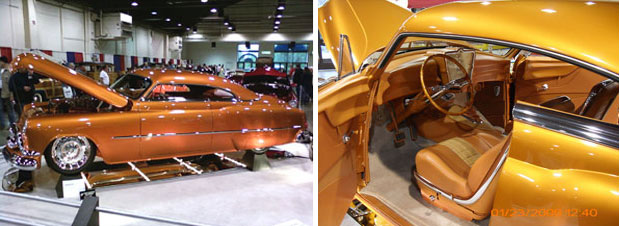
Brian: When the check clears, I love everyone equally. While I've been fortunate to work with some of the biggest names in the industry (Rad Rides By Troy, Recovery Room, ProRides, Chrome Shop Mafia) it's often the low-buck or personal projects of private clients that can prove both challenging and incredibly rewarding. I just finished an 1952 Buick project that will debut at the 2009 Grand National Roadster Show, which blurred the line between private builder and well-known shop, and was as close to "dream clients" as I've ever been. That will always remain a highlight of my career, as the team of owners, builder and myself as designer meshed throughout the process.
Noe: The mind-scrambling A-Tona is my favorite of your designs, which of your cars would you most like to see made into reality?
Brian: Thanks! Either the A-Tona because it's such an over-the-top cartoony hot rod or the Mahi-Mah-Tee, my personal take on the 1960's era show rod. While I'm commonly known for my more subtle designs, both of these vehicles represent my wilder side, and have a definite "in-your-face" nastiness and fun quality... They're really a metaphor for what this whole industry is about.
Noe: If you could pick a designer to work with, past or present, who would it be and why?
Brian: Larry Erickson or Harley Earl. Both are legendary...imagine working with both in one room. Between Harley's iconic designs in the '50's that defined GM to Larry's modern day reinterpretation of design at both GM and Ford. It would be design without bounds... of course, having coffee with legendary French coach builders like Figoni et Falashi wouldn't make for a bad morning, either!
Noe: Being a good artist does not a professional designer make. How important is it to know your history and cars before making a career out of design?
Brian: Tremendously important. If you don't know your history, how do you know where you're going? If you don't understand the logic behind the original design, improving upon it is almost impossible. Like anything, the more information you have the better decision you can make. Anyone can change something for the sake of changing it but someone in-tune with the raw materials before them can create a true work of art. My professional background is in the auto industry, and centered around parts and service... That hands-on training and experience has proven invaluable when designing a project, and affords me insight that someone trained in only drawing cars doesn't have. I can supply part numbers, references, and even estimate build times for components or modifications... It's proven to be a great added value for my clients.
Noe: How important is a solid foundation in art for developing the right techniques?
Brian: Knowing the traditional tools, how to use them and being trained in classical techniques gives you a better opportunity to express your vision. Once you master these, the world is wide open to break the rules and develop your own style. I've found that my education in painting and life drawing have had a profound influence on the way I apply my skills to the digital tools (using them more like traditional paintbrushes and pencils, versus pixels and vector shapes). Understanding the basics gives you a solid foundation to grow on, and really leaves a wide open path to find a unique style.
Noe: What advice would you give budding artists that are thinking about a career in professional design?
Brian: Study Dentistry instead - much more lucrative... Seriously, though, have fun with it, and accept that it won't always be fun, but know when to recognize when opportunities arise that ALLOW for that fun, and make the most of them.
Noe: What about learning the basics?
Brian: Devour all you can. Take life drawing classes, painting, any fine art classes. There's no substitute for formal training and practice... Draw every chance you get... Simply relying on the technology to draw for you is a waste of potential, and to become truly good at anything requires dedication and hard work.
Noe: What about building a portfolio?
Brian: Be as diverse as possible. Include works from all media. The broader your appeal, the more creative work you will attract, and the more influences and inspiration you can bring to the table with every piece you create.
Noe: How about schools?
Brian: Look for a school with a balanced program, of both traditional techniques as well as classes in modern technologies. Seek instructors who have varied interests and backgrounds so that you may incorporate their experiences into your own work, and above all when in school make it your number one priority.
Noe: Last but not least, what about originality?
Brian: Goes without saying, having an original style or technique will give you a distinct advantage. Simply copying someone else's style will subject you to a career filled with statements like, "Oh your work looks just like So and So's". Be prepared to improve your style and push it to evolve as others will very often copy your style.
Noe: I have to tie this interview in with videogames or my friends and readers might have a fit. Do you play videogames? What consoles?
Brian: PS2, Wii and my all-time favorite 3DO (does anyone else still love this thing?). I have a fascination for the more "old school" fighting games like Street Fighter, Way of the Warrior (reason alone to buy an old 3D0!), and sports games like Madden Football, and the NHL-sries from EA Sports... man, I love me some Hockey!

Noe: Do you have any favorite games, systems or gaming stories from growing up?
Brian: I love Super Mario Brothers and being a big hockey fan I really enjoy the EA Sports NHL franchise. Growing up we'd play the Atari 2600 almost non-stop, and bike rides to the local arcade strengthened my wrists for countless hours of drawing cars.
Noe: Would you like to design cars for a videogame some day?
Brian: Most definitely. I think the world is ready for a REAL hot rod inspired game, and I think it would be a blast to be a part of a project like that!
Noe: Are there any titles you look forward to playing, or any projects you would like to be involved in?
Brian: I would love to be involved in a "Top Gear" based game. Or more realistically, the Need for Speed series... As far as new games, I'm looking forward to playing Resident Evil 5, Mass Effect 2, Street Fighter IV, and God of War III.
Noe: A few of the artists I've interviewed had hobbies outside of gaming, they built models, R/C cars and racing carts. Are there any hobbies that you've never outgrown?
Brian: Model car building has always been a focus in my life, painting, building custom surf boards and model railroading. As well as playing with my thee boys and two dogs. Also, making obscene gestures at people in traffic is a fun diversion... To some, it's a simple gesture, to me, it can be art. Am I allowed to say that?
Noe: You are one of the youngest artists I am interviewing for this series. Your legacy in the car community is still being built. At the same time you represent the future of the culture. What lessons have you learned from the legends?
Brian: Having really good hair seems to be a common trait amongst the greats. I mean, man... Foose has inhuman hair, and Thom's is hair you immediately picture when you think of hot rod design... Seriously, developing a unique style and consistently presenting the work with a reverence to history is extremely important. Add to this, an ability to promote yourself and have your work sell itself, especially in today's web-centric society is a key to success and offers opportunity that our predecessors did not have... the key is to market your talents properly, and not under-sell... If you price your work too low at the start, you'll only make that hill harder to climb later.
Noe: Where do you see the future of hot rod and custom culture headed?
Brian: With the economy so shaky and people getting back-to-basics I see a return to the more traditional do-it-yourself style of hotrodding with an emphasis on superior quality. The popularity of hot rod-themed television shows, and the accessibility to top named builders will help to inspire this new level of quality.
Noe: What are the short term and long term goals for your studio?
Brian: Short term - to feed my family and keep a roof over our heads while creating top-notch work for our clients. For the future I'd like to expand the studio to encompass lifestyle-related products as well as a full line of hot rod and custom parts and accessories, perhaps one day expanding to many locations via franchise opportunities.

Noe: Do you want to give any shout outs or props to your co-workers or sponsors?
Brian: I've been fortunate to become friends with some of my heroes, one of these being Charlie Smith who has become not only a good friend but a mentor. I'm fortunate to have support of clients who not only share my vision but inspire me to push harder. It's incredible to work with skilled builders like Zane Cullen and Tim Strange who can take an idea from paper to reality and absolutely nail the design. I've been very fortunate to make friends who design hot rods for a living, such as my good friend Jimmy Smith. Also, the talented Dwayne Vance who recently bestowed the honor upon me or including me in a book which features many of my heroes... Working with manufacturers like Billet Specialties (hey, Scott!) has opened countless doors, and the always helpful Tim Bernsau and Kevin Lee at Rod and Custom Magazine have been tremendously influential in helping to get my work into the public eye.
Noe: That just about does it for questions, any words of wisdom for the people visiting on 1UP?
Brian: In the modern day, and considering our future economy, networking and partnering with those in your industry is a necessity for survival, now more than ever. Gone are the days of cut-throat competition. If you're fortunate to do something you love for a living show it by creating the highest quality work you're capable of and use your networking and partnering connections to push your work even further. I believe that those who choose to go it alone, or pick fights in the new economy will be left behind, and that partnering with other professionals to compliment your own skill set and work will pay off in huge ways. Above all, have fun with it.

No comments:
Post a Comment