Showing posts with label ninja combat. Show all posts

Wednesday, April 26, 2017

Asura Buster Eternal Warriors, the great fantasy fighting games part 5...

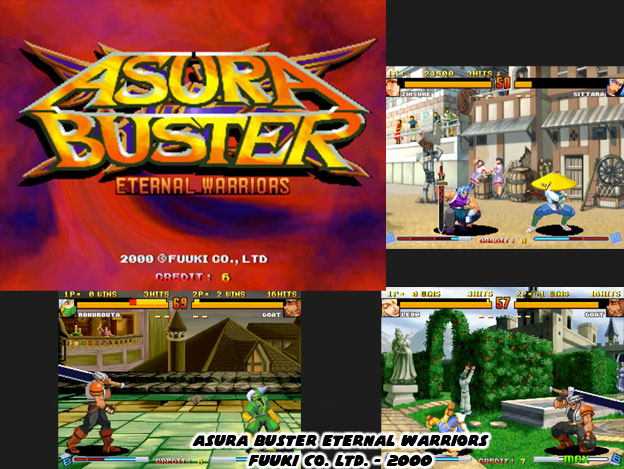
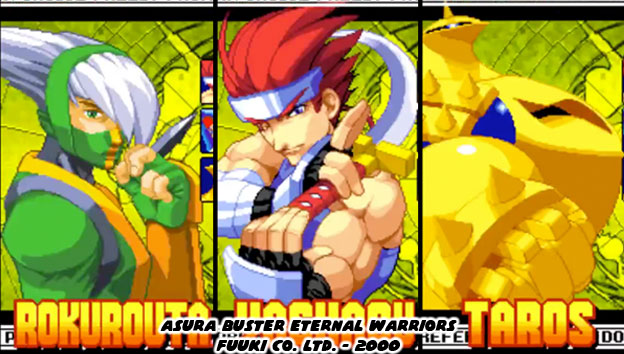
Fuuki Co. Ltd. released Asura Buster - Eternal Warriors in 2000. It was a new fantasy fighting game entry set 3 years after the events in Asura Blade. The publisher had a memorable cast of characters that deserved a little bit more exposure. The publisher also realized that fighting games had been in decline for a few years. They would have little to no competition if they released a fighter at the start of the new millennium. What audiences didn't expect was that the company would create an entirely new set of sprites for the sequel. As far as I can tell the graphics engine was very similar if not exactly the same as it was in the previous game. There was not a major leap in quality as there was between Capcom's CPS-II and CPS-III engines, the ones respectively used for Super Street Fighter II and Street Fighter III for example.


Many of the stars from the first game returned in the sequel. Their costumes and color palettes were in-line to the designs from the first game. The sprites, animations, moves and balance were completely redone. I don't know why the studio decided to do this but I'm glad they did. Many developers added a few new characters and stages to the existing engine and had the audacity to label it a sequel when it was essentially an upgrade kit. Fuuki Co. was breaking from tradition and actually redoing everything from scratch. This approach would have eaten the budget for several games if Capcom tried to do the same thing in a Warzard sequel.
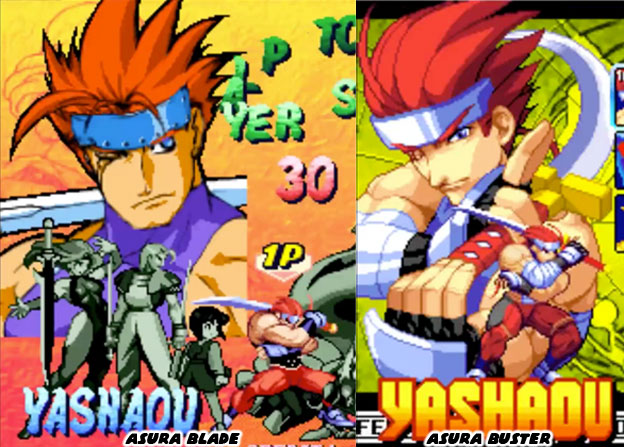
 

The new sprites seemed slightly more detailed than the previous batch. The colors were brighter and more colorful than they had appeared in the first game. A few new faces joined in. Fuuki picked up some of the game design elements they missed the first time around. Yashou was the star character he didn't really have a rival in the original game. A new swordsman was added, from the same clan even, to be his rival. Sittara was a much darker character, not unlike Iori or Genjuro from the King of Fighters and Samurai Shodown games respectively. He was a good balance in the game.
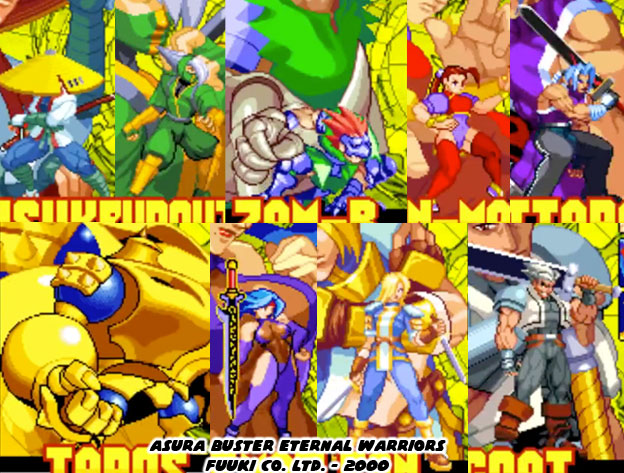
   

The new fighters were very much rooted in Asian history, with a new Chinese-style martial artist Chen-Mao who was the understudy of Footee from the original game, a new samurai named Zinsuke and even ninja character named Rokourouta joining the ranks. The previous game wasn't as focused on the Asian martial arts as much as its sequel. This was fine however because the new game was really delving much deeper into the fantasy world that the studio had created. There were entirely new kingdoms vying for power. There were new locations to explore. This was apparent on the entirely new stages and world map presented to audiences.
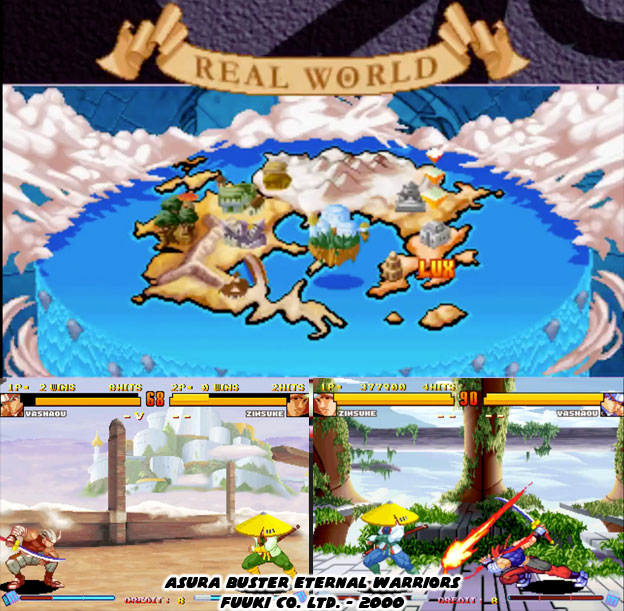
 

Asura Buster had levels that were every bit as unique as the original title. Floating castles, oceans made of sand, opulent palaces and even the city rooftops were all memorable places for a battle. Fuuki added something that was missing in the original title, a bonus game. Fighting games used to have bonus games, the rule was not observed by every publisher, but most of the biggest franchises did have a version of the classic mini game. Perhaps there was a breaking demonstration, a chance to punch up a car or parry a basketball. Each game often had a purpose for the mini games. Some were a score booster but others were trying to get audiences to learn new techniques or master the range for each character. Asura Buster had a little bit of the latter.
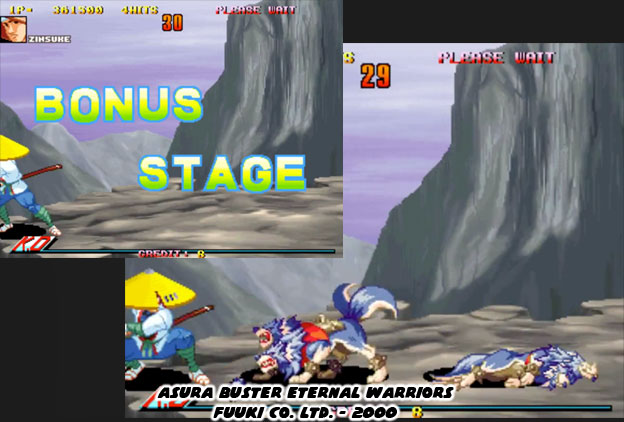
  The bonus game had players fighting off wave after wave of two-headed wolves. Some ran at opponents, some leaped at opponents and some even dropped in from the sky. Players had to react quickly, a single strike was enough to beat most of them. Players couldn't die while facing the mini-cerberus, if hit the player would fall over while the dogs trampled them. Players mostly missed out on bonus points for a poorly timed session. Asura Buster was also memorable for a new sub-boss character. A large, pink, triangular, shapeshifting creature named Vebel waited for opponents in a darkened cave.
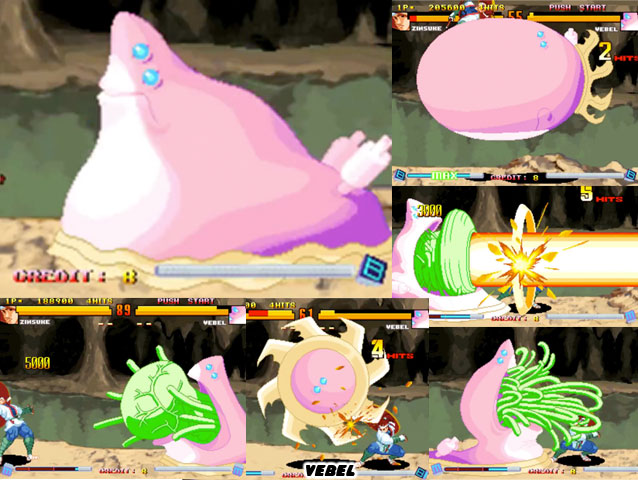
   

Vebel was a very odd character. It moved around in a very fluid manner, like it was made out of pink Jello, but could also inflate like a balloon. It could lash out with its fins, or by spitting out its internal organs. It also had a beam that it could shoot across the entire screen. This was easily one of the strangest characters ever featured in a fighting game. It broke the concept of what makes for a good character but it did not break the design going into Asura Buster. This was a fantasy game, any sense of realistic character designs went right out the window. It was a rule that made the monster designs work in Warzard and even the unreleased Dragon's Heaven. Vebel was also memorable for the sheer scale of the character. It took up a large portion of the screen, there were few fighting game characters that had as much presence. I can only think of a handful of characters that were as big, colorful and possibly influenced the development of Vebel.
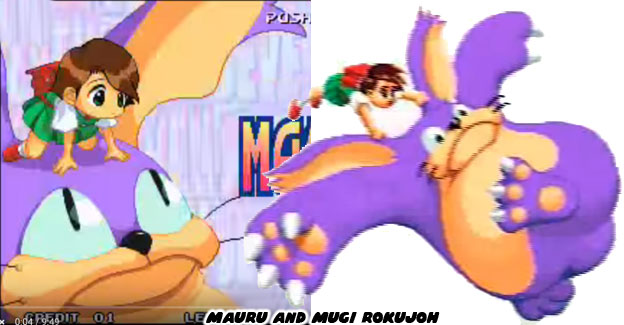
 

The first massive influential character I think was Maururu. It was a giant magical creature that carried a little girl named Mugi on his back. He appeared in the game Waku Waku 7, a fighting game by Sunsoft. The game was released in 1996, it was a spiritual successor to Galaxy Fight: Universal Warriors. I had mentioned Galaxy Fight previously on my blog because it featured a hidden character that was modeled after an elder Ryu / Ryo from Street Fighter / the Art of Fighting respectively. Sunsoft used a lot of humor in their fighting games and they weren’t afraid to poach ideas from other fighters or even anime shows.
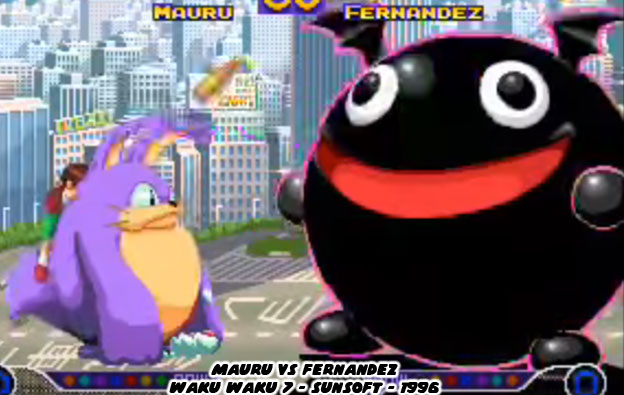
   

As you may have figured out Mauru was a send-up of the titular character from the Hayao Miyazaki film My Neighbor Totoro. Totoro and the littlest girl in the film Mei Kusakabe debuted in 1988. Mauru was among the bigger characters in any game but the boss character, Fernandez took up almost half the screen. Vebel was simply another character that fit this unusual mold. The bright pink color helped it pop off the background. The strange assortment of moves, and its fluid animations ensured it would never be forgotten. Also, in case anyone had the feeling that they had seen the archetype before you would be right.
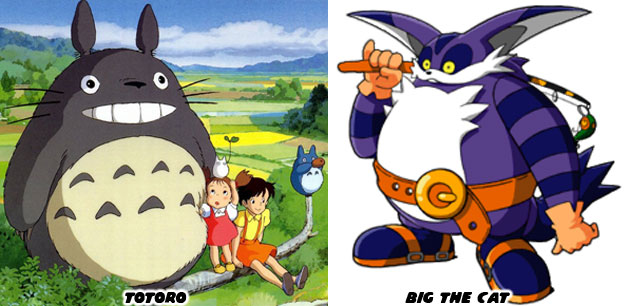
 

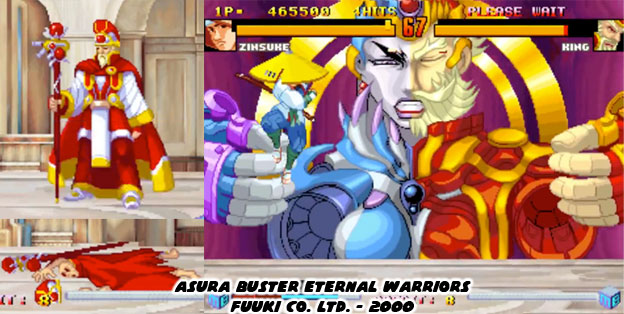
Another oversized character with the ability to get caught up in a bigger plot 10 years after Totoro. Big the Cat debuted in 1998 in Japan and 1999 in the USA in Sonic Adventure. Big was a lovable character with a certain innocence to him. but let’s recognize that Mauru appeared a year earlier. Vebel wasn’t the only case of deja-vu that Asura Buster gave fighting game afficionados. The final boss of the game was an evil king. This character didn’t fight you like other traditional boss characters. Instead the King turned into a giant that was half male and half female. The red and blue color scheme assigned to each half was reminiscent of Gill from Street Fighter III. Of course this was if Gill was 60-feet-tall. Many arcade players had seen a giant boss character in the Capcom “vs” titles.
   

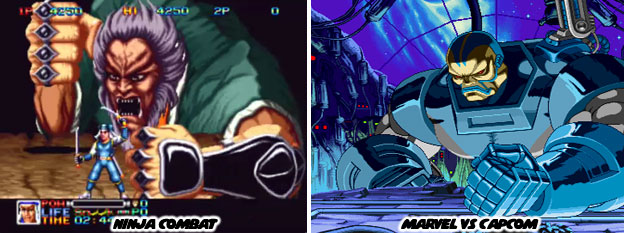
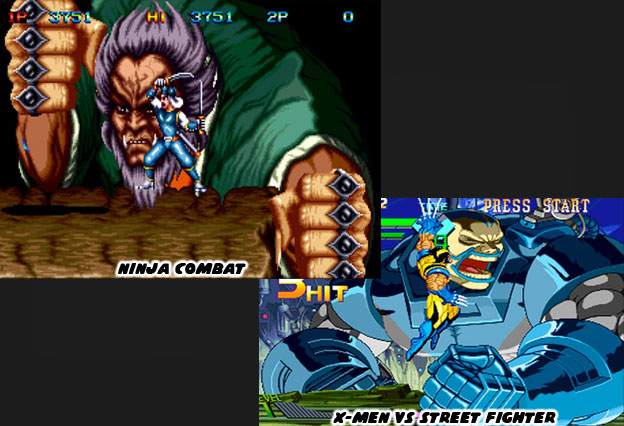
Audiences expected larger-than-life characters in the Capcom crossover games. Many of the villains in the Marvel comics were known for their shape-whiting ability. A character like Apocalypse, a villain from the X-Men comics for example, could become gigantic. He fit right in with the story of the games and appeared in the 1996 game X-Men vs Street fighter. It was a perfect match for the Capcom when other Marvel giants, like Galactus, began appearing in their fighting games as well. Yet hardware in the early to mid ‘90s was not powerful enough to render sprites that were several screens tall. The studio got around this by only animating parts of the character, such as the head and arms. It wasn’t the first time a studio had used this approach. In 1990, before Street Fighter II appeared, ADK had developed a game called Ninja Combat for the Neo Geo arcade system. The final villain in the game was an evil sorcerer named Genyousai. At the end of the game he transformed into a giant and players had to chop off his hands and eventually head. Ninja Combat was a brawler, and not a fighting game but the seeds were planted for the King in Asura Buster.
 

The addition of a new story, new characters, including some hidden characters, a bonus game and a new villain made Asura Buster really stand out from the original game. Also unlike most fighting games where everything wraps up after the villain was defeated this game allowed players to unravel a piece of the story by fighting another main character at the end. It was unique to the genre and helped add more dimension to the fantasy world that Fuuki Co. Ltd. had created. The company still exists however they have made no mention about a new Asura game. It would be nice to see this ported over for the consoles and Steam if we won’t get a third entry.
 

Asura Buster was not the last fantasy fighting game worth mentioning. In the next post we will look at a fantasy fighter that was co-developed by Japan and South Korea but with design elements from one of the oldest British tabletop gaming studios. I hope to see you back for that. As always if you enjoyed this blog and would like to sponsor me please visit my Patreon page and consider donating each month, even as little as $1 would help make better blogs and even podcasts!
 follow the Street Writer on Patreon!

Monday, April 18, 2016

The Abridged History of the Brawler, part 8


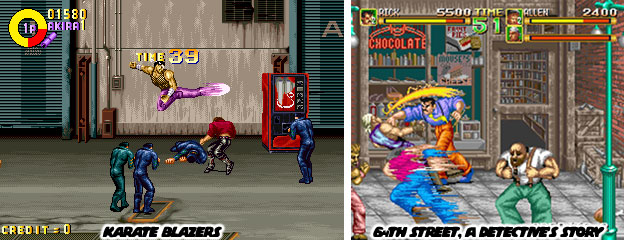
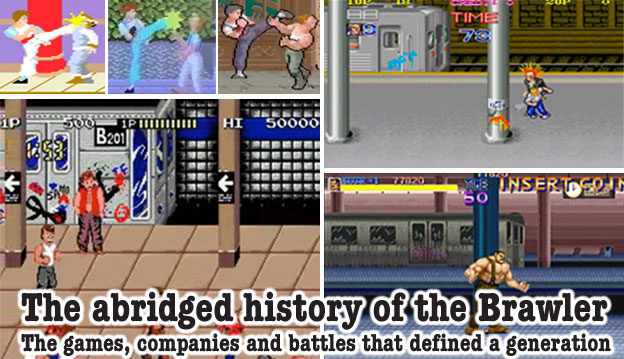
Capcom and Konami seemed to dominate the market in 1991 however several other developers were innovating the brawling experience as well. Video Systems Co. (VSC) was a startup not widely remembered. Their actual contribution to the industry was in creating the Aero Fighters series. The team that developed Aero Fighters formed Psikyo and took the series with them when Video Systems Co. closed at the end of the decade. VSC developed a stand alone brawler named Karate Blazers that was not bad, it combined elements and design aesthetics from titles like Final Fight and Streets of Rage but with slightly different play mechanics.


The main characters in Karate Blazers had the typical punches and kicks used against waves of opponents. The distinct element the game had were that attacks could be powered up and kicks or punches could release waves of energy. Think of the Street Fighter special attacks but in a brawling game. The characters could also perform strikes that moved horizontally across the screen, flying kicks and diving headbutts that traveled further than any regular jump attack could. This ability to cover the screen in attacks gave the brawler an interesting dynamic as players now had the effective range of firearms with the combo ability of a fighter.

A better established publisher, Jaleco, was trying out different themes with the brawler as well. The studio gave 64th Street, A Detective’s Story some unique elements. Visually it was a sort of hard-boiled brawler set in a prohibition-era city. Of course it would have been more authentic if the fashion wasn't based on a late 80's interpretation of the culture, not to mention steampunk robots that fought the heroes. I'm pretty sure that Elliot Ness and the Untouchables never had to fight Al Capone's robot mobsters. But I digress…


64th Street was memorable for how the grapple element worked on opponents. Up until that point a person could grapple an attacker and perform a judo throw to the immediate left or right. In many cases the throw could hurt opponents that were approaching. Jaleco allowed players to choose which direction the thrown opponent would go, this included directional up or down on the screen. Previously the top or bottom of the screens were blind spots for players. Opponents could sneak up on them and strike them cheaply that way. 64th Street allowed gamers to not only throw opponents at each other in those directions but to even throw them off of platforms, like moving rail cars. It was a play mechanic that I do not recall ever being used again.


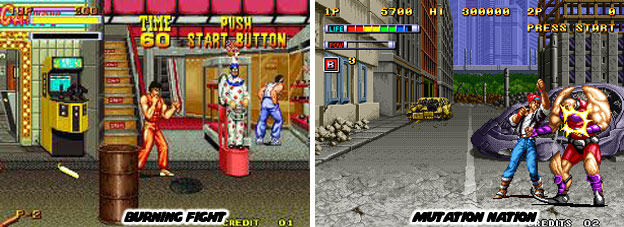
By this time SNK and their Neo Geo arcade cabinet were beginning to gain momentum. They wanted to capitalize on the success of Capcom and Konami by developing and publishing some memorable brawlers. Burning Fight was one of SNK's first dedicated brawlers. The game was very formulaic and nothing exceptional in terms of character design, animation or bosses. The only notable things about this game were the obvious rip-off of Hulk Hogan as one of the boss characters and the location. Burning Fight was set in Japan. The architecture, locations and landmarks were clearly Japanese. It must have been refreshing for Japanese gamers to see an urban brawler set in areas they recognized, going so far as to feature a cameo from Osaka's creepy robot clown Kuidaore Taro. The rivals appeared more like the silly gaijin and Yakuza that they had seen in pop culture than fantastic gangs made up from hair metal bands.

Japan was beginning to break out of the shell of pandering brawlers exclusively to the west. More manga and animé-inspired designs would begin appearing in titles. Mutation Nation was another title released by SNK that had a little more polish and originality than Burning Fight.


The game was based around two heroes with unique fighting abilities taking on a mad scientist and his grotesque mutants. Scores of human gang members, masked weirdos and monsters made their way out of a futuristic city towards our heroes. Players had access to special moves that could be triggered by holding down and releasing button combinations. These special attacks did not diminish the health bar. The rivals were unique character designs. The mutants were less the off-color humans depicted in Marvel comics and more like the monsters fought in the henshin / Power Ranger type shows. The experience was fun, original and proof that SNK was quickly becoming a contender in the brawling arena.


The next titles they released that same year would further cement their status.
Japanese developers were going full bore into the Neo Geo platform. Previous to SNK most publishers developed arcade games using their own proprietary hardware and software. There was a standard created by the Japanese amusement organization, JAMMA, that standardized control boards so that games could be swapped out by arcade owners. Changing out some vinyl stickers and marquee signs while keeping the same controls was less expensive that buying entirely new cabinets for each game. The problem was that publishers took most of the profits from developers they might have contract to program the title. The Neo Geo platform could be configured with multiple games on a single cabinet. Each arcade board was encased in a large cartridge, like a home console. Arcade owners would be able to swap out marquees and games relatively quickly on an SNK cabinet. Developers got a cut of the profits on the Neo Geo setup with SNK publishing all of the titles.

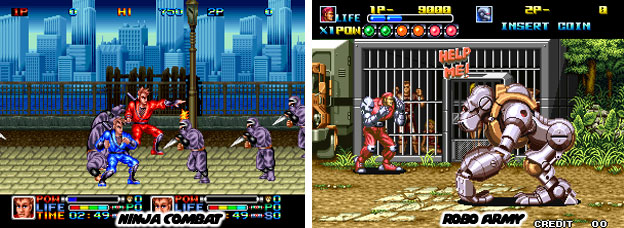
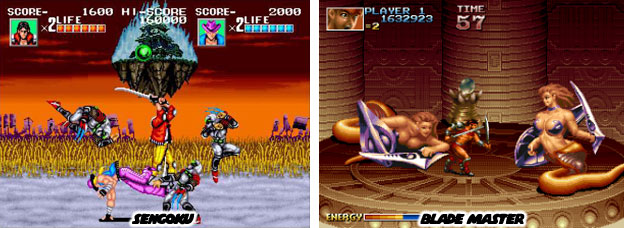
Alpha Denshi was one of the early Neo Geo developers. Their game Ninja Combat was quite more than a take off of Ninja Gaiden. There were five playable ninjas, a generic red and blue ninja, a larger green ninja and two females, each with their own specializations from weapons to magic. Characters had strong and weak attacks depending on how long the buttons were held. The attacks were ranged, from ninja stars to shockwaves sent from a samurai sword. Characters did not have to wait for opponents to be immediately upon them in order to do battle. The boss characters ranged from modern martial artists to demons. The main boss was a green-robed magic user that grew exponentially into what was, at the time, one of the largest sprite based characters ever featured in a game. At his maximum size the character took up 2/3 of the screen. It was an awe inspiring site for arcade players and a bit gruesome as the hands and head of the character could be removed during the battle.


The hardware from 1991 was not capable of handling sprites at a tremendous size. The effect was achieved when the clever programmers at Alpha Denshi made up the segments of the body (like hands and forearms) from individual large sprites. This technique was not really seen again until Marvel vs Capcom, some seven years later.

Robo Army was another SNK title with a decidedly Japanese take on the west In it a pair of soldiers were transformed into cyborgs to combat a mad scientist bent on turning people into machines. It was not unlike Mutation Nation, replacing mutants with robots of course.


The title did poach the location and theme from the film Robocop. In the sci-fi movie Robocop was patrolling the streets of New Detroit. In Robo Army the soldiers were fighting through Neo-Detroit. There were no truly revolutionary elements in the game. Visually and thematically is was fun nonetheless. The robot and cyborg designs were cool and they broke up the monotony of punching random thugs in the face.


The last noteworthy title that SNK released in 1991 was Sengoku. It was a hybrid title in that it featured both brawling and slashing elements. The game had a power up system that automatically upgraded the user from one sword, to multiple swords and finally to be able to transform into different magical creatures in order to defeat spirits and monsters in a sort of post-apocalyptic world.


The game was very heavy on the stylization. It featured a cool Japanese guy wearing a red leather jacket and a shirtless "cool" American wearing a purple vest, purple chaps and purple hat. Once the characters were powered up they could transform into one of several different types of mythological ninjas or samurai. These transformations came with speed and attack power ups. They were not permanent changes for the character, each spirit character was on a fixed countdown clock. Unless the player transformed back or collected spirit orbs then they would out of time and turn back into their original characters. The ability to switch between characters on the fly was revolutionary. The best character for each type of villain could be queued up at a moments notice. It was not unlike the ability to switch swords in Muramasa the Demon Blade.


In one year SNK dropped a library of brawlers that would have made any major publisher proud. They would continue to follow the trends over the decade and try out many other genres. The brawler that saw the most sequels was Sengoku, getting 3 numbered titles over the decade.

Not to be outdone Irem had released a sleeper fantasy title named the Blade Master. It featured sprites and details that were a higher quality than Golden Axe, and arguably Knights of the Round and King of Dragons as well.


The game was a pure hack and slash version of the brawler genre. There were no magic potions, no weapon upgrades, just level after level of fantasy monsters. Stylistically some of the monsters appeared more like aliens but overall the designs were great. Boss characters were huge, some were steam and magic machinations that were a sight to behold. The gameplay was nothing new but the use of exotic locations and combining some tried-and-true mechanics in a fantasy world helped Irem carve out a niche for themselves in the incredibly busy year. The year would close out with a revisit to comic book licenses. One of the titles was considered the best comic book brawler ever made and the other faded into history. I hope to see you back for that blog. As always if you enjoyed this blog and would like to sponsor me please visit my Patreon page and consider donating each month, even as little as $1 would help make better blogs and even podcasts!
 follow the Street Writer on Patreon!