Showing posts with label laperopter. Show all posts

Friday, March 14, 2025

The horse jumped over the moon, the story of Namco, part 16

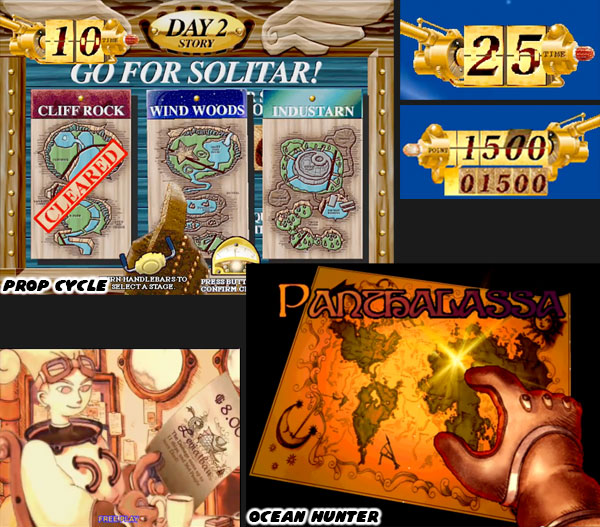
When I started this series I didn’t know that I would end up writing about Wonder Eggs. In all honesty last year I had an idea for a blog. I simply wanted to talk about some of my favorite game art. I planned on deconstructing, and talking about the aesthetic used in two rare arcade games. These were Namco’s Prop Cycle, and Sega’s the Ocean Hunter. I already did a deep dive on Prop Cycle. This was an arcade game where you rode a flying bicycle. You actually had to sit on a mock up of the bike, and pedal the cranks in order to control your speed. I had also called the Ocean Hunter one of my favorite games of all time. In it you traveled the globe hunting gigantic sea creatures using a harpoon machine gun.

Each of these games had a brilliant art style. A surface level comparison might be steampunk. As the technology seemed to rely on analog power, and analog interfaces. There were brass, polished wood, and metal vehicles that looked somewhere from the late 1800’s - early 1900’s. That was not an accurate way to describe the aesthetic. The fashion, costumes, and architecture featured in both the Sega, and Namco games were not Victorian but something original. There were no top hats covered with gears, and goggles. No long flowing dresses, or other costume accessories that might be associated with the steampunk movement. I would better classify the world featured in the Namco game as a precursor to the Hopepunk / Solarpunk / Ecopunk movement. Although the technology seemed simplistic, it was actually set in the far future, where man, and nature existed in harmony.

As I was doing my research on the games in Japanese, especially on Prop Cycle, I kept finding cross information between the game, something called Wonder Eggs, and a place known as Laperot. The reason why was because the name of the flying bike in Prop Cycle was called the Laperopter. There was a ride with the same name in Wonder Eggs. This lead to information on Shigeki Toyama. I would discover that Mr. Toyama was responsible for a majority of the U.G.S.F. science fiction designs. These were by far my favorite space ships, and canon of all sci-fi universes. He was absolutely brilliant with his space ship art, but Prop Cycle allowed him to create something completely different. This was a game, and a place that fit somewhere in between the retro futuristic technology that Jules Verne wrote about, and the cozy cottage-core of Hayao Miyazaki’s animated masterpieces. There was no doubt that his nickname as the Leonardo DaVinci of Namco was well earned.

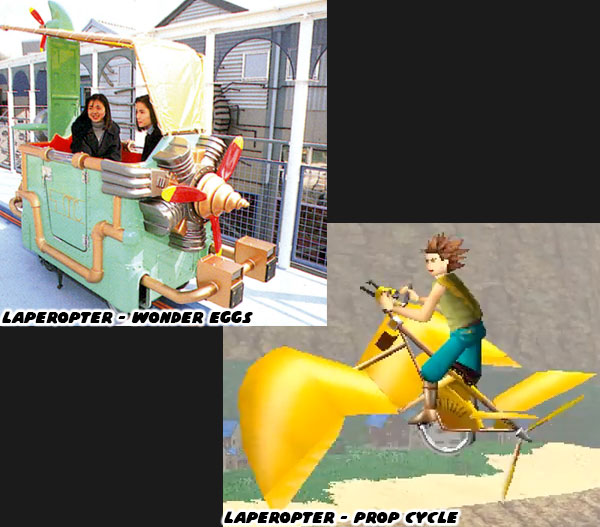
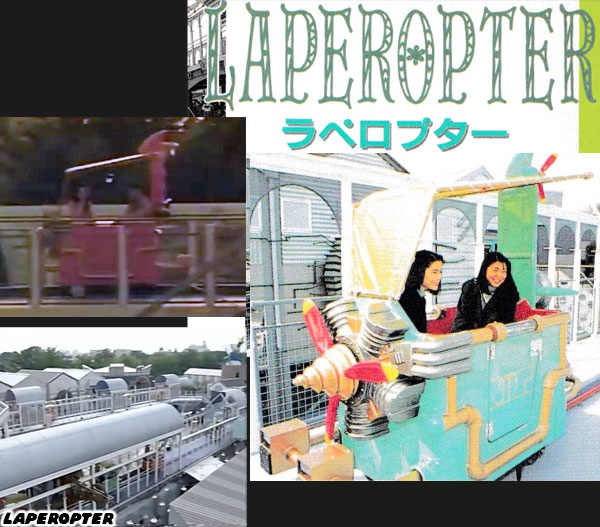
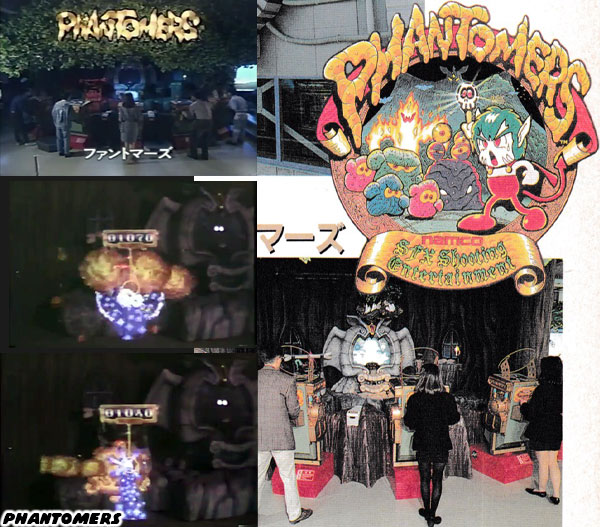
Mr. Toyama’s amusement masterpiece was Galaxian³ which was already a featured attraction at Expo ’90, and Wonder Eggs. He was tasked with designing two other attractions for Wonder Eggs. One of which was the Laperopter ride, and a shooting game called Phantomers. The Laperopter was a People Mover-type attraction which took guests around the perimeter of the park. Here was the description from a Namco Graffiti preview of the park. “The “Laperopter“ allows you to take in the view of the park while circling the sky above Elds Square.You can also view the Imagination Gallery, which is decorated with mysterious paintings such as “The Trump Banquet.“ If you ride with two or more people, you will receive an automatically taken snapshot. Now, let's aim for a two-shot with that girl you're interested in!!”

This ride was simple. It would go over well with visitors of every age. To help put the finance people at ease it would also be using technology that Namco already owned. In many of their rooftop amusement parks, and indoor amusement centers Namco had similar train rides, and monorail rides. The Laperopter would be a two passenger carriage which would feature a new fiberglass frame. It had a wing, tail, and propeller at the front designed by Mr. Toyama. In classic Namco fashion he would be putting in details, and story elements that were interrelated. Namco titles were tied together sometimes directly, and sometimes very loosely. The third attraction that Mr. Toyama oversaw was one of those direct callouts. Phantomers was a light gun attraction where guests could target invisible demons that popped out of their secret base. You could only see the ghosts if you looked through something called the Phantom Scope. The technology used in this attraction was similar to the Golly! Ghost! arcade game that the studio released in 1990. It featured physical props, and video projection with a peppers ghost effect.

I would liken this attraction to Walt Disney’s Enchanted Tiki Room. Except that guests had light gun turrets which could shoot at the tiki gods that appeared during the show. Here was the official description from Namco; “The “Phantom Scope“ was invented by Dr. Eiji Potts. When you use this...it's strange. Phantoms, small devils that are supposed to be invisible to the naked eye, will appear using the Phantom Scope. Shoot the “Bilibili Ray“ at the diorama on the stage and defeat the phantoms! The diorama moves and the phantoms begin to dance to the rhythm of fun music. SFX shooting “Phantomers“. There are lots of fun tricks and performances!”

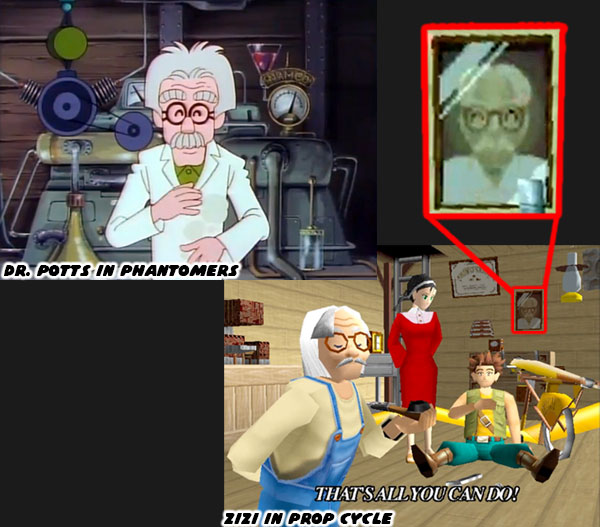
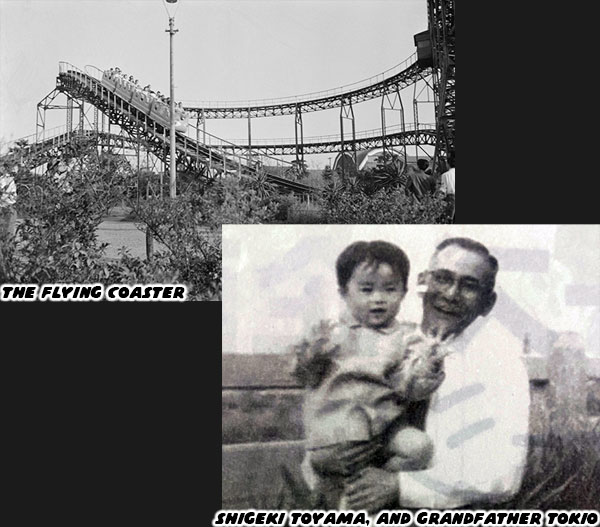
A picture of Dr. Eiji Potts appeared on the workshop wall of Zizi Potts, the mechanic from Prop Cycle. According to the official canon from Namco, and Mr. Toyama’s design notes Dr. Eiji not only created the Bilibili Ray which could be used on evil spirits, he also invented the original Laperopter featured in Laperot village. This vehicle could work on land, sea, and air. Zizi changed the name of his business from the Potts Invention Workshop to the Laperopter Company. He had also founded the Laperot Lobster Company. That’s right! Laperot from Wonder Eggs was immortalized in Namco’s official game canon! This was a fun detail, however the roots of everything that Mr. Toyama did for the park was because of his grandfather. In his design notes he stated that Dr. Potts was based on Tokio. Tokio designed the “Flying Coaster” featured at Futakotamagawa Garden. Before it was taken down the roller coaster was located near the future site of Wonder Eggs. Shigeki had a warm place in his heart for the garden, and a deep love for his grandfather. I’m sure he inherited his fondness of amusement parks from Tokio as well.

Wonder Eggs may have been a strange English word combination, but it was easy to paraphrase in Japanese. The older park that Tokio and later Shigeki worked at was located at Setagaya, Tokyo. It had been in operation from 1922 to 1985. Wonder Eggs was built in a corner of the property in 1992. Both parks were beloved by the community. Locals gave Futako-tamagawa the nickname “Futako” or “Nikotama,” the latter coming from an alternate reading of the first three kanji characters in the name. Tamago meant egg in Japanese. The nickname was probably a play on the expression “nico-nico manma” which referred to a relaxed and carefree attitude, often associated with taking things as they came without worry or stress. It reflected a laid-back approach to life and was used to describe someone who was easygoing or content with the present moment. Wonder Eggs was certainly a carefree place filled with magic. Shigeki Toyama created the template for the rides that would be built there. The goal was to provide play experiences for people of all ages. In the next blog we will look at their unique spin on some classics. Were there any defunct parks that you visited? Please tell me about it in the comments section. As always if you would like to sponsor me please visit my Patreon page and consider donating each month, even as little as $1 would help make better blogs and even podcasts!
follow the Street Writer on Patreon!
Wonder Eggs, and Egg Empire research collected from: Wonder Eggs Guide Map, Namco Graffiti magazine, the book “All About Namco II", NOURS magazine, The Namco Museum, Namco Wiki, Ge-Yume Area 51 Shigeki Toyama Collection, mcSister magazine, first person attraction details from Yoshiki. Event details from Hole in the Socks

Friday, May 14, 2021

Prop Cycle, the most interactive arcade game you've never heard of. A 1UP Classic...

Looking back on the rail shooter arcade legacy got me thinking of other gems players might have missed. One of the most original arcade titles in the entire history of video gaming was also one of the rarest and easily one of the most interactive titles as well.

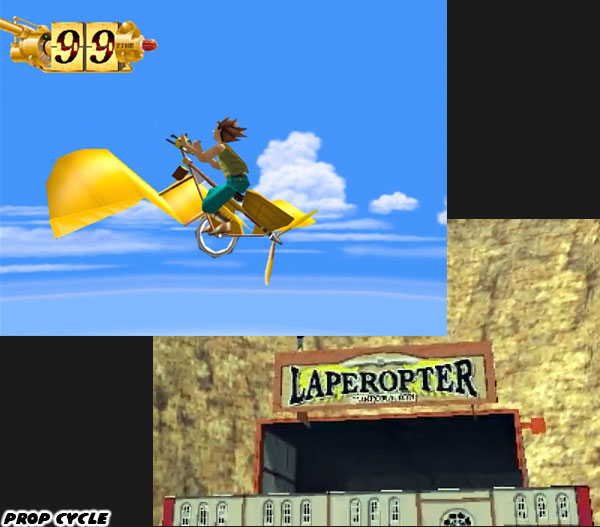
Prop Cycle, released by Namco in 1996, was an arcade game unlike any other. Instead of a joystick or trackball the game was played on a modified exercise bicycle. The handlebars were set vertically and could be tilted forward and backward similar to the yoke on an airplane. The handlebars even had a functional speedometer to show the air speed of the main character. The design of the arcade seat and controls mirrored the "Laperopter" the flying bike featured in the game.

Prop Cycle was an imaginative game, a game so whimsical and improbable that it would probably never have gotten developed in today's market. According to the official story, the game was set in the far future. Following some terrible catastrophe people had finally learned to get along in peace. Steam powered the new world and humanity was the remastering flying. Here is part of the story directly from Namco. 

This is a far away world someday. 200 years ago, the final war caused by the hyperspace magnetic weapon “Tesla bomb” completely changed the landscape. The few survivors abandon high technology and lived a simple but elegant life. The best technology here is the steam engine, and the best energy source is fuel stone.

The technology has become so advanced that it is possible to use it to fly airplanes with steam engines. In the aftermath of the massive bombs, all the terrain had become steep and valley-like, but the personal flight technology necessary for people to live without destroying nature had advanced to a high level. It is the culmination of a new civilization's great wisdom that has been accumulated to allow humans to fly freely in the sky using only human power. That is the human-powered flying machine “Laperopter.” (The name was a combination of two words; helicopter, and Laperot which was the name of the fictional village used in the Namco theme park Wonder Eggs.)

One day, someone touched a part of the altar and a violent bolt of lightning struck the village. Each village was cut into the shape of a sun, moon, or star, and the villagers were taken to the sky together. The land always floated above their heads, and before they knew it, they came to call it “Solitar” (Solitary Island).

The flying machine workshop “Laperopter Ichisha” was established 170 years ago, and while there are several competing companies, it is a flying machine manufacturing company that has become so famous around the world that the generic name for its flying machines is “Laperopter.” It is a long-established store.

Everything you needed to know about the game world, and story was presented on screen, even if you didn't have access to the official translation. There was a temple built in the area over some ancient technology. When a resident of the town touched an ancient (radiation warning) symbol several parts of the village were sent skyward accidentally. The thing I found interesting was that this power source that shot electricity was shaped just like a Tesla coil, but it was covered in stone, and warning symbols. Could this have been some sort of hostile architecture? Additionally under the stone we could see the copper coils, but they were reminiscent of the stripes of the USA flag. Was this a coincidence? The story continued...  

One day, a letter fell from a resident of Solitar. It seems that what was thought to be an altar was actually a weapon controller. The red balls floating in space are floating energy, and if you destroy them all within the time limit, the "Solitar" will return to its original position on the ground, but if it cannot be destroyed, the red balls will return to their original positions with a thunderclap. It was written that it should be put away. Some heroes so far tried, but failed and crashed.

This series of floating islands was called Solita, which is a Spanish word for lonely or isolated, the name was translated to Solitar in the US. The islands had distinct celestial shapes, a sun, a moon and a star. Perhaps it was destined to be the first city in the sky but the technology was premature for the inhabitants as they had no idea how to return the islands back to Earth.

The villagers on the ground had been trying to bring back Solitar for some time. Unfortunately every attempt was met with failure and the implied death of those that tried. Again from the official translation. 

"In order to prevent further casualties, a prop cycle test was to be carried out sponsored by Laperopter. It imitates the properties of the red ball and also serves as a preliminary simulation. The heroes selected in this tournament are tasked with challenging the Solitar, and are launched into the Solitar using a giant slingshot from in front of the Laperopter Company." 

So they had established a challenge to find a champion. A series of balloons spread over the land would test the flying ability, maneuverability and speed of the flying craft. The gameplay would revolve around these themes and players would chase down hot air balloons to explode.

The game was broken down into two basic components. The Novice mode was a one level point attack game. Any one of the three regular stages could be selected in Novice mode, these included Cliff Rock, Wind Woods, and Industarn. This mode was great for players that were trying to memorize the maps and locations of hidden paths however at the end of the time limit the game was over. The Advanced mode followed our unnamed hero through the levels with a story element. If players met the minimum point requirement for each stage then they would be able to progress to the next stage without having to pay for it. Failure to meet the score meant that players had to start over from the beginning but with a reduced point requirement. Unfortunately extra points would not roll over to the next stage.

Early on in the Advanced mode the balloons were evenly spaced and gave players clear lines to follow. The harder levels changed the location and point value of the balloons and made it so that only a flawless ride-through with every time bonus and hidden path would meet the minimum requirements to advance to the next level. Given that this usually cost a $1 per play then it was not hard to see why more players did not try to complete the Advanced levels. With that said the game and level designs were still great and worth the challenge.

Each stage was filled with details that supported the story and world that Namco was setting out to create. The tiny villages were filled with people that would wave at the hero as he rode by on his flying bike. Steam engines ran along tracks connecting the valleys. Every detail was rendered in simple textures, including store fronts, clotheslines, churches and sheep grazing on polygonal fields. Memorization of the levels and layouts of the tunnels and paths was only part of the challenge. The location of the balloons varied slightly between the first day and third day of the story mode. Players had to be extremely proficient at navigating their flying bike through some very tight spaces and doing so quickly.

The art direction of the game was not quite steampunk, at least not in the western definition of the culture, but it certainly was retro-fantastic. The simplicity of the designs, especially for a flying bike was in the vein of Jules Verne meets Hayao Miyazaki. The towns and people had a quaint late 1800's early 1900's stylization. The addition of giant steam powered machines, trains and factories helped reinforce the technological limitations of the universe. The level details, and lighting effects for day, night and even indoor areas helped give the game a distinct look and a level of plausibility. 

The designers at Namco were always mindful to try to connect each of their video games to established canon, or in this case include elements from the history of the company. Namco was known for their prize games, and kiddie rides in Japan, as much as for their arcade hits. The location of the game was inspired by Lapello Village which was a mix of fantasy, and sci-fi from their Wonder Eggs amusement park. Even the steam train running through the village was similar to the kiddie ride created by the company.

To help bring back elements of the dangers of the nuclear energy that sent Solitar into the sky there were radiation symbols hidden throughout the levels. A collection of radioactive barrels was seen spilled inside of a gigantic cave. Rising out of the glowing mist were enormous worms lunging into the air, snapping at the wings of the player. While these worms could not really harm the player they were a sight to behold. They were surreal science fiction monsters placed right into the middle of an inviting simplistic world. The entire game was layered with subtext involving the future of humanity.

If the player beat all three levels in the Story mode they start the final challenge. The player would be hooked up to a gigantic slingshot and shot up at tremendous speeds towards the floating islands of Solitar. The main character was seen pedaling quickly in order to reach a certain altitude. When the islands came into focus they were amazing.

There were parts of the community mostly intact on the island, including houses, factories and businesses. One building was split in half with the interior exposed. Players could find the other half of this building in the regular levels. It turned out that the villagers that went up with the island had managed to survive. The people stranded on Solitar could be seen waving to players from their homestead. Instead of balloons players had to destroy glowing red orbs. The electrified spheres appear to have been what was keeping Solitar suspended in the sky. Players had a fixed amount of time to locate and destroy all of the spheres on the level. There were no orbs that offered 10 or 20 extra seconds as there were on the regular stages. If a player failed to destroy the spheres within the time limit then the final cinematic would play out. A temple would shoot an arc of electricity right at the player and knock him out of the sky. The unconscious player would then be sent spiraling toward the ground, not a friendly ending to the otherwise inviting game.

If a player destroyed the red orbs within the time limit then the islands of Solitar would The plot and design could best be appreciated in the final level of the game. At a high altitude players could see what had become of the Earth. Gigantic craters dotted the surface of the planet. Based on the number and identical scale of craters it was inferred that they were caused by the aformentioned "Tesla Bombs" rather than by meteors hitting the planet. It was an impressive visual but layered with a melancholy subtext.

This game could be a prime example of the greatest elements in the arcade game design as well as some of the worst. The game succeeded on several levels. It was one of the early arcade titles that allowed freedom of movement in 3D space. The character and level designs were fun and memorable. The bicycle seat controller was highly original. Of all the positive elements the most important was that the story was very minimal. All of the details and clues for what happened to Solitar were told through the levels and scenery.

It was up to the players to interpret this world based on what they saw and played. The best games always left enough elements for the players to interpret and internalize the experience. Those games never insulted the intelligence of the player. Many games today have to explain every little detail, auto save frequently and hand-hold the player through boss battles. These things cheapen the universe the developers worked to create and the experience of playing.

Where Prop Cycle fails is in its difficulty and control scheme. The pedal mechanic is great, however it determines both the speed of the player and the ability to gain altitude. While the physics behind this were solid, the control suffered because of how the mechanic worked in the levels. The stages were compact, with high rock cliffs that the player could not fly over. Most stages could be traversed within a few seconds if not for the tight, winding paths. The spacing of the balloons guided players through a set path in the Novice Mode.

Players could never climb too steeply in the Novice Mode and the game would remind players when to pedal faster to gain altitude. In the Advanced Mode the balloons were spaced further apart and the lines to reach them were more open. Players had to have the pedaling speed and stamina of an experienced cyclist, combined with the precision timing of a race pilot . It was difficult to navigate the tight turns in the caves and tunnels and then perform a burst of speed from one balloon to the next. Circling back cost the player precious seconds and most Advanced Levels required a few play throughs to complete. By that time the player would be physically exhausted from playing.

The wonderful universe that Namco had created took a back seat to the laborious gameplay. What started off as an experience that felt like a lost level in Pilotwings quickly degraded to an unforgiving experience. Based on this gameplay I could see why Sonic Team chose to put the gameplay from NiGHTS into dreams… on rails instead of free flying from a behind the back POV as they originally wanted. If it weren't so difficult, or so rare, Prop Cycle would have been celebrated as the most interactive arcade game ever made. By comparison G4 dubbed Arctic Thunder the most interactive arcade game ever because it featured a pair of fans that blew in the face of the player.

In the past few weeks I've highlighted games that did far more to the player, including flipping them upside down and spinning them 360 degrees or immersing them inside a sensory deprivation parabolic dome. Prop Cycle required more physical effort and concentration than just about every other arcade game ever, however it was possibly surpassed in physical demand by Namco's next arcade title. Rapid River, released in 1997 featured a moving seat and paddles that the player used to navigate up and down a series of branching paths. Imagine Sega's Rail Chase sans machine guns and set in a raft. The upper body strength and stamina requirement was absurd. It was a game destined to remind players how out of a shape most gamers were. The use of fans was more luxury than immersion, G4's assessment of interactivity is absurd and I'll take a flying bike over a snowmobile any day. If you would like to sponsor me please visit my Patreon page and consider donating each month, even as little as $1 would help make better blogs and even podcasts!

follow the Street Writer on Patreon!