Showing posts with label carlos. Show all posts

Wednesday, May 24, 2017

The Style Files: Daraku Tenshi The Fallen Angels, part 2...

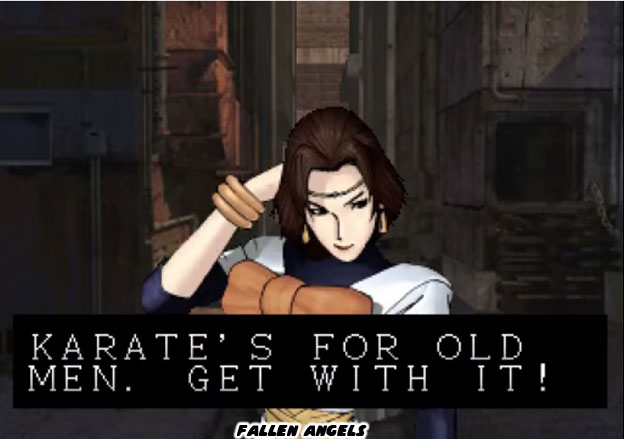
We were looking at Daraku Tenshi: The Fallen Angels in the previous blog. It was a game at least three years in the making from a team called Steel Hearts. The publisher, Psikyo, wanted to create a fighting game the likes of which were never seen before. They released the game before it was completed but it still retained enough elements for audiences to know where it was headed. The game had a very strong aesthetic, one of the most unique visual styles ever created for a fighter. It wasn't set in a cartoonish world, or a hyper-realistic world. It was instead set in a world with realism, painted with memories of a town slowly decaying. The people fighting to survive in this place were not typical game characters. Even the karate fighter, Torao Onigawara, was a homeless brute. He was a far cry from the hero that Capcom had created with Ryu. Then there was the military officer, estranged from his family and dumped on the island of Eden. His sole purpose was tracking down a crime lord. There were a pair of sister club owners, one of which was a (rare for gaming) trans. character. A thief, a bouncer, an assassin and a green skinned brute made up the rest of the cast. Each had their own unique look, moves and reason for fighting.


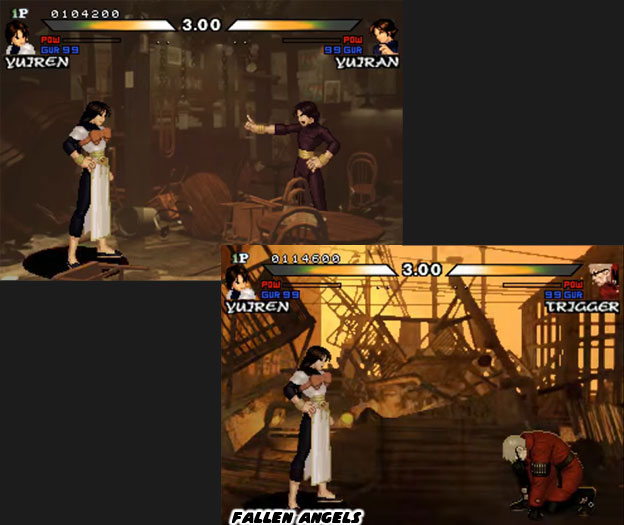
A crime boss by the name of Carlos was pushing all the other mobsters out of power. He wanted to rule the island nation of Eden. This enraged other crime bosses and gangs. But in a world that was cut off from emergency services and even law enforcement this meant that only those that could fight had power. To increase his dominance Carlos began assassinating his rivals. During the events of The Fallen Angels he had heard that there were some dangerous people trying to hunt him down. That was when he called in his right hand man. This person was very stylish, he wore a red suit and dark sunglasses. He was called Trigger and acted as the sub-boss in the game. Trigger was the type of character that could drive a fighting game player mad. He did not use any style of martial arts, instead he fought with a pair of revolvers. They were equally deadly at distance and up close. Also, unlike other fighting games where a bullet was easy to track or evade, in this game every gun shot was near instantaneous. The words cheap and overpowered often came into play when talking about fighting game balance. Yet at the same time Trigger made sense in the context of the game. This was not a tournament, this game was about vigilante justice. There were no rules saying that people could not use weapons in a fight. If audiences were able to get past Trigger then they faced off against the final boss in a darkened board room.
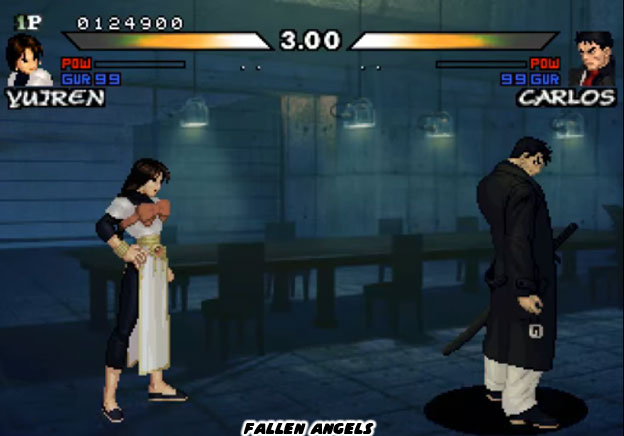
 

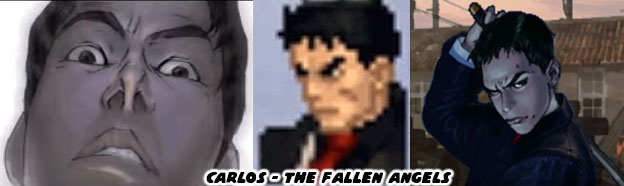
Carlos was tall, almost the tallest character in game. His strength and range were already above average but then Steel Hearts gave him a weapon as well. Carlos fought with a katana aka samurai sword. It didn't matter what type of form the heroes practiced. Just a few slashes with a sword could kill them. In a traditional fighting game this was cheap but in the Fallen Angels it made sense. Think about it for a moment; if this were an action movie, or action game, then audiences wouldn't have complained that a boss character not fighting fair. Bad guys in films always fought dirty and did things that the heroes couldn't. In the end, depending on which character was selected, a single line explained why each person was fighting. Some did it to get a fresh new start in Eden. Some did it to bring justice to the city. Others did it to save themselves. And some did it just for the sake of taking over. Steel Hearts did not get a chance to create any proper ending cinemas for the cast. Nor were they allowed to create any sort of in-depth level intros. Who knows how far the story would have gone and what the fallout would have been. Maybe the game would have had a sequel or maybe it was designed to be a self-contained adventure.
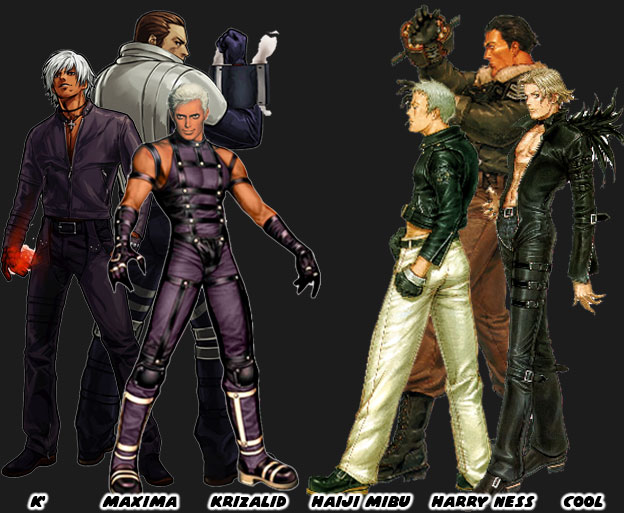
 

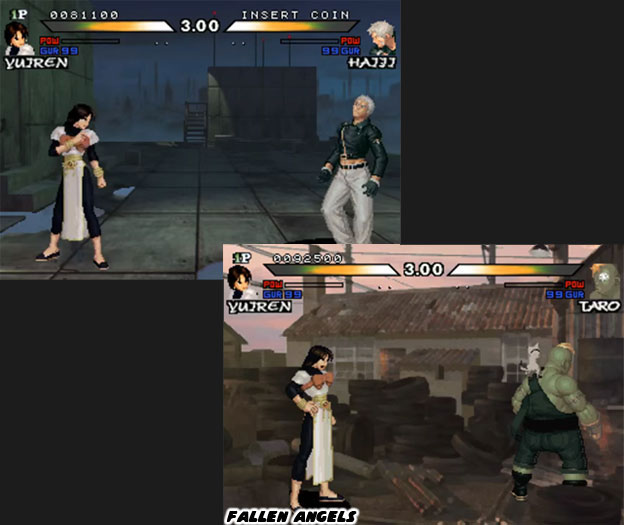
The developers had planned on shaping a bigger experience than what was presented. The incomplete story, unfinished sprites and other data found in the game ROM could attest to that. No other developer followed in their footsteps. The lesson was learned, creating a game with an incredibly strong aesthetic, a unique visual style and presentation would cost too much money and take too much time to be worth it for any publisher. The influence of Steel Hearts, the importance of what the studio was trying to deliver however did not stop with the Fallen Angels. Director and co-designer Mitsuo Kodama, along with artist Toshiyuki Kotani aka Styleos, went to work at SNK. One of the first things they did was change the direction of the King of Fighters franchise. They introduced some new lead characters and villains. Eagle-eyed fans noticed that the new characters in KOF '99 looked eerily similar to the characters in The Fallen Angels. the French website GangGeekStyle did a great writeup and compared the Fallen Angels to the KOF characters that evolved from them. Remember that the team also went on to work on The King of Fighters '00 and The King of Fighters '01. Around this time SNK was in bad financial straights and underwent bankruptcy, I wonder if the change in direction had anything to do with it. The KOF 2001 and 2002 were actually developed by the South Korean studio Eolith. The comparisons between the white-haired antagonists in the KOF series, K' and Krizalid and the metrosexual anti-heroes in the Fallen Angels Haiji Mibu and Cool should be obvious. Also the trademark attacks for both Maxima and Harry Ness were rockets in the sleeves of their jacket. The major difference being that Maxima was a tall cyborg and Harry was a big soldier. Yet the idea of a villain in a long coat was nothing new in SNK fighting games, See Rugal, Goenitz, Mr. Big, etc. Both Krizalid and Carlos fit the mold as well.
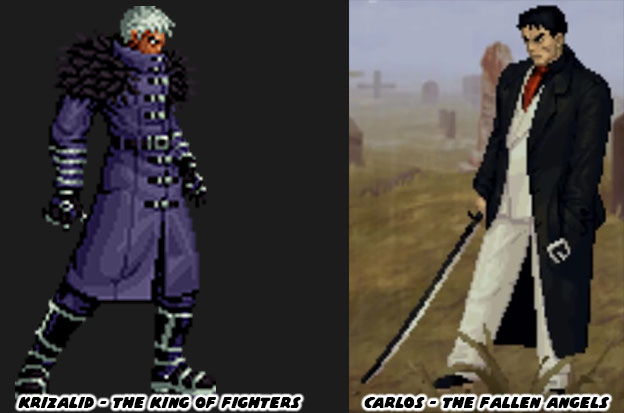
   

SNK had made changes to their franchise very quickly. They didn't try to recreate the aesthetic from the Fallen Angels, the mood of the levels, or even the large detailed sprites. That would have held up the development of the King of Fighter series for a few years and put them way over budget. The decision to pursue Dot Art graphics, detailed high-resolution sprites, eventually happened. It may have been influenced by what Steel Hearts was trying to achieve. But that was not the only interesting thing that happened following the debut of The Fallen Angels. In 2000 ARIKA released Street Fighter EX3. This was the first fighting game that the studio had released after Fighting Layer in the arcade in 1998. ARIKA had made waves with the fighting game community because Fighting Layer was published by Namco but it featured two characters from the Street Fighter EX series, Blair Dame and Allen Snider. Neither of which appeared in Street Fighter EX3. In their place was a new character named Ace. Movie fans noticed how much this new character appeared like Max Rockatansky from the Mad Max films. He had the same angular haircut and the same armored jacket with only his pants being a different color. In the canon of the series Ace was the next evolutionary step from the Cycloid program. These were cyborgs that could copy the moves of any fighter.
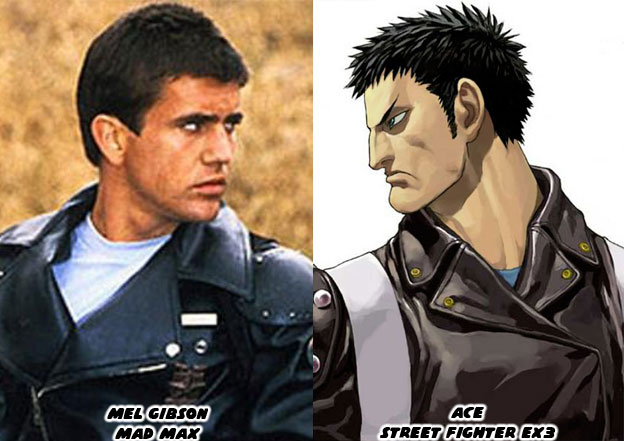
 

Ace ended up having a few of the moves of Blair and Allen at his disposal. Some people wondered if he had crossed paths with the former EX stars. Did he beat them in combat? Did he arrest them? Is he a clone? ARIKA wasn't saying anything official about the events or canon of this game or Fighting Layer. Leaving audiences to speculate about what happened. It didn't help that ARIKA would tease the characters in their infamous April Fool pranks. Credited in Street Fighter EX3 were producer Tatsuya Minami and co-designer: Hiroshi Okuda, Kiminori Tsubouchi. None of the senior people had worked on The Fallen Angels, at least none that I saw in the credits had any involvement with The Fallen Angels. But here is where things get very interesting. For many years some people in the fighting game community thought there was something oddly familiar about Ace. I think his look was partially inspired by Carlos from The Fallen Angels. The sharp hair, and dark coat being the most obvious similarities. But it turned out that there was much more to it than that.
 

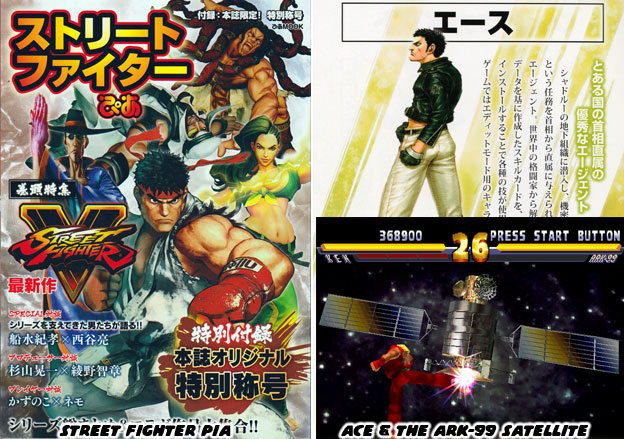
For more than a decade I looked high and low for official art from Capcom or ARIKA on Ace. I got just about every art book Capcom had ever released and even a few of the ones that Udon translated from Japanese. There was nothing outside of the character profile that we had already seen. That was until the Street Fighter PIA Mook (magazine/book) was released in 2016. The paperback talked about every character and game released in the series up until Street Fighter V. F.A.N.G. was at that time the newest character. The book also mentioned every crossover that the series had with other franchises, including the costumes in Monster Hunter, and Dragons Dogma. The reason that I bought the book was because it inlcuded all of the Street Fighter EX characters as well. The most obscure being ARK-99, a satellite that players could beat up in the bonus stage of Street Fighter EX2. The second-most obscure character was Ace and that was when I got a clear shot confirming my suspicions. I bought the issue so that I would always have proof that the character was canon and the art was either stolen or never credited correctly.
 

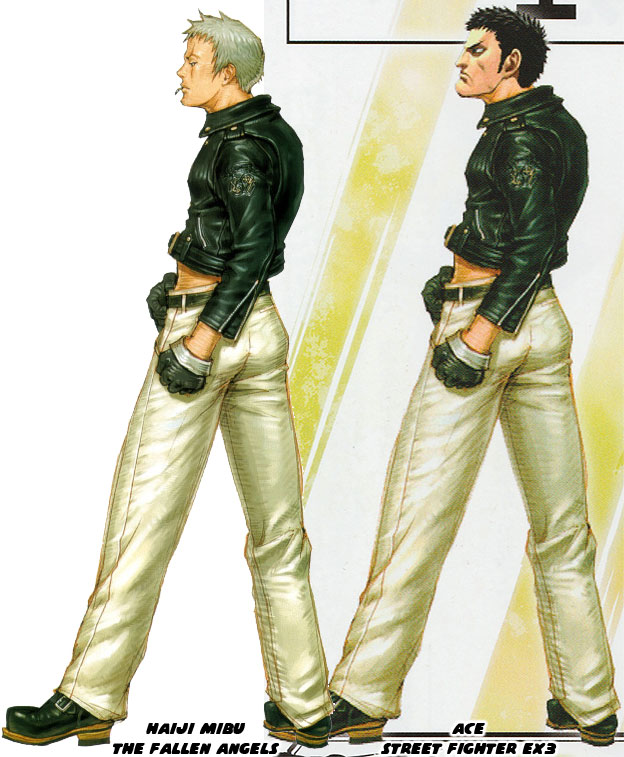
The character art for Ace was poached from the original illustration of Haiji Mibu from The Fallen Angels. I don't mean that they were similar poses, similar costumes or similar color choices. I mean that the studio took the original head off of the character and replaced it with Ace. If the artist that did this was anybody but Morioka Shinichi then it would be art theft. It is possible that Mr. Shinichi went with an alias in the credits. But if so I have to wonder who at ARIKA thought that this would be a good idea. The Fallen Angels may not have been widely received but the characters were so unique that they were hard to miss. When I got the Street Fighter PIA the first thing I did was scan the full body picture of Ace and then track down my copy of Games Mook Vol. 113: Psikyo Illustrations. I scanned in the Haiji Mibu piece and put them side-by-side. There was no mistaking the illustration now. The suspicions that Street Fighter fans had was confirmed. Audiences had seen this character before, and for some they had seen the design used twice in both an SNK and Psikyo game. I have yet to find a Japanese article or site that would explain why the recycled art was used.
 

The Fallen Angels was an example of what would happen if a developer decided to pour all of their resources into a game with an uncompromising aesthetic. They transcended the argument of what good graphics look like because no other studio could compare to what they achieved. Aside from being beautiful to look at The Fallen Angels introduced new ideas into the genre. Things such as characters that were partially animated using rotoscope techniques. A mix of paintings and cgi models used to build interactive stages. Incorporating video loops to create realistic weather and environmental effects. A cast that was not made up of traditional martial artists but whose forms were still realistic and believable. Challenging conventional tournament design and focusing on a story with mature themes. Incorporating characters with and without weapons as well as including a trans character. It had been years since a single studio had pushed so many new ideas on the genre. Of course all of this innovation came at a price. The game did not look or play as Steel Hearts had intended. It took several years to get a mostly running version of the game ready. It left the developers wanting more, even years later they wanted to return to it and finish what they had started. No developer could realistically complete a project like this, it would bankrupt just about any studio. I am grateful that they were willing to give it their best. Steel Hearts showed what one studio could do for the genre. Imagine if every studio poured their heart and soul into setting their fighting game apart. The majority of fighting games today use the same graphics engine. They all have the same visual language, and because of that they have a diminished impact. Audiences are eager to see a return to strong aesthetics, graphics be damned. If you have a favorite fighting game that broke the mold I would like to hear about it in the comments section. As always if you enjoyed this blog and would like to sponsor me please visit my Patreon page and consider donating each month, even as little as $1 would help make better blogs and even podcasts!
 follow the Street Writer on Patreon!

Monday, May 22, 2017

The Style Files, Daraku Tenshi: The Fallen Angels, part 1

Steel Hearts had been working on a fighting game called Daraku Tenshi - The Fallen Angels for about three years. The publisher Psikyo had been patient for the most part but by 1998 almost every fighting game franchise had run its course. Street Fighter, Tekken, Virtua Fighter, Mortal Kombat, the King of Fighters had sequels upon sequels in the arcades and home consoles. Psikyo had been floating the bill all this time and was running out of money and patience. They wanted their new franchise title in arcades as quickly as possible. Steel Hearts did the best they could and polished what they had and scrapped the rest. There were incomplete animations, unbalanced rosters, missing shadows and other sprite data was patchy. The endings, cut scenes and stories were not all in place when the game was released. In recent years arcade fans tracked down copies of the title and dumped the ROMs online for game fans to emulate. Some fans dug through the files and discovered unfinished sprite data for at least four more characters with names and costumes. There may have been even an extra character or two in beta that they had just started before publishing the game.


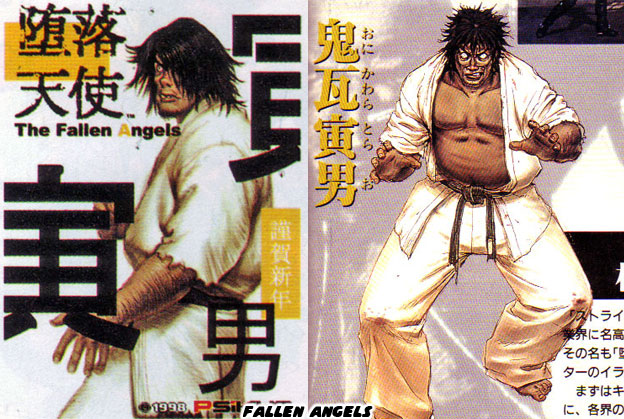
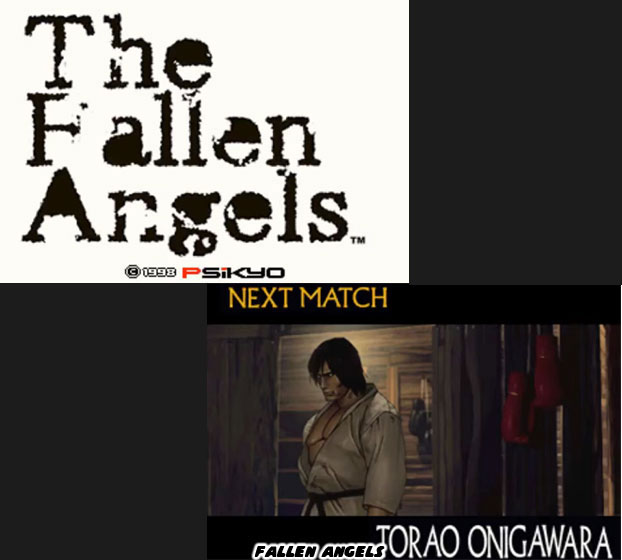
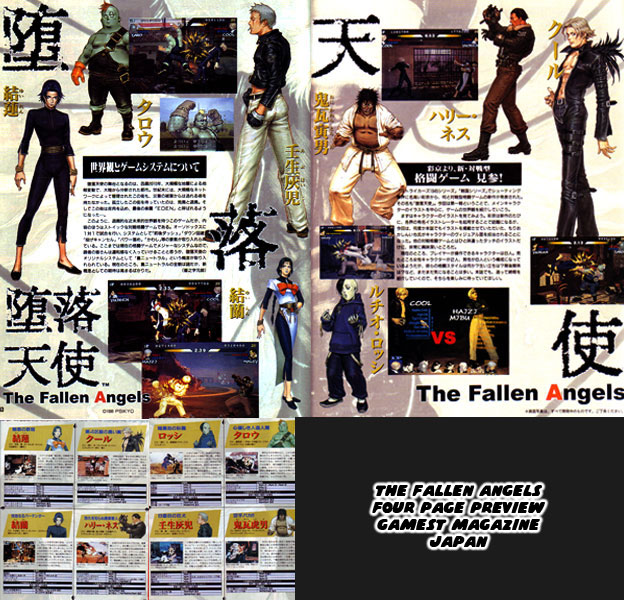
Psikyo had an uphill battle trying to get audiences behind their new game. Battle K-Road was such a poorly received fighter that most people assumed they were going to get more of the same. When it came to sprite-based titles audiences thought that the peak had already been reached. Capcom released Warzard two years earlier and Street Fighter III a year before The Fallen Angels. Fans were skeptical that Psikyo could match the size, and quality of the sprites in either game. Little did they know that there was always room to grow. The Fallen Angels and King of Fighters XII demonstrated that. Anyhow Psikyo went on a full press blitz for their title. They got Gamest, the top Japanese arcade magazine, to do a four-page special on The Fallen Angels. They wanted to show fans that their game was worth the wait. It started by breaking conventions. The majority of fighting games up until that point had martial artists in some sort of tournament. This game had no tournament, the fights were al interconnected through a story. This game had a couple of martial artists but they weren’t the traditional heroes that we had seen previously. Take the karate master in The Fallen Angels for example. Torao Onigawara was the hardest hitting karate fighter the world had ever seen. Yet his extreme dedication to his craft turned him into a literal demon. Well, a homeless demon.


The romantic ideal of the karate fighter, somebody like Ryu for example, is flawed. Ryu was based on people like Mas Oyama and Yoshiji Soeno. People that became heroes by defeating other martial artists. In order to become great karate masters they lived like hermits. They trained in the mountains, under extreme weather conditions, isolated from human contact. They did pretty much nothing else for years. This made them mentally and physically stronger than their opponents. It turned them into legends. Then you take that idea to the extreme with a character like Torao. His zealotry showed in his design. His gi was worn and tattered, like Ryu’s, but unlike Ryu it was also dirty and covered in sweat stains. Torao in the game had literally stepped on screen after a training session. He had long, oily unwashed hair. The character looked like he hadn’t bathed in months. Steel Hearts actually animated Torao with tiny flies buzzing around his head. Other studios presented their characters in an ideal light, Psikyo went the opposite way. Ryu was always illustrated as young and handsome, even if a little bit rugged. Torao was raw, with a wild look in his eyes by comparison. Steel Hearts painted him with flies-a-buzzing and a snaggletooth sticking out from under his lip in the official character art. Even the name Onigawara was a play on words. An oni-gawara, literally a demon tile, was a decoration on a Japanese roof. Torao was no Ryu, he was more accurate to what an insane karate demon would look like.


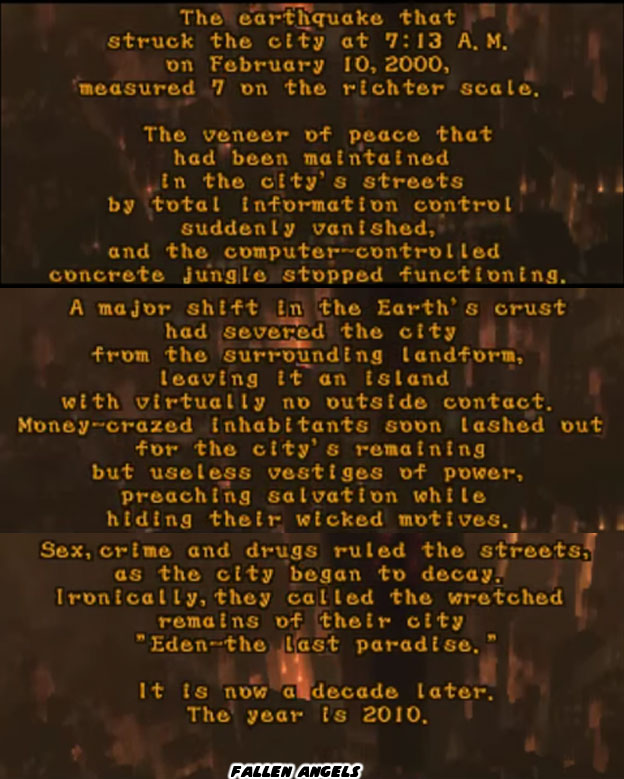
Every character in the game had an intense level of design and back story, not just Torao. Every character had a reason to fight and a reason to go through the lineup. Steel Hearts wanted players to feel as if they were living vicariously through the cast. The society that they were being brought into was on the verge of collapse. The stages were desolate, as if the last people on Earth were the main characters. It turned out that the fate of a tiny island nation rested in the hands of these people and an evil crime lord. Steel Hearts had reached a new level of directing for a fighting game. The situations that the cast found themselves in were serious. These weren’t some random fighters in a tournament, brought together by fate. Each encounter was a life or death struggle. I don’t think that any Japanese game since had matched the tone of The Fallen Angels. It was as if had been written and directed by Michael Mann, David Lynch or Brian De Palma. I’m certain that lead artist Morioka Shinichi, producer / co-designer Kouzou Fujimoto, and director / co-designer Mitsuo Kodama could turn this story into a compelling 6-episode OVA. Just look at the official story that played in the introduction.


The world that Steel Hearts painted was very grim and brooding, more so than any standard metropolis. The island of Eden place never completely recovered from a massive earthquake. There was a reason why the inhabitants on the island were melancholy and hesitant to leave their homes. Drugs and crime had taken over the streets. Without direct access to state emergency resources they were at the mercy of local mob bosses. Also unlike other fighting games, even the gruesome ones like Mortal Kombat, the action here was grounded in realism. The characters did have some level of fantastic martial arts ability but they weren’t shooting fireballs or throwing burning dragon punches. They did actual take downs and slams, spinning backhand punches and thrusting axe kicks. We could imagine that these people were very real, or inspired by real heroes and villains. There was a dash of science fiction rather than fantasy in this world. Demons weren’t real in this game as they were in the Goketsuji Ichizoku / Power Instinct universe. Instead things like kidnapping, brainwashing, cloning were. To an extent even genetic modification was possible in this world. These sci-fi elements had been touched upon in the Tekken and Street Fighter universes. Yet none of the previous games had put the characters in such a foreboding world. No other game was ripe with an aura of depression. It was palpable. It hung over the stages. Over the cast, and over the intro screens.


The streets were desolate in Eden. It made sense given the story leading up to the events in the title. Also since this wasn’t a game about a competition then it made sense that there weren’t bystanders cheering on the fighters. Sure it could be argued that the developers didn’t have enough time to create background characters but I do not think that was their intent all along. After spending years on an unfinished main cast they must have realized their resources weren’t being used to populate the city. This worked to their advantage. It made Eden look like a nice place to drive through but not stay. The team could focus on the cast, on the moves, on the fight mechanics. They could explore things that weren’t being done in other fighting games. For example, one of the things they created were custom win quotes for each character and rival. Having dedicated lines for every opponent helped create a relationship between characters. It helped sell the story and connect the reasons why everyone was fighting.


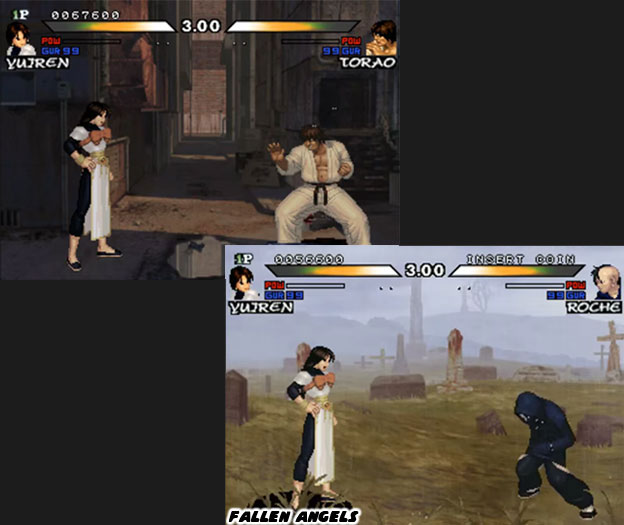
Every stage told a story, like the great fighting games before it. Eden had a literal atmosphere, including realistic fog and rain effects. The studio wanted Eden to look worn and lived in. The buildings and streets weren’t in the best condition. The fights didn’t happen in front of a flashy casino or sporting event. They happened in darkened rooftops and side alleys. They happened in seedy bars and open cemeteries. There was a sense of decay in these levels. This world was real and it was slowly falling apart. The years of neglect following the earthquake were showing. If something didn’t happen soon, and for the better then this world would fall apart completely. This was important to the story. All great stories happen at the critical moment, they don’t take place during the inconsequential periods. It was no different in this game. A crime boss named Carlos was consolidating his power. He was taking out his rivals with the help of some assassins, including a red-suit wearing gunman named Trigger. Carlos was making an already bleak existence in Eden even harder. Every character in the game had a vendetta against Carlos, if they weren’t secretly working for him. At least one person, a soldier named Harry Ness, was trying to bring him to justice in the mainland. But getting through Eden and back out alive would prove to be a challenge.


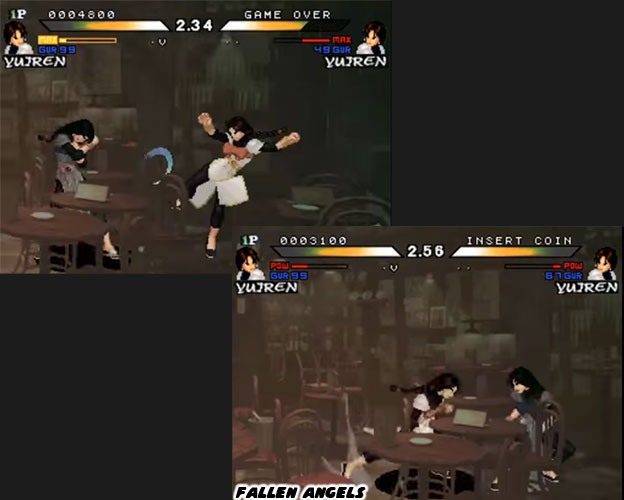
Steel Hearts took a number of unique approaches to the game. The final cast had eight playable characters. Like the original Street Fighter II. It also had a sub boss and boss. But like I said earlier, they were not the traditional martial arts masters. For example there were two female characters in the game, sisters named Yuiran and Yuiren. They ran a club called the Wind Fish. Yurien was a singer in the club and was actually a trans character. She was born the brother of Yurian, acting as protector and entertainment while her sister acted as a bouncer. Yurien had very fast strikes while her sister had the power moves. It was a unique change of traditional roles. This stage was an example of the sort of interactive environment that the studio wanted to build. There were chairs and tables in the foreground that obscured the view of audiences. This sort of blocking wasn’t done in other games. As players fought they could kick the chairs and tables over. It was a nice detail that was rarely used in other fighters. It helped make the fights look like they took place in an action film. The smoky club looked like it had been in business for a few generations and the sisters were doing everything they could to keep it going. The Wind Fish actually appeared twice in the game. The first time the club was intact, as if they had just closed for the night. By the end of the game Carlos and his goons had trashed the club. Whether he wanted the land, the clientele or the sisters out of business we might never know.


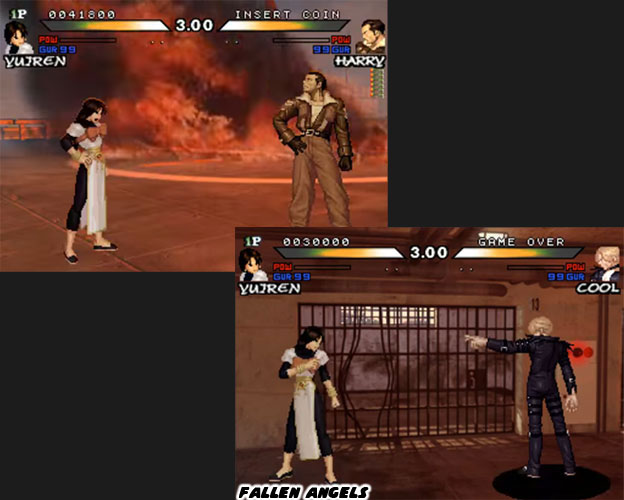
The Wind Fish was the only level to have foreground elements to knock over but again every stage told a story. Steel Hearts was experimenting with the format and trying to add details and effect rarely if ever used in other games. The chairs and tables were one example of expanding stage design. In other places they experimented with effects. Realistic fog and rain were one thing but the studio tried very hard to create a realistic flame effect on Harry’s stage. There was a massive fire on a helipad, as if Harry’s chopper had just crashed. Steel Hearts blended video effects onto the stage so that the raging inferno looked realistic because it was a real fire. The sprites the studio created also had a certain weight and depth to them. This was because not only were they carefully painted to display shadows and highlights, but because many of the idle and strike animations were rotoscoped. This was to say they were based on video of actual people performing the moves.


As the game progressed the encounters got more and more unique. The locations became more diverse and the opponents a little bit stranger. They were all leading up to a final showdown. Carlos had heard the rumors that there were fighters in Eden ready to take him down. So he pushed back with hitmen of his own. Some did it for the money, others did it because they were just evil. The final battles were unique. We will look at these in the next blog and see the legacy that the studio established. As always if you enjoyed this blog and would like to sponsor me please visit my Patreon page and consider donating each month, even as little as $1 would help make better blogs and even podcasts!
follow the Street Writer on Patreon!