Showing posts with label naughty dog. Show all posts

Wednesday, June 8, 2016

The Abridged History of the Brawler, part 30


During the mid '90s all Konami and Capcom seemed capable of doing was slapping a new coat of paint on the tired mechanic in arcades. There was little separating Alien vs Predator from Warriors of Fate from Cadillacs and Dinosaurs, aside from different sprites of course. The gameplay remained the same. Players pressed the attack buttons quickly and survived the onslaught, there was not much gameplay in that. Within a decade the experiences from DMC, Gungrave, P.N. 03 and Bayonetta were also becoming redundant. I had stated this earlier in the series: "The advent of 3D technology gave players a new level of immersion and visual flare but these early 3D titles often lacked the elements that made previous 2D games memorable. Moving to 3D meant that the industry would have to start all over again and figure out how to make a good brawling experience. The studios would have to invent something that took advantage of the next generation of graphics and create the next generation of gameplay to go along with it." Japanese designers as a whole were guilty of relying heavily on visual style and forgetting the importance of substance.

The sandbox game had gained popularity past the millennium. It was successful in the west because developers had figured out how gameplay could be derived from engines which were essentially tech demos. The sandbox environment became one of the ways in which the brawler was able to survive outside of the arcade. More important it allowed the brawler to flourish in 3D and made the gameplay unique. SpikeOut and Final Fight: Streetwise borrowed dated elements, like a countdown clock, and forced players to fight wave after wave of opponents using underpowered characters, making the experience feel slow and terribly redundant. The new crop of western-developed brawlers seemed fresh and exciting by comparison.


London based Rocksteady Studios followed the classic Hokuto No Ken template and then wrapped it in a more open world. The main character would be a master of the fighting arts, far more experienced than anyone that crossed his path, capable of surviving even in mob situations but not as grossly exaggerated or overpowered as Ken. By using Batman from the comic books as the main character players could have an adventure title that was part stealth and part brawling. The 2009 release was one of the best comic-character to game adaptations ever. Rocksteady made a title that took advantage of the character and his universe. This new hero would be an acrobat, escape artist and detective and allow players to take full advantage of the 3D environments.
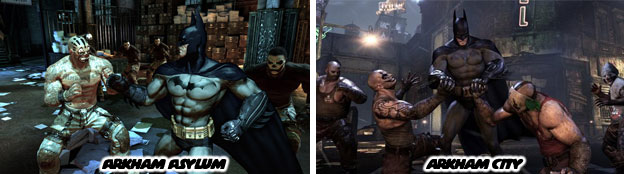

Those at Rocksteady did not look back at the history of the franchise to see what other Batman titles worked well or tried to repeat the 2D lessons on new consoles. Instead they had the insight and confidence that the best Batman experience would reflect the new generation of gameplay. Both Arkham Asylum and the latter Arkham City were independent from the films and comics. Warner Bros. Interactive Entertainment allowed the designers to evolve Batman into a gaming archetype especially after the movie-based titles failed to win over players. Both Arkham games had become critically acclaimed and commercially successful titles. The core of both games was the new brawling experience. Rocksteady had coined their intuitive fighting mechanic "Freeflow Combat." A few button presses allowed players to easily take down waves of opponents. It was something never before possible in a fighting game. To be fair though Capcom, Spike and Sammy had made variations of the game mechanic many years earlier.


Another western studio would become even more popular by following the lessons taught by the brawler. The team at Naughty Dog started out creating great mascot titles like Crash Bandicoot, as well as Jax and Daxter. Yet like Star Team did when they left Konami and created Guardian Heroes, there was much more potential in a new character and game idea. When the studio pursued a new type of experience free from license and conventions they forever changed the industry. Uncharted: Drake's Fortune was a 2007 sleeper-hit It seemed to come out of nowhere and redefine the adventure title as Tomb Raider had done so a decade earlier. Naughty Dog had taken the lessons from the run-and-gun and incorporated them into a sandbox environment. The main character, Nathan Drake, was not the unstoppable fighter that Batman was, he was however more than average at brawling. He was certainly above average as a marksman and as an athlete as well but not as over-the-top as Laura Croft or Rubi Malone. These things made the character and his adventures believable while not leaving him so weak as to make the gameplay dull.
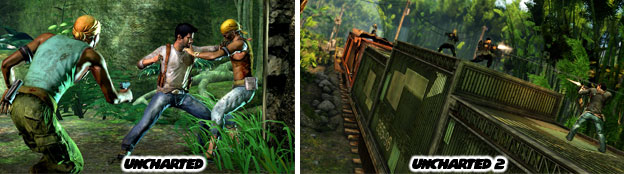

The follow up titles Uncharted 2: Among Thieves from 2009, Uncharted 3: Drake’s Deception from 2011 and Uncharted 4: A Thief's End from 2016 incorporated many of the great moments from gaming and cinema into an interactive experience. There were huge set pieces and big stunts every bit as spectacular as a multi-million dollar blockbuster. Were the fights in exotic locations or shootouts on moving trains inspired by adventure films or classic brawlers? Could the developers have been allowing both influences to shine through as a collective experience? Quite possibly yes. In a Rolling Stone interview Neil Druckmann the Director of Uncharted 4 mentioned that the original version of the game, as in the first Uncharted was much more brawling oriented. It's great that they changed the game play to incorporate all of the new things that these heroes could do, including driving vehicles, and running along rooftops.

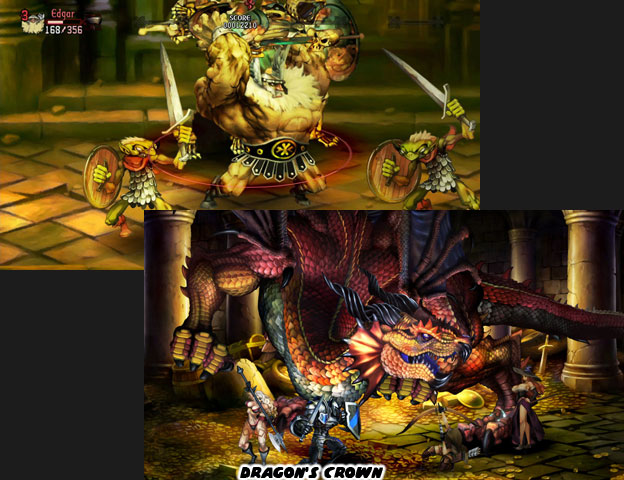
The brawler did not die and never would. The US, UK and Europe were now capable of developing memorable titles based on the legacy built by Japan. God of War, Arkham City and Uncharted were the new respective hack-and-slash, beat-em-up and run-and-gun for the next generation. The genre had matured and developed into amazing 3D experiences because the people that developed them had grown up on 25+ years of fantastic designs, graphics and gameplay. Sure there was still life left in the traditional brawler, Castle Crashers and a score of arcade gems finding their way onto XBL and PSN were proof of that. Vanillaware, the studio that released the visually arresting games Muramasa the Demon Blade and Odin Sphere blew the doors off the hack-and-slash with Dragon’s Crown in 2013.


Vanillaware had studied the genre very carefully and created a game that had brawler, RPG and hack-and-slash elements. It took pieces from more than 20 years worth of brawlers, locations, characters and stories reminiscent of Magic Sword, Arabian Magic, Dungeons and Dragons: Shadow Over Mystaria and Tower of Doom, Golden Axe and many more timeless arcade games. It created something never quite seen before with graphics that were unparalleled. Best of all, like the classic brawlers this was a game that could be enjoyed with a group of friends. Never satisfied, the Japanese would continue to try to make even bigger spectacles and over-the-top moments with the genre, insuring that their contribution would live on.

The brawler now represented something not as obvious as a sports game, combat game, racing game or puzzle game. It had become the heart of the best and most memorable moments in gaming. In 15 or 20 years the next generation of designers would be inspired by these experiences They would continue building on the legacy and show the entire industry that in the end the brawler won the fight.

I hope that you have enjoyed my 30-part series on the brawler. I am constantly researching and preparing new blogs for my readers. Sometimes they are ready right away and sometimes they can take months to come together. If you would like to sponsor me please visit my Patreon page and consider donating each month, even as little as $1 would help. I plan on creating more podcasts and videos and could always use a little help buying some better equipment. Thank you for visiting!
 follow the Street Writer on Patreon!

Monday, July 28, 2014

The Racing Tangent, part 2...

Through the '80s the West was in a race to develop the best arcade games, their console games weren't known however for being exceptional. Japan seemed to excel at every step of the process and had created genres on the consoles that would be copied for the next three decades. The best that the US developers could do was play catch up and try to have a game in the vein of a popular Japanese title for the fledgling Nintendo and Sega systems. There was one niche however where the Japanese had no foothold in and would struggle to keep up with. When it came to computer gaming the Japanese publishers did not invest a lot of time or resources compared to the rest of the world. Consoles were growing at an exponential pace and audiences were starved for content. The money was therefore in the console market. Computers were powerful but more expensive and took up a much smaller slice of the entertainment pie. Computer games ran the gamut of experiences. Mostly education titles and the occasional arcade port. Some of the most memorable experiences took advantage of the advanced storage capacity and graphics engines that computers supported. Young developers and self-taught programmers from the West cut their teeth on computers like the Amiga and Commodore 64 in the '80s. They learned how to program simple game engines and trade games with the homebrew community. By the '90s these young programmers were making headway in their own 3D game engines.

Namco and Sega were pouring millions of R&D money to get their in-house teams up to speed with 3D during the '90s as well. The games they unleashed in the arcade were amazing however the computer users in the US, UK and Europe were creating their own 3D titles to enjoy at home. Suddenly the sprite-based consoles seemed obsolete by comparison. When Sony, Sega and Nintendo began to pursue 3D technology for the next generation of hardware some of the best games would not be coming from Japan. This trend would continue from the mid '90s through the new millennium. The Western publishers began to harness the processing power of newer consoles and the talent reserves of computer game designers to create cutting-edge 3D experiences. One of the first things that Western publishers did was introduce the Western ideals of graphic violence into the industry. First person shooters like Wolfenstein (1992) and Doom (1993) were the proving ground for the modding community. Players in the US enjoyed the over-the-top violence provided in FPS titles. As graphics technology improved Western developers seemed to relish in how much more visceral they could make their main characters appear. That especially was the case with the Playstation 3 and Xbox 360 consoles. Suddenly characters were presented with as much detail as those used in CGI films.


Naughty Dog for example created an adventure series called Uncharted: Drake's Fortune in 2007. It revolved around the fictional explorer Nathan Drake. The series was a testament to Western gameplay and Western aesthetics. The studio had presented a believable adventure with just the right mix of exploration and gun-fighting to satiate most audiences. The character and environments were not pristine and idealized. Instead they were gritty and detailed. As the series progressed Nathan became slightly more disheveled. When the game was first previewed at the E3 in 2006 the character was clean-cut yet that quickly changed when the game came out and as the sequels came out. He had become as weather beaten as his clothes by the time the final game in the series, Uncharted 3: Drake's Deception was released in 2011.

As the Uncharted series progressed audiences could see the world becoming darker and more graphic. This was a precursor to the visceral experience that Naughty Dog had planned in the 2013 hit The Last of Us. The main characters Joel and Ellie were very easy to identify with because they were some of the most realistic characters ever featured in a game. All of the experience that the West had with computer programming was made apparent in the game. In the '90s companies were trying to figure out how to create realistic hair on a character, two decades later they were not only creating realistic hair but also eyes, skin, mouths, muscles and skeletons. These new figures were able to emote with facial expressions and body gestures that were uncannily good. Audiences developed genuine concern for Joel and Ellie as they tried to survive in a world following an epidemic.


By comparison the once popular Tomb Raider series, which began in 1996, had lost its human connection as the years went on. The main character and explorer Lara Croft was the predecessor to Nathan Drake, Joel and Ellie.The developer Eidos did little to keep the content fresh in the series relying instead on the power of marketing. Lara was a very buxom computer model, and sometimes human model in their ad campaigns. Using sex and violence to sell the series to a young male demographic was the top priority for the publisher. The time and money should have been invested into the game itself. In terms of gameplay and level design the series was good but not always the best in the genre. The graphics did get better from year to year but the experience became predictable leading to a downfall for the franchise. As sales declined so did the popularity and even relevancy of the main character.

The success of Naughty Dog did not go unnoticed by Eidos. They decided to create a dark and gritty reboot of Tomb Raider that fell in line with the smaller developer. They copied the realism that had made the Uncharted series popular, but to be fair Uncharted was poaching the exploration, puzzles and action that made Tomb Raider a hit to begin with. There was nothing glamorous about the redesigned Lara. She was still young but looked a little bit more like a seasoned explorer rather than polygonal supermodel. The new Lara would become bloodied and beaten over the course of the new game. The firefights and close combat encounters were much more visceral than ever before.


The realistic and hard hitting encounters were reflective of the more popular titles from the West. In fact since the Western audiences seemed to gravitate towards the new darker, grittier graphics then the developers began pursuing the format for different genres. The concept of the superhero seemed passe' and the rise of the anti-hero in games like Infamous and Prototype became more acceptable. Games that did revolve around comic book heroes presented them in a different light. Instead of colorful spandex costumes the new superheroes wore muted colors over body armor. These visual changes were not limited to human characters either.

Racing games began taking a page out of the new school of game design. Car models were not only expected to be highly detailed and respond realistically, they were also expected to take real damage and break apart like real cars. Minor bumps were expected to take a scratch out of the paint job while a full-on collision was supposed to shatter windshields and tear off body panels. Anything less than that was seen as a failure in the eyes of modern gamers. Of course just because the studios had the technology to create more complex models and more realistic graphics did not necessarily mean that it translated into a better gaming experience.


The post-Destruction Derby world would have to find a balance between combat and racing. It would have to engage the player on multiple levels and not simply feature destructible car models or real-world tracks. The genre for violent racing games would explode (no pun intended) in the new millennium. The roots of the genre were based in the US. The influences of muscle cars and reckless getaways from live-action films would forever color the format. The next blog will look at the shift in racing's accepted format. I hope to see you back for it. If you would like to sponsor me please visit my Patreon page and consider donating each month, even as little as $1 would help make better blogs and even podcasts!
follow the Street Writer on Patreon!